
GMP & Pharmaceutical Manufacturing Expert
✓ Reviewed by: Pankaj Sharma - Quality Control Specialist
Reviewed for Quality Control accuracy, laboratory practices, analytical methods, and technical relevance
📅 Last Updated: October 31, 2026
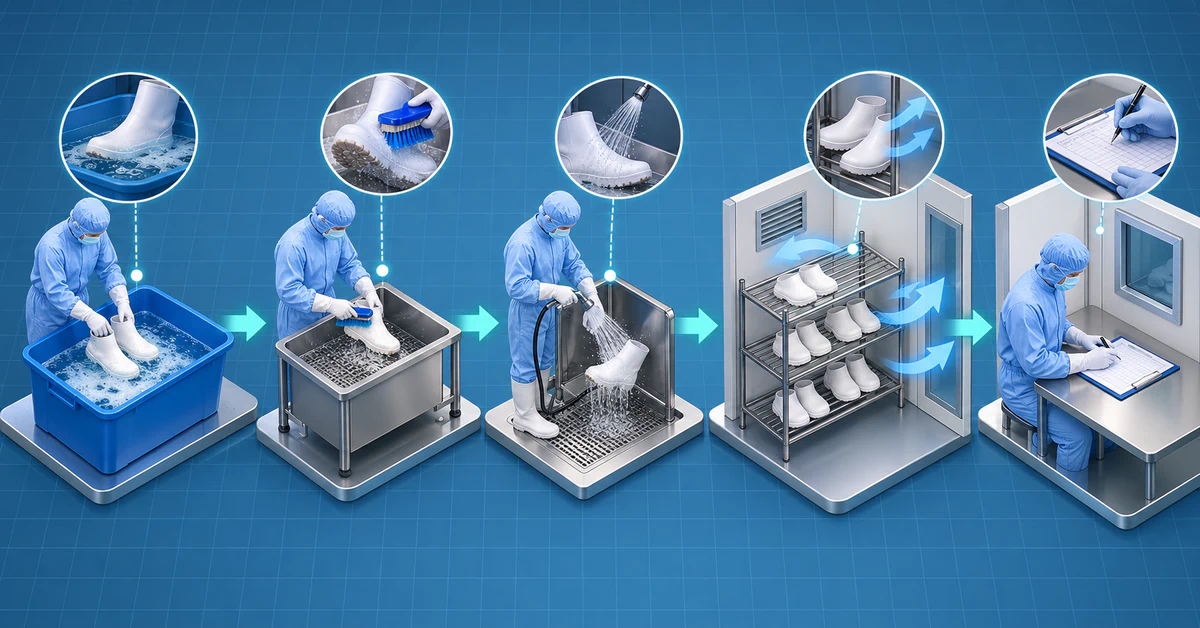
This SOP for footwear cleaning in pharmaceutical production covers the production department. Housekeeping personnel clean footwear once a week. They soak the footwear in 1% v/v teepol solution for 1 hour and scrub it with a nylon scrubber. They flush it with purified water and air-dry it in the change room. Then they record the work as per Annexure-I.
1.0 Objective
To lay down a procedure for footwear cleaning. This SOP describes how housekeeping personnel clean footwear used in the production department once a week. They use 1% v/v teepol solution and purified water. It also sets how housekeeping personnel record the cleaning as per Annexure-I.
2.0 Scope
The procedure is applicable to the cleaning of footwear used in the production department. EU GMP Chapter 5 (Production) expects measures that limit contamination from people and premises, and clean footwear supports this. See also the SOP on Cleaning and Sanitization in Pharmaceutical.
3.0 Responsibility
These three roles are named in this SOP for footwear cleaning in the production department.
Housekeeping personnel
Officer, Executive – Production Department
Manager – Production Department
4.0 Procedure (SOP for Footwear Cleaning in Pharmaceutical)
Clean the shoes once a week. Schedule M requires written procedures for personnel hygiene and for cleaning and sanitation of production areas. This SOP sets footwear cleaning at once a week.
4.1 Collect all the footwear from the male and female change room areas in a polythene bag. Label the bag “TO BE CLEANED”. Do this every week.
4.2 Transfer all the footwear to the washing room.
4.3 Soak all the shoes in a plastic bin in 1% v/v teepol solution for 1 hour.
4.4 Scrub the footwear from the inside and outer surface with a nylon scrubber.
4.5 Drain the teepol solution.
4.6 Flush all the footwear with purified water until no solution traces remain.
4.7 Allow the water to drain. Then wipe off the residual water with a dry duster.
4.8 Transfer the shoes into the respective change rooms.
4.9 Allow the footwear to dry before transfer to change room.
4.10 Collect the dried footwear in polythene bags for distribution.
4.11 Record the cleaning as per Annexure –I.
Under WHO GMP (TRS 986 Annex 2), activities such as cleaning are recorded at the time they are done. This is why housekeeping personnel complete Annexure-I (Footwear Cleaning Record).
Note: During product change over (Type B) cleaning, clean the footwear of the persons working in that area. Follow points 4.4, 4.6 and 4.7 in the wash area of that area.
5.0 Abbreviations
This SOP uses the three abbreviations below. It writes each one in full next to its short form.
QA: Quality Assurance.
SOP: Standard Operating Procedure.
v/v: Volume/Volume.
6.0 Annexure
This SOP has one annexure, which holds the record of footwear cleaning.
Annexure-I: Footwear Cleaning Record.
Related SOP: Entry-exit procedure

Frequently Asked Questions
Housekeeping personnel clean footwear once a week. Housekeeping personnel collect all the footwear from the male and female change room areas in a polythene bag and put a label on the bag that reads “TO BE CLEANED”. They do this every week, and Schedule M requires written procedures for cleaning and sanitation of production areas.
The SOP uses 1% v/v teepol solution. You soak all the shoes in a plastic bin in this solution for 1 hour. After the soak, you scrub the footwear from the inside and outer surface with a nylon scrubber, and then you drain the teepol solution.
You flush all the footwear with purified water until no soap traces remain. This step comes after the teepol solution is drained in step 4.5. Once the rinse is done, you allow the water to drain and wipe off the residual water with a dry duster.
EU GMP Chapter 5 (Production) expects measures that limit contamination from people and premises, and clean footwear supports this. The procedure applies to footwear used in the production department. Schedule M also requires written procedures for personnel hygiene and for cleaning and sanitation of production areas.
References
- EU GMP, European Commission, EudraLex Volume 4
- Schedule M, CDSCO, Drugs Rules, 1945
- WHO GMP, World Health Organization

Naresh Bhakar is the Founder and Author at Pharmaguddu.com, bringing his extensive expertise in the field of pharmaceuticals to readers worldwide. He has experience in Pharma manufacturing and has worked with top Pharmaceuticals. He has rich knowledge and provides valuable insights and data through his articles and content on Pharmaguddu.com. For further inquiries or collaborations, please don’t hesitate to reach out via email at [email protected].