

GMP & Pharmaceutical Manufacturing Expert
✓ Reviewed by: Naresh Bhakar
Reviewed for pharmaceutical accuracy
📅 Last Updated: November 10, 2026
This Standard Operating Procedure (SOP) explains how the production department indents stereos using Annexure-I and checks batch details against the batch production record (BPR). The SOP on indent and approval of rubber stereo for overprinting also covers impressions taken in Annexure-II and approval by in-process quality assurance (IPQA). Approved stereos are stored under lock and key, issued against the stereo register (Annexure-III), collected after the batch and destroyed.
1.0 Objective
To lay down a procedure for indent and approval of rubber stereo for overprinting of batch details on printed packaging material. This SOP is a procedure that lays down how the production department indents, checks, approves, stores, issues and destroys rubber stereos used to overprint batch details on printed packaging material.
2.0 Scope
This procedure is applicable to indenting and approval of stereo for overprinting of packing material in the production department.
3.0 Responsibility
The following persons are responsible for carrying out this procedure.
- Officer, Executive – Production Department
- Manager – Production Department
READ ALSO
SOP On Change of Aluminum Foil During Packing
1.0 Objective: To lay down a procedure for change of the aluminum foil during packing.2.0…
4.0 Procedure
This section describes how stereos are indented, checked, approved, stored, issued, collected and destroyed.
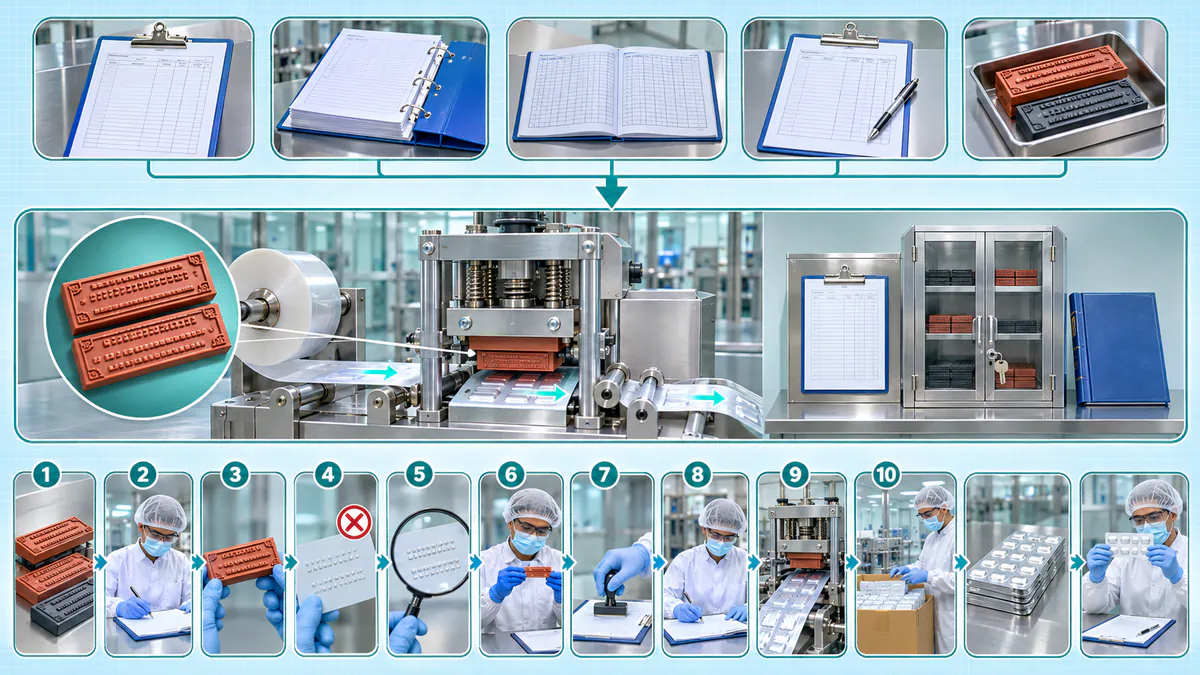
4.1 Stereo required for the overprinting is to be indented as per Annexure- I.
4.2 Before indenting a stereo, the production officer must check the B. No., MFD., EXP., M.R.P. and M.L. No. of the batch in the BPR, the B.No. Log and the standard price approved list from quality assurance (QA). The department head approves the check. 21 CFR 211.130 covers packaging and labeling operations, including the inspection of labeling and the correct batch coding of each package, so the batch details are checked against the BPR before indenting.
4.3 After receipt of stereo, enter receipt details in a stereo Logs.
4.4 Take an impression of each stereo number in the stereo impression format (Annexure-II). Schedule M requires printed packaging materials to be controlled and their records to be kept, which is why each stereo impression is checked and recorded in Annexure-II.
4.5 If the impression is improper, make a new impression and cut the previous impression with a signature. WHO GMP guidance on documentation expects a correction to be signed and the original entry to stay readable, which is why the previous impression is cut with a signature rather than removed.
4.6 The impression of each stereo shall be cross-checked with the indent.
4.7 One production officer checks the impression of each stereo, and a second production officer cross-checks it.
4.8 After IPQA approval, store the stereos under lock and key in the specified location of the stereo cupboard. The production Officer / Executive keeps the key. EU GMP Chapter 5 and Chapter 6 (WHO GMP uses the same principle) expect printing and labeling materials to be stored securely and issued only to authorised persons, which is the purpose of the locked cupboard in this step.
4.9 If the rubber stereo received is incorrect or improper, it must be returned to the supplier or destroyed as per the SOP “Destruction of rubber stereos“. New stereos must then be indented in the format given in Annexure-I.
4.10 An officer or executive of the production department issues the required number of stereos to the production officer/operator and records them in the stereo register as per Annexure-III.
4.11 After the batch is complete, all the rubber stereos must be collected. The number collected must equal the number issued, and it must be recorded in the stereo register.
4.12 After completion of the batch, destroy the Rubber Stereo by cutting into small pieces as per the SOP “Destruction of rubber stereos” and record the destroyed details in a stereo register and the BPR. Each stereo carries batch-specific data, so it is used for one batch only. If production is cancelled or postponed (typically about one month; this varies by manufacturer), the stereos are not destroyed. Keep them in the stereo cupboard with a storage label.
5.0 Abbreviation(s)
The abbreviations used in this SOP are listed below.
Batch Manufacturing Record (BMR): Batch Manufacturing Record
BPR: Batch Production Record
B. No. : Batch number
MFD.: Manufacture Date
EXP.: Expiry
M.R.P.: Maximum Retail Price
M.L. No. : Manufacture License Number
6.0 Annexure(s)
The annexures listed below are referred to in the procedure.
Annexure –I: Stereos indent format for overprinting of batch details.

Annexure, II: Rubber Stereo impression format for recording each stereo impression.

Annexure – III: Stereo impression format.

Frequently Asked Questions
One production officer checks the impression of each stereo, and a second production officer cross-checks it against the indent, after which the IPQA person gives approval. Only after this approval are the stereos stored in the stereo cupboard.
Approved stereos are stored under lock and key in the specified location of the stereo cupboard, and the key is kept by the production officer or executive. Stereos are issued from this cupboard only against entries in the stereo register, as per Annexure-III.
If the rubber stereo received is incorrect or improper, it is either returned to the supplier or destroyed as per the SOP on destruction of rubber stereos. New stereos are then indented in the format given in Annexure-I, so that the batch details can be overprinted correctly.
After the batch is complete, all the rubber stereos are collected, and the number collected must equal the number issued. This is recorded in the stereo register. The stereos are then destroyed by cutting into small pieces as per the SOP on destruction of rubber stereos, and the destroyed details are recorded in the stereo register and the BPR. If production is cancelled or postponed, the stereos are not destroyed but are kept in the stereo cupboard with a storage label.
Before indenting, the production officer checks the B. No., MFD., EXP., M.R.P. And M.L. No. Of the batch in the BPR, the B.No. Log and the standard price approved list from QA. The department head then approves this check, and the stereo is indented as per Annexure-I.
When an impression is improper, a new impression is made, and the previous impression is cut with a signature. Each impression is taken in the stereo impression format (Annexure-II) and cross-checked with the indent. This way the record keeps both the correction and the original impression visible.
References
- 21 CFR 211.130, US Code of Federal Regulations (eCFR)
- Schedule M, CDSCO, Drugs Rules, 1945
- WHO GMP, World Health Organization
- EU GMP, European Commission, EudraLex Volume 4

Naresh Bhakar is the Founder and Author at Pharmaguddu.com, bringing his extensive expertise in the field of pharmaceuticals to readers worldwide. He has experience in Pharma manufacturing and has worked with top Pharmaceuticals. He has rich knowledge and provides valuable insights and data through his articles and content on Pharmaguddu.com. For further inquiries or collaborations, please don’t hesitate to reach out via email at [email protected].