
GMP & Pharmaceutical Manufacturing Expert
✓ Reviewed by: Naresh Bhakar
Reviewed for pharmaceutical accuracy
📅 Last Updated: November 10, 2026
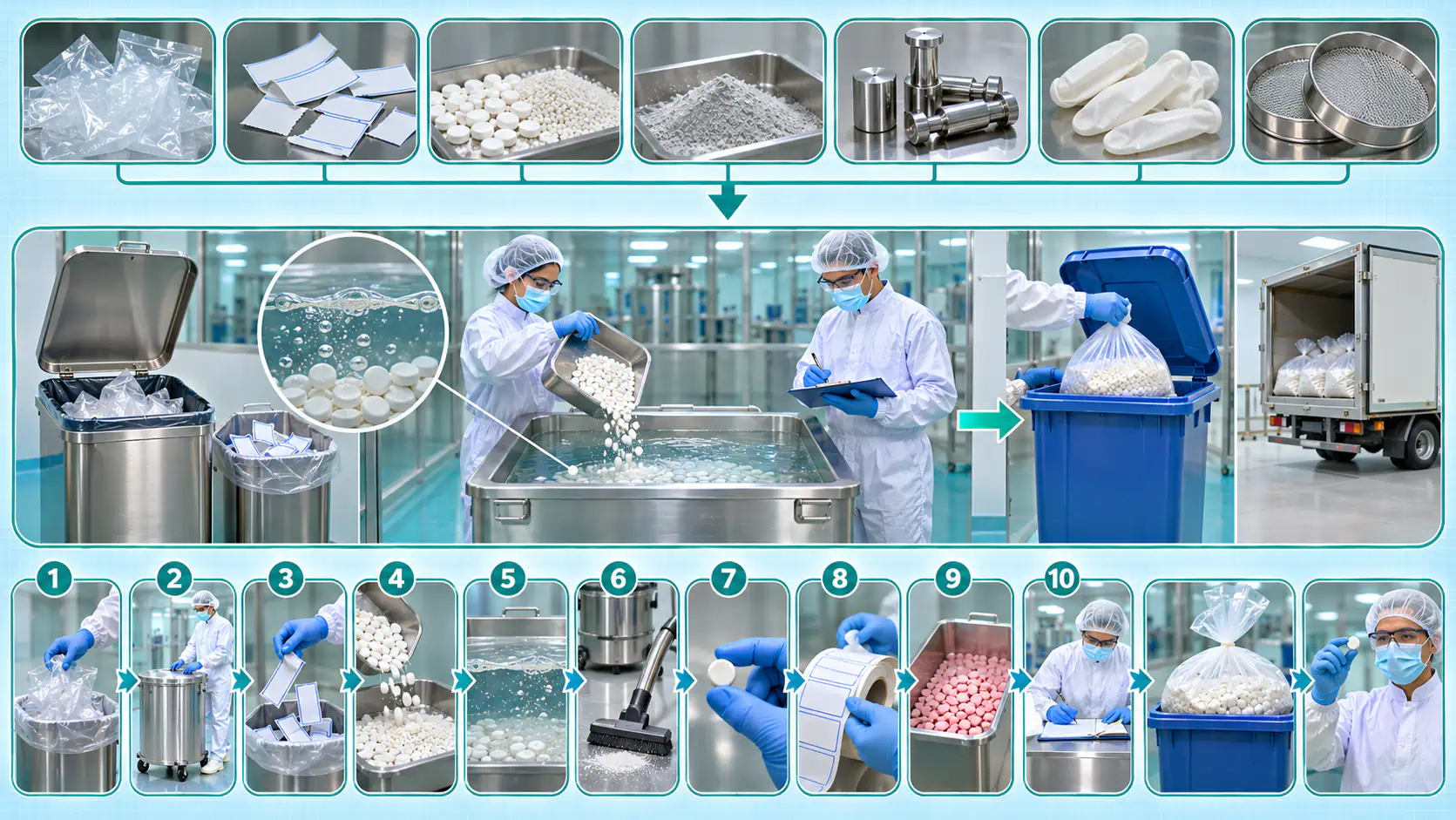
The SOP on disposal in the tablet department covers waste from granulation, compression, coating and inspection. It describes how this waste is collected, made unusable and removed from the area. Used polythene bags and torn unused labels are sent to the scrap yard through housekeeping. Rejected tablets, granules and dust are soaked in purified water in the presence of a production or quality assurance (QA) officer. Rejected tooling and utensils are defaced and sent to scrap by a scrap note approved by the department head, and each step is recorded.
1.0 Objective
To lay down a procedure for the disposal of waste and scrap in the tablet department. The procedure makes sure that rejected product and printed material cannot be reused or mixed with released material. It works together with the site’s product waste collection and disposal SOP, which covers waste from all production stages.
2.0 Scope
This procedure applies to the tablet department (oral solid dosage area) of the production department. It covers waste from granulation, compression, coating, inspection and in-process checks. Rejected raw materials and finished goods are handled under the separate SOP on handling of rejected material, and out-of-specification (OOS) results are handled under the OOS SOP.
3.0 Responsibility
- Operator: collects waste in the designated bins and bags and soaks the rejects.
- Production officer or executive: checks segregation, witnesses the soaking and makes the record entries.
- QA officer or in-process quality assurance (IPQA) officer: witnesses disposal of rejects and checks that labels and tooling are defaced.
- Housekeeping person: moves polythene bags and torn labels to the scrap yard.
- Head of department (HOD), production: approves the scrap note for rejected tooling and utensils. The production manager oversees compliance with this SOP.
4.0 Procedure for Disposal in Tablet Department
The procedure separates rejects and waste (disposed of by soaking or destruction) from scrap (defaced tooling, utensils and polythene sent to the scrap yard). The two streams have different approvals and records.
4.1 All used polythene bags (from granules, raw materials, compressed tablets and coated tablets) must be collected in the waste bin.
4.2 A housekeeping person collects these bags and sends them to the scrap yard.
4.3 All unused labels must be torn into pieces and deposited in the waste bin.
4.4 The housekeeping person collects the torn labels and sends them to the scrap yard.
4.5 Rejected tablets or granules generated at each stage of the process must be collected in a polythene bag.
4.6 The bag is taken to the washing area, and purified water is added to soak the tablets or granules in the presence of a production officer or QA officer.
4.7 The soaked rejects are then sent for disposal by the route approved by the site.
4.8 Dust from vacuum cleaners, dedusters and dust collectors, and all rejects generated during in-process control (IPC) checks, must be disposed of by the same procedure.
4.9 Rejected punches, finger bags, sieves, screens and utensils are sent to scrap by a scrap note, after approval of the HOD. These items must be defaced before they leave the department.
4.10 Rejected material must be identified, labelled with the REJECTED status label and kept in a segregated, dedicated area until disposal. EudraLex Volume 4 Chapter 3 (in operation since 1 March 2015) asks for segregated areas for rejected materials and products.
4.11 Unused printed labels must be reconciled against the issued count before tearing. The labels must be defaced so that no legible product, batch or strength information remains.
4.12 Before scrap is handed over, the production officer checks that labels are defaced and that no usable material or product remains. The department enters the scrap in the scrap log, and QA verifies the entry. The scrap is then moved to the scrap yard against the approved scrap note.
4.13 Rejects of potent, cytotoxic or hormonal products must not be disposed of through the drain. They follow the separate route given in the product waste SOP, under the site’s environmental permit.
4.14 After each disposal, the waste bins and the washing area are cleaned and checked by the production officer. The result is visually clean, which is not the same as validated cleaning, and line clearance is completed before the next product starts.
5.0 Precautions
5.1 Operators must wear the gowning and personal protective equipment (PPE) specified for the area, including gloves, a dust mask and goggles, because tablet dust can be inhaled or can irritate the skin.
5.2 Waste bins must be covered and labelled, and waste must not accumulate in the processing room.
5.3 Waste of one product must not be carried over to the next product. Bins and bags must be emptied before changeover.
5.4 The soaked waste must not be put into the drain unless the site’s environmental permit and the product risk allow it.
5.5 The site’s pollution control board consent conditions and the applicable hazardous and other waste rules govern effluent and waste that leave the site. The Bio-Medical Waste Management Rules, 2016 apply only where the waste is bio-medical waste, such as in a healthcare or biological-research setting.
5.6 Revised Schedule M of the Drugs Rules, 1945 requires that waste is disposed of safely and hygienically.
In the United States, 21 CFR 211.56 requires that trash and organic waste are held and disposed of in a timely and sanitary manner, and that written sanitation procedures are available.
READ ALSO
SOP on Cleaning Operation Tablet Hardness Tester
Learn About SOP on Hardness Tester | SOP Operation, cleaning.
6.0 Records and formats
The following records support each disposal. Production and QA officers must sign every entry.
| Record | Content | Signed by |
|---|---|---|
| Batch manufacturing record (BMR) | Reconciliation of rejects and waste for the batch | Production officer, IPQA officer |
| Disposal log | Material, quantity, method, date and personnel | Production officer, QA officer |
| Scrap note | Defaced tooling, utensils and polythene, with approval | HOD production |
| Scrap log | Scrap handed over, QA verification, transfer to the scrap yard | Production officer, QA officer |
A deviation must be raised when rejects are not accounted for, waste is sent through the wrong stream, or the QA witness is missing. The disposal record annexure of the product waste SOP is used for the disposal entries. Scrap handling at site level is described in the SOP on handling scrap and disposal, and status labels are described in the SOP on status labeling.
7.0 Abbreviations
| Abbreviation | Full form |
|---|---|
| BMR | Batch Manufacturing Record |
| HOD | Head of Department |
| IPC | In-Process Control |
| IPQA | In-Process Quality Assurance |
| OOS | Out of Specification |
| PPE | Personal Protective Equipment |
| QA | Quality Assurance |
| SOP | Standard Operating Procedure |
8.0 References
- EudraLex Volume 4, Part I, Chapter 3: Premises and Equipment, European Commission
- 21 CFR 211.56 Sanitation, eCFR
- Key Notes on Revised Schedule M: Point 16 Waste Materials, The Health Master, 2024
- Site disposal, rejected material and scrap handover procedures, internal library documents

Naresh Bhakar is the Founder and Author at Pharmaguddu.com, bringing his extensive expertise in the field of pharmaceuticals to readers worldwide. He has experience in Pharma manufacturing and has worked with top Pharmaceuticals. He has rich knowledge and provides valuable insights and data through his articles and content on Pharmaguddu.com. For further inquiries or collaborations, please don’t hesitate to reach out via email at [email protected].