
The Carr’s Index and Hausner Ratio Calculator is used by scientists, pharmacists, formulation developers and quality control personnel to assess the flow properties of powders and granules. These two powder flowability parameters are based on the bulk density and tapped density of powders.
In the pharmaceutical industry, the nutraceutical sector, food processing, and powder metallurgy, the ability to get good powder flow is directly related to the blending, compression, capsule filling and product quality.
Calculate Carr’s Compressibility Index and Hausner Ratio quickly and accurately with this calculator and determine whether a powder has excellent, good, fair, passable, poor or very poor flow properties.
How to Use the Calculator
- Enter the measured Bulk Density.
- Enter the measured Tapped Density.
- Click Calculate.
View:
- Carr’s Compressibility Index (%)
- Hausner Ratio
- Powder Flow Classification
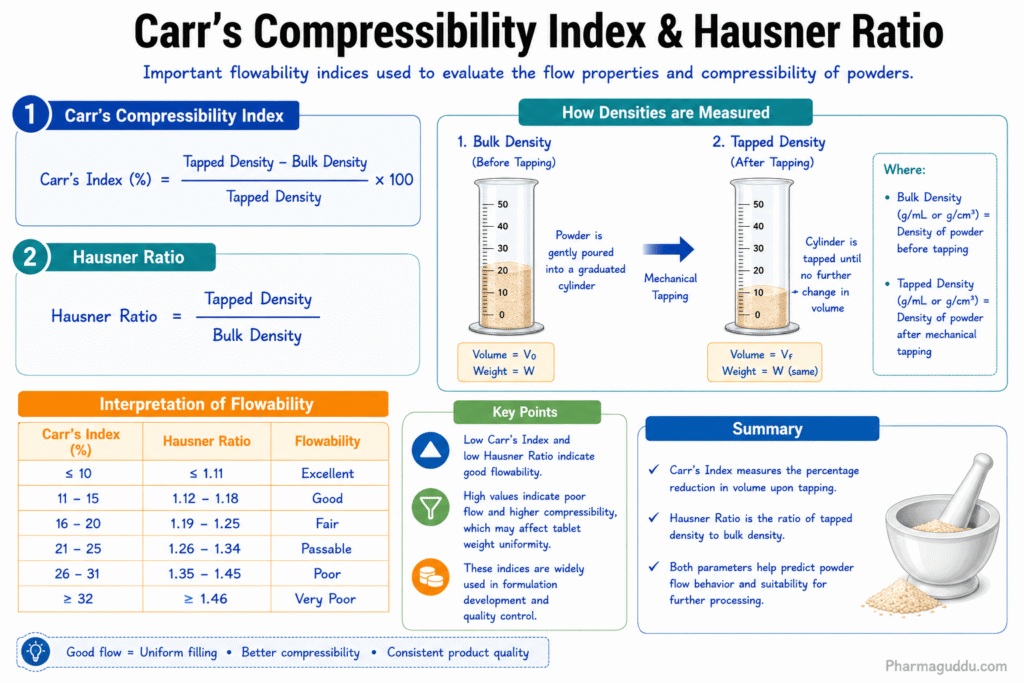
Carr’s Index and Hausner Ratio formula
FAQs on Carr’s Index & Hausner Ratio Calculator
Ans: Bulk density and tapped density can be used to calculate Carr’s Index, also known as Compressibility Index, which is a measure of the flowability of a powder. The lower the value, the better the flow characteristics, the higher the value, the poorer the flow and the more likely it is to be compressible.
Ans: The results range from good to excellent powder flow (1.00–1.25). Values above 1.25 may indicate increased cohesiveness and poor flow properties.
Ans: The bulk density is the density of the powder as it is naturally packed and the tapped density is the maximum density possible after the powder has been tapped together. These values can be used to see the powder compressibility and powder flow.
Ans: Both measure the flowability of powders in the same way, with density measures. Carr’s Index is a percentage of compressibility while Hausner Ratio is a ratio without dimension. These combine to give a full range of powder flow assessment.