
Quality Assurance & Regulatory Specialist
✓ Reviewed by: Pankaj Sharma - Quality Control Specialist
Reviewed for Quality Control accuracy, laboratory practices, analytical methods, and technical relevance
📅 Last Updated: July 21, 2026
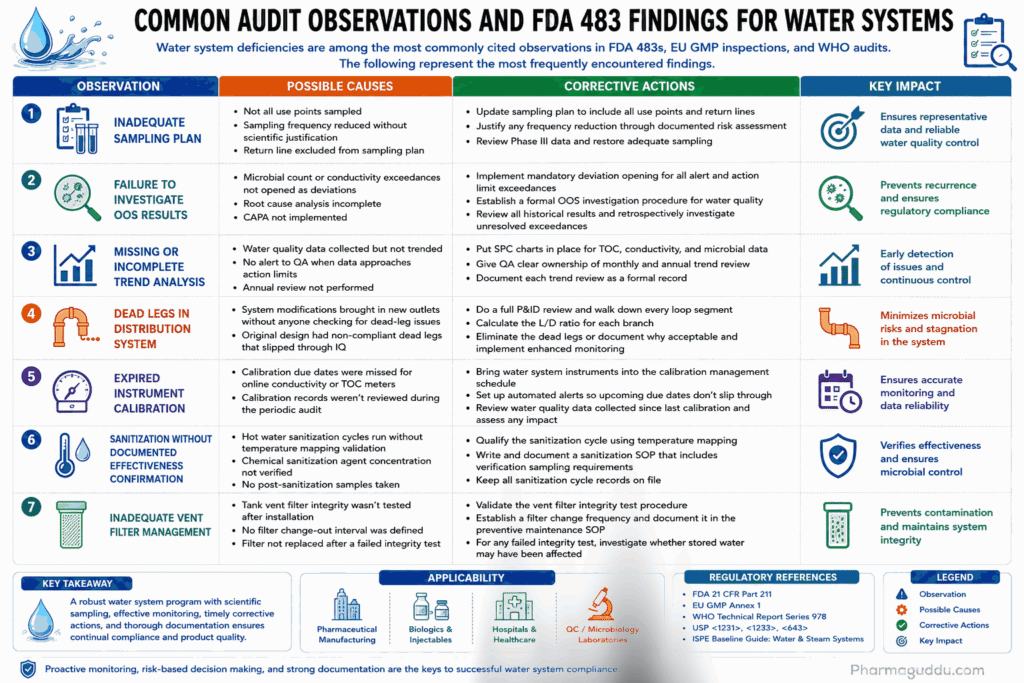
Water system deficiencies are among the most commonly cited observations in FDA 483s, EU GMP inspections, and WHO audits. The following represent the most frequently encountered findings:
Observation 1: Inadequate Sampling Plan
Possible Causes: Not all use points sampled; sampling frequency reduced without scientific justification; return line excluded from sampling plan.
Corrective Actions: Update sampling plan to include all use points and return lines. Justify any frequency reduction through documented risk assessment. Review Phase III data and restore adequate sampling.
Observation 2: Failure to Investigate OOS Results
Possible Causes: Microbial count or conductivity exceedances not opened as deviations; root cause analysis incomplete; CAPA not implemented.
Corrective Actions: Implement mandatory deviation opening for all alert and action limit exceedances. Establish a formal OOS investigation procedure for water quality. Review all historical results and retrospectively investigate unresolved exceedances.
Similar Topic: Water System Validation and Phases
Observation 3: Missing or Incomplete Trend Analysis
Possible Causes: Water quality data collected but not trended; no alert to QA when data approaches action limits; annual review not performed.
Corrective Actions: Put SPC charts in place for TOC, conductivity, and microbial data. Give QA clear ownership of monthly and annual trend review. Document each trend review as a formal record.
Observation 4: Dead Legs in Distribution System
Possible Causes: System modifications brought in new outlets without anyone checking for dead-leg issues; the original design had non-compliant dead legs that simply slipped through IQ without being caught.
Corrective Actions: Do a full P&ID review and walk down every loop segment in person. Calculate the L/D ratio for each branch. Then either eliminate the dead legs or document why they’re acceptable and put enhanced monitoring in place.
Observation 5: Expired Instrument Calibration
Possible Causes: Calibration due dates were missed for online conductivity or TOC meters; calibration records weren’t reviewed during the periodic audit.
Corrective Actions: Bring water system instruments into the calibration management schedule. Set up automated alerts so upcoming due dates don’t slip through. Review the water quality data collected since the last calibration and assess any impact.
Observation 6: Sanitization Without Documented Effectiveness Confirmation
Possible Causes: Hot water sanitization cycles were run without temperature mapping validation; the chemical sanitization agent concentration wasn’t verified; no post-sanitization samples were taken.
Corrective Actions: Qualify the sanitization cycle using temperature mapping. Write and document a sanitization SOP that includes verification sampling requirements. Keep all sanitization cycle records on file.
Observation 7: Inadequate Vent Filter Management
Possible Causes: Tank vent filter integrity wasn’t tested after installation; no filter change-out interval was defined; the filter wasn’t replaced after a failed integrity test.
Corrective Actions: Validate the vent filter integrity test procedure. Establish a filter change frequency and get it documented in the preventive maintenance SOP. For any failed integrity test, investigate whether stored water may have been affected.
Related: 4 Types Process Validation, Pharmaceutical
Expert Tips
Expert Tip 1: Set internal alert limits tighter than your pharmacopoeial action limits. Catching a problem at the alert stage keeps product quality intact and saves you from having to investigate a full action limit breach.
Expert Tip 2: When counts go over the alert limit, identify the organism. Whether you’re dealing with a pseudomonad, a spore-former, or coliforms makes a real difference to how you investigate and what corrective action you take.
Expert Tip 3: Don’t cut Phase III sampling frequency unless you have a documented scientific rationale and QA sign-off. Auditors routinely push back on reductions that aren’t properly supported.
Expert Tip 4: Map temperatures across your hot water sanitization loop regularly, not just during validation. Ambient temperature shifts with the seasons, and that can affect cold spots in the return line.
Expert Tip 5: Revisit your dead-leg assessments any time a use point gets added, removed, or changed. One engineering modification can create a non-compliant dead leg that goes undetected for months.
Expert Tip 6: Treat your water validation master plan (WVMP) as a living document. Update it after every major review, revalidation trigger, or regulatory inspection.
Expert Tip 7: Test your own sampling technique. Run clean water blanks against your process water controls occasionally to make sure sampling errors aren’t behind any false microbial counts.

Satpal Singh — Quality Assurance & Regulatory Specialist
Satpal Singh is an experienced pharmaceutical Quality Assurance and Regulatory professional with expertise in GMP compliance, quality systems, technical documentation, and regulatory requirements. He reviews our pharmaceutical content to ensure accuracy, industry relevance, and alignment with current quality and regulatory standards.
Expertise: QA Systems | GMP Compliance | Regulatory Documentation | Audits | Quality Management