
Quality Control Specialist | Industry Experience
✓ Reviewed by: Pankaj Sharma - Quality Control Specialist
Reviewed for Quality Control accuracy, laboratory practices, analytical methods, and technical relevance
📅 Last Updated: July 24, 2026
Most often, disintegration test failures are related to the mesh sieve, the bath temperature, or a basket-rack assembly that is not properly placed. Early identification of these and other recurring problems that do not relate to the tested drug are crucial to avoiding a time-consuming and fruitless QC investigation. The following troubleshooting guidelines address the most common causes of disintegration test failures encountered in laboratory practice. They also describe the appropriate corrective actions that resolve the problem instead of simply masking it for the next batch.
Read full article: Disintegration Test Apparatus
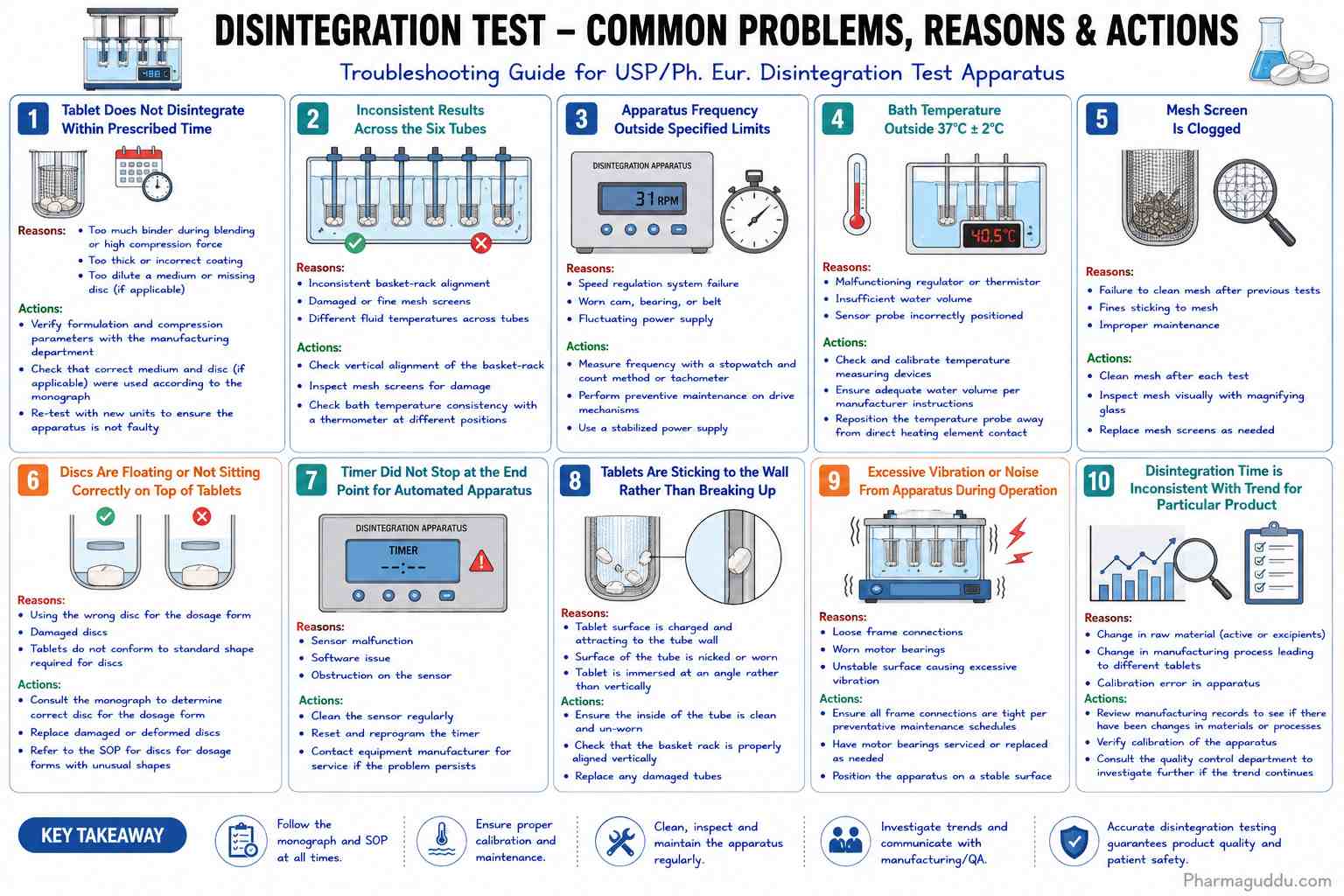
Problem: Tablet Does Not Disintegrate Within Prescribed Time
Reasons:
- Too much binder during blending or high compression force
- Too thick or incorrect coating
- Too dilute a medium or missing disc (if applicable)
Actions:
- Verify formulation and compression parameters with the manufacturing department
- Check that correct medium and disc (if applicable) were used according to the monograph
- Re-test with new units to ensure the apparatus is not faulty
Problem: Inconsistent Results Across the Six Tubes
Reasons:
- Inconsistent basket-rack alignment
- Damaged or fine mesh screens
- Different fluid temperatures across tubes
Actions:
- Check vertical alignment of the basket-rack
- Inspect mesh screens for damage
- Check bath temperature consistency with a thermometer at different positions
Problem: Apparatus Frequency Outside Specified Limits
Reasons:
- Speed regulation system failure
- Worn cam, bearing, or belt
- Fluctuating power supply
Actions:
- Measure frequency with a stopwatch and count method or tachometer
- Perform preventive maintenance on drive mechanisms
- Use a stabilized power supply
Problem: Bath Temperature Outside 37°C ± 2°C
Reasons:
- Malfunctioning regulator or thermistor
- Insufficient water volume
- Sensor probe incorrectly positioned
Actions:
- Check and calibrate temperature measuring devices
- Ensure adequate water volume per manufacturer instructions
- Reposition the temperature probe away from direct heating element contact
Problem: Mesh Screen Is Clogged
Reasons:
- Failure to clean mesh after previous tests
- Fines sticking to mesh
- Improper maintenance
Actions:
- Clean mesh after each test
- Inspect mesh visually with magnifying glass
- Replace mesh screens as needed
Problem: Discs Are Floating or Not Sitting Correctly on Top of Tablets
Reasons:
- Using the wrong disc for the dosage form
- Damaged discs
- Tablets do not conform to standard shape required for discs
Actions:
- Consult the monograph to determine correct disc for the dosage form
- Replace damaged or deformed discs
- Refer to the SOP for discs for dosage forms with unusual shapes
Problem: Timer Did Not Stop at the End Point for Automated Apparatus
Reasons:
- Sensor malfunction
- Software issue
- Obstruction on the sensor
Actions:
- Clean the sensor regularly
- Reset and reprogram the timer
- Contact equipment manufacturer for service if the problem persists
Problem: Tablets Are Sticking to the Wall Rather Than Breaking Up
Reasons:
- Tablet surface is charged and attracting to the tube wall
- Surface of the tube is nicked or worn
- Tablet is immersed at an angle rather than vertically
Actions:
- Ensure the inside of the tube is clean and un-worn
- Check that the basket rack is properly aligned vertically
- Replace any damaged tubes
Problem: Excessive Vibration or Noise From Apparatus During Operation
Reasons:
- Loose frame connections
- Worn motor bearings
- Unstable surface causing excessive vibration
Actions:
- Ensure all frame connections are tight per preventative maintenance schedules
- Have motor bearings serviced or replaced as needed
- Position the apparatus on a stable surface
Problem: Disintegration Time is Inconsistent With Trend for Particular Product
Reasons:
- Change in raw material (active or excipients)
- Change in manufacturing process leading to different tablets
- Calibration error in apparatus
Actions:
- Review manufacturing records to see if there have been changes in materials or processes
- Verify calibration of the apparatus
- Consult the quality control department to investigate further if the trend continues
Best Practices
- Always check calibration of the apparatus before use – don’t rely on calibration dates if you know the machine has been serviced recently.
- Keep detailed records of disintegration tests, including bath temperature and cycle rate. A log book or electronic record with login information is ideal.
- Standardize cleaning of the tubes and mesh screens to ensure consistency from analyst to analyst.
- Cross-train analysts on both automated and manual disintegration testing, as not all products are tested the same way.
- Have spare parts on hand, such as mesh screens, discs, and gaskets, to avoid downtime while waiting for replacements.
- Always keep records of disintegration times for similar products to establish trends that may indicate issues with a particular lot or product.
Expert Tips
Expert Tip 1: Do not blame the apparatus if disintegration times begin to increase for consecutive batches of the same dosage form. First, look at the process, specifically the granulation and coating process. It is far more likely that the process has changed than the apparatus.
Expert Tip 2: Always check the monograph of the specific dosage form to see if a disc is required for the test. This error is very common, so using the wrong disc or using a disc when not required is probably one of the most frequent disintegration test errors.
Expert Tip 3: Do not rely on visual inspection of the mesh screen. It is entirely possible to have a stretched mesh that allows large particles to pass through, resulting in a pass test for a tablet that did not properly disintegrate.
Expert Tip 4: Remember that for enteric-coated products, you do not pass the test merely because the tablet disintegrates in the buffer after exposure to acid. Pay close attention during the acid portion of the test, since any evidence of cracking, softening, or disintegration during this step is also a failure.
Expert Tip 5: If your lab has more than one disintegration apparatus, make sure calibration and OOS records are specific to an individual instrument. Most often, when inspecting or auditing a lab, an inspector will request records specific to the apparatus, not just the lab in general.
Expert Tip 6: When checking the water temperature for a disintegration test, it is best to check more than just one point in the bath. Some older disintegration baths can have significant variation from the temperature at the thermocouple to other areas within the same vessel.

Pankaj Sharma — Quality Control Specialist
Pankaj Sharma is a pharmaceutical QC professional who reviews our technical content for GMP accuracy, laboratory practices, and regulatory relevance.