
GMP & Pharmaceutical Manufacturing Expert
✓ Reviewed by: Satpal Singh - Quality Assurance & Regulatory Specialist
Reviewed for GMP compliance, quality systems, and regulatory accuracy
📅 Last Updated: June 12, 2026
Quick Answer
The Drugs and Cosmetics Rules, 1945 categorize drugs, cosmetics and medical devices under Schedules A to Y. Every schedule is for a particular purpose, application forms (Schedule A), lab fees (Schedule B), biological products (Schedule C), GMP for pharmaceuticals (Schedule M), GMP for ASU drugs (Schedule T), and labelling of narcotics (Schedule H, H1, X). Understanding what each schedule covers is critical to the process of licensing, manufacturing, labelling, and inspection readiness.
Key Takeaways
- The Drugs and Cosmetics Rules 1945 are under the Drugs and Cosmetics Act 1940.
- The schedules are organized into sections: Licensing forms, Lab fees, Drug classification, GMP requirements, and Labeling rules.
- The GMP schedule for pharmaceutical manufacturing is the main schedule (Schedule M) which has been amended for augmenting the quality systems.
- Prescription drugs, habit-forming drugs and narcotic/psychotropic substances are covered under Schedule H, H1 and X.
- Schedule T implements the GMP principles for Ayurvedic, Siddha and Unani drug manufacturers (ASU) manufactures.
What are Drugs and Cosmetics Rules 1945?
Drugs and Cosmetics Rules 1945 are the rules under the Drugs and Cosmetics Act 1940 under which it is operating. The law is contained in the Act. The Rules provide the detail on how that law operates: licensing process, manufacturing standards, labelling requirements, storage conditions, etc.
The Rules have a separate schedule for each functional area. Some of the schedules refer to forms. Some list fees. Others set quality standards for manufacturing. Some categorize drugs according to their recommended method of sale, storage or labeling.
Drugs and Cosmetics Rules 1945 Schedules (A–Z): Complete Visual Guide
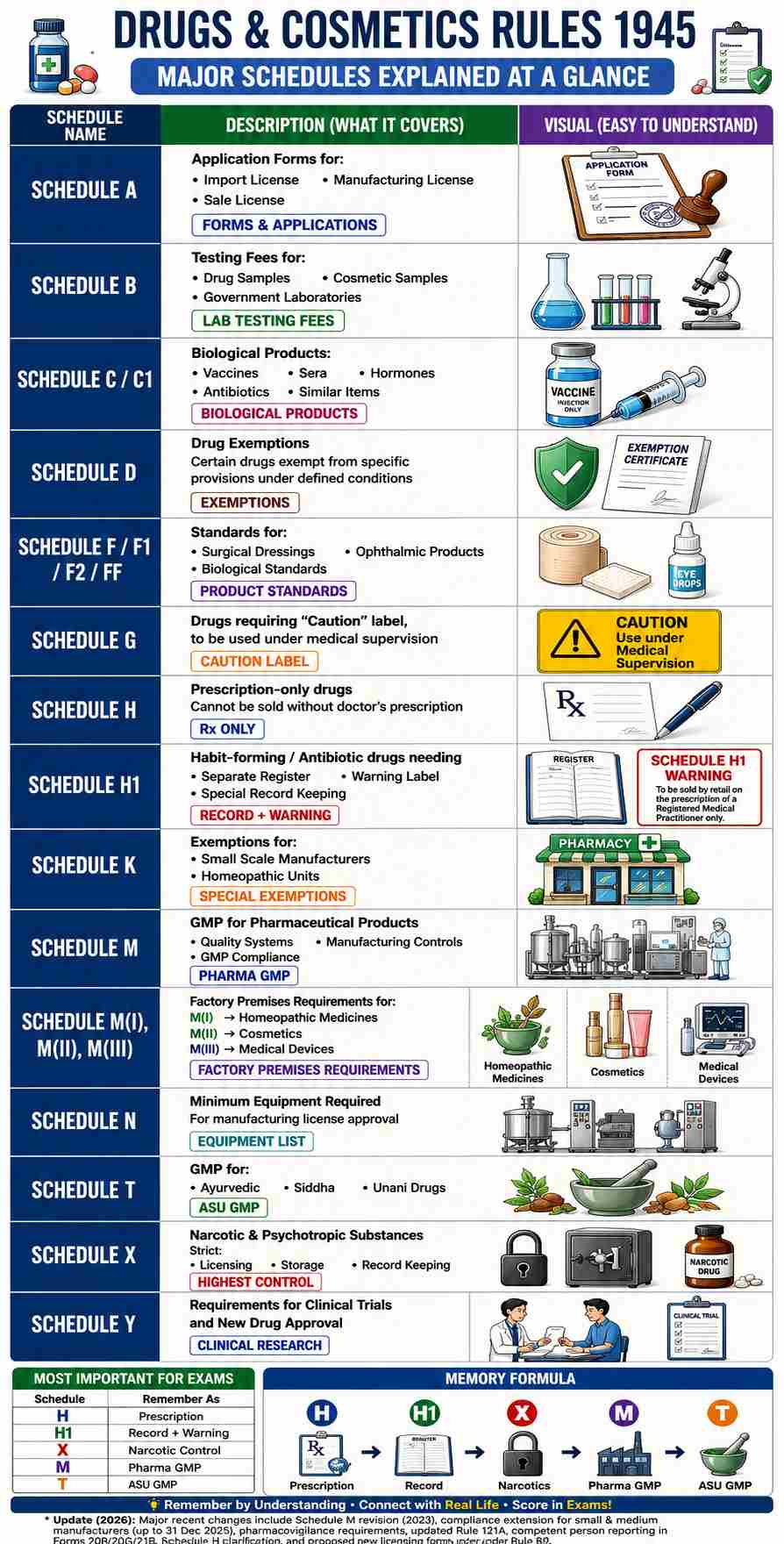
Drugs and Cosmetics Rules 1945 – All Schedules Explained Easily
Schedule A: Application for license for import, manufacture, and sale of the drug and cosmetic, the forms in which the license is granted and renewed, and other forms.
The amendments, which were notified in 2026, brought in further compliance requirements with regard to competent-person reporting, in Forms 20B, 20G and 21B.
Schedule B: Fees for drug analysis and Cosmetics that must be paid to the central drug Laboratories or other government laboratories.
Schedule C: List of biological and immunological products, antibiotics and ophthalmic lotions and ointments, and other products for parenteral use (injection).
Schedule C(I): List of drugs from a biological origin, Namely alkaloids, Hormones, vitamins, and antibiotics for oral use.
Schedule D: Exemptions that are granted to drugs and importers of medicine from complying with the necessities of import of medicine and additionally the conditions for exemptions.
Schedule E: A list of poisons with which labeling and other requirements were to comply with.
Schedule E(I): List of poisonous substances under the Ayurvedic Sidha and Unani system of medicines. Examples: Sarpa Visha (Snake venom), Parada (Mercury), etc.
Schedule F: Special provisions to be complied with for manufacturing, testing, and labeling of biological products for human use like Sera and Vaccines. These provisions have now been deleted under drugs and cosmetics rules. The requirements for the running blood bank and other requirements are now included in this schedule.
Related Topic: List of Drugs Schedule C, C1, G, H, H1, K, P, M, N, and X with CAUTION and WARNING
Schedule F(I): Special provisions to be complied with for manufacturing, testing, and labeling veterinary biological products.
Schedule F (II): Standards for surgical dressing.
Schedule F(III): Standards for umbilical tapes.
Schedule FF: Additional standards for ophthalmic preparations.
Schedule G: List of drugs that should be used by the patient under medical supervision and which shall be labeled with the words “Caution- it is dangerous to take this preparation without medical supervision.
Schedule H: List of drugs that are to be sold by retail against the prescription of a registered medical practitioner and which shall be labeled with “Rx” words, Schedule H drugs
Under the Drugs (Amendment) Rules, 2026, some drug classes mentioned in Schedule K (Serial No.15) are explicitly exempted from the coverage of Schedule H drugs.
Warning: to be sold by retail on the prescription of an “RMP only”. An example are androgenic, anabolic, estrogenic, and progestational substances; Alprazolam (Xanax), Hepatitis B vaccine, Ibuprofen, Vasopressin, etc.
Schedule I: List of poisons and particular about the proportion of poison in certain cases. Schedule I was linked with Schedule E. When Schedule E was deleted in 1982 under Drugs and Cosmetics rules, schedule I is not currently accepted. Examples of these types of drugs as heroin, lysergic acid diethylamide (LSD), marijuana (cannabis), 3,4-methylenedioxymethamphetamine (ecstasy), methaqualone, and peyote.
Schedule J: Names of diseases and ailments (by whatever name described) which are drugs may not purport to prevent or cure by means of claims made on the label of the container of the drug.
Schedule K: Names of drugs for classes of drugs that are exempted from complying with the previous for manufacture, sale, and Standards of drugs and the conditions of such exemptions.
Schedule L: List of drugs that were required to be sold by retail against the prescription of a registered medical practitioner. Subsequently, the drugs listed in Schedule L were transferred to Schedule H. After that Schedule L was deleted in 1982.
Schedule M: Good Manufacturing Practices (GMP) for pharmaceutical manufacturer is discussed in Schedule M. The Drugs (Amendment) Rules, 2023 have made significant changes to the schedule to bring it closer to the principles of WHO-GMP, enhance the quality management system and reinforce the pharmacovigilance expectations.
Schedule M(I): Requirements for factory premises of homeopathic medicine.
Schedule M(II): The requirement of factory premises of cosmetics.
Schedule M(III): The requirement of factory premises for the manufacture of medical devices.
Schedule N: List of minimum equipment requirements of furnaces for the effective running of the pharmacy.
Schedule O: Standards for disinfectant fluids.
Schedule P: Life period and conditions of storage of drugs.
Schedule P(I): Pack sizes of drugs.
Schedule Q: List of Coal Tar classes permitted to be used in cosmetics.
Schedule R: Standards and labeling requirements of condoms, copper-T, and contraceptive tubal rings.
Schedule R(I): Standards to be complied with by medical devices.
Schedule S: Standards for cosmetics.
Schedule T: Requirements of factory premises and hygiene conditions to be complied with by the manufacture of Ayurvedic, Siddha, and Unani drugs.
Schedule U: Particulars to be shown in the manufacturing record, a record of the raw materials, and the analytical records of the drugs.
Schedule V: Standards for the patient and proprietary medicines and additionally the minimum quantities of Vitamins that are permissible to be added in such preparations for oral use.
Schedule W: Name of drugs that shall be marketed under generic names only.
Schedule X: Names of psychoactive drugs that special control measures are laid down. The distributor should keep a duplicate of the prescription for two years.
Examples of such types of drugs are Secobarbital, Glutethimide, etc.
Schedule Y: Requirements and guidelines on clinical trials for the import and manufacture of new drugs.
Schedule Y remains valid and will be co-existing with the NDCT Rules, 2019, which currently regulates several aspects of clinical trial and new drug approval.
Key Statistics
- There are 26 schedules (A-Z) in the Drugs and Cosmetics Rules 1945, and some of these schedules have subparts (M-I, M-II, M-III, F, F1, F2, FF etc.).
- As part of the Drugs (Amendment) Rules 2023, a significant overhaul of the GMP schedule (Schedule M) has been made to bring the Indian GMP more in line with WHO-GMP requirements for pharmaceutical and biopharmaceutical products.
- As of mid-2026, all the licensees have been instructed to establish pharmacovigilance systems as per Schedule M and the Rules under the National Drug Control Organisation (NDCT) 2019 and compliance is being assessed during inspections of CDSCO and State Licensing Authority.
GPAT exams take 2-4 questions every year from the schedule classification in Pharmaceutical Jurisprudence.
Risk-Based Approach to Schedule Compliance:
Schedule M (GMP) — fundamental part of each CDSCO/State FDA audit.
The Schedule H1 and X are not just observations, but can be a cause for legal action under the Act if handled incorrectly.
Schedule M-III — medical device manufacturers are coming under increasing scrutiny with the development of medical device regulation.
Medium risk (Documentation and labelling focus):
Labeling errors are frequently discovered in audits (Schedule H, G).
Schedule C/C1 — pertinent largely to the makers of biological products.
Lower risk (administrative/reference):
Schedule A, B, D1 — largely applicable in the licensing process but less so during normal operations — lapses in these can slow down license renewals. Pro Tip Box
Pro Tip: When preparing for GPAT or Drug Inspector exams, make a simple two column list: Schedule letter on one side, one-line “real world action” on the other side (e.g. H1 = extra prescription record + red warning box on label). This is an active-recall approach in which is much more enduring than rote memorization of definitions.
For QA Proffessionals: When doing internal audits, pay attention to whether the master document list in your facility is referring to the proper and up-to-date version of the document, particularly the master document list for the Schedule M and M-III as well as any schedule that has been amended within the past 2-3 years.
Case Study: Schedule M Reference Error in an SOP
This is a case study of an SOP with a Schedule M reference error.
Challenge: A QA reviewer during a routine internal audit discovered a manufacturing site’s “Equipment Qualification” SOP cited requirements for Schedule M, but in terms prior to the amendment of 2023. The SOP wasn’t updated with the rule change.
Investigation: Document control log checked by the QA team. The last revision of the SOP’s was prior to the amendment notification. The regulatory change had not been identified by any periodic review.
Corrective action: The SOP was updated to reflect the new Schedule M. The cross functional step was added in which the regulatory affairs team will mark SOPs for out of cycle review when CDSCO notifies (2023) of any amendment to the schedule.
Preventive action: A tracker was established for all SOP that contain a specific schedule so that any future changes to SOP can be traced to the affected SOP quickly.
Complete Guide to Schedules in Drugs & Cosmetics Rules 1945 | B.Pharm & D.Pharm Notes
For B.Pharm and D.Pharm students, it is best to learn the schedules in functional groups, not alphabetical order.
Cluster 1 — Licensing and Forms: Schedule A (application forms), Schedule D1 (registration certificate information).
Cluster 2 — Fees and Testing: Schedule B (lab analysis fees).
Cluster 3 — Biological and Special Products: Schedule C, C1 (biologicals, vaccines, hormones, antibiotics), Schedule F series (biological product standards, surgical dressings, ophthalmic preparations).
Cluster 4 — Drug Classification and Labeling: Schedule G (caution), Schedule H (prescription), Schedule H1 (habit-forming/special record), and Schedule X (narcotics/psychotropics).
Cluster 5 — Manufacturing and GMP: Schedule M and its parts (M-I, M-II, M-III); schedule N (equipment list); schedule T (ASU drug GMP).
Cluster 5 — Schedule Y (Clinical trial and New Drug Approval Requirements).
Pharmaceutical Jurisprudence: Drugs and Cosmetics Rules 1945 Schedules (A to Z)
The schedules are directly linked to enforcement from a jurisprudence perspective. Consequences of violation under the Drugs and Cosmetics Act 1940 are different for Schedule H1, Schedule X and Schedule M.
Key jurisprudence points:
- The classification of a schedule is used in enforcement to identify the part of the Act that applies.
- The State Licensing Authority is responsible for taking the licensing action (suspension/cancellation) in case of Schedule M non-compliance.
- Schedule H1 and X violations have penal provisions under the Act due to their association with controlled substances and prescription drugs.
- Schedule Y regulates the legal structure for clinical trials, and is linked to the New Drugs and Clinical Trials (NDCT) Rules, 2019.
It is important to note that in the pharmaceutical jurisprudence exams, students may be asked to match the content of a schedule with the type of consequence (administrative or penal) rather than just match the content.
How to Memorize All Schedules of Drugs & Cosmetics Rules 1945 | GPAT & Drug Inspector Prep
Memory technique 1; Functional grouping (above recommended): Organize by function, not by alphabet. The main source of GPAT errors is a lack of understanding of a schedule’s letter but not its function, or the other way around.
Memory technique 2 — “Anchor schedules” first: These are the 5 most tested schedules: A, B, H, H1, M, and X. These account for approximately 70% of jurisprudence questions of previous GPAT papers.
Memory technique 3: Link to real products — Link each schedule to a familiar product. Example: Schedule H1 → a common antibiotic which needs a special prescription record. Schedule X (C) → a controlled substance for which a narcotic licence will be required.
Memory technique 4 — Practice with amendment timelines: Recent amendments (such as in 2023 Schedule M) are favorites because they are “new.” Maintain an updated list of schedules for the past 3 years.
Memory technique 5: Spaced repetition with past papers: Take out all the questions with “Schedule _ deals with” from the previous 5 year GPAT papers and review them each week.
Real-life example: making a Pharmacy visit a memory book
A D.Pharm student enters a pharmacy to purchase cough syrup with codeine in it. The pharmacist requests a prescription, records the student’s name and the prescriber’s information on a separate register and refers to a red warning box on the label. Your one visit will provide three schedules:
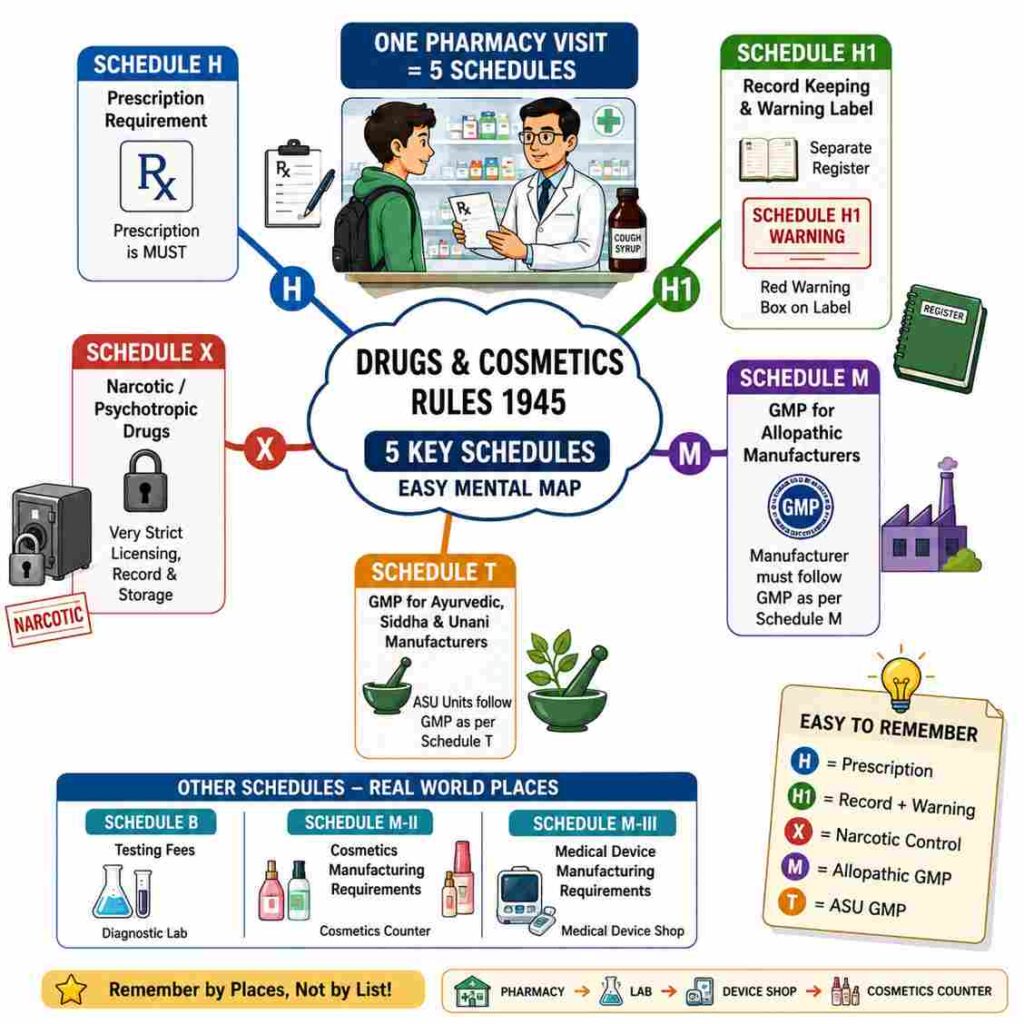
Recent regulatory updates: Schedule M was significantly amended under the Drugs (Amendment) Rules, 2023 to make the Indian GMP requirements more aligned with the WHO-GMP Requirements. SMEs were later given longer compliance dates (up to 31 December 2025). CDSCO has also highlighted the pharmacovigilance system as per Schedule M and NDCT Rules 2019. Between 2024 and 2026, additional changes were notified or proposed for Rule 121A, the licensing forms (20B, 20G and 21B), Schedule H, labelling requirements and proposed Rule 89 licensing forms. The professionals are requested to check the latest notifications of CDSCO for the latest compliance requirements.
Frequently Asked Questions (FAQs)
Ans: Schedule H drugs are those which can only be sold with a doctor’s prescription. Drugs that are habit-forming or antibiotic are divided into a group called schedule H1 drugs, which require the seller to keep a separate record of the name or patient, prescriber information, and quantity issued, as well as a warning label on the pack. H1 was put in place to reduce the misuse of antibiotics and self-medication.
Ans: Schedule M provides the details about Good Manufacturing Practices (GMP) applicable to pharmaceutical products, premises, plant and equipment and quality management systems. An amendment was made to the Drugs (Amendment) Rules 2023 to improve the quality control requirements, such as pharmacovigilance reporting requirements for licensees.
Ans: Schedule M-III sets out the requirements of factory premises for the manufacture of medical devices. It is applicable to medical device manufacturers and includes infrastructure, cleanliness and quality system expectations specific to device manufacture.
Ans: Schedule T is related to Good Manufacturing Practices (GMP) for Ayurvedic, Siddha and Unani (ASU) drugs. It establishes standards for manufacturing establishments, equipment, handling of raw materials and quality control only for traditional medicine manufacturers.
Ans: Schedule B provides details of the fees to be paid for drug and cosmetic samples tested or analysed by Central Drugs Laboratories or State Drugs Laboratories. Samples submitted for quality testing and/or regulatory sampling will be charged these fees.
Ans: Narcotic and psychotropic drugs are listed in Schedule X, where there are regulations for their manufacture, storage, sale and record-keeping. In terms of narcotics control laws, those manufacturers would require extra licenses and would need to take steps to ensure that they don’t get diverted, including extra documentation.
Ans: Schedule D1 contains information and undertaking to be furnished with the application form for a registration certificate, which includes the details regarding the manufacturing, the information regarding the product and the declaration of compliance required by the licensing authority.
Ans: Yes. Schedule M-II lays down the requirement of factory premises for manufacture of cosmetics. Further, Cosmetics Rules 2020 added their own set of Schedules (First, Second, Third Schedule) to the Cosmetics Rules which include cosmetics authorization, registration information and fees for cosmetics.
Ans: Schedule N contains the list of minimum requirements of equipment for a manufacturing unit for obtaining a licence for drug manufacture, including machinery and apparatus for manufacture and quality control.
Ans: Schedule G drugs are required to have a “Caution” label and a statement saying that they are to be used under the direction of a medical practitioner; however, they do not have to be formally prescribed to be sold. On the other hand, Schedule H drugs are not allowed to be sold legally without a prescription.
Ans: The Drugs (Amendment) Rules 2023 has amended Schedule M to appropriately bring it in line with WHO-GMP standards with an enhanced focus on quality management systems. CDSCO has also instructed the licensees to put in place pharmacovigilance (PV) systems as per Schedule M and NDCT Rules 2019, which will be evaluated during inspections by CDSCO or State Licensing Authority (SLA). Manufacturers should include both changes in SOPs and quality systems.
Ans: Keeping the records of the sale of Schedule H1 items (patient’s name, prescriber, date, quantity) is a common inspection finding and can result in regulatory action by the licensing authority against the pharmacy’s license (like a warning, fine or suspension of the license, depending on the severity and occurrence of the failure).
Ans: Biological products and special products (sera, vaccines, antibiotics, and products for parenteral use) are identified in Schedule C. Schedule C1 includes other drugs of biological origin for oral administration including some hormones, vitamins and antibiotics. They are similar but have different product categories.
Ans: Amendments occur on an ad hoc basis, when they are required under regulation. In the last few years, schedules M and device-related schedules have got the maximum number of amendments in view of the changing GMP and medical device regulation. The professionals should check the notification of CDSCO for any changes and not wait for a fixed update.
Summary
Pharmaceutical regulation has been categorized into functional schedules in Drugs and Cosmetics Rules 1945, ranging from licensing forms (A, D1) and lab fees (B) to GMP requirements (M, M-I to M-III, T) and drug classification/labeling (G, H, H1, X, C, C1, F series). The most important day-to-day schedules for working professionals are M (GMP), H/H1 (prescription and record-keeping) and X (narcotics). The grouping schedules by function are easier to recall than alphabetically by the students for GPAT and Drug Inspector exams. It is imperative to remain up to date with amendments (particularly Schedule M) as these changes have a direct impact on SOPs, audits and licensing.
This article is for educational and informational purposes. Specific licensing/compliance decisions should be made upon referring to the official Drugs and Cosmetics Rules 1945 text and current CDSCO notifications or with the help of a qualified regulatory affairs professional.
Read Also: Polymerase Chain Reaction (PCR)
REFERENCES:
CDSCO— Drug and Cosmetic rules act 1940 and rule 1945 Pdf
Latest update from CDSCO: Visit the official site

Naresh Bhakar is the Founder and Author at Pharmaguddu.com, bringing his extensive expertise in the field of pharmaceuticals to readers worldwide. He has experience in Pharma manufacturing and has worked with top Pharmaceuticals. He has rich knowledge and provides valuable insights and data through his articles and content on Pharmaguddu.com. For further inquiries or collaborations, please don’t hesitate to reach out via email at [email protected].