

Quality Control Specialist | Industry Experience
✓ Reviewed by: Pankaj Sharma - Quality Control Specialist
Reviewed for Quality Control accuracy, laboratory practices, analytical methods, and technical relevance
📅 Last Updated: October 31, 2026
To prepare 0.1 N HCl, dilute 8.50 ml of concentrated HCl with distilled water to 1000 ml. To standardize it, titrate 5 ml of 0.1 M sodium carbonate solution with the HCl, using methyl orange indicator. Repeat three times, take the mean, and calculate normality with N x V = wt. / eq. wt. x 1000.
Preparation and standardization of 0.1 N HCl is done by an acid-base titration against sodium carbonate (also known as washing soda, soda ash and soda crystals) as the primary standard. To standardize 0.1 N HCl, you run the HCl against a known quantity of primary standard sodium carbonate. Methyl orange is the indicator, and the titration gives the exact normality of the HCl.
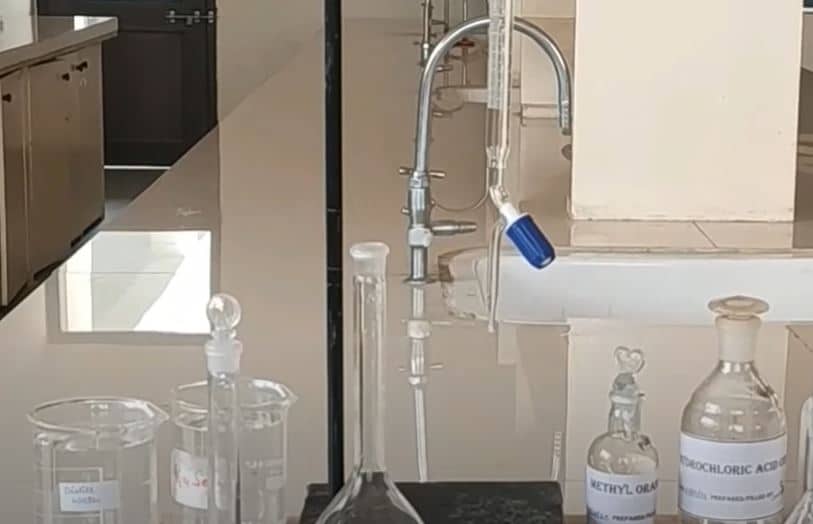
Prerequisites for preparation and standardization of 0.1 N HCl:
You need the glassware and chemicals listed below before you start. Gather them on the bench first.
Glassware:
- Burette
- Stand for burette
- Conical flask
- Volumetric pipette
- Beaker
- Volumetric flask
- Funnel
- Glass rod
- Wash bottle
Chemicals:
- Concentrated HCl
- Sodium carbonate (Na2CO3)
- Methyl orange indicator
Principle:
This section explains how the titration works and how to prepare the two solutions. You use methyl orange indicator to titrate the hydrochloric acid solution against the sodium carbonate solution. A primary standard is a pure substance of known weight, used to find the exact strength of a solution.
The Indian Pharmacopoeia describes the preparation and standardization of volumetric solutions such as hydrochloric acid, using a primary standard and a visual indicator.
When you titrate a slightly acidic solution with a weak base, the endpoint is also slightly acidic. The endpoint is the point where the indicator changes colour. When a weak acid is titrated with a strong base, the solution is somewhat alkaline because the salt produced is partially hydrolyzed.
The reaction of sodium carbonate with hydrochloric acid is:
Na2CO3(aq) + 2HCl(aq) → 2NaCl(aq) + CO2(g) + H2O(l)
CO32-(aq) + 2H+(aq) → CO2(g) + H2O(l)
In an acid-base titration, the acid added becomes chemically equivalent to the quantity of base present. A strong acid titrated with a strong base gives a neutral solution.
How to prepare 0.1 N HCl:
To prepare 0.1 N HCl, dilute about 8.5 ml of concentrated HCl (typically about 36–37 % w/w) with distilled water to 1000 ml. This volume is approximate: the exact volume depends on the assay and density of the acid, so always standardize the solution. For another acid titrant, see Preparation and Standardization of 0.025 M Sulphuric Acid Solution.
How to prepare 0.1M Na2CO3 solution:
To prepare 0.1 M Na2CO3 solution, weigh 1.06 gm of sodium carbonate. Dissolve it in 50 ml of distilled water in a volumetric flask. Mix until dissolved. Make up the volume to 100 ml.
Titration procedure for standardization of 0.1 N HCl:
Follow these steps in order. Schedule M and WHO GMP for quality control laboratories require equipment and glassware to be clean and suitable for use before testing.
- Make sure you clean all the glassware properly before use, as per standard laboratory procedure.
- Rinse the burette with distilled water before use. Then rinse it with a small portion of the titrant solution to avoid contamination.
- Take the titrant solution in a clean, dry beaker. Fill the burette using the funnel to remove air bubbles. Set the reading to zero.
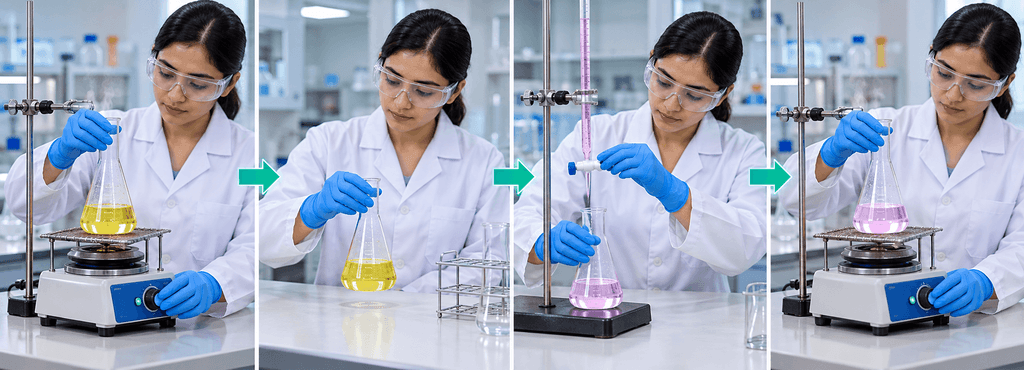
- Use a pipette to transfer 5 ml of the prepared sodium carbonate (Na2CO3) solution into a conical flask. Add one or two drops of methyl orange indicator.
- Start the titration by adding hydrochloric acid (HCl) drop by drop, stirring continuously, until the solution turns pale pink.
- Boil the solution until the colour turns yellow again. Cool it and titrate again in the same way. Repeat until the faint pink colour does not change on boiling.
- Repeat the titration three times for a reliable result. Note each burette reading. Calculate the mean and use it to find the normality of the HCl solution.
Related Post: pH Meter | Principle, Calibration, and Working
USP <541> Titrimetry covers the standardization of volumetric solutions against a primary standard, and repeat titrations with a mean value support a reliable result. For other titrant standardizations, see 0.1M Ethanolic Sodium Hydroxide Solution, 0.1 M KOH Solution and 0.1 N Perchloric Acid.
Calculation for standardization of 0.1 N HCl:
You calculate the normality of the HCl from the weight of sodium carbonate and the volume of HCl used. Normality is the strength of a solution. Equivalent weight is the weight of the substance that matches one unit of acid or base.
N x V = wt. / eq. wt. x 1000
Where,
N = normality of HCl, the value you calculate
V = volume of HCl used
Wt. = weight of Na2CO3
Eq. wt. = equivalent weight of Na2CO3
Result:
The strength of the prepared HCl solution is _____ N.
Frequently Asked Questions
Dilute about 8.5 ml of concentrated HCl with distilled water to 1000 ml. This volume is approximate, because the exact volume depends on the assay and density of the acid. This gives the 0.1 N HCl solution that you then standardize by titration against sodium carbonate. The article uses concentrated HCl for this dilution, so start from the concentrated acid.
Sodium carbonate is the primary standard. It is also known as washing soda, soda ash and soda crystals. A primary standard is a pure substance of known weight, used to find the exact strength of a solution. You prepare a 0.1 M Na2CO3 solution and titrate 5 ml of it against the HCl.
Methyl orange indicator is used. After you transfer 5 ml of sodium carbonate solution into a conical flask, add one or two drops of methyl orange. Then add the HCl drop by drop, stirring continuously, until the solution turns pale pink.
Weigh 1.06 gm of sodium carbonate. Dissolve it in 50 ml of distilled water in a volumetric flask. Mix until it dissolves. Then make up the volume to 100 ml. Use 5 ml of this solution for each titration.
Repeat the titration three times for a reliable result. Note each burette reading, then calculate the mean. Use that mean value to find the normality of the HCl solution. USP <541> Titrimetry supports repeat titrations with a mean value.
The formula is N x V (ml) = wt. (g) x 1000 / eq. wt. Here N is the normality of HCl to be calculated, V is the volume of HCl used, Wt. is the weight of Na2CO3, and Eq. wt. is the equivalent weight of Na2CO3.
References
- Indian Pharmacopoeia, Indian Pharmacopoeia Commission
- Schedule M, CDSCO, Drugs Rules, 1945
- WHO GMP, World Health Organization
- USP <541>, United States Pharmacopeia (USP–NF)

Pankaj Sharma — Quality Control Specialist
Pankaj Sharma is a pharmaceutical QC professional who reviews our technical content for GMP accuracy, laboratory practices, and regulatory relevance.