
GMP & Pharmaceutical Manufacturing Expert
✓ Reviewed by: Pankaj Sharma - Quality Control Specialist
Reviewed for Quality Control accuracy, laboratory practices, analytical methods, and technical relevance
📅 Last Updated: October 21, 2026
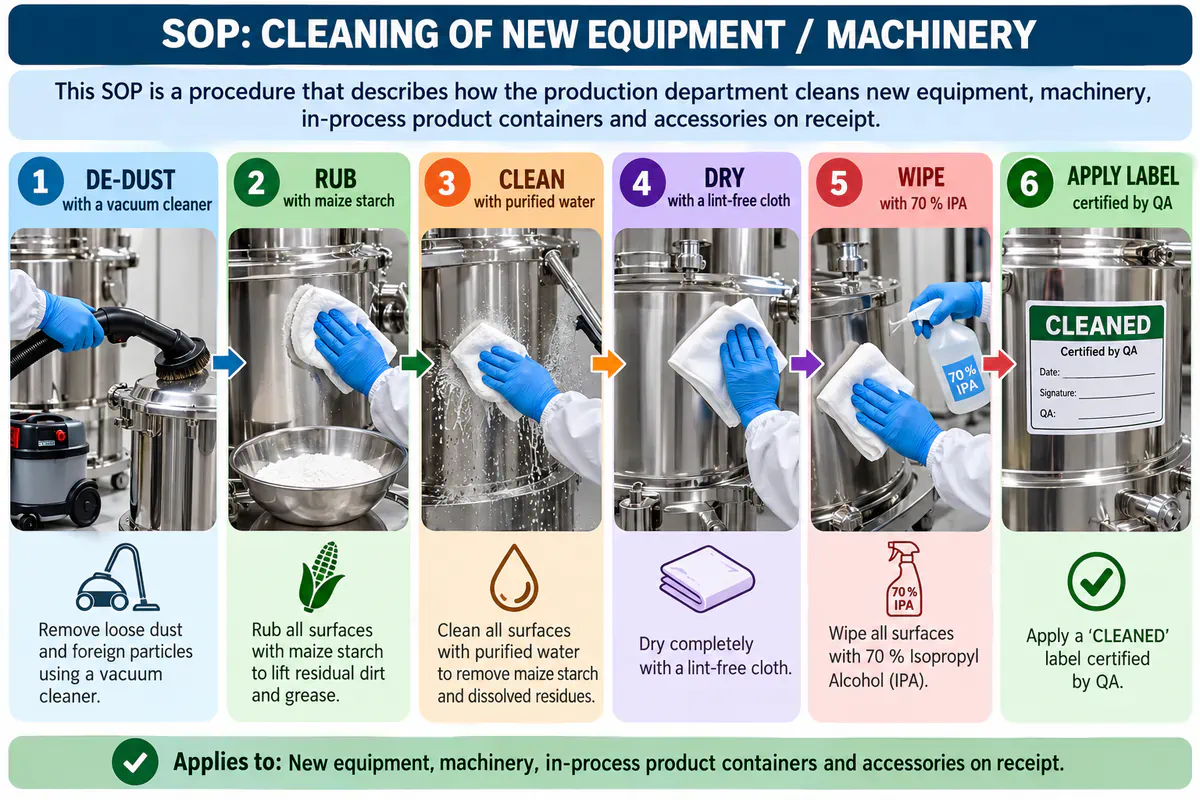
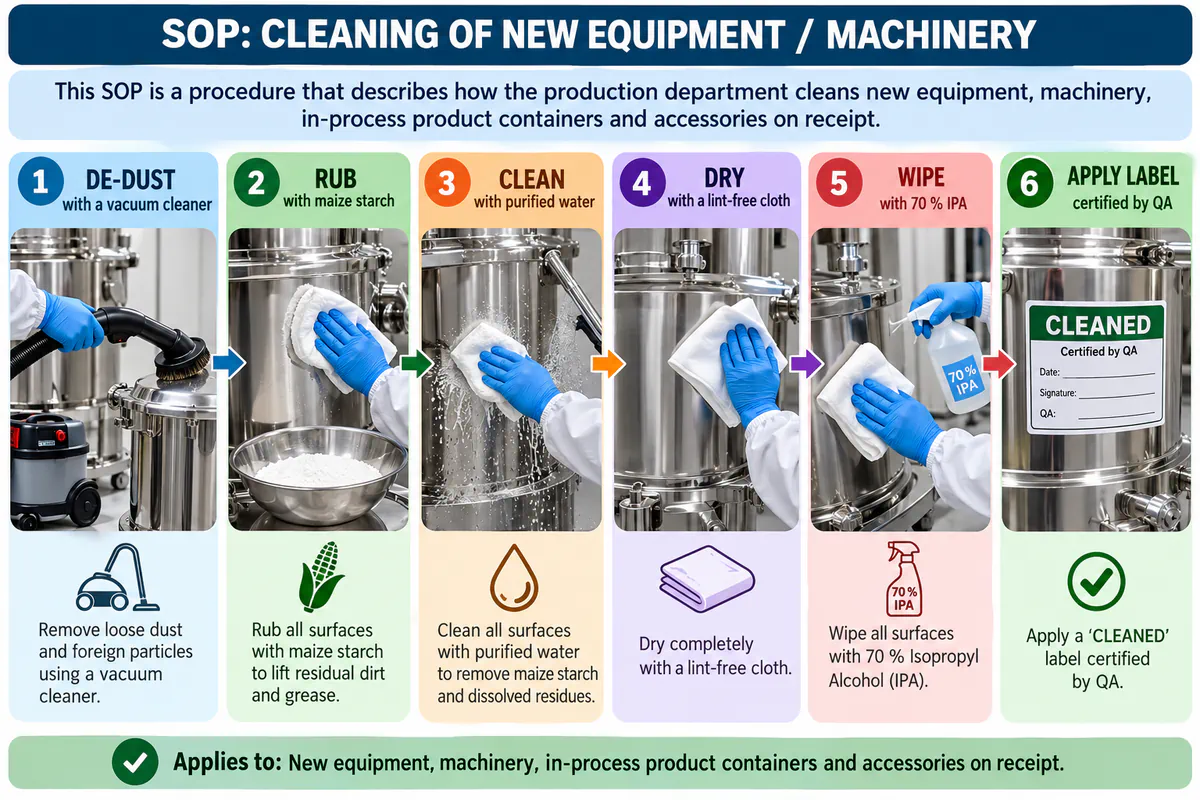
This SOP on cleaning of new equipment/machinery is a procedure that describes how the production department cleans new equipment, machinery, in-process product containers and accessories on receipt. De-dust with a vacuum cleaner, rub with maize starch, clean with purified water, dry with a lint-free cloth, wipe with 70 % IPA, then apply a ‘CLEANED’ label certified by QA.
Written procedures for cleaning and maintaining equipment are required by Schedule M (India), 21 CFR 211.67 (US), and EU GMP and WHO GMP.
1.0 Objective
To lay down a procedure for cleaning of new equipment, machinery, in-process product containers and accessories received.
2.0 Scope
This procedure is applicable to the cleaning of new equipment, machinery, in-process product containers and accessories in the production department.
3.0 Responsibility
Officer, Executive – Production Department
Manager – Production Department
4.0 Definition(s)
Accessories: sieves, screens, spatulas, scoops, SS jugs, SS buckets, SS pellets, SS containers, IPC (in-process product container), SS trolleys, SS dustbins, SS furniture, etc.
5.0 Procedure
Follow these steps in order to clean new equipment and accessories.
5.1 De-dust the new equipment, machine, in-process product container and accessories with a vacuum cleaner to remove any adherent dust.
5.2 Rub the inner and outer surfaces with maize starch to remove black particles or foreign matter generated during the buffing process at the manufacturer site.
5.3 Clean the equipment, machine, in-process product container and accessories with purified water to remove traces of black particles, foreign matter and starch.
5.4 Dry the equipment by using a fresh laundered lint-free cloth.
5.6 Finally, wipe the inner and outer surfaces of the equipment, machine and in-process product container with a freshly laundered lint-free cloth dipped in 70 % Isopropyl Alcohol (IPA).
5.7 Put a ‘CLEANED’ status label with Unit, Department, Equipment name, Cleaned by, Checked by Production Officer, Date, and certified by Quality Assurance (QA).
Note: For new equipment, machines or in-process product containers, write a dash (-) against Previous Product and Batch No. on the label.
Related SOP: SOP on Decontamination of used Material Contacted with API
See also: Cleaning and Sanitization in Pharmaceutical SOP, SS/HDPE containers, IPCs, blender bins and new sieve/screen SOP, Vacuum Cleaner cleaning SOP and Equipment Usage Log Book SOP.
6.0 Abbreviation(s)
IPA: Isopropyl Alcohol
QA: Quality Assurance
SS: Stainless Steel
Frequently Asked Questions
Maize starch is rubbed on the inner and outer surfaces in step 5.2. It removes black particles or foreign matter generated during the buffing process at the manufacturer site. Purified water then cleans off the traces of these particles and the starch in step 5.3, which keeps the new equipment clean.
Step 5.6 uses 70 % Isopropyl Alcohol (IPA). The inner and outer surfaces of the equipment, machine and in-process product container are wiped with a freshly laundered lint-free cloth dipped in it. This is the last cleaning step before the ‘CLEANED’ status label is applied.
Under step 5.7, the ‘CLEANED’ status label carries the Unit, Department, Equipment name, Cleaned by, Checked by Production Officer and Date. Quality Assurance (QA) certifies the label. For new equipment, the Previous Product and Batch No. fields get a dash (-).

Naresh Bhakar is the Founder and Author at Pharmaguddu.com, bringing his extensive expertise in the field of pharmaceuticals to readers worldwide. He has experience in Pharma manufacturing and has worked with top Pharmaceuticals. He has rich knowledge and provides valuable insights and data through his articles and content on Pharmaguddu.com. For further inquiries or collaborations, please don’t hesitate to reach out via email at [email protected].