
The Relative Standard Deviation (RSD) Calculator is used to calculate the relative standard deviation (RSD) of a data set, which is a measure of the precision and consistency of the data within the set. RSD, which is also referred to as the Coefficient of Variation (CV) in statistics, is extensively used in pharmaceutical analysis, laboratory testing, quality control, analytical chemistry, manufacturing and research studies.
The RSD value is lower, which means there is less variation from the mean, and that the data is more precise and repeatable. The larger the RSD the more variation will be in the data.
How to Calculate %RSD (Relative Standard Deviation)
In the pharmaceutical field, %RSD is used for analytical chemistry, quality control, laboratory testing, and method validation to determine repeatability.
Formula for %RSD
%RSD = (Mean/SD)×100
Where:
SD = Standard Deviation
Mean = Average of all measurements
%RSD = Relative Standard Deviation
Method 1: Calculate %RSD Using Raw Data
If you have individual replicate results, follow these steps:
Step 1: Enter Replicate Values
Suppose you obtained the following assay results:
| Replicate | Value (%) |
| 1 | 99.8 |
| 2 | 100.4 |
| 3 | 99.5 |
| 4 | 100.1 |
| 5 | 100.2 |
Step 2: Calculate the Mean
Mean= 99.8+100.4+99.5+100.1+100.2/5
Mean=100.0
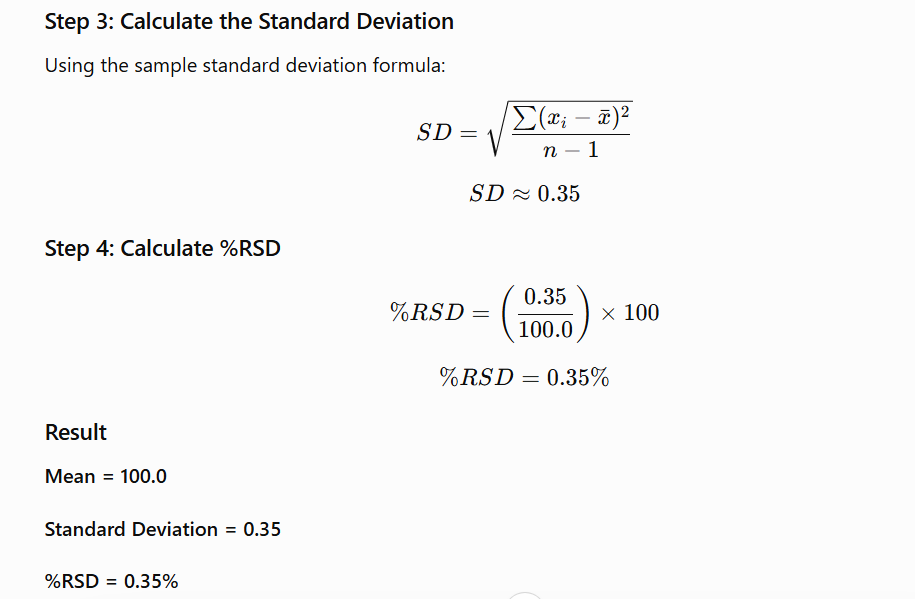
Steps 3 and 4: Calculate SD and RSD
Method 2: Calculate %RSD Using Mean and Standard Deviation
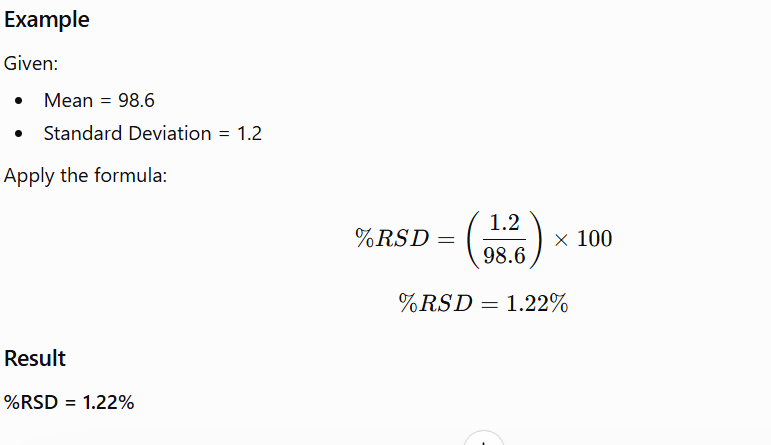
If the mean and the standard deviation are already known, %RSD can be calculated directly.
Why %RSD is important.
Relative Standard Deviation is useful for scientists and quality professionals to:
- Evaluate method precision
- Assess repeatability of analytical results
- Compare variation within and between datasets
- Control consistency of the manufacturing process
- Cooperate in GMP and quality control investigations
- Check for conformance with validation requirements
%RSD is a percentage measure of precision, thus giving a comparable value of precision regardless of the units used.
Related Pharmaceutical Calculators:
Frequently Asked Questions
Ans: The %RSD varies with the analytical method used and the regulatory requirements. The %RSD is typically acceptable for precision testing in many pharmaceutical assays and, in such assays, the %RSD should be less than 2.0%. Specific limits, however, should always follow the approved course, or the pharmacopoeia or the validation protocol.
Ans: A high %RSD indicates that the measurements are widely spread around the mean. Common causes include:
-Instrument variability
-Sample preparation errors
-Operator inconsistencies
-Environmental fluctuations
-Small sample sizes
-Outlier results
Ans: Yes. If the mean and the standard deviation are already known then % RSD can be calculated directly from the % RSD Formula as given above.
Ans: The standard deviation is 2% of the mean value when the RSD is 2%. The measurements demonstrate a relatively small range of variability and are deemed to be reasonably precise in many laboratory applications.
Ans: Yes. The %RSD will be more than 100% if the standard deviation is greater than the mean. This means very high level of variation and can indicate that the data is poor quality or the measurements are not stable or there are large outliers.
Ans: Standard Deviation and %RSD can only be calculated if there are a minimum of two replicate measurements. But for precision studies and to get a more reliable result, laboratories often take 5-6 replicates.
Ans: Standard deviation indicates absolute variation whereas %RSD indicates the variation relative to the mean. This is particularly helpful for comparing datasets with different units or different average values, making %RSD more useful.
Ans: If the values are in cells A1-A6, use:
=STDEV.S(A1:A6)/AVERAGE(A1:A6)*100
The sample standard deviation is calculated, divided by the sample mean and multiplied by 100 to output a percentage indicating the Relative Standard Deviation.
Ans: One of the most commonly used numerical measures of precision is %RSD. The lower the %RSD, the greater the precision.
Ans: A %RSD value of less than 2.0% is sometimes considered acceptable for many HPLC system suitability and assay tests. Depending on regulatory requirements and validation, some methods might need more stringent limits, e.g. less than 1.0%.
Ans: Yes, if the mean is not zero. However, if the mean is very near zero or negative, the %RSD could be misleading and should be used with caution.