
Quality Control Specialist | Industry Experience
✓ Reviewed by: Pankaj Sharma - Quality Control Specialist
Reviewed for Quality Control accuracy, laboratory practices, analytical methods, and technical relevance
📅 Last Updated: June 22, 2026
Limit tests for heavy metals need not be confusing. This guide includes detailed protocols with equipment, reagent preparation and step-by-step instructions to perform a typical test procedure. For all of the Test A, B, C and D options, there are clear instructions to ensure your pharmaceutical quality control is accurate and on track.
1.0 Scope: This procedure covers the limit test for heavy metals. Choose one method from the STP to run the test.
2.0 Apparatus: Grab the glassware you need for your specific test. Here is the full list:
- 50 ml Nessler’s cylinder
- 2 ml graduated pipette
- 25 ml measuring cylinder
- 10 ml volumetric flask
- 250 ml volumetric flask
- 10 ml graduated pipette
- 100 ml volumetric flask
- 250 ml conical flask
- U-shaped glass tube
- Nessler cylinder
- 50 ml measuring cylinder
- Silica crucible
Just use what your specific test requires.
3.0 Reagents: Here are the chemicals you will need. Only use what your test calls for.
- Hydrochloric acid (AR grade)
- Acetate buffer (pH 3.5)
- Thioacetamide reagent
- Lead standard solution (1 ppm Pb)
- Lead standard solution (20 ppm Pb)
- Dilute acetic acid
- Dilute ammonia solution
- Sulphuric acid (AR grade)
- Nitric acid (AR grade)
- Magnesium sulphate
- Magnesium oxide (AR grade)
- Phenolphthalein solution
- Ammonia (13.5 M, AR grade)
- Glacial acetic acid (AR grade)
- 1M sulphuric acid
- 2M hydrochloric acid
- 5M hydrochloric acid
- Lead standard solution (10 ppm Pb)
- Lead standard solution (2 ppm Pb)
- 6M ammonia
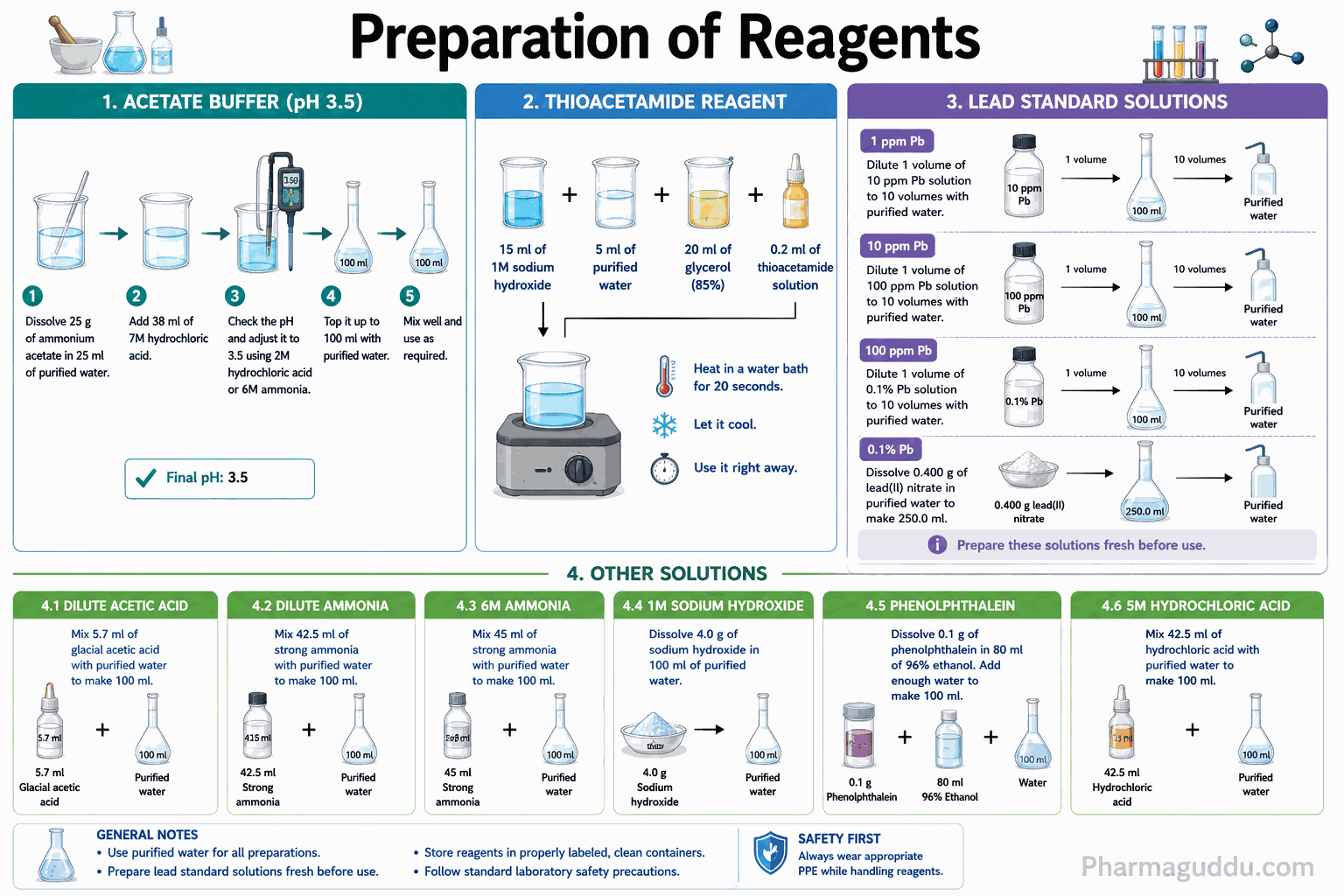
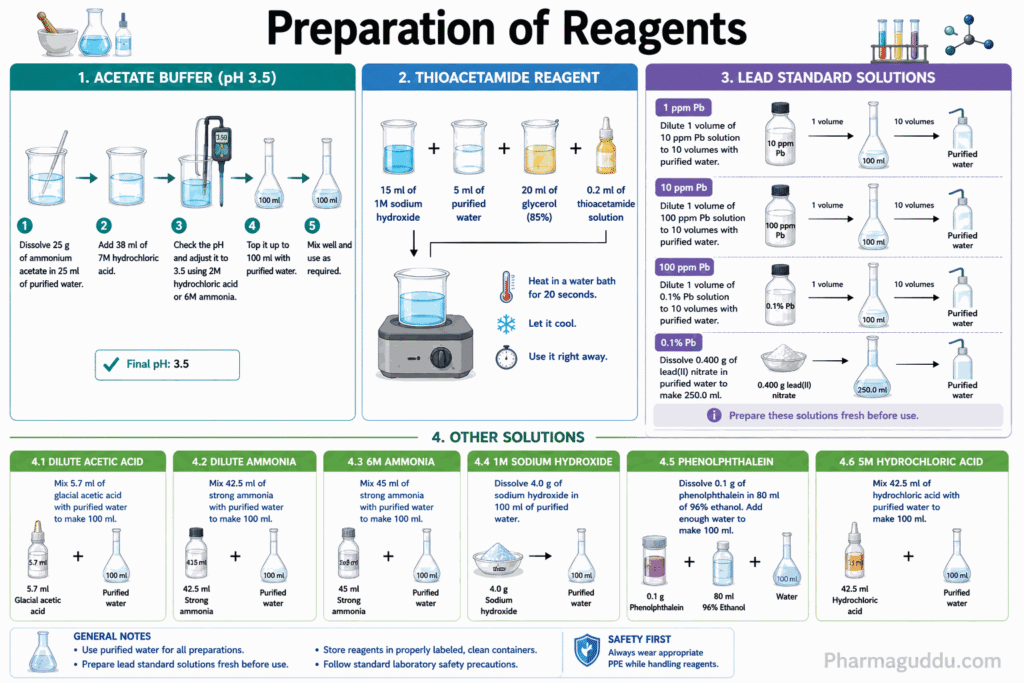
Preparation of Reagents
Related: pH Meter | Principle, Calibration, and Working
Acetate buffer (pH 3.5):
Dissolve 25 g of ammonium acetate in 25 ml of purified water. Add 38 ml of 7M hydrochloric acid. Check the pH and adjust it to 3.5 using 2M hydrochloric acid or 6M ammonia. Top it up to 100 ml with purified water.
Thioacetamide reagent:
Mix 15 ml of 1M sodium hydroxide, 5 ml of purified water, and 20 ml of glycerol (85%). Add 0.2 ml of thioacetamide solution to this mix. Heat it in a water bath for 20 seconds. Let it cool and use it right away.
Lead standard solutions:
1 ppm Pb: Dilute 1 volume of 10 ppm Pb solution to 10 volumes with purified water. Make this right before use.
10 ppm Pb: Dilute 1 volume of 100 ppm Pb solution to 10 volumes with purified water. Make this right before use.
100 ppm Pb: Dilute 1 volume of 0.1% Pb solution to 10 volumes with purified water. Make this right before use.
0.1% Pb: Dissolve 0.400 g of lead(II) nitrate in purified water to make 250.0 ml.
Other solutions:
Dilute acetic acid:
Mix 5.7 ml of glacial acetic acid with purified water to make 100 ml.
Dilute ammonia:
Mix 42.5 ml of strong ammonia with purified water to make 100 ml.
6M ammonia:
Mix 45 ml of strong ammonia with purified water to make 100 ml.
1M sodium hydroxide:
Dissolve 4.0 g of sodium hydroxide in 100 ml of purified water.
Phenolphthalein:
Dissolve 0.1 g of phenolphthalein in 80 ml of 96% ethanol. Add enough water to make 100 ml.
5M hydrochloric acid:
Mix 42.5 ml of hydrochloric acid with purified water to make 100 ml.
TEST A-Sample preparation:
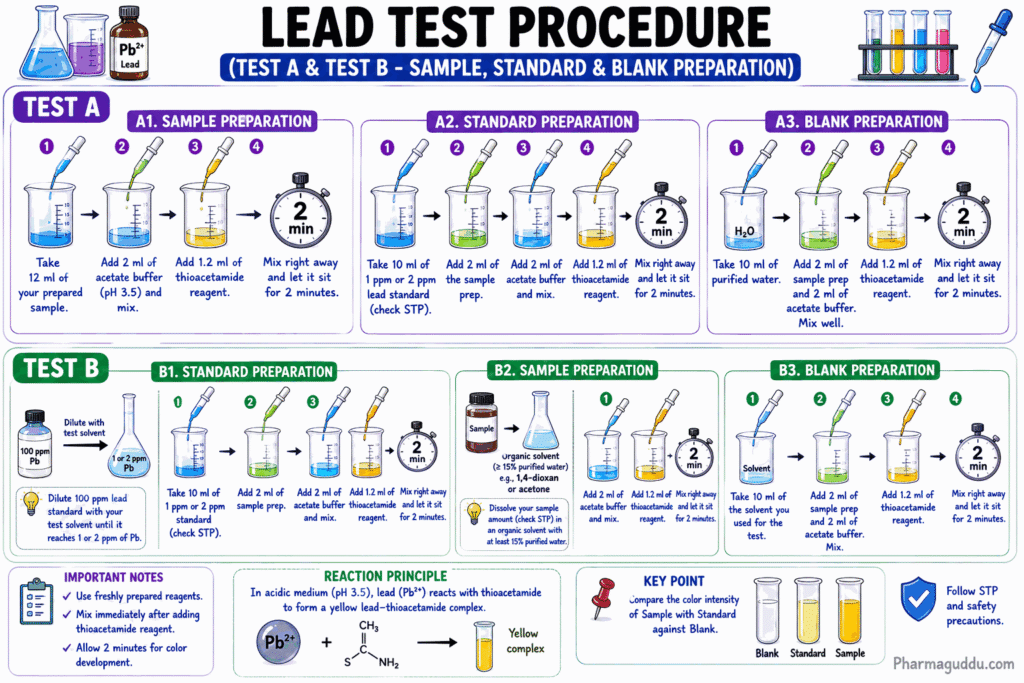
- Take 12 ml of your prepared sample.
- Add 2 ml of acetate buffer (pH 3.5) and mix. Add 1.2 ml of thioacetamide reagent.
- Mix it right away and let it sit for 2 minutes.
Standard preparation:
- Take 10 ml of 1 ppm or 2 ppm lead standard (check your STP).
- Add 2 ml of the sample prep. Add 2 ml of acetate buffer and mix.
- Add 1.2 ml of thioacetamide reagent.
- Mix right away and let it sit for 2 minutes.
Blank preparation:
- Take 10 ml of purified water. Add 2 ml of sample prep and 2 ml of acetate buffer. Mix well.
- Add 1.2 ml of thioacetamide reagent.
- Mix right away and let it sit for 2 minutes.
TEST B- Standard preparation:
- Dilute 100 ppm lead standard with your test solvent until it hits 1 or 2 ppm of Pb.
- Take 10 ml of this 1 ppm or 2 ppm standard (check your STP). Add 2 ml of sample prep. Add 2 ml of acetate buffer and mix.
- Add 1.2 ml of thioacetamide reagent. Mix right away and let it sit for 2 minutes.
Sample preparation:
- Dissolve your sample amount (check STP) in an organic solvent with at least 15% purified water (like 1,4-dioxan or acetone).
- Add 2 ml of acetate buffer and mix. Add 1.2 ml of thioacetamide reagent.
- Mix right away and let it sit for 2 minutes.
Blank preparation:
- Take 10 ml of the solvent you used for the test.
- Add 2 ml of sample prep and 2 ml of acetate buffer. Mix.
- Add 1.2 ml of thioacetamide reagent.
- Mix right away and let it sit for 2 minutes.
TEST C- Sample preparation:
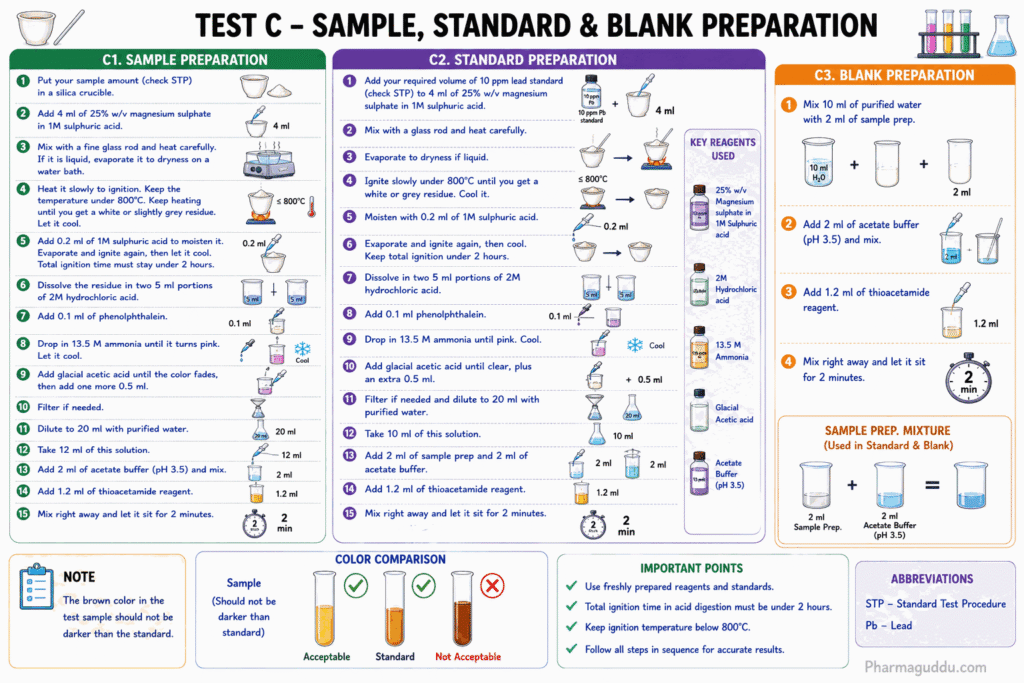
- Put your sample amount (check STP) in a silica crucible.
- Add 4 ml of 25% w/v magnesium sulphate in 1M sulphuric acid.
- Mix with a fine glass rod and heat carefully. If it is liquid, evaporate it to dryness on a water bath.
- Heat it slowly to ignition. Keep the temperature under 800°C. Keep heating until you get a white or slightly grey residue. Let it cool.
- Add 0.2 ml of 1M sulphuric acid to moisten it. Evaporate and ignite again, then let it cool. Total ignition time must stay under 2 hours.
- Dissolve the residue in two 5 ml portions of 2M hydrochloric acid.
- Add 0.1 ml of phenolphthalein.
- Drop in 13.5 M ammonia until it turns pink. Let it cool.
- Add glacial acetic acid until the color fades, then add one more 0.5 ml. Filter if needed.
- Dilute to 20 ml with purified water. Take 12 ml of this solution.
- Add 2 ml of acetate buffer (pH 3.5) and mix.
- Add 1.2 ml of thioacetamide reagent. Mix right away and let it sit for 2 minutes.
Standard preparation:
- Add your required volume of 10 ppm lead standard (check STP) to 4 ml of 25% w/v magnesium sulphate in 1M sulphuric acid.
- Mix with a glass rod and heat carefully.
- Evaporate to dryness if liquid. Ignite slowly under 800°C until you get a white or grey residue. Cool it. Moisten with 0.2 ml of 1M sulphuric acid.
- Evaporate and ignite again, then cool. Keep total ignition under 2 hours.
- Dissolve in two 5 ml portions of 2M hydrochloric acid.
- Add 0.1 ml phenolphthalein.
- Drop in 13.5 M ammonia until pink. Cool.
- Add glacial acetic acid until clear, plus an extra 0.5 ml.
- Filter if needed and dilute to 20 ml with purified water.
Take 10 ml of this solution. Add 2 ml of sample prep and 2 ml of acetate buffer. Mix. - Add 1.2 ml of thioacetamide reagent. Mix right away and let it sit for 2 minutes.
Blank preparation:
- Mix 10 ml of purified water with 2 ml of sample prep.
- Add 2 ml of acetate buffer and mix.
- Add 1.2 ml of thioacetamide reagent.
- Mix right away and let it sit for 2 minutes.
Note: The brown color in the test sample should not be darker than the standard.
TEST D-Sample preparation:
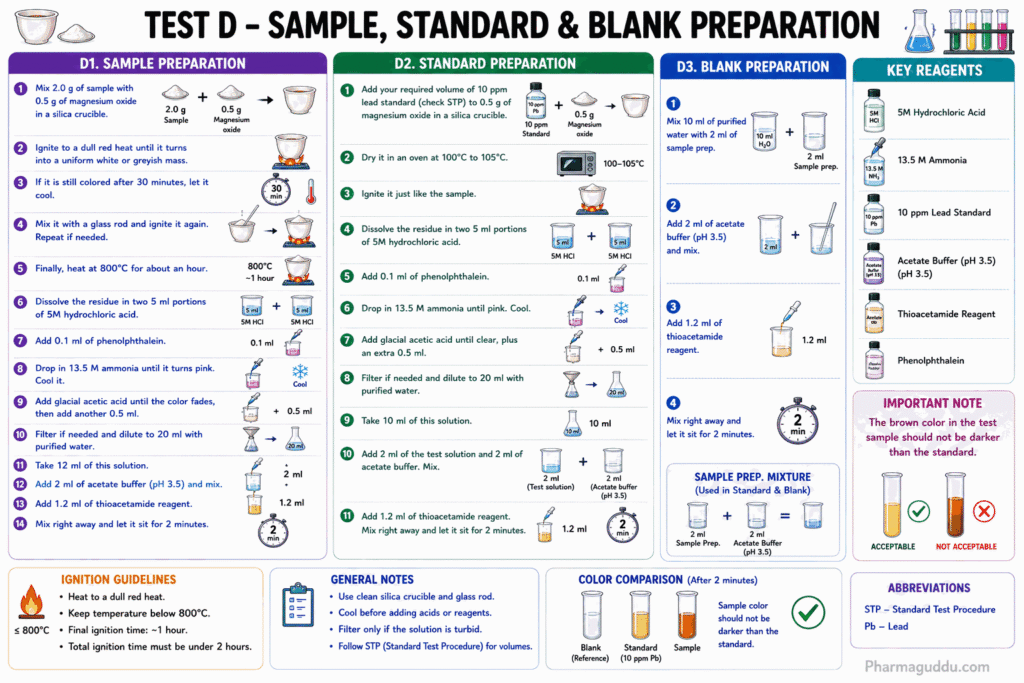
- Mix 2.0 g of sample + 0.5 g of magnesium oxide in a silica crucible. Ignite it to a dull red heat until it turns into a uniform white or greyish mass. If it is still colored after 30 minutes, let it cool.
- Well Mix it with the help of glass rod and ignite it again. Repeat if needed. Finally, heat at 800°C for about an hour.
- Dissolve the residue in two 5 ml portions of 5M hydrochloric acid. Add 0.1 ml of phenolphthalein. Drop in 13.5 M ammonia until it turns pink. Cool it.
- Add glacial acetic acid until the color fades, then add another 0.5 ml. Filter if needed and dilute to 20 ml with purified water.
- Take 12 ml of this solution. Add 2 ml of acetate buffer (pH 3.5) and mix. Add 1.2 ml of thioacetamide reagent. Mix right away and let it sit for 2 minutes.
Standard preparation:
- Add your required volume of 10 ppm lead standard (check STP) to 0.5 g of magnesium oxide in a silica crucible.
- Dry it in an oven at 100°C to 105°C. Ignite it just like the sample.
- Dissolve the residue in two 5 ml portions of 5M hydrochloric acid. Add 0.1 ml of phenolphthalein.
- Drop in 13.5 M ammonia until pink. Cool. Add glacial acetic acid until clear, plus an extra 0.5 ml. Filter if needed and dilute to 20 ml with purified water.
- Take 10 ml of this solution. Add 2 ml of the test solution and 2 ml of acetate buffer. Mix. Add 1.2 ml of thioacetamide reagent. Mix right away and let it sit for 2 minutes.
Blank preparation:
- Mix 10 ml of purified water with 2 ml of sample prep.
- Add 2 ml of acetate buffer and mix. Add 1.2 ml of thioacetamide reagent.
- Mix right away and let it sit for 2 minutes.
5.0 Reference: BP-2002 (Appendix VII, page A – 191)
Related Pharmaceutical Calculators:

Pankaj Sharma — Quality Control Specialist
Pankaj Sharma is a pharmaceutical QC professional who reviews our technical content for GMP accuracy, laboratory practices, and regulatory relevance.