
Quality Control, Quality Assurance Specialist | Industry Experience
✓ Reviewed by: Pankaj Sharma - Quality Control Specialist
Reviewed for QC, QA accuracy, laboratory practices, analytical methods, and technical Documents
📅 Last Updated: November 16, 2026
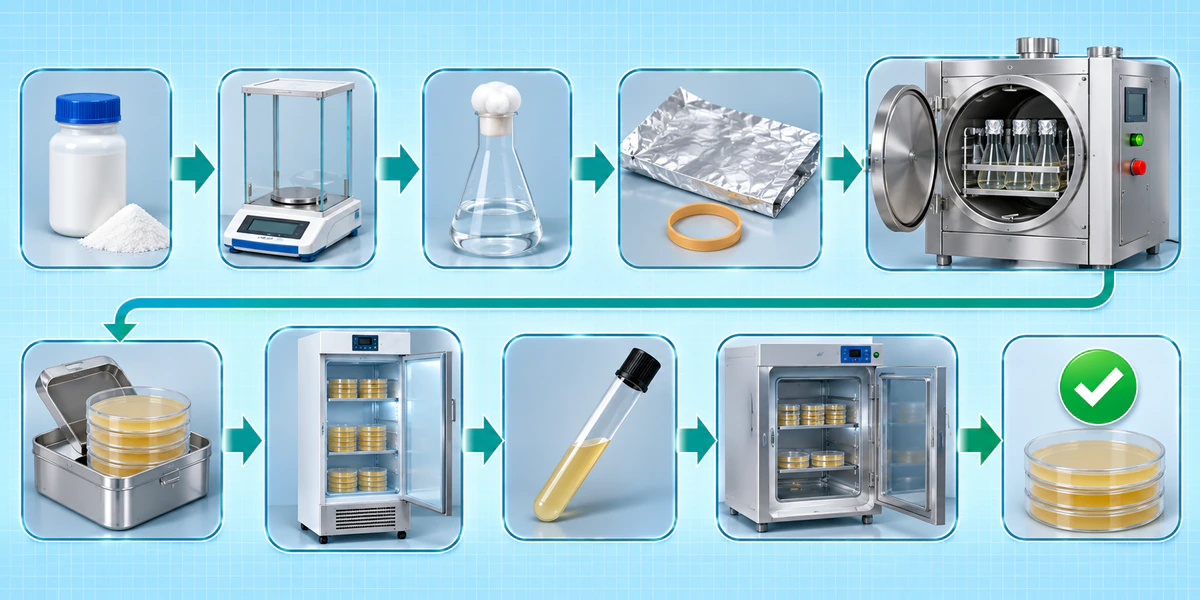
This standard operating procedure (SOP) describes how the Microbiology department weighs dehydrated media, dissolves it in purified water, sterilizes it at 121 °C for 15 to 20 minutes or as the label states, tests pH, sterility and growth promotion, labels and stores the media, and keeps cultures within five passages of the master seed.
| Title | SOP No. | Revision No. | Effective Date | Review Date | Supersedes | Department | Page |
|---|---|---|---|---|---|---|---|
| SOP for Storage and Preparation of Media and Culture | MIC/XXX | 00 | DD/MM/YYYY | DD/MM/YYYY | NA | Microbiology | 1 of X |
1.0 Objective of the SOP for Storage and Preparation of Media and Culture
This SOP for storage and preparation of media and culture is a procedure that lays down how microbiological culture media are prepared and stored. It also states how cultures are maintained, so that the media support the growth of microorganisms in test samples. Media perform as intended only when they are prepared and stored as specified, and incorrect storage can reduce growth support and give unreliable results.
2.0 Scope
This procedure for storage and preparation of media and culture applies to the Microbiology department.
3.0 Responsibility
The Microbiologist prepares the media, performs the checks and keeps the records.
4.0 Accountability
Head Microbiology is responsible for overall compliance with this SOP. Head Quality Assurance (QA) approves the SOP and reviews the records.
READ ALSO
What is Media fill in Pharmaceutical
Media fill (aseptic process simulation) runs growth medium through an aseptic process to show it…
5.0 Procedure
EU GMP Chapter 6 expects culture media to be prepared as the media manufacturer requires, unless scientifically justified, and the performance of all media to be verified before use. Media, labelling and organism handling in pharmaceutical microbiology laboratories are also covered by WHO TRS 961 Annex 2.
5.1 Receipt and storage of dehydrated media
5.1.1 At receipt, the warehouse person and the Microbiologist shall check the container, the label and the expiry date. Handling in the store follows the storage and labelling of raw and packing materials SOP.
5.1.2 Ensure that the dehydrated media bottles are stored closed, in a cool and dry place, as per the manufacturer’s label.
5.1.3 Record the opening date on the bottle and issue the media by first expiry, first out (FEFO). Discard any medium that is caked or discoloured.
5.2 Media preparation and sterilization
5.2.1 Weigh the quantity of dehydrated medium given on the manufacturer’s label (g per litre) carefully on a calibrated balance, record it, and transfer it into the conical flask.
5.2.2 Measure the volume of purified water (or better) given on the label with a calibrated measuring cylinder, add it to the medium and record the volume in the media preparation register.
5.2.3 Shake the conical flask well until the medium is completely mixed.
5.2.4 Close the flask with a cotton plug, cover the plug with aluminium foil and secure it with a rubber band.
5.2.5 Load the conical flask in the autoclave within 2 hours of preparation, because the unsterilized medium can otherwise be contaminated or change before heating.
5.2.6 Sterilize at 121 °C for 15 to 20 minutes, or as the medium label states or the validated cycle sets. The hold time depends on the load size, and the media must not be overheated because most media are heat sensitive and overheating can lower their performance.
5.2.7 Record the autoclave load number and cycle in the autoclave log, and use chemical or biological indicators with the load.
5.2.8 Cool the sterilized agar to 45 to 50 °C before pouring. Molten agar that is kept on hold must stay at 50 to 60 °C, and a 90 mm plate takes about 20 mL (a 75 mm cassette about 15 mL).
5.2.9 Store the cooled media as per the storage condition in Section 5.4.
5.3 Testing of prepared media before use
5.3.1 After cooling, check the pH of the medium against the manufacturer’s tolerance.
5.3.2 Pre-incubate the plates to check sterility: soybean casein digest agar (SCDA) at 30 to 35 °C and Sabouraud dextrose agar (SDA) at 20 to 25 °C for 5 days, and liquid media for 14 days. Reject the batch if more than 5% of the plates are contaminated, because the batch cannot then be shown to be sterile.
5.3.3 Perform the growth promotion test (GPT) on each batch with 10 to 100 colony forming units (CFU) of the strains named in the pharmacopoeia or the approved in-house method. The recovery should be 50 to 200% of the control.
5.3.4 Do not use a batch that fails growth promotion. Reject it and open a deviation.
Editor note: Accuracy flag (5.3): the pre-incubation period (some sites use 48 hours) and the 50 to 200% recovery are in-house criteria from one trade SOP, to be checked against United States Pharmacopeia (USP) <61>, <62> and <71>.
5.4 Labelling and storage of prepared media
5.4.1 Label each medium, reagent and solution with the preparation date, the opening date, the preparer’s signature, the expiry date and the storage conditions, as EU GMP requires. Add a batch number that is linked to the autoclave load number.
5.4.2 After the samples are inoculated, any sterilized medium left in the conical flask must be kept with the cotton plug and the rubber band in place.
5.4.3 Write the date of preparation and the name of the medium on the conical flask.
5.4.4 Place the conical flask in the refrigerator at the storage temperature the site has validated. Refrigerated storage of prepared media is typically 2–8 °C, and no pharmacopoeia or regulator sets one fixed value, so the range varies by site and manufacturer.
5.4.5 Do not re-sterilize or reuse the left-over medium on another day. Decontaminate it by a standard procedure and discard it as described in Section 5.6.
5.4.6 Use the prepared medium only within its in-use shelf life, which the site sets from documented stability data. Under EU GMP Chapter 6, this shelf life must be established, documented and scientifically justified. One example is use of prepared plates and broths within 7 days when stored below 25 °C as validated.
5.4.7 Seal agar plates in a package or container before prolonged storage, so that they do not lose moisture.
5.5 Culture maintenance
5.5.1 Cultures are of two types: the mother culture and the subculture. The mother culture is held as a traceable reference strain, and a subculture is prepared from it for routine use.
5.5.2 Prepare the nutrient agar solution, transfer about 5 mL of it into a 10 mL test tube and sterilize it in the autoclave.
5.5.3 Remove the tube from the autoclave, place it in a slanted position on the laminar air flow (LAF) bench and let it cool until the agar solidifies. The bench should be disinfected beforehand as described in the isopropyl alcohol disinfectant preparation SOP.
5.5.4 Take one loopful of the mother culture and streak it on the agar of the tube.
5.5.5 Place the tube in the incubator for 24 hours at about 35 °C.
5.5.6 After 24 hours, the culture is considered a fresh culture. It can be used for the sample cultures and must be stored in a refrigerator.
5.5.7 Autoclave and discard the old mother culture.
5.5.8 The fresh culture is considered the mother culture for one month, and the procedure is repeated once a month so that the cultures survive.
5.5.9 Keep working cultures no more than five passages from the original master seed lot, as the seed-lot system in USP <71> requires. Record every passage in the culture passage register.
Editor note: the one-month interval, the 35 °C incubation for all organisms and the definition of the mother culture (purchased strain or in-house subculture) are site practice without a source.
5.6 Disposal of used media and cultures
5.6.1 Decontaminate used media and strains by a standard procedure (usually autoclaving) and dispose of them so that cross-contamination is prevented. Details are in the SOP on disposal of microbial media.
5.7 Ready-to-use media
5.7.1 Ready-to-use irradiated plates may replace in-house preparation when the supplier is qualified and each lot is verified for performance.
5.8 Troubleshooting
| Problem | Likely cause | Action |
|---|---|---|
| Agar does not solidify, or pH is off | Overheating during sterilization, or an error in weighing or volume | Review the autoclave cycle, the weighing record and the water volume, and prepare a fresh batch |
| Contaminated plates in pre-incubation | Lapse in aseptic technique | Reject the batch if more than 5% of plates are contaminated, and review aseptic technique |
| Failed growth promotion | Medium does not recover the test strains | Do not use the batch, and open a deviation |
note: only overheating and the rejection of a failed batch are supported by USP <1117>.
6.0 Precautions
The medium must not be overheated, because USP <1117> advises against it and a heated medium can lose performance. A batch that fails growth promotion must not be used, and agar plates must be sealed before long storage.
7.0 Abbreviations
| Abbreviation | Full form |
|---|---|
| SOP | Standard Operating Procedure |
| LAF | Laminar Air Flow |
| °C | Degree Celsius |
| ml / mL | Millilitre |
| GPT | Growth Promotion Test |
| CFU | Colony Forming Unit |
| SCDA | Soybean Casein Digest Agar |
| SDA | Sabouraud Dextrose Agar |
| QA | Quality Assurance |
| FEFO | First Expiry, First Out |
8.0 References
- EudraLex Volume 4, Chapter 6 Quality Control, European Commission
- TRS 961 Annex 2: WHO good practices for pharmaceutical microbiology laboratories, WHO
- USP <1117> Microbiological Best Laboratory Practices, USP via drugfuture.com
- USP <71> Sterility Tests, USP via drugfuture.com
9.0 Annexures
Annexure-I: Media Preparation Register
| Date | Medium | Batch No. | Quantity (g) | Water Volume (mL) | pH | Autoclave Load No. | Done By | Checked By | Remarks |
|---|---|---|---|---|---|---|---|---|---|
Annexure-II: Autoclave Log
| Date | Load No. | Cycle | Temperature (°C) | Hold Time (min) | Indicator Result | Done By | Remarks |
|---|---|---|---|---|---|---|---|
Annexure-III: Growth Promotion Record
| Date | Medium | Batch No. | Test Strain | CFU Inoculated | Recovery (%) | Result | Done By | Checked By |
|---|---|---|---|---|---|---|---|---|
Annexure-IV: Culture Passage Register
| Date | Culture | Master Seed Lot No. | Passage No. | Medium | Incubation | Done By | Remarks |
|---|---|---|---|---|---|---|---|
10.0 Revision History
| Revision No. | Effective Date | Reason for Revision | Changed By |
|---|---|---|---|
| 00 | DD/MM/YYYY | New SOP |
Frequently Asked Questions
Growth promotion proves that the medium can recover the specified organisms. EU GMP Chapter 6 asks for verification of media performance before use, and under USP <1117> a medium batch that fails growth promotion is not used.
The label must show the preparation date, the opening date, the signature of the person who prepared the media, the expiry date and the specific storage conditions, as EU GMP Chapter 6 requires for culture media.
Atleast 2 hours between preparation and sterilization. The limit used at a site depends on the load size and the validated process.
Used media and strains must be decontaminated by a standard procedure, usually autoclaving, and then disposed of in a way that prevents cross-contamination.

Pankaj Sharma — Quality Control Specialist
Pankaj Sharma is a pharmaceutical QC professional who reviews our technical content for GMP accuracy, laboratory practices, and regulatory relevance.