
Quality Control, Quality Assurance Specialist | Industry Experience
✓ Reviewed by: Pankaj Sharma - Quality Control Specialist
Reviewed for QC, QA accuracy, laboratory practices, analytical methods, and technical Documents
📅 Last Updated: November 17, 2026
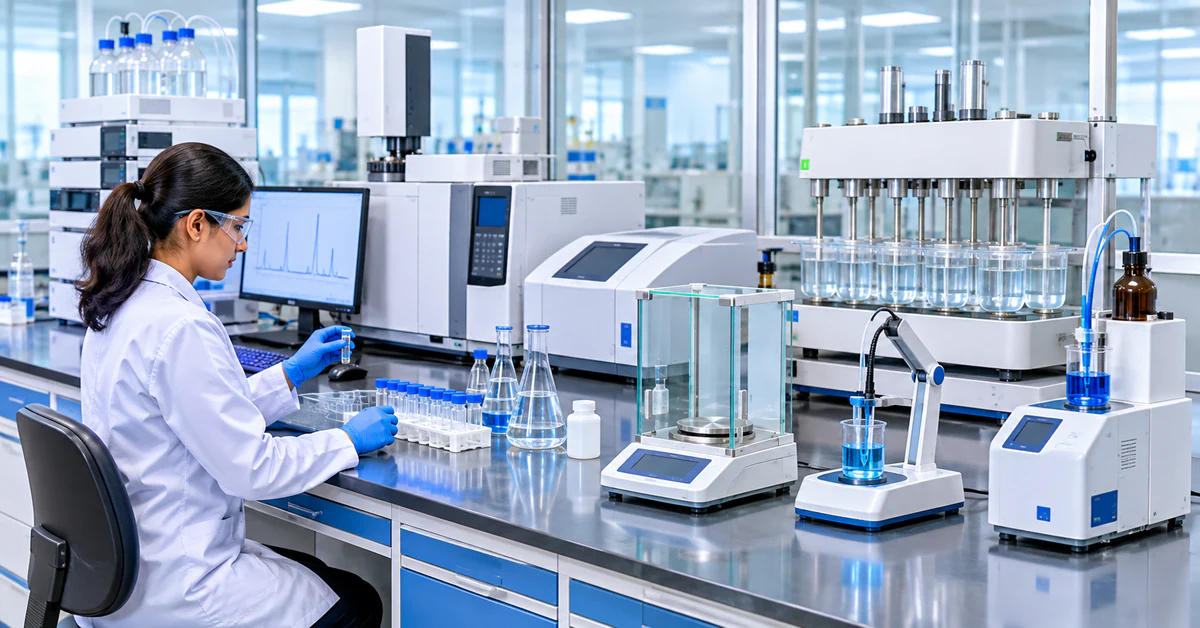
A pharmaceutical Quality Control (QC) laboratory uses chromatography (HPLC, Gas Chromatography (GC)), spectroscopy (UV, Fourier-Transform Infrared (FTIR)), titration and electrochemistry (KF titrator, pH meter, conductivity meter), physical testers (balance, polarimeter, viscometer) and dosage-form testers (dissolution, disintegration, hardness, friability). Storage equipment, microbiology and water systems are also used. All of it must be qualified and calibrated.
This list of quality control equipment in pharmaceuticals covers the instruments a QC laboratory uses to test raw materials, in-process samples and finished products against pharmacopoeial and registered specifications. Stability chambers and refrigerators monitor storage conditions, while balances and pH meters support routine release testing.
Most QC instruments, such as HPLC, GC, FTIR and UV spectrophotometers, now run on software, so they need qualification, access control and data integrity controls in addition to calibration.
List of Quality Control Equipment in Pharmaceuticals by Group
A QC instrument is a calibrated measuring or testing device used in a laboratory to generate data that supports the release of a drug. The equipment is grouped below by what it tests or does.
Chromatography and spectroscopy
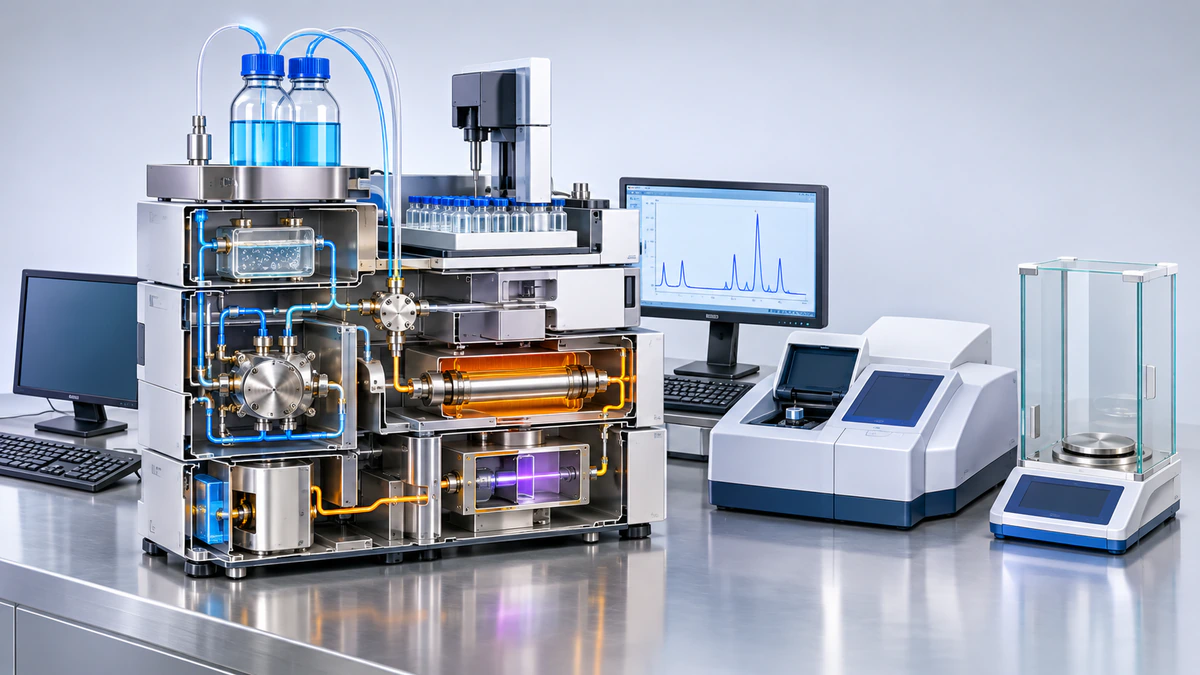
- HPLC: separates and quantifies components in liquid samples, used for assay and related substances.
- Gas Chromatography (GC): separates volatile components, used for residual solvents.
- UV spectrophotometer: measures absorbance of light by a solution, used for assay and identification.
- FTIR: records the infrared spectrum of a sample, used for identification of raw materials.
- KBr press: presses a sample with potassium bromide into a pellet for FTIR.
Titration, electrochemistry and water analysis
- Karl Fischer (KF) titrator: determines water content in raw materials and products.
- pH meter: measures the pH of solutions, buffers and water.
- Conductivity meter: measures the conductivity of water and solutions.
- Total organic carbon (TOC) analyser: measures organic carbon in purified water.
- Milli-Q water system: produces high-purity water for mobile phases and standards.
Physical testing
- Electronic balance: weighs samples and standards for every analytical preparation.
- Standard weight box: provides reference weights for balance calibration checks.
- Polarimeter: measures optical rotation of optically active substances.
- Refractometer: measures the refractive index of liquids and solutions.
- Viscometer: measures the viscosity of liquids and semisolids.
- Melting point apparatus: measures the melting range for identification and purity.
- Tap density tester: measures bulk and tapped density of powders and granules.
- Sieve shaker: separates particles by size for particle size distribution.
- Polarising microscope: examines crystal form.
- Vernier caliper: measures tablet thickness and diameter.
- Stop watch: measures time in timed tests.
- Liquid particle counter: counts particles in injectable and liquid samples.
- Visual inspection board (station): a viewing board or booth with black and white backgrounds and controlled lighting, used for visible particles in injections. It is often called a particulate matter testing board, a site or trade name that varies by manufacturer.
Dosage-form testers
- Dissolution tester: measures the drug release rate of tablets and capsules.
- Disintegration tester: measures the time a tablet or capsule takes to break up.
- Hardness tester: measures the crushing strength of tablets.
- Friability test apparatus: measures tablet weight loss on tumbling.
- Bursting strength tester: measures the pressure needed to burst a packaging material.
These testers are also described in Solid Dosage Forms: Tablets, Types, Quality Control Test, and the tests for sprays are covered in Quality Control Tests for Pharmaceutical Aerosols.
Storage, environment and general laboratory equipment
- Humidity chamber: holds set temperature and humidity for stability studies.
- Refrigerator: stores samples, standards and media cold.
- Oven and vacuum oven: dry samples with or without vacuum, used for loss on drying.
- Muffle furnace: heats samples to a high temperature for ash and residue on ignition.
- UV viewing cabinet: provides UV light, typically at 254 nm and 366 nm, for viewing thin-layer chromatography (TLC) spots in the absence of ambient light. It is often called a UV chamber, a name that varies by manufacturer.
- Centrifuge: separates solids from liquids during sample preparation.
- Sonicator: dissolves or disperses samples with ultrasound.
- Vortex mixer: mixes small volumes quickly.
- Magnetic stirrer, hot plate and heating mantle: stir and heat solutions.
- Vacuum pump: creates vacuum for filtration and vacuum drying.
- Bolometer: listed in the original post.
Microbiology and water testing
Microbiology testing uses these instruments:
- Autoclave, which sterilises media and waste.
- Laminar air flow (LAF) unit, which gives a clean work zone for aseptic handling.
- Incubators, which hold samples at the temperature needed for growth.
- Colony counter, which counts microbial colonies on plates.
- Particle counter, which counts airborne or liquid particles.
Water is tested with the TOC analyser and the conductivity meter listed above, and it is produced for laboratory use by the Milli-Q system.
Maintenance, out-of-calibration handling and troubleshooting
Preventive maintenance and calibration are carried out on a planned schedule under written procedures, and each activity is recorded. Who performs the work and where it is recorded are as per the site SOP. Related utility equipment is listed in List of Engineering & Utility Equipment, and the laboratory itself is cleaned as described in SOP for Cleaning of Quality control department.
When an instrument is found out of calibration, follow these steps:
Label the instrument “Out of use” and stop its use at once.
Assess the impact on all results generated since the last good calibration.
Raise a deviation and investigate the cause, with QA reviewing the investigation.
Return the instrument to use only after it is recalibrated and the new status label is attached.
Results that drift from the usual pattern are handled as described in Out of trend (OOT) results in Pharmaceutical Quality control.
What new in QC laboratories
Chromatography is moving from HPLC to UHPLC, and USP <621> allows this transfer when system suitability passes. Industry sources also describe paperless laboratories, direct instrument-to-Laboratory Information Management System (LIMS) and ELN data transfer, and rapid microbiology methods. McKinsey presents digitisation, automation and online testing as the future of pharma quality control, but this is the consultancy’s own view and not independent data.
QC departments are audited on this as in Audit Checklist for Quality Control Department in Pharma.

Pankaj Sharma — Quality Control Specialist
Pankaj Sharma is a pharmaceutical QC professional who reviews our technical content for GMP accuracy, laboratory practices, and regulatory relevance.