
GMP & Pharmaceutical Manufacturing Expert
✓ Reviewed by: Pankaj Sharma - Quality Control Specialist
Reviewed for Quality Control accuracy, laboratory practices, analytical methods, and technical relevance
📅 Last Updated: October 20, 2026
The SOP on handling products during a power failure tells staff to switch off the machine main, protect or unload in-process material, and check temperature, humidity and air differential pressure after power resumes. Record the conditions and the activity in the BMR/BPR. It covers granulation, compression, coating, inspection and packing areas.
1.0 Objective
To lay down a procedure for handling products during a power failure in the production area.
This SOP on handling products during a power failure is a procedure that tells production staff how to stop machines, protect in-process material and verify area conditions before restarting in the granulation, compression, coating, inspection and packing areas.
Schedule M, WHO GMP and 21 CFR 211.100 expect written procedures for production and process control, including equipment operation and deviations. Schedule M and WHO GMP (TRS 986 Annex 2) control temperature, humidity and differential pressure in production areas under their premises requirements.
2.0 Scope
This procedure is applicable to the handling of products during a power failure in the production area.
3.0 Responsibility
This section names the roles responsible for handling products during a power failure.
Officer and Executive of the Production Department and Quality Assurance
Manager of the Production Department and Quality Assurance
4.0 Definition(s)
This section lists the terms that are defined for use in this SOP.
NA
5.0 Procedure: SOP on Handling Products During a Power Failure
This section gives the actions for each production area during a power failure.
5.1 Action to be taken in granulation area during power failure:
5.1.1 Switch off the ‘main’ of the machine.
5.1.2 Cover the in-process material with lid/polybag.
5.1.3 After the resumption of power, the following checks are to be done:
5.1.3.1 Check the temperature and humidity of the area.
5.1.3.2 Check the air differential pressure of the area.
5.1.4 Ensure that the parameters are within the limit.
5.1.5 Switch on the mains of the machines.
5.1.6 Check the time elapsed and required time of FBD for drying, RMG for mixing, and bin blender for blending.
5.1.7 Check and record the environmental conditions in the respective formats.
5.2 Action to be taken in compression area during power failure:
5.2.2 Switch off the ‘main’ of the machine.
5.2.3 Unload the in-process granules from the hopper.
5.2.4 Tie the poly bags of in-process granules and compressed tablets container.
5.2.5 After the resumption of power, the following checks are to be done:
5.2.5.1 Check the temperature and humidity of the area.
5.2.5.2 Check the air differential pressure of the area.
5.2.6 Remove the upper punches.
5.2.7 Switch ‘on’ the main of the machine.
5.2.9 Check the direction of rotation of the machine in ‘inch’ mode.
5.2.10 Ensure that the parameters are within the limit.
5.2.11 Record the environmental conditions.
5.2.12 Replace the upper punches and discard the initial two rotation tablets.
5.2.13 Check all the in-process parameters as per BMR.
5.2.14 Record the downtime in the equipment usage and cleaning log sheet.
5.3 Action to be taken in coating area during power failure:
5.3.1 Take out the gun assembly from the coating pan.
5.3.2 Switch off the ‘main’ of the machine.
5.3.3 Unload the tablets/granules from the coating pan in the double-lined polybag with a proper status label.
5.3.4 After the resumption of power, the following checks are to be done:
5.3.4.1 Check the temperature and humidity of the area.
5.3.4.2 Check the air differential pressure of the area.
5.3.5 Ensure that the parameters are within the limit.
5.3.6 Switch ‘on’ the main of the machine.
5.3.7 After getting all the parameters within the limit, get it certified by QA.
5.3.8 Record the environmental conditions in the respective formats.
5.3.9 Load the tablets into the coating pan and start coating operation as per BMR.
5.4 Action to be taken in Inspection area during power failure:
5.4.1 Switch off the ‘main’ of the machine.
5.4.2 Unload the tablets from the hopper in the double-lined polybag with a proper status label.
5.4.3 Remove the tablet from the inspection belt.
5.4.4 After the resumption of power, the following checks are to be done:
5.4.4.1 Check the temperature and humidity of the area.
5.4.4.2 Check the air differential pressure of the area.
5.4.5 Ensure that the parameters are within the limit.
5.4.6 Switch ‘on’ the main of the machine.
5.4.7 Discard the leftover tablet between two belts.
5.4.8 Ensure that the metal detector conforms to the challenge test.
5.4.9 Check and record the environmental conditions in the respective formats.
5.4.9 Load the tablets into the hopper and start as per BMR.
5.5 Action to be taken in Packing area during power failure:
5.5.1 Switch off the ‘main’ of the machine (strip/blister packing).
5.5.2 Unload the tablets/granules from the hopper in the double-lined polybag with a proper status label.
5.5.3 Remove the tablets/granules from the feeding box, feeding channel guide track.
5.5.4 After the resumption of power, the following checks are to be done:
5.5.4.1 Check the temperature and humidity of the area.
5.5.4.2 Check the air differential pressure of the area.
5.5.5 Switch ‘on’ the main of the machine.
5.5.6 Discard the strips/blisters/sachets under the sealing roller and the forming roller of the machine if the machine is stopped for more than 2 minutes.
5.5.7 Check the sealing temperature and the forming roller temperature of the blister machine, and the side sealing temperature of the sachet machine, using a calibrated thermometer.
5.5.8 After getting the set parameter within the limit, start the operation as per BMR.
5.6 Note: Record all power failures activity in respective BMR / BPR.
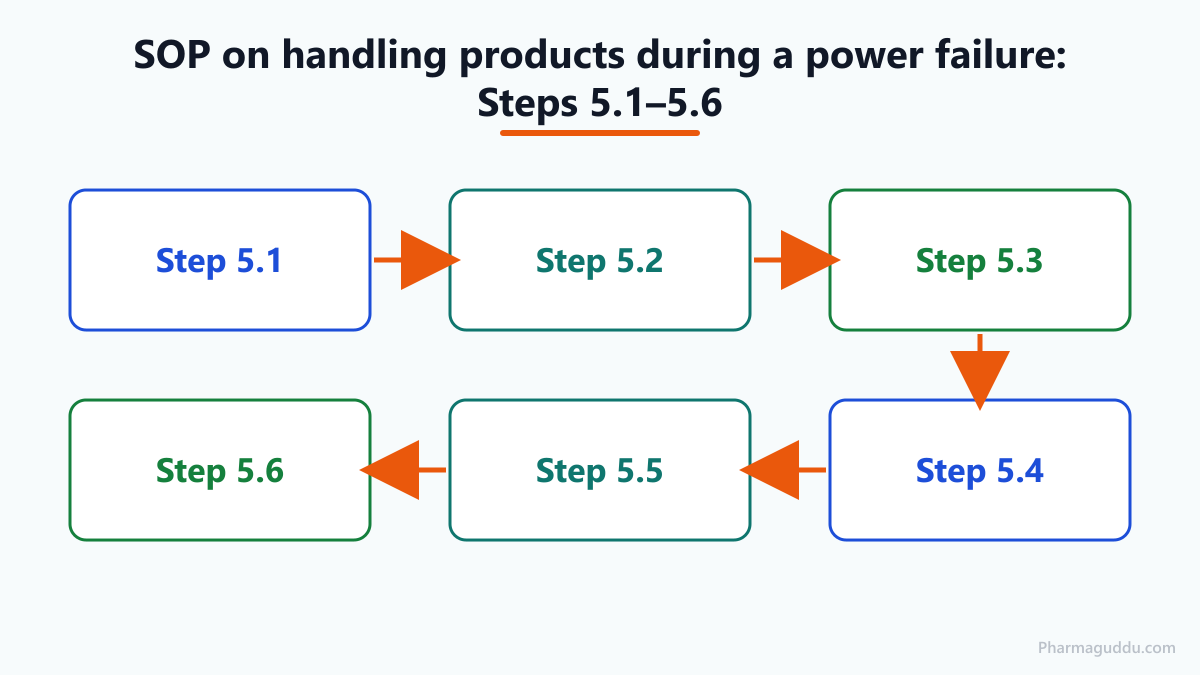
Schedule M and 21 CFR 211.188 require batch records such as the BMR and BPR to document this activity.
Related SOPs: In Process Quality check during Manufacturing, Procedure for Handling of Deviations (SOP), SOP on Handling Scrap and Disposal in Pharmaceutical
6.0 Abbreviation(s)
This section lists the abbreviations used in the steps of this SOP.
BMR: Batch Manufacturing Record
BPR: Batch Packing Record
RMG: Rapid Mixer Granulator
FBD: Fluidized Bed Drier
QA: Quality Assurance
Frequently Asked Questions
Staff check the temperature and humidity of the area and the air differential pressure of the area. They ensure that the parameters are within the limit. They then check and record the environmental conditions in the respective formats. These checks apply in the granulation, compression, coating, inspection and packing areas covered by this SOP.
After the power resumes and the area checks are done, remove the upper punches. Then switch on the main of the machine and check the direction of rotation in ‘inch’ mode. Later, replace the upper punches and discard the initial two rotation tablets. Finally, check all the in-process parameters as per BMR.
Strips, blisters or sachets under the sealing and forming rollers are discarded if the machine has stopped for more than 2 minutes (step 5.5.6). Staff then check the sealing temperature with a calibrated thermometer. After the set parameter is within the limit, the operation starts as per BMR.
Record all power failure activity in the respective BMR / BPR, as step 5.6 states. In the compression area, also record the downtime in the equipment usage and cleaning log sheet. Environmental conditions are recorded in the respective formats. Schedule M and 21 CFR 211.188 require batch records to document this activity.
Switch off the ‘main’ of the machine and cover the in-process material with lid/polybag. After power resumes, check the area conditions and ensure the parameters are within the limit. Then switch on the mains. Check the time elapsed and required time of FBD (Fluidized Bed Drier) for drying, RMG (Rapid Mixer Granulator) for mixing, and bin blender for blending.
In the coating area, take out the gun assembly and unload the tablets/granules into a double-lined polybag with a proper status label. In the inspection area, unload the tablets from the hopper into a double-lined polybag with a proper status label and remove the tablet from the inspection belt. After restart, discard the leftover tablet between two belts.

Naresh Bhakar is the Founder and Author at Pharmaguddu.com, bringing his extensive expertise in the field of pharmaceuticals to readers worldwide. He has experience in Pharma manufacturing and has worked with top Pharmaceuticals. He has rich knowledge and provides valuable insights and data through his articles and content on Pharmaguddu.com. For further inquiries or collaborations, please don’t hesitate to reach out via email at [email protected].