
GMP & Pharmaceutical Manufacturing Expert
✓ Reviewed by: Pankaj Sharma - Quality Control Specialist
Reviewed for Quality Control accuracy, laboratory practices, analytical methods, and technical relevance
📅 Last Updated: August 15, 2026
Quick Answer
A multimill is a size reduction machine used in pharmaceutical wet and dry granulation processes. This machine operates on the principle of controlled impact, cutting, and pulverization – the material to be processed falls from a hopper onto rotating sets of knife and impact blades and is subjected to pressure through openings in a perforated screen, thus forming granules of the desired size. Such machines may have a rotational speed varying from 720 to 2880 rpm and may be equipped with either knife-forward or knife-backward blades and various screen sizes to provide cutting, granulation, or fine crushing functions. They are used in the pharmaceutical, cosmetic, chemical, food, and nutraceutical industries to ensure the required quality of the produced materials, including granules, pastes, powders, and tablets.
What Is a Multimill?
A multimill is a size-reduction (comminution) machine, which is primarily used within the granulation section of the pharmaceutical processing unit. The machine is used to reduce wet or dried granules, lumps, and agglomerates to a desired particle size distribution before blending, lubricating, or compressing.
The multimill is a versatile milling machine that offers multiple functions, including wet and dry granulations, pulverization, and de-lumping processes. This is achieved by varying the screen size, the blade’s angle, and the rotor’s speed. As a result, multimills are the preferred machines in all granulation, tabletting, and capping processing lines. Moreover, they are also commonly used in topical and oral powder processing plants.
How Does a Multimill Work?
In short, the principle of multimill operation is that either wet or dry granules are fed to the hopper, which drop into a milling chamber having a cylindrical or conical perforated screen, inside which a rotor with blades rotates at a high speed, cutting or bruising the material and pushing it against the screen. Particles that pass through the screen appear in the discharge chute, located below the milling chamber, from which they are collected in a desired container.
The most significant factors that affect the resulting particle size are the screen’s mesh, the blade’s orientation (cutting edge pointing in the rotation direction or opposite to it), and the rotor’s speed. Varying these parameters allows optimizing the multimill performance for different products and/or granulation stages.
Principle and Mechanism of Multimill:
The principle involves variable force, rotating blades having both knife and sharp edges with validated screen size to reduce particles in a controlled manner. The mechanism involves the pulverization process (Pulverization is the grinding and crushing of materials into small particles). Knife blades are used to cut the large particles into small size particles, that are generated during the FBD drying process. The hummer process is also used to break large particles into small sizes.
Components of multi-mill:
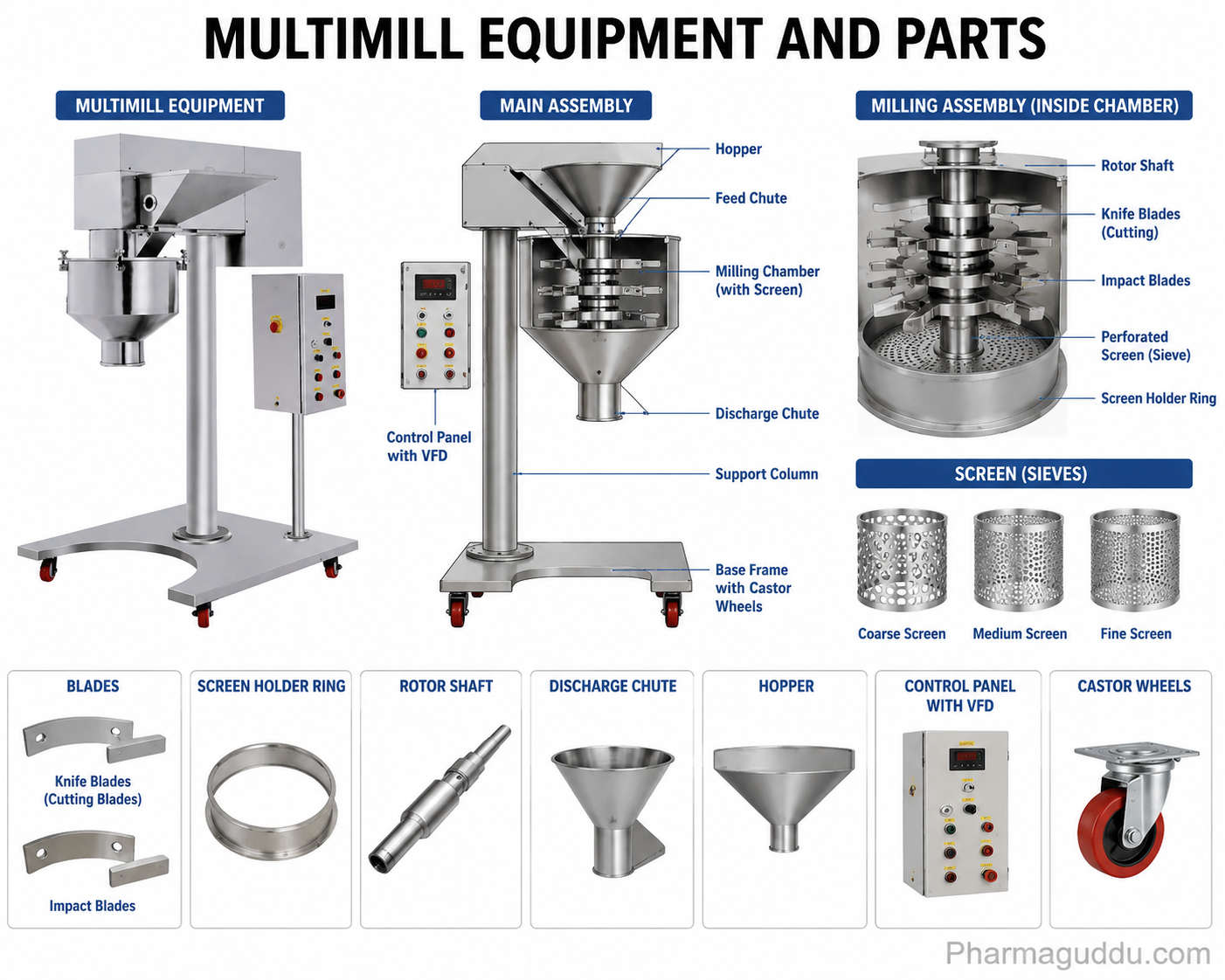
Hopper (Feed Inlet)
Overview: Usually introduces the wet/dry granular material to be milled into the milling chamber
Description: Serves as a receiving vessel and can be manually loaded or connected to a feed conveyor (in large installations).
Operational significance: Controls the rate of flow into the chamber which determines the loading, motor amperage, and percent screen capacity utilization.
Common issues: Clogging or bridging of hopper throat by moist cohesive mass results in improper feed rate to the mill and irregular milling.
Milling Chamber
Purpose: The mill chamber is the housing of the perforated sieve and the rotating blade. It contains the material during processing and confines the milling/cutting force of the blade.
Operating principles: The shape of the chamber (cylindrical, conical) and the angle of the curved sieve define how long the material remains in the mill, as well as the direction of its movement, which determines the particle size.
Common failures: Screen blinding with fine particles or moisture, overheating for long runs, and chamber buildup are frequent problems.
Rotor and Blade assembly (knife and impact blades)
Purpose: This mechanism is responsible for the milling action, either by cutting or impact.
It consists of a driven shaft, on which a number of blades are mounted, typically including one or more sets of knife blades and scraper blades.
Operational description: The operator can select either forward or backward rotation of the rotor containing the knives relative to the rotor’s rotational direction, as well as the rotor’s speed, thereby influencing the prevailing mode of size reduction – cutting or impact.
Common problems: The knives tend to become worn, reducing their effectiveness and increasing fines production and heat generation; the blades can also be out of balance, causing excessive wear on the screen.
Screen (Sieve)
Description: Sets the maximum size of the particles that can escape the milling chamber.
Function: The screen, which is a validated aperture sieve, surrounds the blade assembly; only particles that are small enough to pass through the sieving surface can exit the milling chamber.
Operating role: The mesh size of the screen is determined by the desired granule size specification of the product; interchangeable screens are used for different products and must be dedicated to a specific product or be thoroughly cleaned between use.
Potential issues: Clogging of the screen with product, tearing or piercing of the screen by the blades, and cross-contamination of products due to shared use of screens.
Discharge Chute (Outlet)
Purpose: To direct the sized product coming out of the milling chamber into the collection bin.
Function: The flow of finished granules is guided through a gravity discharge or slightly inclined chute into a collection bin, drum or conveyor.
Operating role: The design of the discharge chute will govern the flow characteristics of the material being discharged so as to prevent clogging, bridging and dust generation.
Potential problems: Materials, particularly those with high hygroscopic tendencies tend to cake and adhere to the chute surface causing flow problems.
Mechanical and Electrical Chamber (Drive Assembly)
Purpose: Holds the motor, gear box, drive belts, and electrical components that powers and controls the mill.
Function: Converts electricity to rotation of the rotor shaft, usually by means of a motor and belt or direct drive.
Operating role: A VFD (variable frequency drive) is used in this section allowing the operater to set RPMs for different products and granule sizes.
Common failures: Belt slippage or stretching, bearing wear causing vibration and/or noise, and motor overload due to overfeeding or incorrect screen usage.
Speed Ranges of Multimill:
Multimill has a wide range of options for speeds to run. It can be operated from 720 to 2880 RPM (also depending on the make).
Related Post: Fluidized bed dryer
Technical Specification
| Parameter | Range |
| Operating speed | 720–2880 RPM (model dependent) |
| Construction material (product contact) | SS 304 / SS 316 |
| Blade configuration | 12 knife/cutting-edge blades + 2 scraper blades (standard configuration; varies by OEM) |
| Screen type | Perforated, interchangeable, validated aperture size |
| Drive | Motor with gearbox/belt drive and VFD speed control |
| Approximate equipment cost | US $900–$1,400 for a standard stainless-steel multimill (varies by capacity, OEM, and region) |
Features of Multimill:
- All parts of the mill are made of S.S. 304/ S.S. 316 grade.
- Product contact parts are easy to dismantle and clean.
- Blades and scrapers are made of hard materials and plated with hard chrome.
- It can be run for a long time continuously.
- Usage of the cylindrical drum for more output.
Multimill Application:
- Multi mills can be used for a variety of functions such as wet and dry granulation, pulverization
- The multi-mill unit is useful in pharmaceuticals, cosmetics, dyes, paints, food products, herbs, detergents, pesticides, polymers & resins, and fertilizers.
Advantages and Disadvantages of Multimill:
Advantage:
- It can be used for milled wet materials.
- Easy for operational activity.
- Variable speed options are also available.
- Easy to dismantle and clean.
- Required less space to install.
Disadvantage:
- It causes more noise.
- Chance of an accident on changes the speed frequently.
Price:
Stainless steel Multi Mill price ranges from $900 to $1400.
Related Post: Rapid mixture granulator
Frequently asked Questions
Answer: Knife-forward orientation utilizes the ‘cutting edge’, while knife-backward orientation uses the ‘impact or blunt edge’ of the knives. The former is suitable for cutting wet and cohesive granules, while the latter is used for cutting dry and friable granules.
Answer: Yes. It is possible to make both wet and dry granules by using a mm, by changing blade angles, screen sizes and rpm according to the characteristics of each material.
Answer: The most common causes of oversized granules are: dull blades, incorrect screen size, and over feeding the feed chamber with material beyond what the machine can effectively process. Blades and screen size checking should be done first to determine the root cause.
Answer: Too fast a rotor speed, using a knife-backward (impact) orientation on materials that should be cut rather than impacted, or over-processing material that has been reduced to the desired particle size in the chamber are some of the reasons why a mill produces excessive fines.
Answer: Screen blinding occurs when the material being ground clogs the openings in the screen. It can be caused by high moisture content in the material and/or using a screen with an opening too small for the material’s adhesion properties. It is corrected by checking the moisture of the feed and/or changing to a larger opening screen and/or checking that the scraper blades are present and working properly to clear material from the screen.
Answer: Blades and screens should be replaced on a scheduled basis as part of a preventive maintenance program based on run-hours and visual inspection, not just on a need basis. Replacement intervals should be set during initial startup qualification by the installation sites and adjusted based on trend analysis.
Answer: No. A multimill is a machine that uses cutting and impact blades to size dry or wet granules against a screen while a colloid mill is used to make liquid suspensions and emulsions by using a rotor-ator shear gap. Therefore, the two machines are used in different stages and have different applications in the production process.
Answer: Particle size and the narrowness of the particle size distribution from the multimill are factors that directly affect granule flow properties, compressibility, and hence weight consistency and tablet quality at the tablet press. Poor milling practice upstream often manifests itself downstream as weight variations, capping, or content uniformity problems.
Answer: Interview questions typically center on the cutting vs impact principles, the effect of screen size and the angle of the blades on particle size, the normal RPM, the mill’s main components, common difficulties, and the change/cleaning procedure for different products.
References
- OEM equipment manuals and manufacturer technical documentation for multimill/comminuting mill equipment
- General pharmaceutical engineering and unit operations references on granulation and size reduction
Related Post: Colloid Mill: Working and Principle in Pharmaceutical Industry

Naresh Bhakar is the Founder and Author at Pharmaguddu.com, bringing his extensive expertise in the field of pharmaceuticals to readers worldwide. He has experience in Pharma manufacturing and has worked with top Pharmaceuticals. He has rich knowledge and provides valuable insights and data through his articles and content on Pharmaguddu.com. For further inquiries or collaborations, please don’t hesitate to reach out via email at [email protected].