
GMP & Pharmaceutical Manufacturing Expert
✓ Reviewed by: Pankaj Sharma - Quality Control Specialist
Reviewed for Quality Control accuracy, laboratory practices, analytical methods, and technical relevance
📅 Last Updated: May 1, 2026
1.0 OBJECTIVE: To lay down the procedure for cleaning and operation of linear bottle washing
Machine
2.0 SCOPE: This procedure is applicable for cleaning and operation of linear bottle washing machine in Liquid department at Pharmaceutical.
3.0 RESPONSIBILITY:
Operator, Officer, Executive- Production Department
Officer, Executive- Quality Assurance Department
Manager –Production and Quality Assurance Department.
4.0 DEFINITION(S):
NA
5.0 PROCEDURE:
5.1 Cleaning
5.1.1 Checking Status Labeling: Check the status “TO BE CLEANED” on equipment with details filled. If next product is the same as previous product (campaign production), follow batch-to-batch change over procedure. If next product is different from previous product, follow product-to-product change over procedure and follow shift end cleaning procedure at the end of day’s work.
5.1.2 Batch-to-Batch change over procedure (TYPE A): To maintain batch segregation-
5.1.2.1 Remove “ TO BE CLEANED “ label and affix “ UNDER CLEANING “ label to the machine.
5.1.2.2 Ensure that no empty bottles from the previous batch remains in the machine.
5.1.2.3 Carry out wet mopping of the machine followed by dry mopping with lint free cloth from outside.
5.1.2.4 Remove all the good and rejected bottles from the area and carry out the reconciliation. Destroy the rejected bottles.
5.1.2.5 Record the details of cleaning in equipment usage record sheet as per below Annexure- I.
5.1.3 Shift end cleaning procedure:
5.1.3.1 Switch off the electric supply from the mains.
5.1.3.2 Close purified water supplies from their respective valves.
5.1.3.3 Close the compressed air supply.
5.1.3.4 Remove all the bottles from the machine and keep them in closed container with status label.
5.1.3.5 Open the drain valves of water storage containers and drain out all the water.
5.1.3.6 Remove all the water from machine by mopping with lint free cloth.
5.1.3.7 Dry the water storage containers and Drip trays with the help of lint free cloth.
5.1.3.8 Mop the complete machine with the help of dry lint free cloth.
5.1.4 Product-to-product change over procedure (TYPE B): This procedure is applicable if -there is a change in product or during campaign production, 7 batches have been Processed .Equipment is taken for maintenance during processing and maintenance work continues for more than 24 hrs or maintenance work involves any part, which comes in direct contact with purified water.
5.1.4.1 Remove all the good and rejected bottles from the area and carry out the reconciliation. Destroy the rejected bottles.
5.1.4.2 Close purified water supplies from the valve .
5.1.4.3 Close the compressed air supply.
5.1.4.4 Dismantle infeed caps, Spacer bar, bottle holder, and Erector if the next product is not having the same bottle size.
5.1.4.5 Clean the change parts with purified water and nylon brush.
5.1.4.6 Dry the change parts and store them.
5.1.4.7 Open the drain valves of water storage containers and drain out all the water. Ensure that there is no water in the water lines if required, open and drain the water.
5.1.4.8 Rinse the water storage containers and Drip trays with purified water and dry them with lint free cloth.
5.1.4.9 Set the change parts infeed caps, Spacer bar, and Erector of the bottle size for next product.
5.1.4.10 Mop the machine with dry lint-free cloth.
5.1.4.11 Visual inspection: Check that all the surfaces of the parts of Bottle Washing Machine are visually clean and dry.
5.1.4.12 Reassembly: Reassemble all accessories and parts dismantled for cleaning purpose.
5.1.4.13 Status labeling: Put ‘CLEANED’ status label having Unit, Department, Equipment name, Cleaned by, Checked by Production Officer, Date and finally certified by Quality Assurance (QA).
5.1.4.14 Protection of clean equipment: Protect the cleaned Bottle washing machine by covering the water storage containers with SS lid and loading and unloading sides with clean polythene bag if the equipment is not planned for use within a day.
5.1.4.15 Records: Record the details of cleaning in equipment usage record sheet as per below ref. SOP
5.2 Machine set up and operation
5.2.1 Machine set up
5.2.1.1 Ensure that Bottle Washing Machine is cleaned.
5.2.1.2 After line clearance from QA, put the “UNDER PROCESS” label dully filled and signed on the machine.
5.2.1.3 Change / fix the bottle holders as per the bottle size.
5.2.1.4 Set up the drum assembly, infeed guide spacer and erecter as per the required size of the bottle.
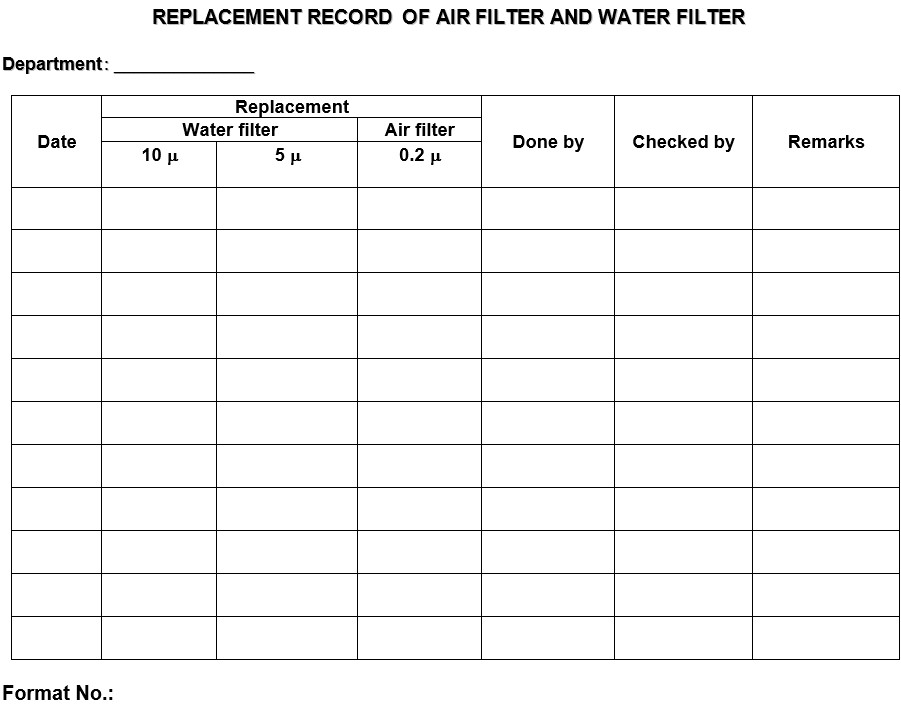
5.2.1.5 Air filter for bottle drying to be changed after every three Months and water filters for purified water to be changed when water pressure on pressure gauge come down under 2 Kg/ cm² or if required earlier.
5.2.1.6 Record the change of filter as per below Annexure-I.
5.2.2 Operation:
5.2.2.1 Open the valves for the purified water to fill the water containers.
5.2.2.2 Open the air valve and check the wash air pressure from air pressure gauge, the air pressure should be NLT 2.0 kg/ cm² and mechanical air pressure at 6 kg/ cm².
5.2.2.3 Switch ON the main.
2.2.4 If no ERROR message display on screen then select MANUAL MODE and observe the machine carefully for proper functioning by starting individual items.
5.2.2.5 Press Pump 1, then Pump 2, check respective dial gauge mounted on panel. The pressure should be NLT 2.0 kg/ cm² for bottle size 15ml to 120ml.
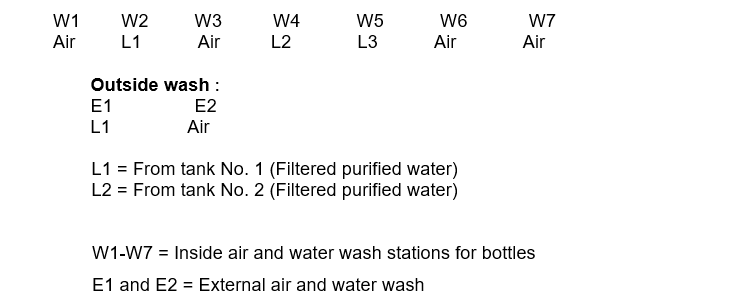
5.2.2.7 Wash Sequence:
Inside Wash:
5.2.2.8 Switch ON/OFF Globe valves 1,2 and 3 and observe its proper functioning.
5.2.2.9 Press the key for Pumps & Globe valves again to switch it OFF.
5.2.2.10 Run Machine Conveyor for few minute and observe its free movement & timely movement of pins and erector.
5.2.2.11 Operate extractor for its proper response by pressing extractor button.
5.2.2.12 Operate feed conveyer in Manual mode so as Bottles available up to the loadingdrum through infeed guide.
5.2.2.13 Select AUTO mode. To start the washing operation.
5.2.2.14 Press Cycle start switch ON, Then PLC takes over Auto operation.
5.2.2.15 First, Pump No. 1 Switches ON.
5.2.2.16 Then Pump No. 2 will get ON with a delay of few sec.
5.2.2.17 Turn machine conveyer ON & then Feed conveyer will switch ON automatically.
5.2.2.18 In case of improper machine setting, the PLC may show the following faults:
- Air pressure low
- No Bottles on In-feed Conveyer
- Low water level in tank
- Emergency button is pressed
- Jamming of Conveyer
- Cam Clutch slipped
- Geneva Clutch slipped.
5.2.2.19 Once error has been removed AUTO mode will work after pressing RESET button.
5.2.2.20 Start the water pumps and machine, check that water pressure is with in the range and uniform flow from all the nozzles.
5.2.2.21 Receive the empty glass bottles from day store in packed cartons.
5.2.2.22 Remove the cartons and load the bottles on the loading platform. Put the empty cartons in waste bin.
5.2.2.23 Put any broken bottle in another waste bin meant for damaged bottles.
5.2.2.24 Washed and air-dried bottles will be unloaded automatically on the other side of the machine.
5.2.2.25 After the completion of operation, Switch ‘OFF’ Bottle washing machine.
5.2.2.26 Affix “TO BE CLEANED” label on the machine as per below refrence SOP.
5.2.2.27 Record the details of operation of Bottle washing machine in equipment usage log sheet as per below refrence SOP.
5.3 NOTE:
5.3.1 Ensure adequate oil level by reduction gearbox.
5.3.2 Ensure air pressure in the unit is not less than
5.3.3 Lubricate daily all moving parts with food-grade oil when product comes in contact and grease for closed parts.
6.0 ABBREVIATION (S)
SOP: Standard Operating Procedure.
No. : Number
NA: Not applicable
PLC: programmable logic controller
7.0 REFERENCE(S)
Status labeling in production department.
Making entries in equipment usage and cleaning log sheet.
8.0 ANNEXURE (S)
ANNEXURE-I: Replacement record of air filter and water filter
9.0 DISTRIBUTION
9.1 Master copy: Quality Assurance
9.2 Controlled copy( s): Production department.
9.3 Reference copy (s): Production Department

Naresh Bhakar is the Founder and Author at Pharmaguddu.com, bringing his extensive expertise in the field of pharmaceuticals to readers worldwide. He has experience in Pharma manufacturing and has worked with top Pharmaceuticals. He has rich knowledge and provides valuable insights and data through his articles and content on Pharmaguddu.com. For further inquiries or collaborations, please don’t hesitate to reach out via email at [email protected].