
GMP & Pharmaceutical Manufacturing Expert
✓ Reviewed by: Pankaj Sharma - Quality Control Specialist
Reviewed for QC, QA accuracy, laboratory practices, analytical methods, and technical Documents
📅 Last Updated: November 7, 2026
This Standard Operating Procedure (SOP) on cleaning, operation of the automatic dosing cap pressing machine covers two activities in the liquid department. Cleaning includes the label change, removal of previous-batch bottles and dosing cups, reconciliation, mopping with a lint-free cloth and the log entry. Operation includes machine setup, loading caps, feeding bottles, switch-off and labelling.
1.0 Objective of the SOP on Cleaning, Operation of the Automatic Dosing Cap Pressing Machine
To lay down the procedure for Cleaning and Operation of the automatic dosing cap pressing machine. This SOP is a procedure that sets out how the Production Department cleans and operates the automatic dosing cap pressing machine in the liquid department.
2.0 Scope
This procedure is applicable for the Cleaning and Operation of the automatic dosing cap pressing machine in the liquid department.
3.0 Responsibility
Operator, Officer, Executive – Production Department
Manager – Production Department
4.0 Procedure
The procedure covers cleaning at batch change-over, machine setup and operation, and notes on oil level, lubrication and speed.
4.1 Cleaning
Schedule M requires written procedures for cleaning and maintaining equipment. This SOP sets them out for the machine.
4.1.1 Batch-to-Batch change over procedure (Type A): To maintain batch segregation.
WHO GMP expects equipment and the area to be cleared of previous-batch materials before the next batch starts, and the change-over steps here do that for bottles and dosing cups.
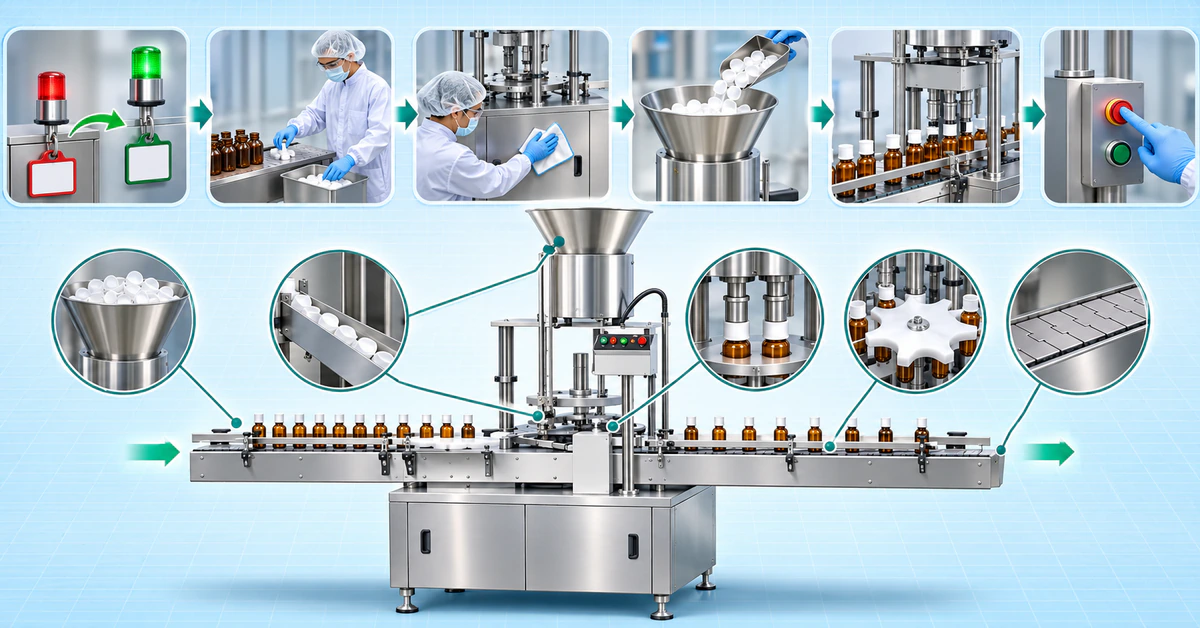
4.1.1.1 Remove the “TO BE CLEANED” label and affix the “UNDER CLEANING” label to the machine.
4.1.1.2 Ensure that no dosing cups from the previous batch remain in the machine.
4.1.1.3 Remove all good and rejected bottles and dosing cups from the area and the machine. Carry out the reconciliation. Destroy the rejected bottles and dosing cups.
4.1.1.4 Mop the entire machine with a clean lint-free cloth.
4.1.1.5 Attach the cleaned label to the machine.
4.1.1.6 Records: Record the details of machine cleaning in the equipment usage log book.
Under 21 CFR 211.182, a firm keeps a log of equipment cleaning and use. Each cleaning and batch end time is therefore entered in the equipment usage logbook.
4.2 Machine Setup and Operation of the Automatic Dosing Cap Pressing Machine
4.2.1 The machine consists of the following parts:
• Slat conveyor belt
• Bottle star plate for feeding and discharging
• Bottle guide
• Worm shaft assembly
• Feeder pressing heads
• Cap feeder with chute
4.2.1.1 Panelboard description of the automatic dosing cap pressing machine
4.2.1.2

4.2.1.3 Connect the Panel Board with the main plug.
4.2.1.4 Switch ‘ON’ the Main.
4.2.1.5 The Main ‘ON’ indication lamp should glow.
4.2.1.6 Press the main motor Inch push button. Only the main motor starts, at a low predetermined speed, and it runs while the button is held. When the Inch push button is released, the main motor stops.
4.2.1.7 Press the main motor start push button. The machine starts together with the conveyor.
4.2.1.8 Press the feeder motor inch push-button. The dosing cap hopper runs while the button is held.
4.2.1.9 Direction of rotation: the machine rotates clockwise, and bottles move from left to right.
4.2.2 Machine Set-Up
4.2.2.1 Ensure that the Dosing cap pressing machine is cleaned.
4.2.2.2 Fix change parts if required as per bottle size.
4.2.2.3 Adjust the height of cap hopper, chute track, and dosing cap pressing as per bottle size.
4.2.2.4 After line clearance from Quality Assurance (QA), attach the status label on the machine.
4.2.2.5 Record the activity in the equipment logbook.
4.2.3 Operation
4.2.3.1 Load the dosing cap in the cap hopper.
4.2.3.2 Switch ‘ON’ the machine.
4.2.3.3 Start the cap feeding machine for the continuous feeding of caps.
4.2.3.4 Place the filled and inspected bottles on the conveyor belt of the dosing cap pressing machine.
4.2.3.5 If the machine stops for a lunch break during the shift, leave no bottle on the conveyor belt.
4.2.3.6 After completion of operation, switch off the machine.
4.2.3.7 Affix the “TO BE CLEANED” label on the machine.
4.2.3.8 Enter the ending time of the batch in the Equipment Usages Logbook.
Related SOP: SOP on the Procedure for Packing Vials
Related SOP: SOP for the Cleaning, Operation of Labeling machine
Related SOP: SOP for operation of Automatic Filling and Sealing Machine
4.3 NOTE
4.3.1 Ensure that the oil level in the reduction gearbox is adequate.
4.3.2 Lubricate all moving parts daily. Use food-grade oil on parts that contact the product, and grease on closed parts.
4.3.3 Never start the machine in the reverse direction.
4.3.4 The speed of the machine can be varied.
5.0 Abbreviation (S)
SOP: Standard Operating Procedure.
No.: Number.
QA: Quality Assurance.
Frequently Asked Questions
The “UNDER CLEANING” label is affixed to the machine during cleaning, and it replaces the “TO BE CLEANED” label, which is removed from the machine first. After cleaning is complete, the cleaned label is attached to the machine, so the status of the machine is always clear to the operator.
All good and rejected bottles and dosing cups are removed from the area and the machine. The reconciliation is then carried out. After that, the rejected bottles and dosing cups are destroyed. This is done at batch change-over so that no previous-batch material remains with the machine.
The machine rotates clockwise, and the bottles move from left to right. It must never be started in the reverse direction. The speed of the machine can be varied, but the direction of rotation stays the same during operation.
If the machine stops for a lunch break during the shift, no bottle should be left on the conveyor belt, and the filled and inspected bottles are placed on the conveyor belt only during operation of the dosing cap pressing machine. The machine is switched off at the end of operation.
All moving parts are lubricated daily. Food-grade oil is used on parts that contact the product, and grease is used on closed parts. The oil level in the reduction gearbox must also be adequate. These points are listed in the note section of the procedure.
References
- Schedule M, CDSCO, Drugs Rules, 1945
- WHO GMP, World Health Organization
- 21 CFR 211.182, US Code of Federal Regulations (eCFR)

Naresh Bhakar is the Founder and Author at Pharmaguddu.com, bringing his extensive expertise in the field of pharmaceuticals to readers worldwide. He has experience in Pharma manufacturing and has worked with top Pharmaceuticals. He has rich knowledge and provides valuable insights and data through his articles and content on Pharmaguddu.com. For further inquiries or collaborations, please don’t hesitate to reach out via email at [email protected].