

GMP & Pharmaceutical Manufacturing Expert
✓ Reviewed by: Pankaj Sharma - Quality Control Specialist
Reviewed for Quality Control accuracy, laboratory practices, analytical methods, and technical relevance
📅 Last Updated: October 31, 2026
This SOP covers temperature, relative humidity (RH) and differential pressure. It tells Production staff how to read, record and act on room conditions. Temperature stays at 20°C to 25°C and RH at NMT (not more than) 50%. The Magnehelic gauge must read not less than +1.5 mm of the water column. Pressure deviations go to Engineering and QA.
1.0 Objective
To lay down a procedure for monitoring temperature, relative humidity, and differential pressure in the production area. This SOP on monitoring temperature, relative humidity, and differential pressure is a procedure that tells Production staff how to read, record and act on these three room conditions in the production area.
2.0 Scope
This procedure is applicable to the monitoring of temperature, relative humidity, and differential pressure in the production area.
3.0 Responsibility
These Production Department roles are responsible for carrying out the monitoring procedure in this SOP. Each role below has its own part in the procedure.
Officer, Executive – Production Department
Manager – Production Department
4.0 Procedure in the SOP on Monitoring Temperature, Relative Humidity, and Differential Pressure
This section explains how to record temperature, relative humidity and differential pressure. It also says what to do when a value goes out of limits. WHO GMP guidelines require measuring instruments to be calibrated at defined intervals. That is why steps 4.1.1 and 4.2.1 check the hygrometer and the Magnehelic gauge before use.
4.1 Recording of Temperature and relative humidity:
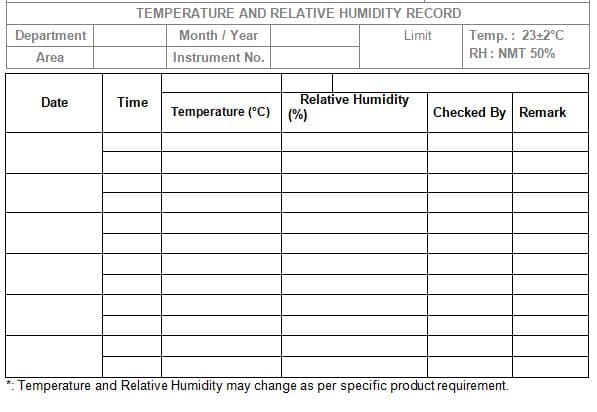
You record temperature and relative humidity with a calibrated hygrometer. Schedule M requires manufacturers to control and monitor temperature and humidity in production areas where they can affect product quality. This SOP sets the operating limits of 20°C to 25°C and NMT 50% RH.
4.1.1 Ensure that the hygrometer is calibrated.
4.1.2 Frequency: At the start of the shift, at the start of the activity, or at the end of the shift.
4.1.3 Limit of Temperature:
Operating Limit: 20°C to 25°C.
4.1.4 Limit of Relative Humidity:
Operating Limit: NMT 50%
Note: The limits of temperature and relative humidity may change as per the product requirement.
4.1.5 When the temperature or the relative humidity exceeds the operating limits, the responsible officer raises an intimation to the Engineering department. The officer also closes all the in-process material.
For example, cover the powder in the hopper of the compression machine with polybags.
4.1.6 When RH and temperature return, the officer monitors the temperature continuously until the observations are within limits. Operations then resume.
4.2 Recording of Differential Pressure:
The Magnehelic gauge of the concerned area shows the differential pressure. EU GMP (Chapter 3, Premises and Equipment) expects a pressure differential between rooms of different cleanliness classes. This keeps air flowing from the cleaner area to the less clean one. This SOP sets the minimum at +1.5 mm of the water column.
4.2.1 Ensure that the Magnehelic gauge of the concerned area is calibrated.
4.2.2 Ensure the zero error of the Magnehelic gauge by opening the door of the concerned area.
4.2.3 Production Officer shall ensure that all the doors are closed properly before recording the reading.
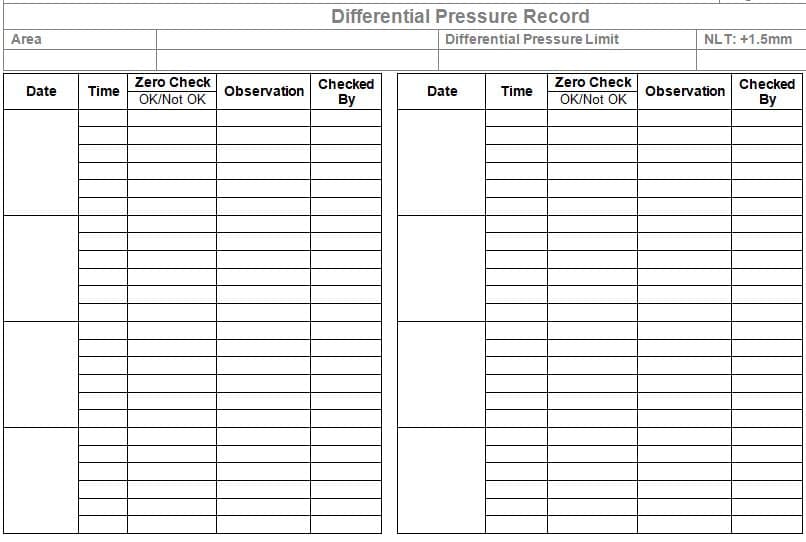
4.2.4 Check the Magnehelic gauge reading. Record it in the format shown in Annexure-II. The reading shall be not less than +1.5 mm of the water column.
4.2.5 If the differential pressure deviates, the production officer informs the Engineering department and the Quality Assurance department immediately. The activity is stopped.
4.2.6 The production officer or the concerned responsible person records the differential pressure reading.
4.2.7 Frequency: At the start of the shift, at the start of activity, after product change over, or twice in a shift, whichever is earlier.
See also: SOP for monitoring and recording critical environmental parameters of different classes and SOP on handling products during a power failure.
5.0 Abbreviation
These are the abbreviations used in this SOP. The list covers quality assurance and the degree Celsius.
QA: Quality assurance
°C: Degree Celsius
6.0 Annexure(s)
These two records go with this SOP. One records temperature and relative humidity, and the other records differential pressure.
Annexure-I: Temperature and Relative Humidity Record
Annexure-II: Differential Pressure Record.
Frequently Asked Questions
Record it at the start of the shift or at the start of activity. Also record it after product change over or twice in a shift, whichever is earlier. The production officer or the concerned responsible person records the differential pressure each time in the Differential Pressure Record (Annexure-II) used for this SOP.
Record them at the start of the shift, at the start of the activity, or at the end of the shift. Before recording, ensure that the hygrometer is calibrated. The values go into the Temperature and Relative Humidity Record. This record is Annexure-I of this SOP on monitoring temperature, relative humidity and differential pressure.
The production officer informs the Engineering department and the Quality Assurance department immediately. The activity is stopped. This protects the area. The SOP sets a minimum of +1.5 mm of the water column so that air flows from the cleaner area to the less clean one.
Schedule M requires manufacturers to control and monitor temperature and humidity where they can affect product quality. EU GMP (Chapter 3, Premises and Equipment) expects a pressure differential between rooms of different cleanliness classes. WHO GMP guidelines require measuring instruments to be calibrated at defined intervals, which is why the hygrometer and Magnehelic gauge are checked first.
References
- WHO GMP, World Health Organization
- Schedule M, CDSCO, Drugs Rules, 1945
- EU GMP, European Commission, EudraLex Volume 4

Naresh Bhakar is the Founder and Author at Pharmaguddu.com, bringing his extensive expertise in the field of pharmaceuticals to readers worldwide. He has experience in Pharma manufacturing and has worked with top Pharmaceuticals. He has rich knowledge and provides valuable insights and data through his articles and content on Pharmaguddu.com. For further inquiries or collaborations, please don’t hesitate to reach out via email at [email protected].