
GMP & Pharmaceutical Manufacturing Expert
✓ Reviewed by: Satpal Singh - Quality Assurance & Regulatory Specialist
Reviewed for GMP compliance, quality systems, and regulatory accuracy
📅 Last Updated: June 2, 2026
Packaging is an important part of pharmaceutical manufacturing. It protects the final product from alteration, external environment, physical, and barrier protection, which makes it safe to deliver it to last consumers. So, to achieve this, final product is enclosed in the form of blister, strips, carton, bottle, and pouches at different stages up to the final stage, where it is lastly packed into the corrugated box. But what are these stages we actually call in pharmaceutical terms? Let’s understand the difference between primary, secondary, and tertiary packaging in a easy way.
Difference between Primary, Secondary, and Tertiary Packaging:
1. Primary Packaging with examples:
Primary Packaging is that which directly comes into contact with drug product. for example: tablets (eg. Blister and strips), liquid syrup (eg, bottle), ointment (eg, aluminium tube), and injection (eg, ampoules and vials).
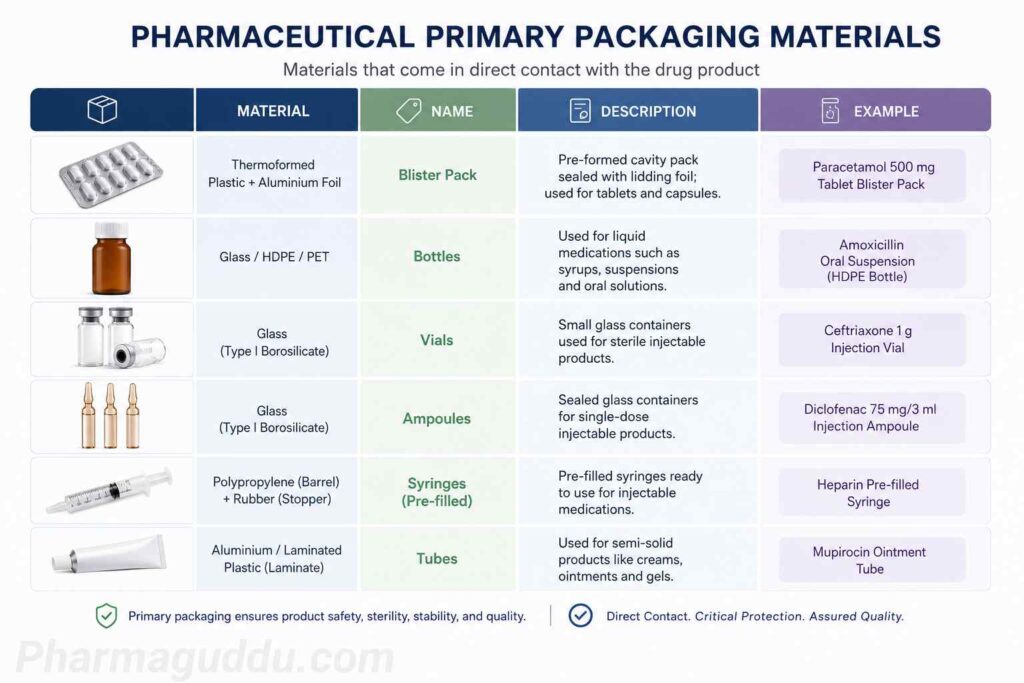
Examples of Primary packaging:
Blister/Strip Pack: In case of tablets/capsules, it is enclosed inside the PVC, PVDC, and Alu-Alu foil, the tablets and capsules are filled inside the thermofolded cavity using the lower thermo die roller, and sealed with the upper aluminium foil at the sealing heater.
- Bottle: A bottle pack is used to pack tablets, capsules, and syrups.
- Vials: Vials are made of glass and used to enclose the parenteral formulation.
- Ampules: These are single dose holder usally made of glass.
- Syringe: is made up of glass to fill the parenteral products.
- Tube: tube is made of glass, aluminium to fill the ointment, cream.
Related topic: SOP for Analysis and Release of Packing Materials
2. Secondary Packaging with examples:
Primary packaging was the first layer; now the second layer is the groupings of blister, strips, syrups, ointments, injection inside the printed cartons, plastic tray, shrink wrap, and corrugated boxes.
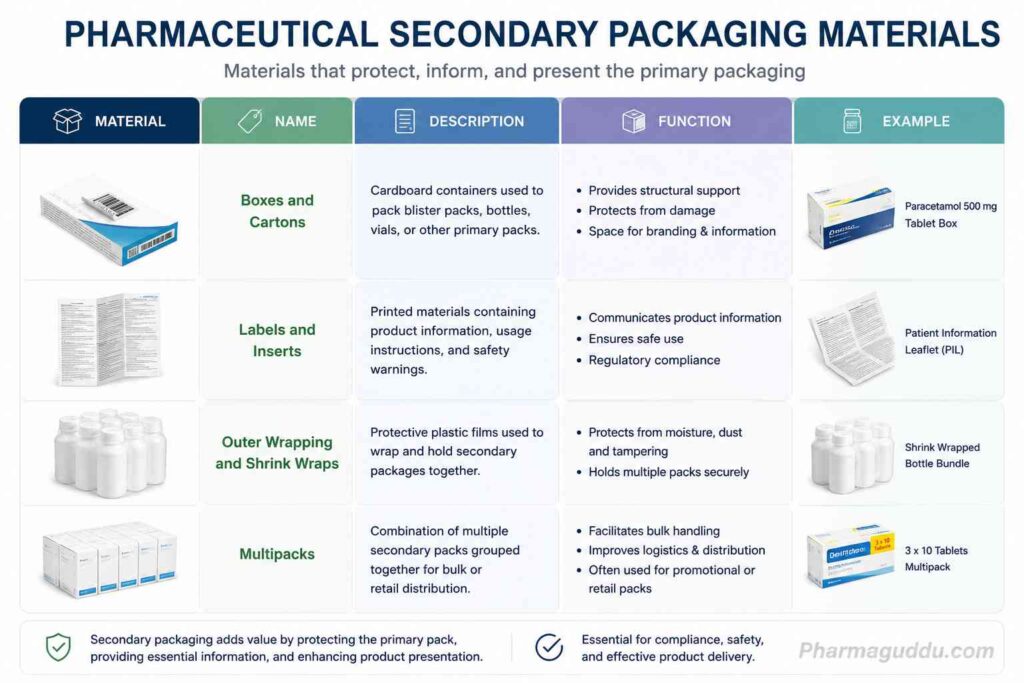
Examples of Secondary packaging:
- Printed monocarton/carton containing one bottle.
- Plastic tray.
- Package insert (leaflet).
Related Topic: Quality Control Test for Secondary Packing Materials
3. Tertiary Packaging and examples:
After Grouping of blisters, strips, bottles, and ampoules in a printed mono carton, next stage is tertiary packaging. It is also the same process of grouping printed mono cartons, and finally enclosed inside the corrugated box, shrink wrap, strapping, and placed on dedicated plates to transfer them to warehouse.
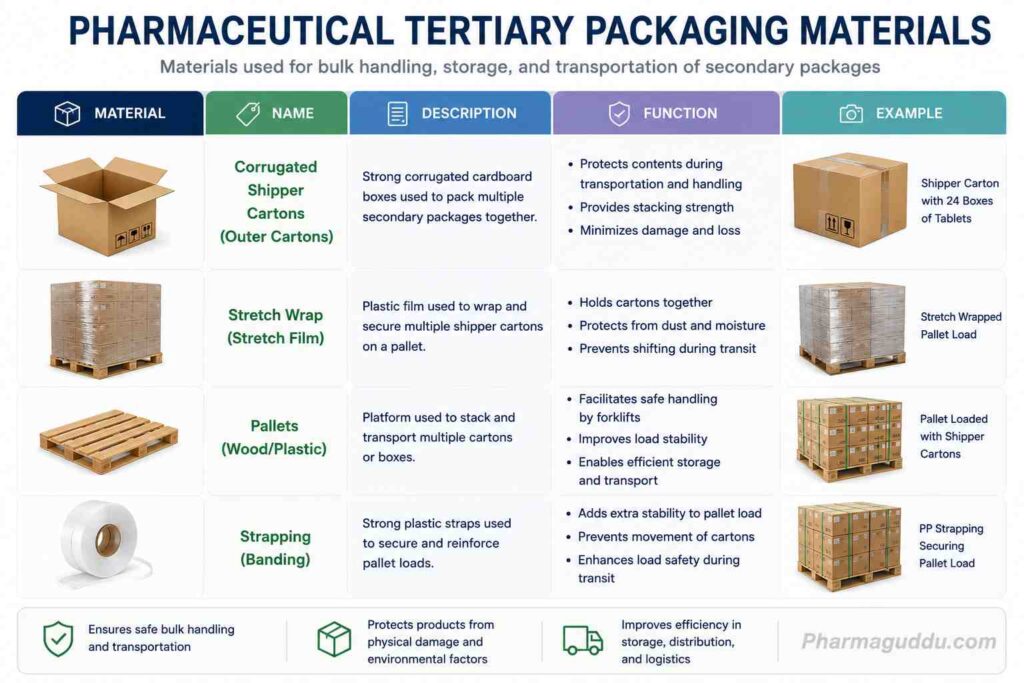
Tertiary Packaging examples:
- Corrugated shipper box containing multiple monocartons (e.g., 24 or 48 mono cartons)
- Stretch wrap
- Pallet
Regulatory Requirements for Pharmaceutical Packaging Materials
Following regulatory requirements should be considered for pharmaceutical packing materials:
FDA 21 CFR Part 211 states that containers and closures used for packaging must not be reactive, additive, or absorptive so that it not alters the safety, identity, strength, quality, or purity of the drug.
Stability studies performed under ICH Q1A(R2) conditions can help demonstrate whether the selected packaging provides proper protection from environmental factors, for example, moisture, light, temperature, and oxygen exposure, because they can affect the product quality. Refer to EMA ICH Q1A(R2) Guidelines.
USP Standards also describe it in chapters for elastomeric closures, glass containers, and plastic packaging systems.
USP standards, including USP <660> for glass containers, USP <661.2> for plastic packaging systems, and USP <382> for elastomeric closures, provide quality requirements for pharmaceutical packaging materials used to protect drug products throughout their shelf life.
What GMP says about pharmaceutical packaging materials:
Current Good Manufacturing Practices (cGMP) describes that all incoming packaging materials must be quarantined in a separate section labelled as “Under testing”. It should only be used if they passed and been approved by QC officer.
Storage Conditions: Materials must be stored in designated area with proper labels, under controlled temperature and humidity (depending on nature of product).
Related Topic: SOP on Receiving, Handling and Storage of Packaging Materials
Packaging material must have proper labelling, for example, (under testing, Approved, and Rejected) as per area GMP SOP or in-house SOP.
For packaging material standards, for Glass Containers, Plastic Packaging Systems, Elastomeric Closures, and Performance Testing Standards, refer to (https://www.usp.org).
Frequently Asked Questions (FAQs)
Answer: A corrugated box is a tertiary packaging. They are use for bulk handling, storage, and transportation. Main purpose of C. Box is to protect the secondary packages from physical damage, moisture, and environmental stress during distribution.
Answer: Yes, a monocarton (or folding carton) is comes under secondary packaging. Secondary packaging does not come into direct contact with the drug product. Instead, it encloses the primary packaging, such as a blister strip or glass vial.
Answer: The answer is Primary packing materials. For example, glass vials, ampoules, plastic bottles, blister pack foils (PVC/PVDC or aluminum), rubber stoppers, and dropper assemblies.
Related Articles around Pharmaceutical Packaging:

Naresh Bhakar is the Founder and Author at Pharmaguddu.com, bringing his extensive expertise in the field of pharmaceuticals to readers worldwide. He has experience in Pharma manufacturing and has worked with top Pharmaceuticals. He has rich knowledge and provides valuable insights and data through his articles and content on Pharmaguddu.com. For further inquiries or collaborations, please don’t hesitate to reach out via email at [email protected].