
GMP & Pharmaceutical Manufacturing Expert
✓ Reviewed by: Pankaj Sharma - Quality Control Specialist
Reviewed for Quality Control accuracy, laboratory practices, analytical methods, and technical relevance
📅 Last Updated: June 5, 2026
Pharmaceutical serialization is the process of assigning a unique identifier/code to each pack (strip, carton, shipper, and palletization) in the form of 2D DataMatrix barcode. It contains the product code, serial number, batch number, and expiry date. So the benefit is that now every pack is traceable from manufacturing to patient. In 2026, regulatory bodies made serialization mandatory to prevent from rising threat of substandard and falsified medicines; now they are focusing on enabling a track-and-trace system from manufacture to dispensation.
Key Takeaways
- As of May 2026, 26 markets have mandatory serialization in force, including the European Union (under EU FMD), the United States (under DSCSA), Russia, China, India, Japan, South Korea, Turkey, Saudi Arabia, UAE, and most CIS states.
- Full enforcement of DSCSA serialization for all prescription drugs is effective November 2024, ongoing in 2025–2026.
- Small dispensers with 25 or fewer employees have until November 27, 2026 per FDA exemptions.
- The global pharma track-and-trace solutions market is estimated at USD 2.5 billion in 2026, projected to reach USD 9.7 billion by 2035 at a 16.1% CAGR.
- The FDA has made clear that enforcement is no longer theoretical — warning letters and criminal indictments for DSCSA violations have been issued, with civil fines up to $500,000 per violation.
What Is Pharmaceutical Serialization?
Serialization means giving every single drug pack its own unique identity. Think of it like a national identity card for a medicine package — no two packs carry the same number.
The unique identifier typically contains four data points:
- GTIN (Global Trade Item Number) — product identity
- Serial number — unique to each individual pack
- Lot/batch number — production batch reference
- Expiry date — shelf life information
Every prescription drug package must carry a unique product identifier consisting of the National Drug Code, a unique serial number, the lot or batch number, and the expiration date, encoded in a 2D DataMatrix barcode.
Serialization is done using the long process that is called track and trace — the ability to follow a product through every step of the supply chain and verify its authenticity at any point.
Serialization in Pharmaceuticals: What does it do?
Serialization in pharmaceuticals involves tracing the product’s origin and batch details, like the Batch number and Expiration date, via the unique serial number from the manufacturer to consumers.
The manufacturer will produce a serial number for products and apply it to different batches via printing on labels and cartons with a barcode system. The manufacturer keeps all the records of these serial numbers for every batch after the manufacturing or packing of a product.
The units will then be tracked through their entire supply chain — from production to retail distribution to the ultimate dispensation to the patient. The DQSA mandates that every pharmaceutical sold within the USA should be serialized at each marketable unit level.
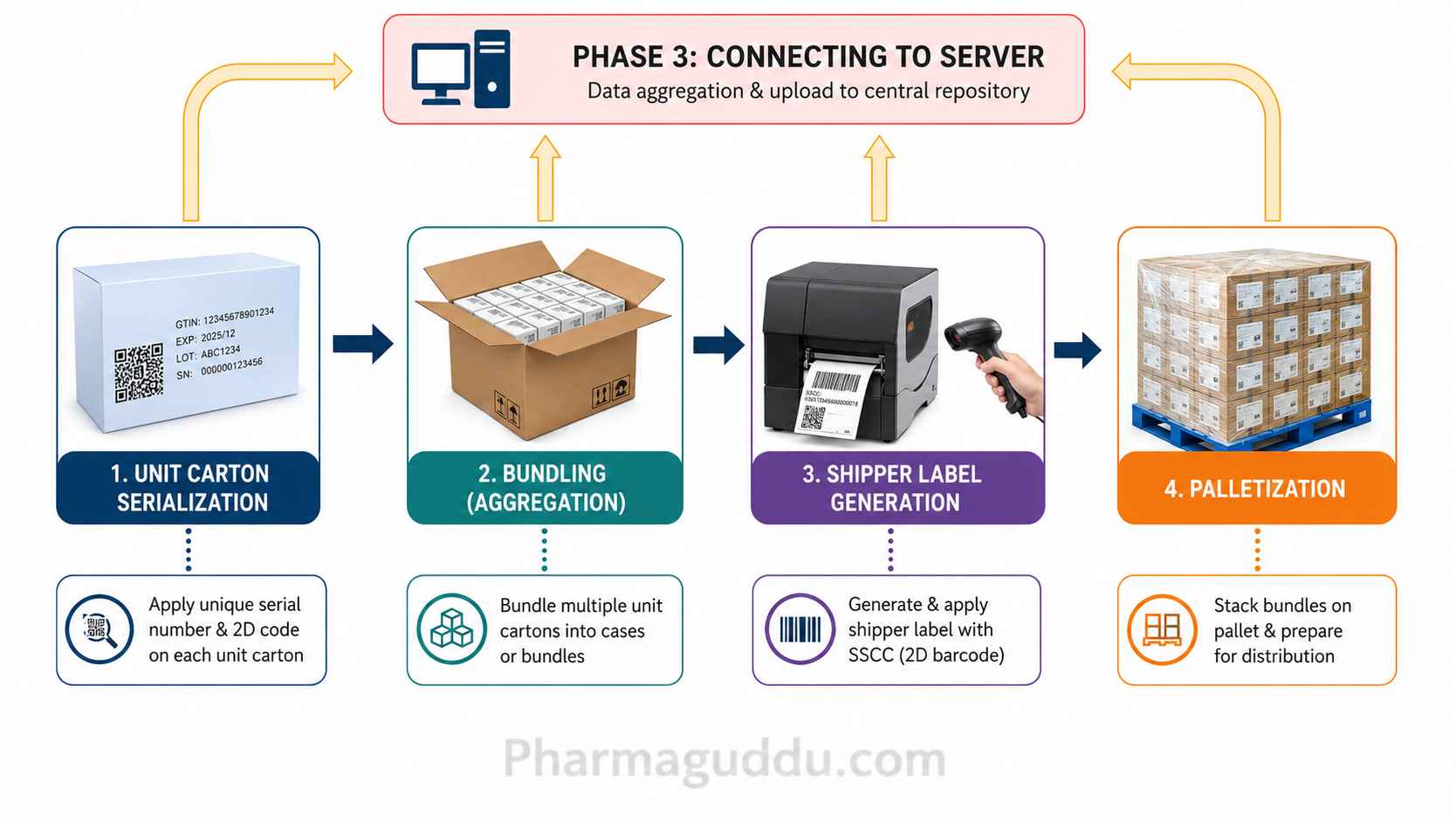
Serialization Process Flow Diagram:
What Is Aggregation in Serialization?
Aggregation is the very important steps in serialization process. It links each carton/monocarton serial numbers to the shipper or pallet they are packed in. So when a pallet moves, you know exactly which serialized packs are inside it — without scanning every single one.
But nodays, we can not say that it is mandatory for all market, but if you are exporting the drug, then you have to follow wharehousing and aggrigation process for better traceability. Regulations like DSCSA and EU FMD wrote about it.
Why Serialization Matters in 2026
Counterfeit Medicines Are a Real Problem
Counterfeit pharmaceuticals are a growing global crisis, responsible for thousands of deaths annually. These fake and illegitimate drugs often contain incorrect ingredients, improper dosages, or toxic substances, endangering patients and healthcare systems.
So Serialization is most important process to stop it. regulators have to stop counterfeits from entering the legitimate supply chain. A pharmacist scanning a pack at the point of dispense can confirm in real time whether the product is authentic — or flag it as suspicious.
Regulatory Enforcement Is Tightening
The updates comes into play November 2024, mean that all prescription drugs will have a fully interoperable electronic tracking system by 2025. These changes make it possible to track and verify all prescription products available in the U.S. market. This helps to prevent counterfeit and mislabeled drugs.
As of early 2026, the EMVS links more than 2,900 Marketing Authorisation Holders, 4,000+ wholesale distributors, 115,000+ commercial pharmacies and 6,000+ hospital pharmacies in Europe.
This isn’t just compliance anymore. This is a real-time interconnected verification network.
Step-by-Step: How Pharmaceutical Serialization Works
Step 1: Generate Serial Numbers
The starting process is to generate serial number, Serial numbers are generated by the manufacturer or a third-party serialization software platform. They must be unique, randomized, and follow GS1 standards. No two packs — ever — should carry the same serial number for the same product.
Step 2: Print and Apply the 2D DataMatrix Code
The unique identifier is printed as a 2D DataMatrix barcode directly on the packing box (cartons). The barcode encodes the GTIN, serial number, batch/lot number, and expiry date. Tract and trace system Vision camera on the packaging line verify that every code is legible and correctly encoded before the pack proceeds.
Step 3: Linking the Serial Number
This stage links the printed serial number to the specific pack and recording it in the serialization system. From this point, the pack officially “exists” in the track-and-trace database.
Step 4: Aggregation
This is most important steps for serialization process. Now, Each barcode encodes carton/packs is manually varified and match with the track system software, at last Every carton aggregate into linked shipper case, and after that, and the shipper to the pallet (pallet-level SSCC). This creates a parent-child relationship in the data — scan the pallet and you know what is inside.
Step 5: Upload to the National Repository
In Europe: Upload pack data (GTIN, SN, LOT, EXP) to the European Medicines Verification System (EMVS) via your National Medicines Verification System (NMVS) before the product reaches market.
In the US: Exchange serialized transaction data (Transaction Information, Transaction History, Transaction Statement — T3 data) with trading partners electronically via EPCIS.
Step 6: Exchange EPCIS Events with Trading Partners
Many companies use EPCIS XML or JSON messages to transmit data. Test connections with all your major trading partners. Where possible, join established networks or use provider services that connect to multiple parties to avoid building one-to-one connections with every customer.
Step 7: Verify at the Point of Dispense
Under EU FMD: The pharmacist scans the pack before dispensing to the patient. The EMVS confirms the code is authentic and active — then decommissions (marks as dispensed).
Under DSCSA: When a product is returned or flagged as suspect, trading partners verify it via the Verification Router Service (VRS). When a product is suspect, illegitimate, or being processed as a saleable return, the trading partner must verify its product identifier against the manufacturer or repackager, typically through a Verification Router Service
Risk Framework: What Can Go Wrong with serilization process
Risk 1: Mismatching to linked shpper
Sometimes, the printed carton on which the serial numbers are printed can lead to mix-ups. For example, when we are collecting cartons inside linked shipper, a carton may accidentally get placed into the rejection bin. If proper attention is not given, we may place the carton that is linked to next shipper into same shipper. that can lead to unmatched data, so it is necessary to keep eyes on track system data and do match each filled carton’s serialized number with track and trace software-generated data.
Risk 2: EMVS Upload Failure
In Europe, you have to upload pack data to the EMVS before a product is sent to market. If you don’t, pharmacies will fail to verify the pack. Pharmacies will then either reject the product or notify the NMVS. Failing to upload pack data due to issues with the internet, data format, or issues with the system, can lead to an entire product batch being unverifiable at the point of dispense.
Risk 3: Poor Barcode Print Quality
If the barcode on your product cannot be scanned, then you might as well have no barcode at all. The GTIN, batch, and serial data all come from different systems (e.g. SAP, MES, and a serialization database). It is important to maintain the integrity of data across all systems and validate all relevant systems. This is especially important for packaging lines.
Risk 4: Trading Partner Connectivity Gaps
DSCSA requires a business to be able to send EPCIS data to all trading partners. If a trading partner is not able to receive EPCIS data, then a business cannot send product to that trading partner. The FDA expects a business to have their systems ready to facilitate electronic data by 2025. If you have data errors or an outage, you should implement your contingency plan. However, you should not revert to paper-based systems.
Risk 5: Non-Compliance in New Markets
Africa’s regulations differ greatly from country to country, and manufacturers will need to track guidelines, pilots, and enforcement dates for each individual country. If you enter a new market without checking the serialization requirements, you can face rejected shipments, the inability to access the market, or monetary fines.
Common Mistakes in Pharmaceutical Serialization
These mistakes are seen repeatedly during serialization audits and inspections:
Not validating the camera vision system — As per the Protocols, we do the Qualification, validation but not planned for revalidation on due date, this can lead to problem.
Skipping aggregation data quality checks — Aggregating packs into shipper cases without checking that all the pack serial numbers have been successfully commissioned. Incomplete commissioning translates to incorrect aggregation data. so to prevent this, instruct to varify it manually after filling of each shipper case.
Thinking of serialization as just an IT project — Serialization impacts Quality, Packaging, Regulatory, Supply Chain, and IT. Projects that are solely handled by IT and do not include QA in the process validation stage invariably fail.
Not modifying the EMVS after batch recalls — When a batch is recalled, the data of the serialized packs in the EMVS must be updated to show that the packs are now decommissioned. Otherwise, the recalled codes in the EMVS will still be “active.”
No exception handling SOP — Sometime, carry out serialization without thinking of what to do when a pack fails verification. This creates disorder at inspection.
Disregarding xEVMPD and correct product master data — Incorrect product registration data will result in a barcode that will not match at verification and thus will fail verification at the pharmacy level.
Case Study: A Manufacturer Faces DSCSA Enforcement — What Happened
Background
This US-based mid-size generic drug manufacturer had been shipping serialized product since 2017. The company thought that it was in compliance. In late 2024, the FDA released guidance on full interoperable electronic data exchange, and the manufacturer came to find that it was still using PDFs and email to exchange transaction data – not EPCIS.
The Problem
The manufacturer was notified by several large wholesale customers including a major distributor that they would not accept shipments without the T3 data in EPCIS format from January 2025 onwards. Some large distributors had self-imposed accelerated timelines, with letters to all partners mandating interoperability, and threatening to reject shipments without matching EPCIS data.
Immediate Actions Taken
Immediately, QA and IT was informed and a cross functional team was put together. An emergency gap analysis was conducted with respect to DSCSA EPCIS requirements. A third party serialization platform was expedited. The top 10 trading partners were on boarded first.
Root Cause
The manufacturer had some serialization in place (barcode printing and lot tracking) but never developed the electronic data exchange. The original serialization project was viewed as a compliance project for packaging, rather than a project involving data for the supply chain.
Corrective and Preventive Actions.
- The existing serialization software was integrated with event generation of EPCIS.
- EPCIS 2.0 was chosen because it supports both XML and JSON-LD format.
- All trading partners were mapped and connectivity tested prior to go live.
- An SOP for continuous monitoring was developed to prevent failures in data exchange prior to shipment.
- An annual DSCSA compliance review was included in the quality calendar
Outcome
After six months, full EPCIS connectivity with the major trading partners was established. No warning letters received. With the November 2026 implementation date for small dispensers now behind the manufacturer is ready to proactively handle future regulations.
Lesson Learned
Serialization is more than just an application of a barcode on a box. The information associated with the code needs to be passed electronically across the entire supply chain. The most frequent reason manufacturers lag behind is because they treat it as packaging or labeling project and not as a supply chain data project.
Read Also: ICH Guidelines in Pharmaceutical
FAQs: Serialization in Pharmaceutical
Answer: Serialization is the unique identification number assigned to each pack of cartons and bottles. A globally unique number is assigned to each batch of finished products in the form of a two-dimensional code known as a Datamatrix.
Answer: The track system makes it easy to understand the location of any product items, and Trace is used to understand the history of products that come in contact with the item in the supply chain.
Answer: The track and trace system can determine the current and past location of unique items. In response to an increase in the number of recalled products from the market, the track and trace system is employed in the pharmaceutical, which is good in traceability through radio frequency identification and barcode.
Answer: RFID is radio frequency identification, a new technic is a part of supply chain management in international pharmaceutical production and distribution. RFID is employed to counterfeit drug products, which are highly challenging for the government, pharmaceutical companies, clinical, and patients.
Answer: The Global Location Number (GLN) identifies the nation of origin. Serial Number is a unique identifier for each product under the specific GTIN (Global Trade Item Number) to identify the kind of product. Lot information is used to distinguish across manufacturer-specific batches of items from the same production run.
Answer: For manufacturers and repackagers, DSCSA enforcement is slated to begin May 27, 2025, while wholesale distributors are set to be hit Aug. 27, 2025, and dispensers with 26 or more employees are to be hit Nov. 27, 2025, and dispensers with 25 or fewer employees are to be hit Nov. 27, 2026. 100% of the electronic exchange of EPCIS data must be interoperable with all trading partners. Warning Letters and civil fines have been issued by FDA for non-compliance. All entities should verify that they are indeed using EPCIS for the exchange of transaction information – not PDFs or spreadsheets.
Answer: DSCSA emphasizes “transactional trace”, which means that transaction information needs to be electronically shared among authorized trading partners but not necessarily scanned at dispensing. EU FMD adopts a model of “point-of-dispense verification” of each pack dispensed by the pharmacy. EU FMD has a centralized EMVS repository, DSCSA has a decentralized model with the Verification Router Service (VRS). They both need four pieces of data in the 2D barcode: product code, serial number, lot, and expiry.
Answer: The Verification Router Service (VRS) is a network that has been developed by industry to route product verification requests to the appropriate manufacturer or repackager database. If a product is suspect of being illegitimate or it is being used as a saleable return, then the trading partner needs to evaluate the product identifier with the manufacturer or repackager, usually via a Verification Router Service. VRS connectivity is required in case of investigating a suspect product or saleable return. Any DSCSA compliant serialization platform now requires built-in VRS integration.
Answer: Serial numbers are created by the manufacturers or MAHs and unique ID data (GTIN, SN, LOT, EXP) for each pack are uploaded by the manufacturer’s or MAH’s National Medicines Verification System (NMVS) to the EMVS. All valid codes are listed in the “master list” of codes included in the EMVS. The product is scanned by the pharmacy and the NMVS verifies the code with the EMVS. If the code is valid it is dispensed (marked as decommissioned). If already dispensed, suspect or not found, an alert is generated.
Answer: Aggregation involves associating individual serialized packs to the case or pallet that they are in. Aggregation is not a legal requirement of DSCSA or EU FMD. Where possible, though, where a distributor or wholesaler is involved, it is preferable to be part of an existing network or work with a provider that serves multiple parties rather than set up one-to-one connections with each customer, and most large distributors and wholesalers require aggregation data for receiving and warehouse operations. For goods receipt, if there is no aggregation, there is no other way. In practice, aggregation is a business requirement and not necessarily a legal requirement.
Answer: The FDA has sent warning letters and criminal indictments for DSCSA violations, civil fines can reach $500,000 per infraction and intentional violations could be criminal. In addition to federal fines, late submissions may lead to regulatory fines, pharmacy and retailer rejection of shipments, and loss of trading partner trust. The FDA has stated that its enforcement is not hypothetical, but real. Businesses that are unable to show that they are capable of full electronic, interoperable data exchange risk enforcement action.
Answer: You have to deal with a serialization deviation the same way you deal with any deviation with your standard deviation process. Immediately quarantine the affected batch. Determine scope: which packs are affected, which serial numbers were either incorrectly applied, or were not uploaded. Inform QA and raise Deviation Report. Identify the cause of the incident, such as a system failure, people error or integration gap. Determine if the batch can be corrected e.g., relabelled with the correct codes, re uploaded to EMVS/EPCIS, or it needs to be destroyed. Record all actions, decisions and CAPA in batch record and deviation log.
Answer: Before a serialization inspection ensure the following: All packaging lines are qualified and have current vision systems with calibration records; have documented/validated serial number generation procedures; have complete and retrievable EPCIS transaction data exchange logs; have exception handling SOPs and staff is trained; have complete EMVS upload history for all batches (EU); and have active and tested VRS connectivity (US); and have all serialization deviations investigated and closed. Never use paper systems — FDA expects electronic systems to be in place. Check the previous 12 months’ exception reports prior to the inspection.
Summary
For pharmaceutical companies, serialization is no longer a future project, but is a current legal requirement in 26 markets. DSCSA full electronic interoperability is enforced in the US. EMVS is in operation in the EU with more than 2,900 MAHs and 115,000 pharmacies registered. In 2026, the last date is November 27 for small dispensers in the US.
It’s obvious that the change in 2026 means serialization is transforming from a compliance action to a data infrastructure asset. Serialization data is used for the development of AI, IoT, and digital products. Businesses that have designed their solutions correctly — validated, linked, and maintained — are set to gain. Firms that viewed it as a ‘box-ticking exercise’ are now subject to enforcement.
The key actions for 2026:
- Ensure EPCIS data exchange is in production and tested with all key trading partners
- Confirm that your EMVS upload process ensures that all EU markets you supply are included.
- Verify Vision Systems and create documentation
- Impart training to your staff on protocols to follow during an exception.
- Keep an eye on evolving market demands, especially in Asia, the Middle East, and Africa, where regulation is growing.

Naresh Bhakar is the Founder and Author at Pharmaguddu.com, bringing his extensive expertise in the field of pharmaceuticals to readers worldwide. He has experience in Pharma manufacturing and has worked with top Pharmaceuticals. He has rich knowledge and provides valuable insights and data through his articles and content on Pharmaguddu.com. For further inquiries or collaborations, please don’t hesitate to reach out via email at [email protected].
Serialization will do wonders in alleviating the growth of counterfeit drug market. Thanks for sharing.