
Quality Control Specialist | Industry Experience
✓ Reviewed by: Pankaj Sharma - Quality Control Specialist
Reviewed for Quality Control accuracy, laboratory practices, analytical methods, and technical relevance
📅 Last Updated: October 11, 2026
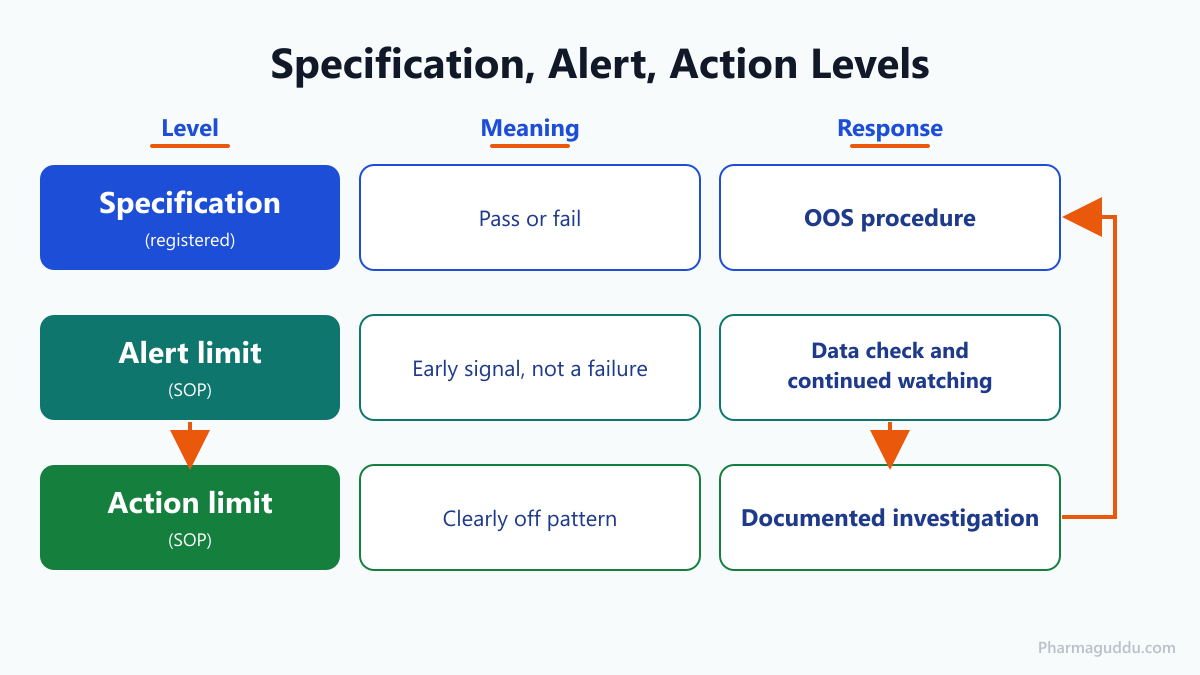
The alert limit vs action limit OOT question comes down to how much attention a result needs. An alert limit is an early-warning level. A result past it gets a data check and closer watching. An action limit is a wider level. A result past it starts a documented investigation. Both are internal control levels written in your SOP. Neither is the registered specification. A result outside the specification is OOS and follows the OOS procedure. Fix all levels in writing before you review any data.
What Are Alert and Action Limits in OOT Trending?
Out-of-Trend (OOT) means a result that is still within specification but breaks the usual pattern. Alert and action limits are the internal control levels (also called trending limits) that tell you how far off pattern it is. The specification is the registered limit that decides pass or fail.
Think of a car dashboard. A yellow light says “check this soon”. A red light says “stop now”. Your alert limit is the yellow light, and your action limit is the red one.
In stability work, these limits are usually bands around the expected trend, such as prediction intervals. They are not fixed values just inside the specification. Near the end of shelf life, a band can even reach the specification limit.
Related topic: out of trend (oot) results in pharmaceutical quality control
Alert Limit vs Action Limit OOT: What Does Each Level Trigger?
Each level needs a clear trigger in the SOP. Without it, two analysts will react differently to the same result.
| Level | Set by | What it means | What it triggers |
|---|---|---|---|
| Specification | Registered (regulatory filing) | Pass or fail | OOS procedure |
| Alert limit | Your SOP | Early signal, not a failure | Data check and continued watching |
| Action limit | Your SOP | Clearly off pattern | Documented investigation |
At the alert level, check the calculation, peak integration, transcription, system suitability and sample handling. Then keep watching the next time points.
At the action level, start a documented laboratory investigation (phase I). Move to phase II only if phase I finds no laboratory cause. Never test into compliance, and never retest without a written justification.
When a result crosses the specification, the OOS procedure takes over. See OOT vs OOS in pharma for the difference. Do not average an OOT result or discard it without an assignable cause. Call a result “invalid” only when you can name that cause.
How Do You Set Limits for Each Attribute?
Limits take the form expected value ± k × s, where s is the spread of historical data. The k factor depends on the method and the confidence you choose, so your SOP must state it. According to a 2025 ISPE article, 95% confidence is the usual convention.
Each attribute behaves differently:
- Assay: usually falls slowly, so use a two-sided band. An unexpected rise is also odd.
- Degradants and impurities: they grow over time, so an upper (one-sided) limit matters most.
- Dissolution: a drop is the worry, so a lower limit is often the focus.
- Water content: it may rise in permeable packs, so watch the upper side.
Don’t confuse these with in-process limits. One company’s batch record for a 500 mg tablet uses fixed weight tiers: alert ±2.5%, action ±4%, limit ±5% of target. That is a fixed percentage, not a statistical band. Environmental monitoring also has its own alert and action levels, based on microbial counts.
What Does a Worked Example Look Like?
This example is illustrative only. It is not a regulatory requirement. Suppose assay has a specification of 95–105%. At 18 months, history gives a 95% prediction band of 97.6–99.2% (alert). Assume a 99% band of 97.2–99.6% (action).
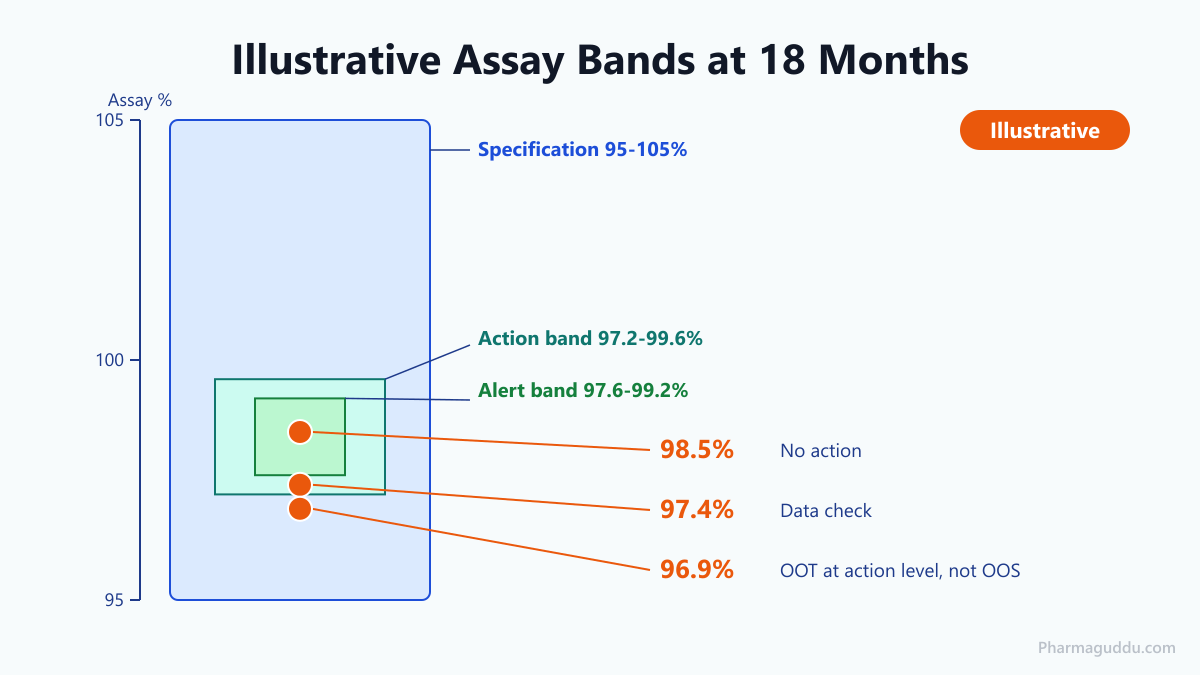
A result of 98.5% sits inside both bands, so you do nothing. A result of 97.4% is below the alert band but above the action band, so you run the data check. A result of 96.9% is below both bands but still inside 95–105%. That is OOT at the action level, not OOS.
How Much Data Do You Need Before Using the Limits?
You need a suitable reference data set, enough data points and a model that fits normal degradation, linear or non-linear. Your SOP should state the minimum number of batches and time points required before limits are used.
For a new product with one or two batches, treat limits as provisional. Review them as more batch data arrive, and after method or process changes.
What Should the SOP Say About Limits?
Fix the limits before data review. Setting them afterwards invites bias. Follow these steps:
- Name the trigger method and the k factor or confidence level.
- State who reviews an alert breach, within what time, and what record is kept.
- State the closure criterion and check the history, such as earlier flags for the same attribute. Environmental-monitoring CPAR forms use this idea, so treat it as an analogy.
- Set the deviation, CAPA and shelf-life review thresholds. See CAPA in pharma.
- Approve the limits, and use change control for every revision.
Spreadsheets and statistical software need validation. Apply ALCOA+ data integrity controls, including an audit trail.
Industry Standards and Regulatory Requirements
No regulator publishes numeric OOT trigger values. A 2025 ISPE article reports that FDA’s OOS guidance expects OOT handling to be scientifically justified but gives no method. So your SOP must define it.
Recent Technology Trends
The research found no dated software or equipment change specific to alert and action limits. The April 2025 ISPE article in Pharmaceutical Engineering shows that practice is still SOP-defined and statistics-based, using regression, by-time-point and slope methods. For the methods, see statistical methods to identify OOT.
Common Problems and Troubleshooting
Too many flags:
Possible causes: bands too narrow, a confidence interval used instead of a prediction interval, or high method variability.
Corrective actions: review the interval type and the data set under change control.
Limits copied from another product:
Possible causes: no product-specific degradation data.
Corrective actions: derive limits from that product’s own batches.
Alert breaches ignored:
Possible causes: no named reviewer or time limit.
Corrective actions: add responsible person, timeline and record to the SOP.
Frequently Asked Questions
No. Specifications are registered acceptance criteria that decide pass or fail. Alert and action limits are internal trending levels that describe the expected pattern. They give early warning before a specification is at risk.
No regulator publishes numeric OOT trigger values. Companies must define the identification method in their own SOP, with a scientific justification, before data generation begins.
Yes. An OOT result can sit inside the specification while breaking the trend. It still needs a documented investigation. Only a result outside the specification becomes OOS.
Not automatically. An alert breach is an early signal that needs a data check. Your SOP should say when a breach becomes a deviation, usually at the action level.
Summary
Alert limits give you an early look, and action limits start a formal investigation. Specifications still decide pass or fail. Write all three in the SOP before you see the data. Then your team reacts the same way every time.
References
- Identifying Out-of-Trend Data in Stability Studies, ISPE Pharmaceutical Engineering, 2025
- Methods for Identifying Out-of-Trend Results in Ongoing Stability Data, Pharmaceutical Technology
- What is an alert limit and what happens when it is exceeded, GMP Compliance Adviser
- What is an action limit and what happens when it is exceeded, GMP Compliance Adviser
- LAMISTAR 30 bmr, owner library

Pankaj Sharma — Quality Control Specialist
Pankaj Sharma is a pharmaceutical QC professional who reviews our technical content for GMP accuracy, laboratory practices, and regulatory relevance.