
GMP & Pharmaceutical Manufacturing Expert
✓ Reviewed by: Pankaj Sharma - Quality Control Specialist
Reviewed for Quality Control accuracy, laboratory practices, analytical methods, and technical relevance
📅 Last Updated: July 21, 2026
Water system validation is the process pharmaceutical manufacturers use to prove — on paper, with data — that a purified water (PW) or water for injection (WFI) system reliably produces water that meets defined quality specs. It’s not optional. FDA 21 CFR, EU GMP, WHO GMP, and PIC/S guidelines all require it, because the stakes are product quality and patient safety.
The process runs through three sequential phases — Phase I, Phase II, and Phase III — and takes a minimum of one year from start to finish. Underpinning all of it are four qualification activities: Design Qualification (DQ), Installation Qualification (IQ), Operational Qualification (OQ), and Performance Qualification (PQ). Throughout each phase, sampling, microbial testing, and chemical analysis happen at set frequencies and defined locations.
Related: 4 Types Process Validation, Pharmaceutical
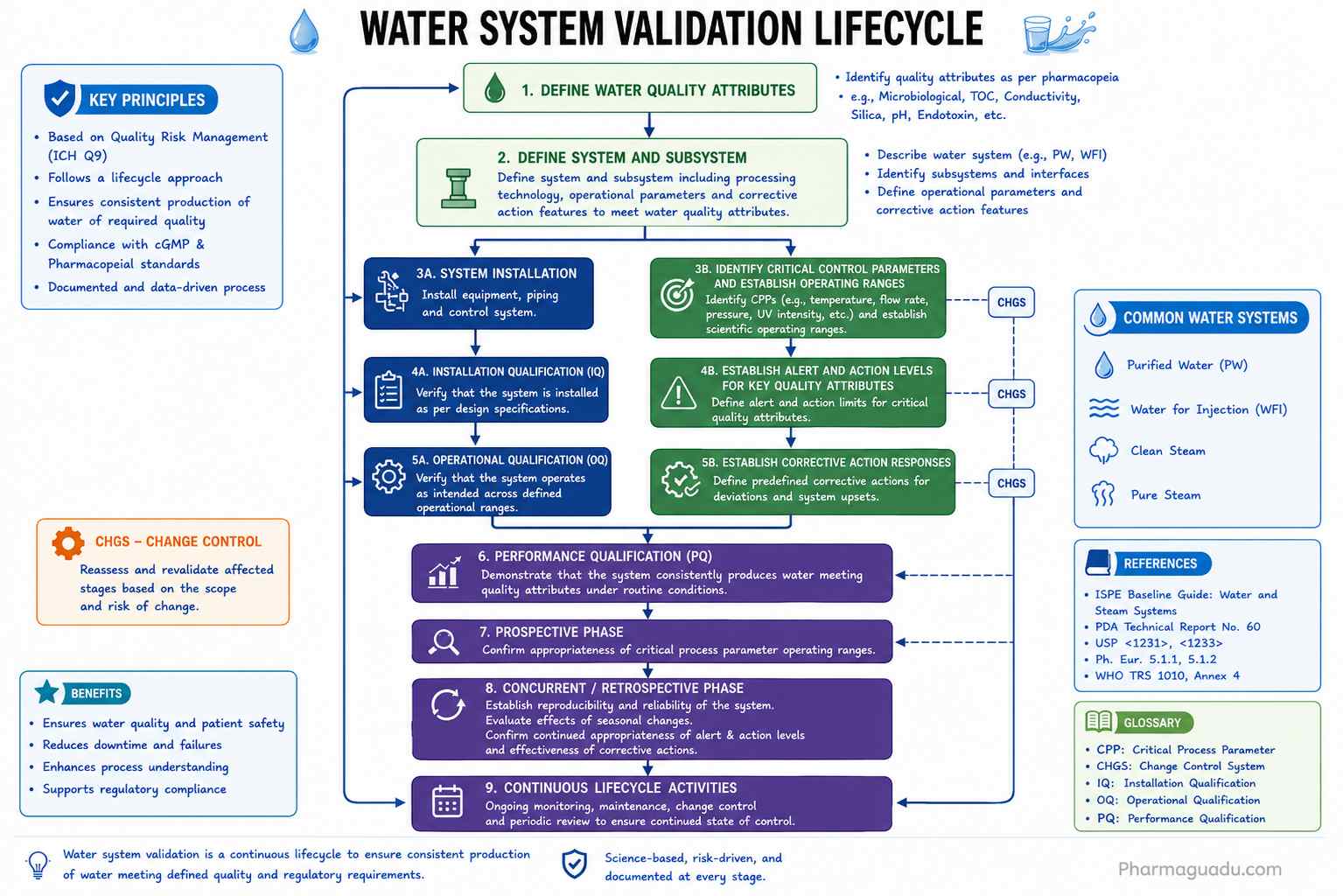
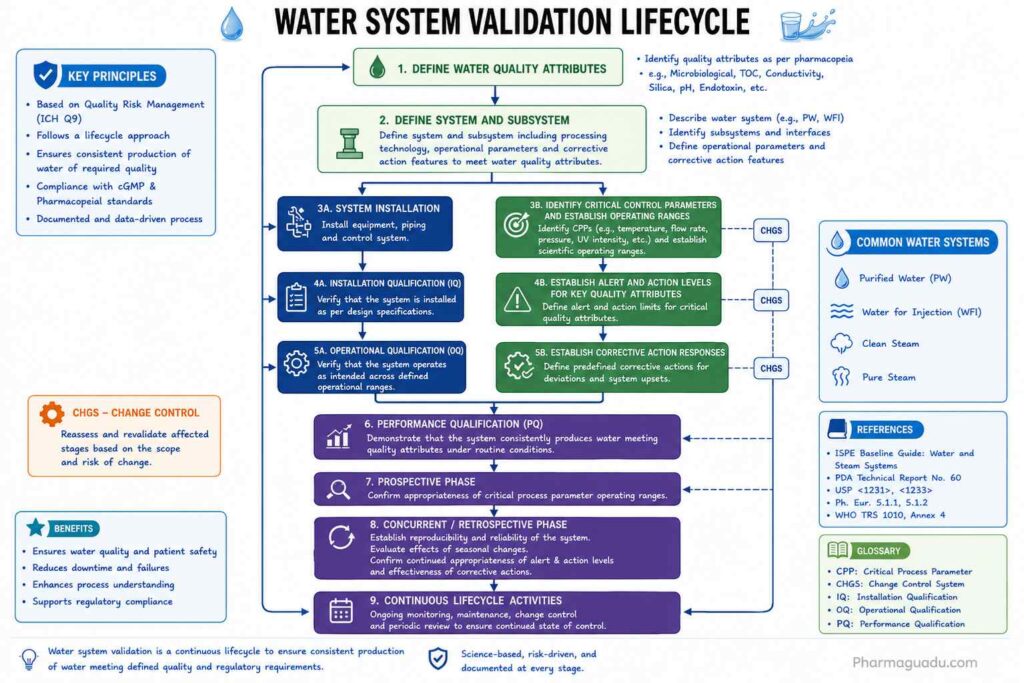
Water System Validation Lifecycle:
What Is Water System Validation in Pharmaceutical Manufacturing?
Water system validation is basically the paper trail that proves your pharmaceutical water system actually does what it’s supposed to do — consistently, reliably, every time. It covers everything from how the system was designed and installed to how it performs day in, day out.
Here’s why it matters: in a GMP facility, water isn’t just water. It’s classified as a raw material. It goes into product formulations, gets used to clean equipment, runs through analytical testing, and plays a central role in sterile manufacturing. That’s a lot of places for things to go wrong.
And because water quality ties directly to drug quality and patient safety, regulators around the world don’t leave this to chance. Formal validation is required before any of these systems can be used in production.
3 Types of Water System Validation
- Water System Validation Phase 1
- Water System Validation Phase 2
- Water System Validation Phase 3
Water System Validation Phases: Phase I, Phase II, and Phase III
The three-phase approach to water system validation is the gold standard in pharmaceutical manufacturing. It comes from the FDA Guide to Inspections of High Purity Water Systems and gets referenced in both WHO TRS 929 and the ISPE Baseline Guide for Water and Steam Systems.
Together, the three phases run for at least a year — long enough to catch how the system behaves through seasonal shifts, maintenance windows, and whatever production throws at it.
Phase I: Initial Validation (2–4 Weeks Intensive Sampling)
Phase I kicks off right after IQ and OQ wrap up successfully. It’s an intensive stretch of sampling and testing with one goal: prove the system produces compliant water before anyone uses it in manufacturing.
Phase I Objectives
- Confirm the system consistently produces water meeting all specifications
- Establish microbiological and chemical baseline data
- Demonstrate that the sanitization cycle effectively controls microbial levels
- Generate data for alert and action limit setting
Phase I Sampling Plan
- Duration: minimum 2 to 4 weeks of daily sampling
- Sampling locations: all use points, all return line points, post-generation (pre-storage) sample
- Frequency: daily sampling from all points
- Tests: TOC, conductivity, microbial count, pH, visual clarity
- For WFI systems: endotoxin testing at all use points
Phase I is validation only — no production. You can’t start manufacturing until the data is reviewed, everything meets spec, and Phase I is formally closed.
Phase I Acceptance Criteria
- All TOC results: NMT 500 ppb
- Conductivity: NMT 1.3 µS/cm at 25°C
- Microbial count: within alert and action limits for all samples
- No systematic OOS results without documented investigation
- Sanitization cycles: confirmed effective with no post-sanitization exceedances
Related Topic: Cleaning Validation Protocol for Pharmaceutical Equipment
Phase II: Extended Monitoring (Additional 2–4 Weeks to Several Months)
Phase II stretches the monitoring window and opens the system up for manufacturing — under restricted conditions. Sampling stays intensive, just not quite as relentless as Phase I. The point is to validate performance under real production conditions, not a controlled test environment.
Phase II Objectives
- Confirm continued system compliance during production activities
- Evaluate system performance under varying operational loads
- Continue building the microbiological trend database
- Confirm sanitization effectiveness under production use conditions
- Identify any variation in water quality related to production activity
- Phase II Sampling Plan
- Duration: typically 4 to 8 additional weeks (facility-defined based on risk)
- Sampling locations: all use points and return lines (same as Phase I)
- Frequency: daily or every other day depending on SOP and risk assessment
- Tests: TOC, conductivity, microbial count, endotoxin (WFI)
- Water is now used in manufacturing, but results continue to be reviewed before release
Phase II Acceptance Criteria
The same chemical and microbiological limits from Phase I carry over. On top of that, Phase II can’t close with unresolved deviations or unexplained OOS results sitting on the table. Anything that comes up needs a full investigation, documented with a CAPA, before you move forward.
Phase III: Long-Term Routine Monitoring (Ongoing After Validation)
Phase III is what the system lives in for the rest of its operational life. Once Phases I and II are done, this is the normal monitoring program — continuous, ongoing, indefinite.
Phase III Objectives
- Maintain the validated state of the water system
- Detect any trend toward OOS results before exceedances occur
- Capture seasonal variability in source water and microbial loading
- Provide data for periodic review and revalidation decisions
Phase III Sampling Plan
- Duration: continuous, ongoing throughout system operational life
- Sampling frequency: reduced from Phase I/II but must remain sufficient to detect trends
- Typical frequencies: daily conductivity and TOC online, weekly or bi-weekly microbial testing per SOP
- Endotoxin testing for WFI: typically weekly minimum or as per risk-based program
- Annual review of all Phase III data is required
Phase III Acceptance Criteria
- Ongoing compliance with all pharmacopoeial specifications
- Alert and action limits stay the same as what you locked in during Phases I and II
- Trending analysis shows no systematic degradation
- Any OOS results get investigated within the timeframes your SOP defines
Related Post: Difference between Validation, Calibration, and Qualification in Pharma
Three-Phase Summary Table
| Feature | Phase I | Phase II | Phase III |
| Duration | 2–4 weeks | 4–8 weeks (or more) | Ongoing |
| Sampling Frequency | Daily from all points | Daily or alternate day | Reduced, risk-based |
| Production Use | Not allowed | Allowed under monitoring | Normal production |
| Purpose | Establish baseline | Confirm under production load | Maintain validated state |
| Endotoxin Testing | All WFI use points, daily | All WFI use points, defined frequency | Weekly or per SOP |
| Data Review | Before production starts | Before each batch release | Periodic review (annual) |
| Sanitization Testing | Full cycle validation | Continued confirmation | Scheduled per SOP |
Sampling and Testing Requirements for Water Validation
Sampling is the backbone of water system validation. Your sampling plan needs to cover every use point, every return line location, and the storage tank — no shortcuts. Samples have to be collected using defined, validated procedures, because contaminating the sample itself is a very real risk.
Sampling Locations
- Post-generation sample (after RO/EDI, before storage tank)
- Storage tank top and bottom
- All use points: each outlet valve in the distribution loop
- Return line: final return to storage tank
- Selected mid-loop points for long distribution systems
Sampling Technique
- Flush the use point for a defined time (typically 30–60 seconds) before collection
- Use pre-sterilized sample containers for microbial testing
- Collect at least 100 mL for microbial testing; 50–100 mL for TOC and chemical tests
- Label immediately: sample point, date, time, sampler ID
- Transfer microbial samples to the laboratory within 2 hours or as per validated hold time
| Test | Purified Water Limit | WFI Limit | Method |
| TOC | NMT 500 ppb | NMT 500 ppb | USP <643> / online analyzer |
| Conductivity | NMT 1.3 µS/cm @ 25°C | NMT 1.3 µS/cm @ 25°C | USP <645> |
| Microbial Count | Alert: 100 CFU/mL | Alert: 10 CFU/100 mL | Membrane filtration or spread plate |
| Endotoxin | Not required | NMT 0.25 EU/mL | LAL / BET (USP <85>) |
| pH | 5.0–7.0 (check current USP) | Not required by USP | pH meter |
| Nitrates | Per EP if applicable | Per EP if applicable | Ion chromatography |
| Heavy Metals | Per EP | Per EP | ICP-MS or colorimetry |
Acceptance Criteria for Pharmaceutical Water Systems
Acceptance criteria need to be defined before you run any validation — not after. They come from three sources: pharmacopoeial specifications, regulatory expectations, and your site’s own manufacturing risk assessment.
Chemical Acceptance Criteria (PW and WFI)
- TOC: NMT 500 ppb (0.5 mg/L) per USP <643> and EP 2.2.44
- Conductivity: meets Stage 1, 2, or 3 limits per USP <645> — typically NMT 1.3 µS/cm at 25°C for PW and WFI
- Nitrates (EP): NMT 0.2 ppm
- Heavy metals: Complies with EP 2.4.8 (if applicable)
Microbiological Acceptance Criteria
- PW Alert Limit: 100 CFU/mL (action limit typically 200 CFU/mL per facility SOP)
- WFI Alert Limit: 10 CFU/100 mL (action limit 50 CFU/100 mL)
- Return line: same limits apply as use points
- All alert and action limits must be documented in the SOP and the validation protocol
Endotoxin Acceptance Criteria (WFI only)
- NMT 0.25 EU/mL as per USP <85> and USP <1231>
- Facilities may set tighter internal limits based on product endotoxin specifications
Revalidation Requirements for Pharmaceutical Water Systems
A validated water system needs to be revalidated any time something changes that could throw off water quality or system performance. That revalidation can be full — all three phases from scratch — or partial, depending on what actually changed.
Triggers for Revalidation
- Major system modifications: addition of new use points, change in loop design, replacement of RO membranes or storage tank
- Change in source water quality or municipal supply
- Change in sanitization method or agent
- Repeated microbial OOS results indicating system failure
- Significant changes to production schedules affecting system demand
- Regulatory inspection findings requiring corrective action
- Scheduled periodic revalidation as defined in the site requalification SOP (typically every 3–5 years)
Conclusion:
So, if you are establishing a new facility, you will undoubtedly want assistance with water system validation. so for that validation authority should be approved by state drug control and CDSCO, under the Drugs and Cosmetics Act. Also, validation authority must be approved by state drug control and CDSCO. Furthermore, the Central Drugs Standard Control Organization, India’s national regulatory organization for pharmaceuticals and medical devices, has accepted the validation authority.
FAQs
Ans: It is important that the quality of water should be specific for product quality. Low quality of water can lead to product degradation, contamination, loss of product, and profit.
A minimum of one year is recommended — you need that full cycle to catch seasonal variation. The formal three-phase monitoring program starts with Phase I at 2–4 weeks, then Phase II adds another 4–8 weeks on top of that. Phase III’s annual data review is what closes out the one-year loop most regulators expect.
Purified Water (PW) is for non-sterile manufacturing, and endotoxin testing isn’t required. Water for Injection (WFI) has to hit all the same PW specs, plus an endotoxin limit of NMT 0.25 EU/mL and tighter microbial limits on top of that. If you’re making parenteral or sterile products, WFI is non-negotiable.
Your sampling plan needs to cover all use points in the distribution loop, the storage tank, the post-generation (pre-tank) sample, and the return line before it feeds back into the tank. No use point gets a pass — every single one has to be in the plan.
The TOC (Total Organic Carbon) limit for both Purified Water and WFI is not more than 500 ppb (0.5 mg/L), per USP <643> and European Pharmacopoeia 2.2.44. Your facility can always set a tighter internal limit if the process calls for it.
Not more than 0.25 EU/mL, as laid out in USP <85> and USP <1231>. That said, some manufacturing processes will demand tighter limits depending on the endotoxin spec of the final drug product.
USP <1231> puts the alert limit at 100 CFU/mL for Purified Water, and most facilities write their action limit in at 200 CFU/mL in their SOPs. Hit the alert limit and you’re investigating; blow past the action limit and you’re doing a full product impact assessment and CAPA.
References:
- US FDA Guide to Inspections of High Purity Water Systems (1993, updated guidance)
- USP <1231> Water for Pharmaceutical Purposes
- USP <643> Total Organic Carbon
- USP <645> Water Conductivity
- USP <85> Bacterial Endotoxins Test
- WHO Technical Report Series No. 929, Annex 3 — WHO Guidelines on Water for Pharmaceutical Use
- EU GMP Guidelines Chapter 3: Premises and Equipment
- EU GMP Annex 1: Manufacture of Sterile Medicinal Products (2022 revision)
- PIC/S Guide to GMP for Medicinal Products PE 009

Naresh Bhakar is the Founder and Author at Pharmaguddu.com, bringing his extensive expertise in the field of pharmaceuticals to readers worldwide. He has experience in Pharma manufacturing and has worked with top Pharmaceuticals. He has rich knowledge and provides valuable insights and data through his articles and content on Pharmaguddu.com. For further inquiries or collaborations, please don’t hesitate to reach out via email at [email protected].