
GMP & Pharmaceutical Manufacturing Expert
✓ Reviewed by: Pankaj Sharma - Quality Control Specialist
Reviewed for QC, QA accuracy, laboratory practices, analytical methods, and technical Documents
📅 Last Updated: November 24, 2026
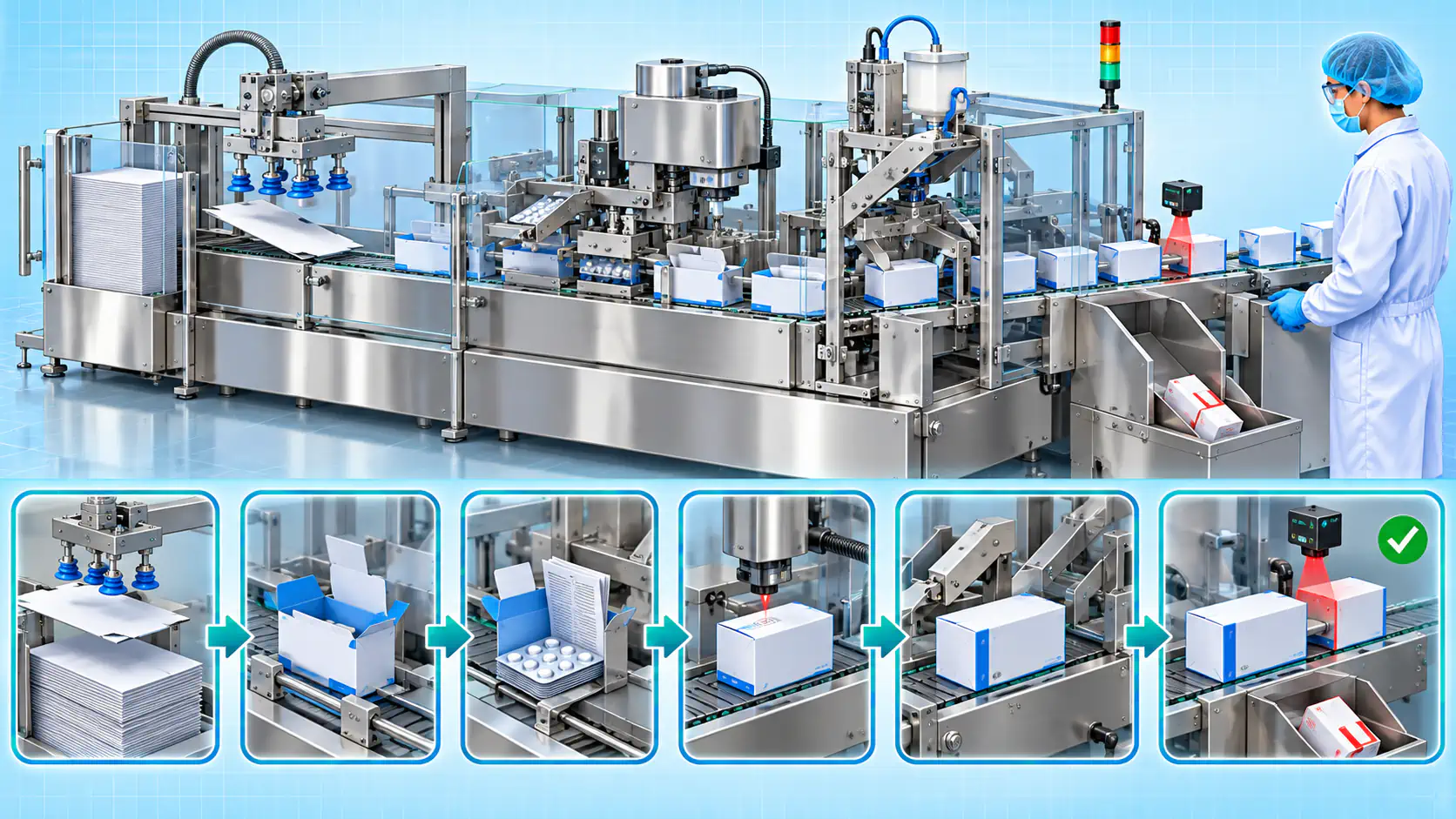
The working of cartonator machine in the pharma secondary packaging area follows one repeated cycle. First, vacuum suction cups pick a flat pre-glued carton from the magazine and open it on the carrier chain. The product (blister, strip or bottle) and a folded leaflet are then pushed in. Next, the embossing unit codes the batch details. Once coding is complete, the flaps are closed by tuck-in or hot-melt glue, and the carton is then discharged from the machine. Sensors on the line reject any carton without product or leaflet, or any carton that did not open. Line clearance, challenge tests and carton reconciliation keep the line under GMP control.
What Is a Cartonator Machine in Pharma?
A cartonator (also called a cartoner or cartoning machine) is an automatic machine that places a primary pack and its leaflet into a printed/ embossing carton. Indian plants use the word “cartonator”, while equipment manufacturers mostly say “cartoner”. For tablets, it works at the end of the manufacturing flow: dispensing, granulation in a rapid mixer granulator, drying in a fluid bed processor, blending in a double cone blender or bin, compression, coating (if any), primary packing and cartoning.
In one Indian oral solid dosage plant, a Pam-Pac auto cartonator output is around 150 cartons/min. A second unit in the dry syrup hall of the same plant cartons bottles in line with a measuring-cup placement machine and a shrink wrapper.
How Does a Cartonator Machine Work?
The principle of a cartonator is the synchronized movement of cartons, blisters and leaflets with one carrier (bucket) chain. Each pack size packed in one open carton and one folded leaflet at the push-in station. There, the pusher slides both into the carton from the side. A PLC system with HMI controls the timing which is sets before start packaging, while vacuum and pneumatic systems handle the cartons. Sensors at each station check every pocket so that a carton with no product or no leaflet, or one that has not opened, is rejected automatically before discharge.
Main Parts and Step-by-Step Working of Cartonator Machine
Each step of the cycle is done by one part of the machine, in this order:
- Carton magazine and pick-up: the magazine holds flat cartons, and vacuum suction cups pull one carton at a time.
- Carton opening and carrier chain: the carton is opened and placed in the carrier chain.
- Product infeed: a conveyor or turntable places blisters, strips or bottles into the buckets.
- Leaflet magazine and folder: the leaflet is folded 1 to 4 times to insert with blister in carton.
- Pusher (inserter): Blister and the leaflet are pushed together into the open carton.
- Batch coding unit: the embossing unit codes the batch number, manufacturing date and expiry date.
- Flap folding station: the flaps are closed by tuck-in or by hot-melt glue.
- Sensors and reject unit: incomplete or unopened cartons are removed from the line.
- Discharge conveyor: finished cartons move on to the next machine, such as the shrink wrapper.
Machine change parts are used as per the carton size or pack size. These parts include the carton holder, carrier, pusher, guides and the leaflet folder settings. They are changed whenever the carton size changes.
Types of Cartonator: Intermittent and Continuous Motion
Cartonators are of two types intermittent and continuous motion machine, Intermittent machines index the carrier chain between each station. Continuous machines allow for a steady flow of cartons, and are therefore appropriate for high speed lines. For example, Körber’s P2 sideload machine is intermittent, with speeds of up to 150 cartons/min. However, their P3 and P5 models are continuous, with speeds of up to 300 and 500 cartons/min. Körber’s P4 machine can also be intermittent, with speed up to 400 cartons/min. Therefore, speed depends on the machine type and model.
How Is the Cartonator Operated on the Packing Floor?
The floor sequence is the same for every batch:
- First, the operator and the packing supervisor remove the previous batch’s cartons, leaflets and coded rejects from the magazines, the carrier chain, the reject bin and the area. The IPQA officer then gives line clearance, and it is recorded in the batch packaging record (BPR).
- If the carton size has changed, fit the change parts and verify the settings against the new carton before production.
- Receive the cartons and leaflets issued against the BPR. Keep coded and uncoded stock in identified cages at the line.
- Set the batch details on the embossing unit and run a few cartons. The first coded carton is verified against the BPR and countersigned by IPQA before the continuous run.
- Perform challenge tests for missing product, missing leaflet, unopened carton and wrong or missing code, and record the results in the BPR.
- Run the machine at a speed balanced with the blister or strip machine, with both outputs expressed in the same unit.
- At the end of the batch, reconcile the cartons and leaflets, and offer the line for clearance again.
What In-Process Controls Apply to the Cartonator?
While the machine runs, the production and IPQA officer checks coded cartons online for correct and legible batch details. EU GMP Chapter 5 expects embossed information to be distinct and resistant to fading. Carton appearance is also checked online for correct product details. Make sure challenge tests has to perform at batch start and at the intervals set in the site Standard Operating Procedure (SOP), and every result is entered in the BPR.
At batch completion, the issued, used, rejected and returned quantities of cartons and leaflets are reconciled. Unused batch-coded cartons must be destroyed under supervision, and the destruction is recorded so that they never return to stores with uncoded stock.
Critical Process Parameters of a Cartonator
Below is the some parameters which need to sets before start the process. it also varies from product to product and plant SOP.
| Parameter | Setting or range | Why it matters | How it is monitored |
|---|---|---|---|
| Machine output | 150 cartons/min (Pam-Pac, one Indian plant); up to 150–500 cartons/min (Körber P-series) | Must be balanced with the primary packing output | Counter on the HMI |
| Carton size | 55 × 30 × 20 mm to 150 × 115 × 50 mm (Marya ZH120) | Wrong change parts damage cartons and flaps | Change-part check at changeover |
| Leaflet folds | 1 to 4 folds | The folded leaflet must fit the carton with the product | First coded carton check |
| Carton magazine load | About 1,000 flat cartons (Jornen ZH120) | Keeps the pick-up fed | Visual check by the operator |
| Hot-melt glue temperature | As set for the glue and carton board | Unstable temperature can cause glue leakage | Glue unit display |
| Batch coding details | As per the BPR | Wrong details cause a mix-up | First carton and online checks |
Common Problems and Fixes on the Cartonator
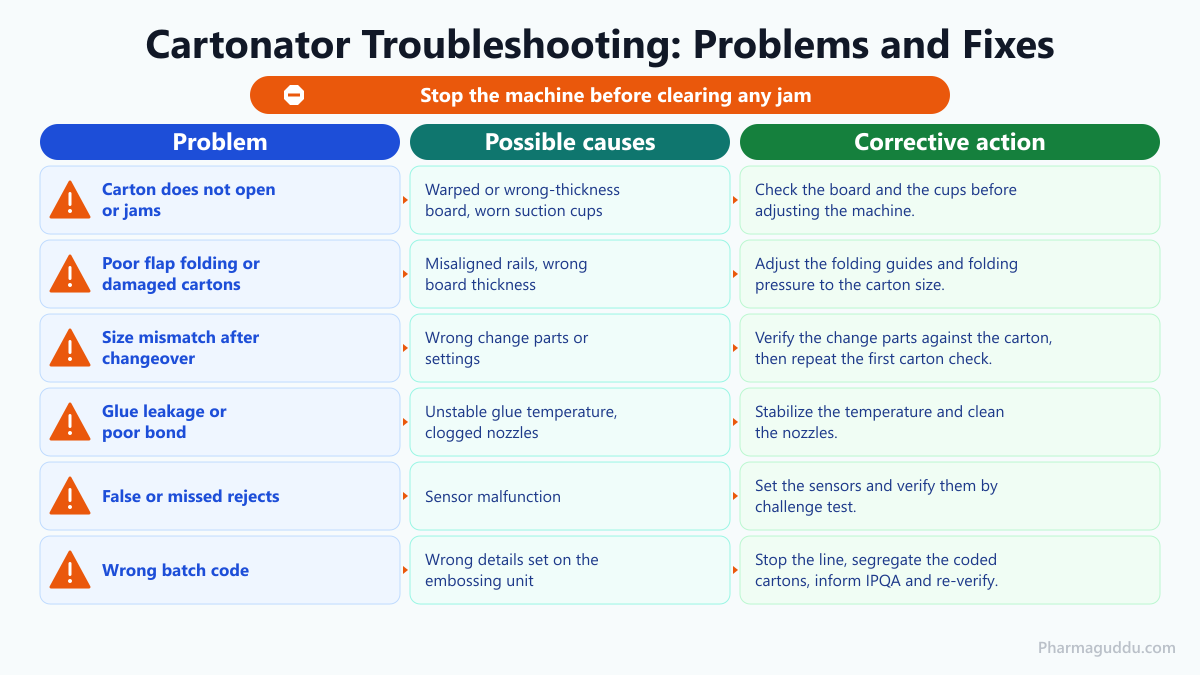
Most cartonator faults come from the carton board, worn parts or wrong settings after changeover. Before clearing any jam, stop the machine and inform the production officer.
| Problem | Possible causes | Corrective action |
|---|---|---|
| Carton does not open or jams | Warped or wrong-thickness board, worn suction cups | Check the board and the cups before adjusting the machine, also manually soften the carton bundle before place to holder. |
| Poor flap folding or damaged cartons | Misaligned rails, wrong board thickness | Adjust the folding guides and folding pressure to the carton size |
| Size mismatch after changeover | Wrong change parts or settings | Verify the change parts against the carton, then repeat the first carton check |
| Glue leakage or poor bond | Unstable glue temperature, clogged nozzles | Stabilize the temperature and clean the nozzles |
| False or missed rejects | Sensor malfunction | Set the sensors and verify them by challenge test |
| Wrong batch code | Wrong details set on the embossing unit | Stop the line, segregate the coded cartons in separate plates, inform to Head of department and IPQA for further action. |
How Is a Cartonator Maintained?
On scheduled plan Preventive maintenance of machine is done for cleaning and greasing of conveyors, lubrication, and replacement of worn cups and folding parts. Maintenance records must be kept as GMP records. After maintenance, the machine ready for production only after cleaning and line clearance by IPQA.
Frequently Asked Questions
Pharma cartoners fold the leaflet 1 to 4 times. The number of folds is set during changeover. It is chosen as per the leaflet size and the carton. The folded leaflet has to lie beside the Bliters so that the pusher can insert both together into the open carton.
Yes, automatic cartonator always connected to Blister machine. In such case, the cartonator speed has to be maintained with the blister output (for example, blisters drops per minute converted to cartons per minute).
A cartonator can pack blisters, strips, bottles, vials, tubes and sachets. It uses change parts made for each format. In oral solid dosage lines, it receives blisters and strips from the primary packing rooms. In a dry syrup line, the same type of machine cartons labelled bottles after the measuring cup is placed, and the cartons then pass to a shrink wrapper.
References
- 21 CFR 211.130 Packaging and labeling operations, Cornell LII (US FDA regulation)
- EudraLex Volume 4, Part I, Chapter 5: Production, European Commission
- Gazette Notifications, G.S.R. 922(E) Schedule M, CDSCO
- List of production equipments, D block (plant equipment list), owner’s library
- Vendor audit and development form, Annexure II, internal library
- EU GMP Chapter 5: 5.62

Naresh Bhakar is the Founder and Author at Pharmaguddu.com, bringing his extensive expertise in the field of pharmaceuticals to readers worldwide. He has experience in Pharma manufacturing and has worked with top Pharmaceuticals. He has rich knowledge and provides valuable insights and data through his articles and content on Pharmaguddu.com. For further inquiries or collaborations, please don’t hesitate to reach out via email at [email protected].