
GMP & Pharmaceutical Manufacturing Expert
✓ Reviewed by: Naresh Bhakar
Reviewed for pharmaceutical accuracy
📅 Last Updated: November 22, 2026
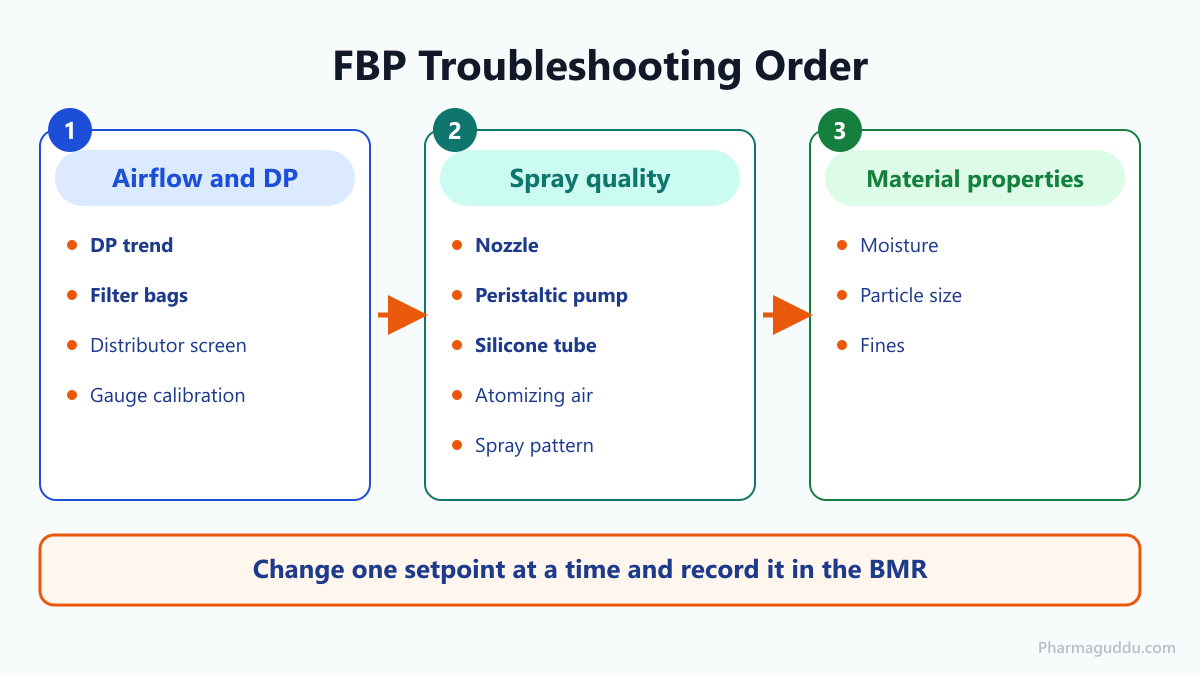
Troubleshooting fluid bed processors is performed in a following order. First, check the air flow and DP, followed by checking the spray and then the material properties. Common issues include clogged or torn bag filters in the exhaust, gasket leakage, blockage in the nozzle/silicone tubing and fluctuating air inlet temperatures and dew points. However, before blaming set points, check that the DP gauge and temperature and humidity sensors are correctly calibrated. Changes to set points should be made gradually in single increments. All changes to set points should be recorded in the batch manufacturing record (BMR).
How is a fluid bed processor fault diagnosed?
A fault is diagnosed by reading the DP trend first, then the spray, then the material. A fluid bed processor (FBP) granulates or coats in one bowl, while a fluid bed dryer (FBD) only dries. For the full overview, see the fluid bed processor article.
Bed pressure drop is the main stability indicator, and it should stay steady during a run. An unstable trend points to channeling, filter loading or an impending bed collapse (GMP Insiders). The reason is that granulation is a heat and moisture balance: air volume and inlet temperature remove moisture, while the spray liquid adds moisture and cools the bed by evaporation (Pharmaceutical Manufacturing, 2013).
Which parameters need watching during troubleshooting?
Process validation lists inlet and exhaust air temperature, product temperature, air volume, incoming air dew point and exhaust humidity as variables to monitor. Bowl charge, bowl sieve and filter bag porosity are fixed factors.
| Parameter | Typical setting or range | Why it matters | How it is monitored |
|---|---|---|---|
| Batch size in bowl | 30–80% of bowl volume (trade guidance) | Poor fluidization when too low or too high | BMR charge weight |
| Inlet air temperature and dew point | Set during development and validation | Controls drying capacity and overwetting | Inlet sensors, humidity sensor |
| Spray rate and atomizing air | Product and scale specific | Droplet size, granule growth | Pump setting, air gauge |
| Sealing air to container and filter bag tubes | 2.0–2.5 kg/cm² gauge (one 250 kg model) | Low pressure lets dust and air bypass | Pressure gauge |
| Main compressed air | 6–8 kg/cm² gauge (same model) | Drives seals and bag shaking | Pressure gauge |
| Bag shaking piston up and down time | 1.2–1.8 s each (same model) | Filter cleaning | Visual and timing check |
READ ALSO
Fluid Bed Processor (FBP), Principle, and Working
The fluid bed processor (FBP), principle, and working: hot filtered air fluidizes granules so granulation.
What are the common problems and fixes?
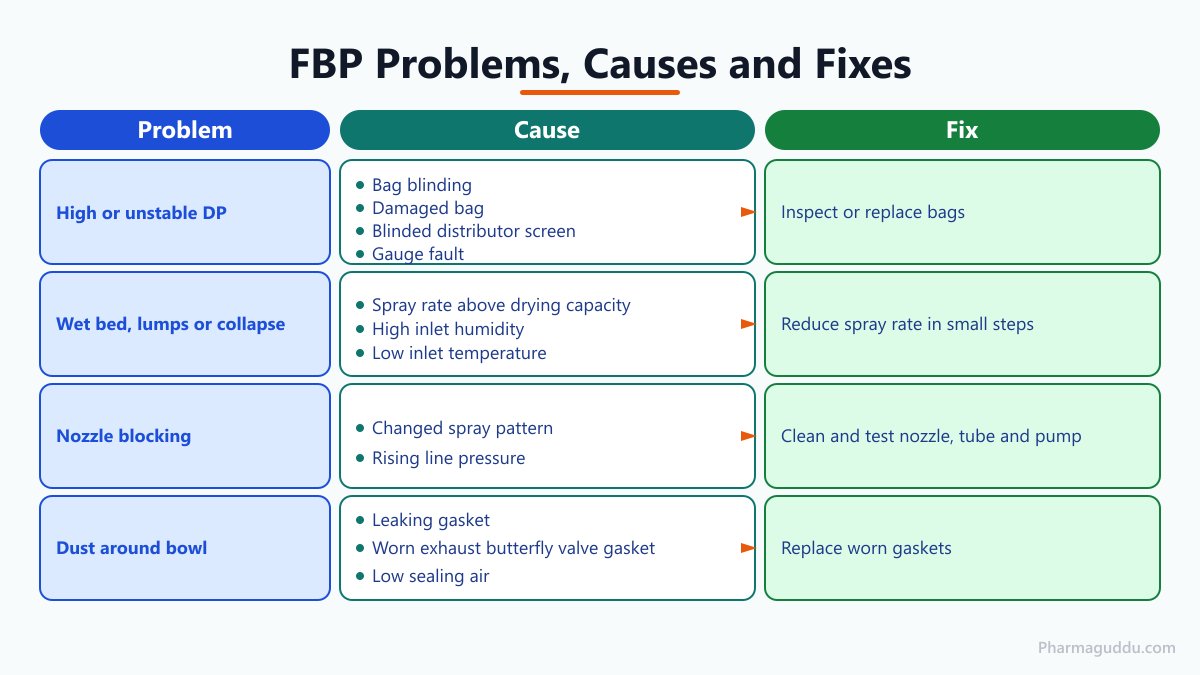
High or unstable differential pressure
Possible causes include bag blinding, damage to the bag, Dutch weave distributor screen blinding, or gauge error. A cake of wet fines reduces the efficiency of cleaning, therefore increasing the DP. This is a general consideration for bag houses, rather than specific to FBP or pharmacopoeia. There is no official definition for this parameter, therefore the normal margin will vary between manufacturers. Inspection of the exhaust filter (bag or cartridge) occurs, and replacement takes place if damage is present.
Wet bed, lumps or collapse
If the feed rate is too high (or if air is poorly distributed) then over-wetting will occur. If the relative humidity of the inlet air is higher, less drying will occur. If the inlet temperature is low, more moisture will remain in the bed and larger granules will form. The feed rate is adjusted or the inlet air altered gradually.
Nozzle blocking or spitting
If an irregular spray pattern, increased pressure, uneven coating or clumping occurs, the nozzle, peristaltic pump and silicone tubing will be checked. The nozzle will be cleaned and then tested at the correct spray rate and atomisation pressure. The process can then be continued.
Dust around the bowl or fines in the filter
Leaking inflatable gaskets, a worn exhaust butterfly valve gasket, a bag seated badly on its ring, or low sealing air pressure cause dust leakage. Worn gaskets are replaced, not worked around.
What should be checked before process settings are blamed?
Verify that air pressure, sealing air pressure, heating and earth detection are all working. Check that the explosion flap is in place. Static and dust can pose a hazard. Lock out/tag out must be used before opening.
How are faults recorded and prevented?
If deviations occur and set points are changed, this must be recorded in the BMR. The shift officer must be informed of these occurrences so that QA can raise a deviation. Runs cannot be performed without recording set point changes.
According to 21 CFR 211.67, there must be written procedures for cleaning, maintenance and inspection of equipment prior to use. As per 21 CFR part 211, automated/electronic equipment must be regularly calibrated and tested as part of a written scheme. In a typical FBD SOP, pressure gauges, differential pressure gauges, temperature probes and transmitters should be calibrated. Preventive maintenance is carried out using a standard SOP. Validation samples for cleaning following a fault have been taken from the bowl, screen, retarding chamber and filter bags.
Expert Tips
- Check calibration status first. The production officer reads the calibration label on the DP gauge and sensors, because a drifted gauge looks like a process fault.
- Read the DP trend before touching a setpoint. The operator notes the reading at each stage in the BMR, otherwise the cause cannot be traced later.
- Change one setpoint at a time. Air temperature, dew point, spray rate and air volume interact, so several changes at once hide the cause.
- Inspect bags, gaskets and nozzle at changeover. Engineering staff replace worn parts, and QA verifies the record before the next batch.
- Raise a deviation for any bag failure or nozzle blockage during a batch. The shift in-charge informs QA before the batch continues.

Naresh Bhakar is the Founder and Author at Pharmaguddu.com, bringing his extensive expertise in the field of pharmaceuticals to readers worldwide. He has experience in Pharma manufacturing and has worked with top Pharmaceuticals. He has rich knowledge and provides valuable insights and data through his articles and content on Pharmaguddu.com. For further inquiries or collaborations, please don’t hesitate to reach out via email at [email protected].