
GMP & Pharmaceutical Manufacturing Expert
✓ Reviewed by: Naresh Bhakar
Reviewed for pharmaceutical accuracy
📅 Last Updated: November 21, 2026
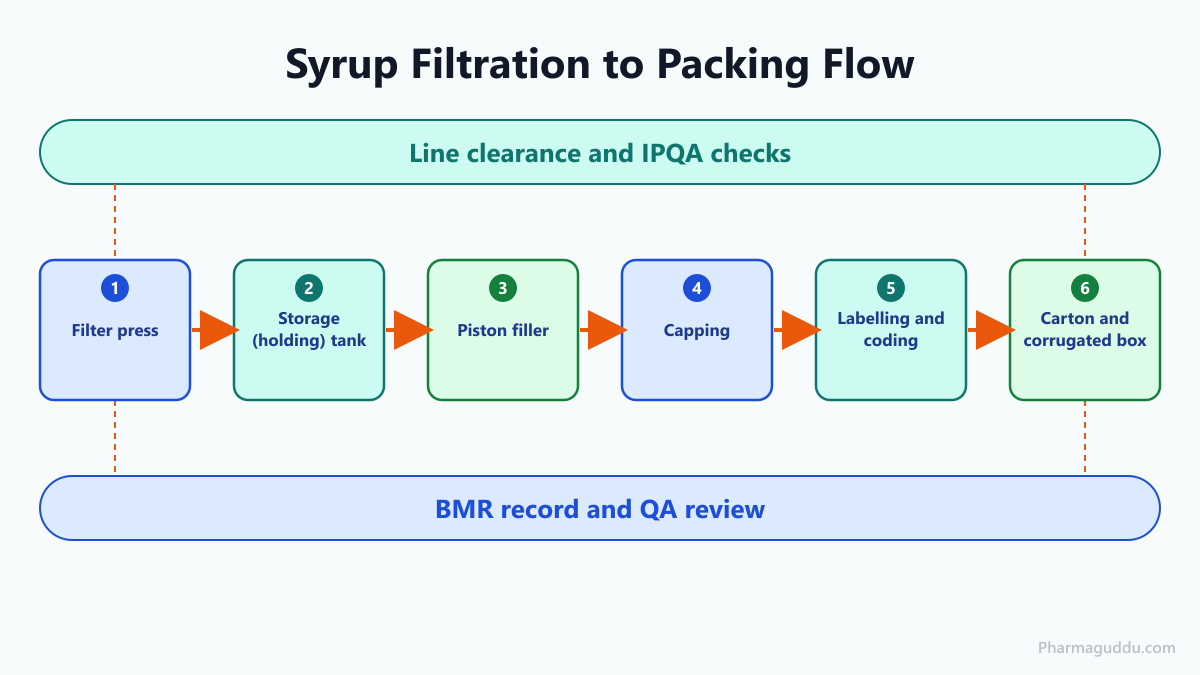
Syrup filtration and filling are the stages that follow mixing. The bulk syrup is filtered through a filter press to remove undissolved and precipitated material and is held in a storage (holding) tank. It is then filled into cleaned bottles by a piston or pump filler, and capped, labelled and coded. The filled bottles are packed into cartons and corrugated boxes. Line clearance, in-process quality assurance (IPQA) checks and the batch manufacturing record (BMR) control every stage, and Quality Assurance (QA) reviews the reconciliation before batch release.
What are syrup filtration and filling?
Syrup filtration and filling are the closing stages of oral liquid manufacturing. Filtration removes particles and precipitate from the mixed bulk, and filling transfers the clear bulk into containers that are closed, labelled and packed. For the full overview, see liquid syrup types and manufacturing process. The sugar concentration and the preparation of the base are covered in simple syrup concentration as per IP and USP.
Why is syrup filtered before it is held and filled?
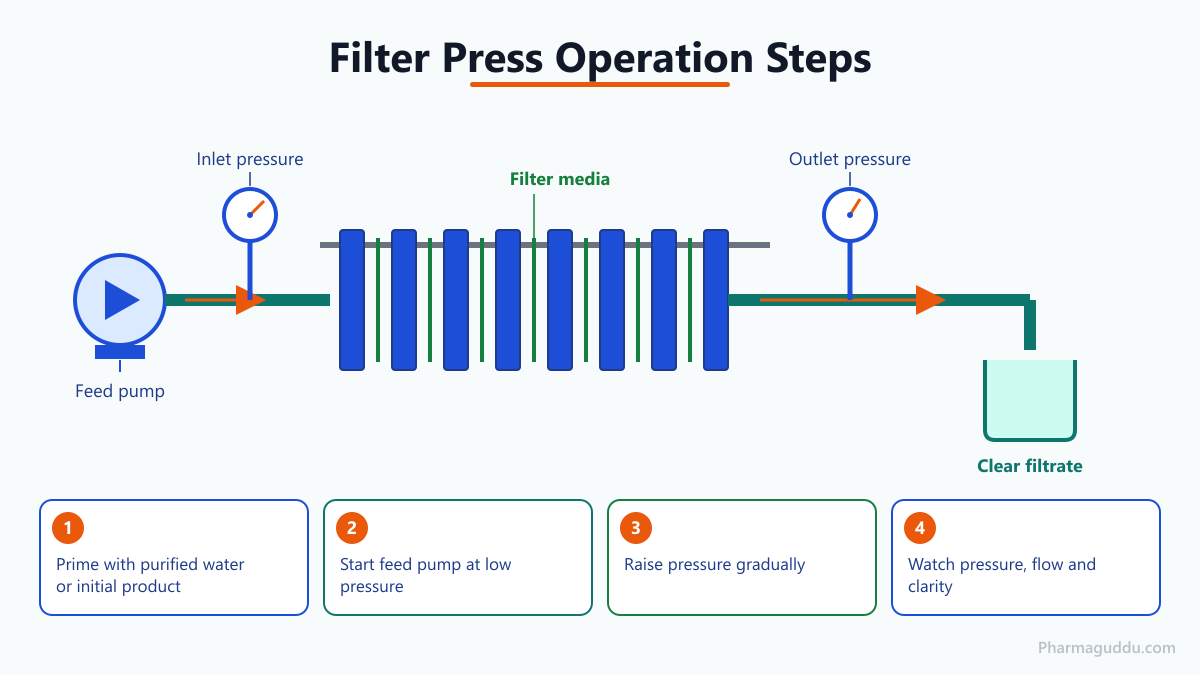
Mixing can leave undissolved particles, precipitated material and loose fibres from sieves or nylon cloth in the bulk. A filter holds these back while the liquid passes through the media (filter paper, cloth or membrane) under pump pressure, and the solids collect on the media, so the inlet pressure rises and the flow falls as the media loads. This is why pressure and flow are watched.
The filtered bulk then goes to a storage (holding) tank, where clarity and pH can be checked before the filling line draws from it. Filling is volumetric. A piston draws a fixed volume and pushes it into the bottle, and this suits viscous syrup because the liquid does not flow freely under gravity.
What are the stages after mixing?
Below is the steps given as follow:
- The filter press is assembled with the filter media given in the BMR and primed with purified water or initial product to remove air.
- The mixed bulk is filtered, and the filtrate is checked for clarity.
- The filtered bulk is transferred to the cleaned storage (holding) tank, and Quality Control (QC) samples it before filling.
- Washed and dried bottles are inspected and supplied to the line.
- The filling machine fills each bottle, and the bottle is capped. Some plants also add induction sealing or neck banding.
- Labels are applied, and batch number, manufacturing date, expiry date and maximum retail price (MRP) are printed or coded.
- The bottles are packed into cartons with the leaflet, and the cartons are packed into weighed corrugated boxes (shippers).
- Packing material and finished product quantities are reconciled, and QA reviews the batch record before release.
Which equipment is used for filtration, filling and capping?
The equipment depends on the product, the viscosity and the bottle type. Exact values depend on the Plant SOP; always follow the equipment manual and the site Standard Operating Procedure (SOP).
| Stage | Equipment | Remark |
|---|---|---|
| Bulk filtration | Filter press with paper, cloth or membrane media | Common for sugar-based syrup; a cartridge filter may follow as a polish filter |
| Polish filtration | Cartridge filter | Filter validated for the product, with the rating given in the BMR |
| Filling | Piston filler | The usual choice for viscous syrup; a pump filler is an alternative |
| Filling and capping | Monoblock unit | Suits small bottles |
| Capping | ROPP (roll-on pilfer-proof) capper for aluminium caps; chuck capper for plastic screw caps | as per the plant SOP |
The validation equipment list of a plant names the syrup manufacturing vessel, filter press, filling machine, capping machine, labelling machine, cartonator, shrink wrapper and overprinting machine. Each of these must be qualified before routine use.
How are filtration, filling and packing operated on the floor?
First, take line clearance from the IPQA officer. Then check that the “under process” and calibration status labels are up to date on the filter press, tank, filler and capper, and next check the dispensed and filtered material against the BMR.
During filtration, start the feed pump at low pressure and raise it gradually, while the operator watches inlet pressure, outlet pressure, flow and filtrate clarity and records them in the BMR. If the pressure rises or the flow falls, the media is clogged. Stop the pump and inspect the media. Never open the press under pressure, because product can spray out and injure the operator.
Before filling starts, the production officer checks dispensing material along with details for example, Batch number, Quanity, A.R. Number against the BMR/BPR. The fill volume and speed are then set for the batch, and the first bottles are checked before the run continues. While the machine runs, the operator watches nozzle alignment, bottle position and leaks, and after capping, the cap seal, bottle integrity and label legibility are checked before cartoning.
At the end of the batch, the packing officer reconciles the materials, and the equipment is cleaned as per the written procedure. The BMR is then handed over to QA.
Which in-process checks apply to filling and packing?
IPQA checks follow the BMR and are recorded at the interval it gives. The checks in the liquid section cover area cleanliness and the room conditions (relative humidity, temperature and differential pressure). They also cover the dispensed material against the BMR, status labels, syrup clarity, bulk pH and the integrity of sieves and nylon cloth. Balance calibration is also checked and recorded. See also in-process quality checks during manufacturing.
In packing, IPQA checks the batch coding on the container label, label clarity and overprinting on the inner and outer cartons. It also checks the fill weights of cartons and shippers against their limits, room temperature and humidity, and the leak test, and any discrepancy is reported to the packing supervisor. Washed, filled and labelled bottles are also inspected online as described in the online inspection of washed, filled and labelled bottles.
At the end of batch, Packing officer do material and batch reconciliation for issued, consumed, extra consumed, returned, rejected and destroyed quantities. For the finished product, the quantity produced is compared with the quantity packed, and QA reviews this before release. Additional packing material is requested and reconciled as per the SOP for additional packing material.
What problems occur and how are they fixed?
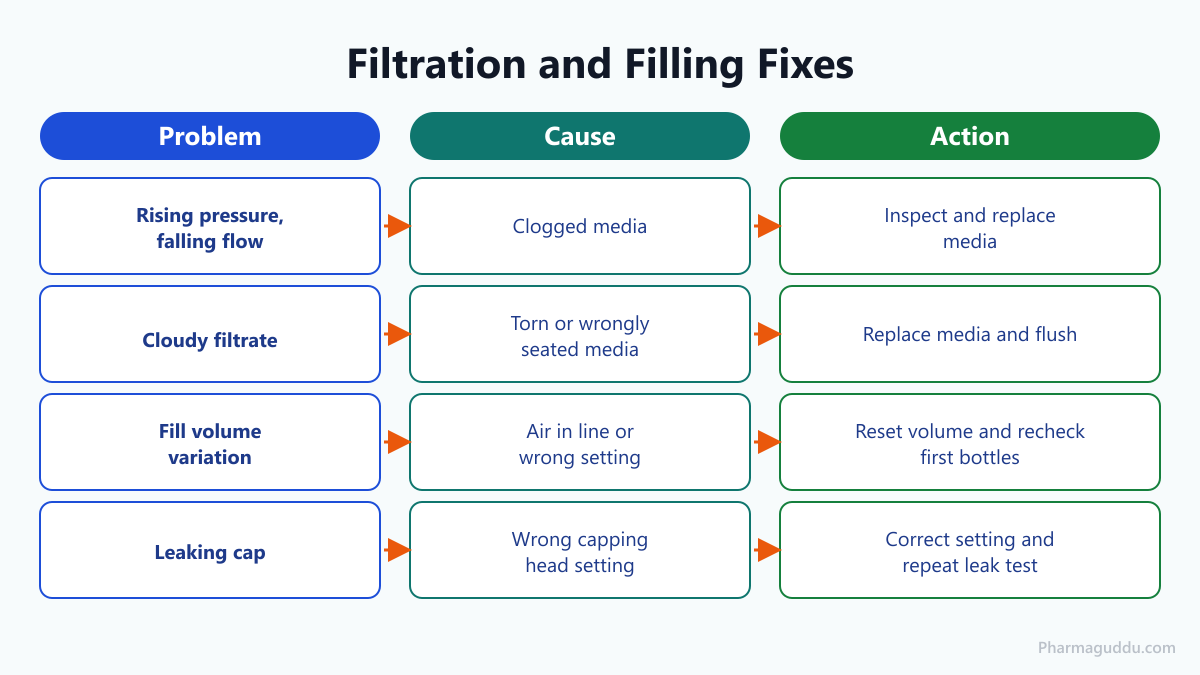
| Problem | Possible cause | Corrective action |
|---|---|---|
| Cloudy filtrate | Torn or wrongly seated media, or fibres shed by the media | Stop, inspect and replace the media, then flush before restart |
| Rising pressure, falling flow | Clogged media | Inspect the media and replace it if needed |
| Nozzle drip | Worn seal or poor nozzle alignment | Align the nozzle, and engineering staff replace the worn part |
| Fill volume variation | Air in the line, or wrong setting | Remove air, reset the volume and recheck the first bottles |
| Leaking cap | Wrong cap type or capping head setting | Segregate the bottles, correct the setting and repeat the leak test |
| Label misalignment | Bottle position or label web setting | Stop the line, correct the setting and review the labelled bottles |
Bottles with improper labels are handled as per the SOP for filled bottles with improper labels.
Which regulatory points apply?
Under 21 CFR 211.67, equipment must be cleaned and maintained at intervals that prevent contamination, and written procedures and records are required. The batch record under 21 CFR Part 211 holds the equipment used, in-process results, yield and labelling records. Revised Schedule M of the Drugs Rules 1945 applies to Indian oral liquid plants.
USP-NF general chapter <698>, Deliverable Volume, gives assurance that an oral liquid delivers the volume declared on the label. The World Health Organization (WHO) Medical Product Alert N°8/2023 reports ethylene glycol at 0.62 to 0.82% w/w in syrups, against an accepted limit of not more than 0.10% w/w. It urges manufacturers to test each container of each incoming batch of excipients such as glycerin, sorbitol and propylene glycol before use.
Frequently Asked Questions
Glycerin, sorbitol and glycol excipients can carry diethylene glycol (DEG) or ethylene glycol (EG), and both are toxic and can be fatal. Filtration cannot remove them because they dissolve in the bulk. WHO therefore urges testing of each container of each incoming batch before use.
Roll-on pilfer-proof (ROPP) capping is used for aluminium caps. The capping head forms the thread and the pilfer-proof band on the neck of the bottle. Chuck capping is used for plastic screw caps, and the choice follows the packing material approved for the product.
IPQA checks the batch coding, label clarity and carton overprinting, and it also checks the carton and shipper weights against limits, the room conditions and the leak test. The leaflet insertion is also confirmed. Any discrepancy is reported to the packing supervisor, and the affected lot is held until it is corrected.
References
- Medical Product Alert N°8/2023, WHO, 7 December 2023
- 21 CFR 211.67 Equipment cleaning and maintenance, Cornell LII / US CFR
- 21 CFR Part 211 (211.65, 211.100, 211.188), US FDA / eCFR
- USP-NF <698> Deliverable Volume, USP
- In-process check procedure, liquid department, (internal reference)
- In-process quality assurance packing inspection checklist, (internal reference)
- Site master file, reconciliation of materials, (internal reference)
- Validation standard operating procedure, equipment list, Library page (internal reference)
- 21 CFR 211.188

Naresh Bhakar is the Founder and Author at Pharmaguddu.com, bringing his extensive expertise in the field of pharmaceuticals to readers worldwide. He has experience in Pharma manufacturing and has worked with top Pharmaceuticals. He has rich knowledge and provides valuable insights and data through his articles and content on Pharmaguddu.com. For further inquiries or collaborations, please don’t hesitate to reach out via email at [email protected].