
GMP & Pharmaceutical Manufacturing Expert
✓ Reviewed by: Pankaj Sharma - Quality Control Specialist
Reviewed for QC, QA accuracy, laboratory practices, analytical methods, and technical Documents
📅 Last Updated: November 23, 2026
The fluid bed processor inlet air handling unit (AHU) cleans, dries and heats the air before it enters the product bowl. Air normally passes a coarse pre-filter (G4) and an intermediate filter (F8), then an optional dehumidifier and an air heater with its control valve, and the last stage is a final High-Efficiency Particulate Air (HEPA) filter (H13). G4 and F8 are EN 779 classes, now replaced by ISO 16890, and H13 is an EN 1822 class. The order is typical, and the exact filter grades vary by manufacturer. Temperature and humidity sensors report to the controller. Differential pressure gauges across the filter housings show when a filter must be changed. The heater type (steam, hot water or electric) and the dehumidifier depend on the design and on the product.
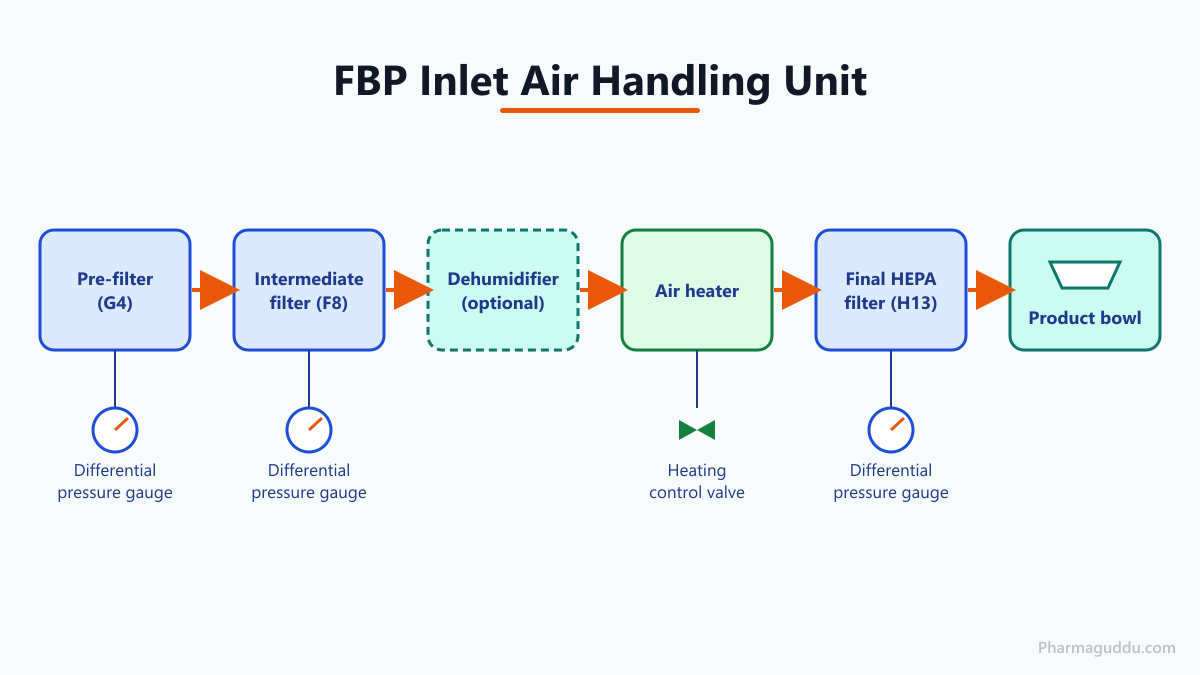
What is the inlet air handling unit of a fluid bed processor?
The inlet AHU conatning filters, conditioning units, valves and sensors that treats outside or room air before it fluidizes the product. Granulation, drying and coating all depend on the temperature, moisture content and cleanliness of this air. For the full overview of the machine, see the fluid bed processor article. Each component is described below.
How does the AHU prepare the process air?
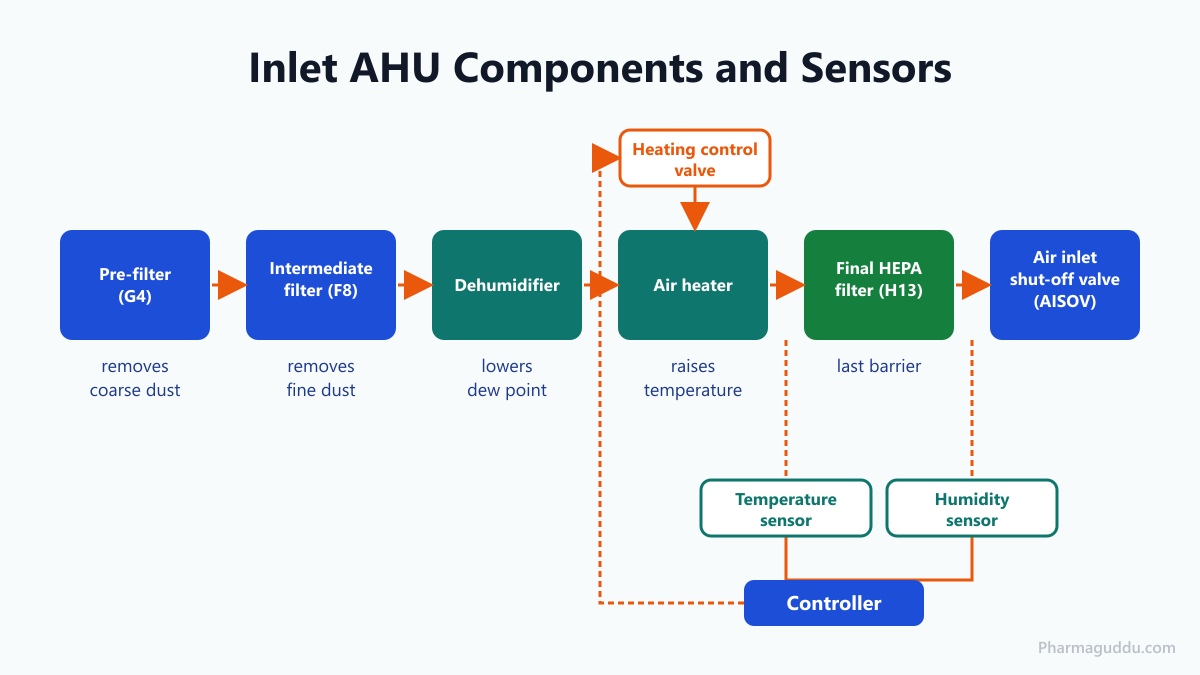
Each stage protects the next one. The coarse filter removes dust so that the finer filters do not block early. The dehumidifier and heater then fix the moisture and temperature of the air, and the final filter removes any particles added by ducts and equipment upstream. For this reason, within an AHU, a HEPA filter will always be positioned at the furthest point along an air flow path.
Air conditions matter to the product. Lower inlet humidity increases the drying rate, and so does higher inlet temperature, but the temperature must stay below the limit of the product.
What are the components of the inlet AHU?
Pre-filter and intermediate filter
The pre-filter (G4) is the coarse first stage. The intermediate filter (F8) is the second stage and takes fine dust before it reaches the HEPA filter. G4 and F8 are EN 779 legacy names, which ISO 16890 replaced with the coarse and ePM1 classes, although Original Equipment Manufacturer documents still use the old names. One Indian OEM dryer in the reference documents lists a pre-filter and an air filter of 24 × 24 × 6 inch size (20 + 5 micron), so the grades vary by manufacturer.
Dehumidifier
A cooling coil (condenser) dries ordinary air. For hygroscopic or effervescent products that need a very low dew point, adsorption devices are added. A desiccant wheel is a slowly rotating rotor coated with a moisture-adsorbing material, such as silica gel. One section dries the process air, while a second one is regenerated with hot air. The wheel dries air without cooling it, although design details depend on the manufacturer.
Air heater and heating control valve
The heating control valve (HCV) regulates the flow of steam or hot water to the heater. Where cold and hot air streams are mixed, a cold and hot air valve adjusts the blend to reach the temperature setpoint.
Final filter
The final HEPA filter (H13) is the last barrier before the product bed. H13 means an efficiency of at least 99.95% at the most penetrating particle size (MPPS) under EN 1822. A test window or injection port allows the HEPA filter integrity test (DOP/PAO test). For more on HEPA use, see HEPA filter uses in pharmaceutical manufacturing.
Shut-off valve and sensors
The air inlet shut-off valve (AISOV) isolates the AHU from the bowl. Temperature sensors (often PT100) and humidity or dew point sensors send readings to the controller.
READ ALSO
Fluid Bed Processor (FBP), Principle, and Working
The fluid bed processor (FBP), principle, and working: hot filtered air fluidizes granules so granulation.
How is the inlet AHU operated and controlled?
Operation follows the batch manufacturing record (BMR) and the equipment standard operating procedure (SOP).
- Read the differential pressure gauge on each filter housing and confirm the value is below the change point.
- Start the AHU fan and set the inlet temperature in the BMR range, always below the product limit.
- Wait until the temperature and the dew point or humidity reading are steady, then load the product.
- While the batch runs, the operator records inlet temperature and humidity at the BMR interval, and reports a drifting reading to the production officer.
- At the end, shut the AISOV and record the readings in the BMR.
Inlet air qualification uses a thermocouple and hygrometer to find the delay time needed to reach constant air conditions, both at first start of the day and on later starts the same day (validation SOP for fluid bed dryers).
What limits and parameters apply to the inlet air?
Pfizer process validation material lists inlet and exhaust air temperature, air volume and inlet air humidity (dew point) as monitored variables of fluid bed drying.
| Parameter | Typical setting or range | Why it matters | How it is monitored |
|---|---|---|---|
| Inlet air temperature | Below the product limit; set by the validated process | Controls drying rate and protects heat-sensitive product | PT100 sensor, controller trend, BMR |
| Inlet dew point or humidity | Set by the product; low dew point for hygroscopic products | Affects drying rate and product moisture | Humidity or dew point sensor |
| Air volume | Set by the validated process | Controls fluidization | Airflow sensor |
| Filter differential pressure | Below the filter change point | Shows loading of the filter | Differential pressure gauge |
| Hot water to heater (one OEM, hot-water unit) | 3.5 to 4.5 kg/cm² gauge, 125 °C minimum | Supplies heat to the air | Pressure gauge, DQ and IQ checks |
What common problems occur in the inlet AHU?
High differential pressure across a filter: the filter is loaded. Change it at the set change point and record the change.
Inlet temperature below setpoint: the heating control valve, the steam or hot-water supply or a sensor may be at fault, so engineering staff check the supply pressure and the sensor calibration.
High dew point: the dehumidifier may be off or underperforming, or a filter or duct may be leaking humid air. The production officer informs engineering staff and stops loading until the reading is stable.
Unstable readings: a sensor out of calibration can give false readings. The calibration status label should therefore be checked.
What do the regulations say?
21 CFR Part 211 requires equipment for adequate control over air pressure, micro-organisms, dust, humidity and temperature when appropriate to the operation. Part 211.46(c) requires air filtration, including prefilters and particulate matter air filters, on production area air supplies when appropriate. The regulation does not name filter grades. A generic validation SOP template uses 200 CFU/m³ or less for inlet air, which is an internal example and not a regulatory limit.
How is the inlet AHU maintained?
Installation qualification checks the pre-filter and HEPA filter fitting in the housings, the air heater with its control valve, and the air inlet shut-off valve. Differential pressure gauges, temperature sensors, temperature transmitters and the humidity sensor must be calibrated on schedule and carry calibration status labels. For general AHU practice, see good practices for air handling units. The bag filter in the exhaust path is covered in bag filter.
Expert Tips
- Read the differential pressure before every batch. The operator notes the value for each filter housing in the BMR, because a loaded filter reduces the air volume without any alarm.
- Set the inlet temperature below the product limit. The production officer enters it from the BMR, otherwise heat-sensitive product can degrade.
- Wait for stable air before loading. The operator loads product only after temperature and dew point are steady, otherwise the first minutes run on unconditioned air.
- Calibrate gauges and sensors on schedule. Engineering staff attach the calibration label and Quality Assurance (QA) reviews the record.
- Lock out the unit before filter or heater work. Engineering staff apply lockout/tagout, and QA releases the unit after maintenance is recorded.
Frequently Asked Questions
No. Dehumidification is added where the climate or a hygroscopic product requires it, and cooling coils or desiccant wheels are chosen depending on the dew point needed.
The filter is changed when the differential pressure gauge across its housing passes the set change point. The change is recorded, and a new filter in a HEPA housing needs a HEPA filter integrity test (DOP/PAO test) before use.
Yes. Romaco reported in 2025 a heat pump system that moves heat from exhaust air to inlet air, with a reported heating energy saving of up to 60% (Manufacturing Chemist, 15 July 2025).
References
- GEA Fluid Bed Processors, GEA
- Classification of air filters, Freudenberg Filtration
- Closer to reality with ISO 16890, Freudenberg Filtration
- Fluid bed dryers guide, Andritz
- 21 CFR 211.46, Ventilation, air filtration, air heating and cooling, Cornell Legal Information Institute
- F.B.D installation qualification (Alliance Engineering), Library
- Macleods Pharma design qualification, 250 kg fluid bed dryer, Library
- Validation SOP for fluid bed drier and air handling units, Library
- Process validation material (Pfizer), page 48, Library
- 21 CFR 211.46(b)

Naresh Bhakar is the Founder and Author at Pharmaguddu.com, bringing his extensive expertise in the field of pharmaceuticals to readers worldwide. He has experience in Pharma manufacturing and has worked with top Pharmaceuticals. He has rich knowledge and provides valuable insights and data through his articles and content on Pharmaguddu.com. For further inquiries or collaborations, please don’t hesitate to reach out via email at [email protected].