
GMP & Pharmaceutical Manufacturing Expert
✓ Reviewed by: Naresh Bhakar
Reviewed for pharmaceutical accuracy
📅 Last Updated: November 19, 2026
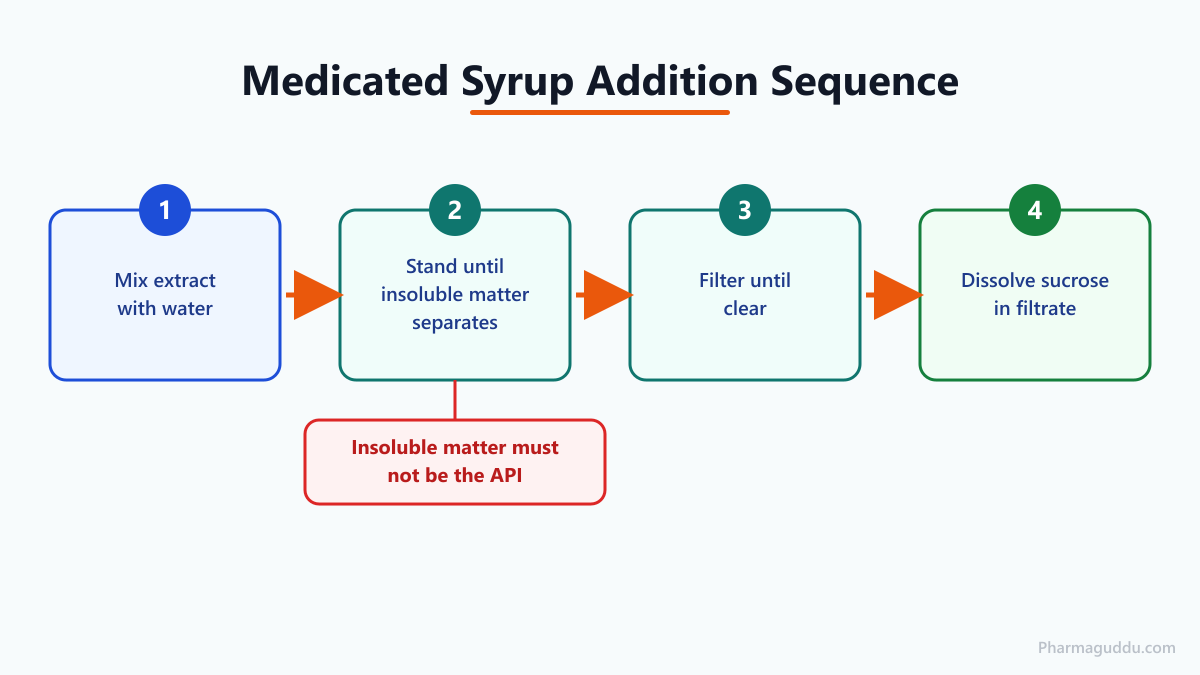
The addition of medicated syrup method for tinctures and fluid extracts follows a fixed order. The extract is first mixed with water, and the mixture is allowed to stand until the water-insoluble matter separates. It is then filtered, and sucrose is dissolved in the clear filtrate. Sucrose is added last because a thin liquid filters faster and gives a clearer filtrate. The method is valid only when the insoluble matter is inactive. The resinous matter that separates is often active, and filtering it out lowers potency.
What is the addition of medicated syrup method?
It is the procedure used to prepare a medicated syrup from a tincture or fluid extract without leaving haze or sediment in the finished product. A tincture is an alcoholic extract of a drug, and a fluid extract is a more concentrated liquid extract of plant material. For the full overview of syrup types, see liquid syrup types and manufacturing process. For extraction principles, see extraction methods in pharmaceutics.
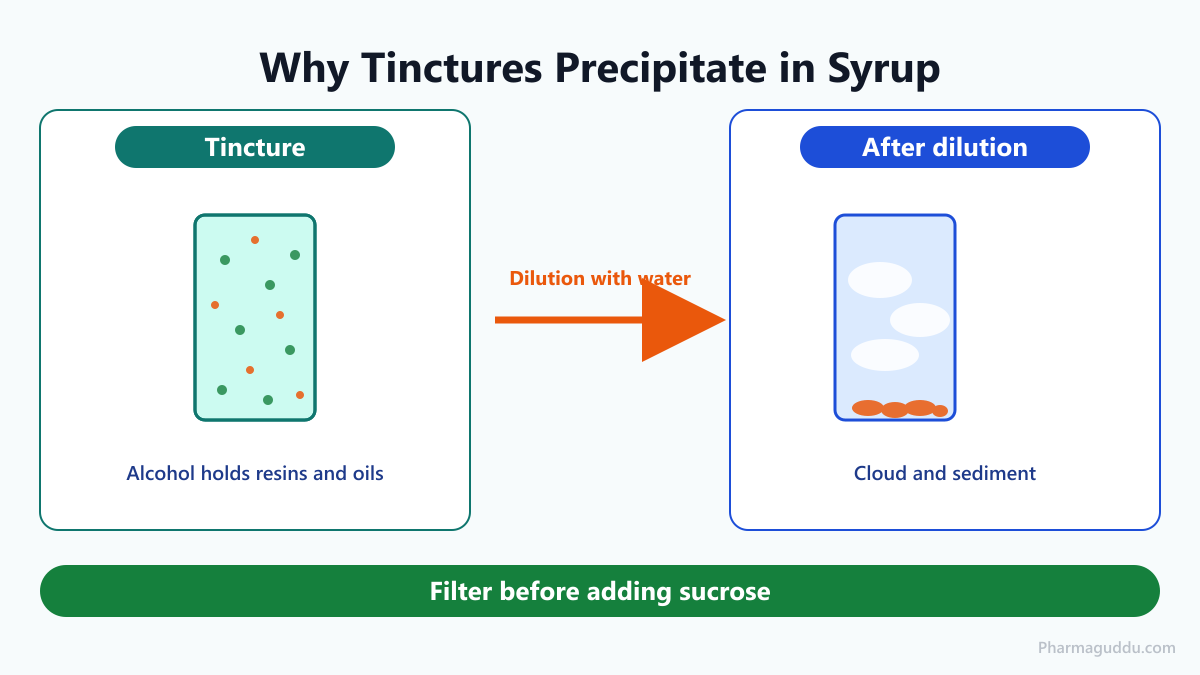
Why does syrup turn cloudy when a tincture is added?
Tinctures and fluid extracts contain alcohol, which holds resins, oils and other alcohol-soluble matter in solution. A syrup is mostly water, so dilution lowers the solvent power of the mixture, and this matter comes out of solution. The syrup then turns cloudy or throws a sediment.
What are the process steps?
- Dilute the tincture or fluid extract with purified water in a stainless steel vessel.
- Allow the mixture to stand until the water-insoluble matter has separated.
- Filter the mixture, and recirculate the first filtrate until it is clear.
- Dissolve sucrose in the clear filtrate, with heat or without it.
- Make up to the final volume or weight with purified water, and transfer the syrup to the storage vessel.
An extract that is fully miscible with water and does not precipitate can instead be added straight to a sucrose syrup or a flavoured syrup.
How is the method carried out on the floor?
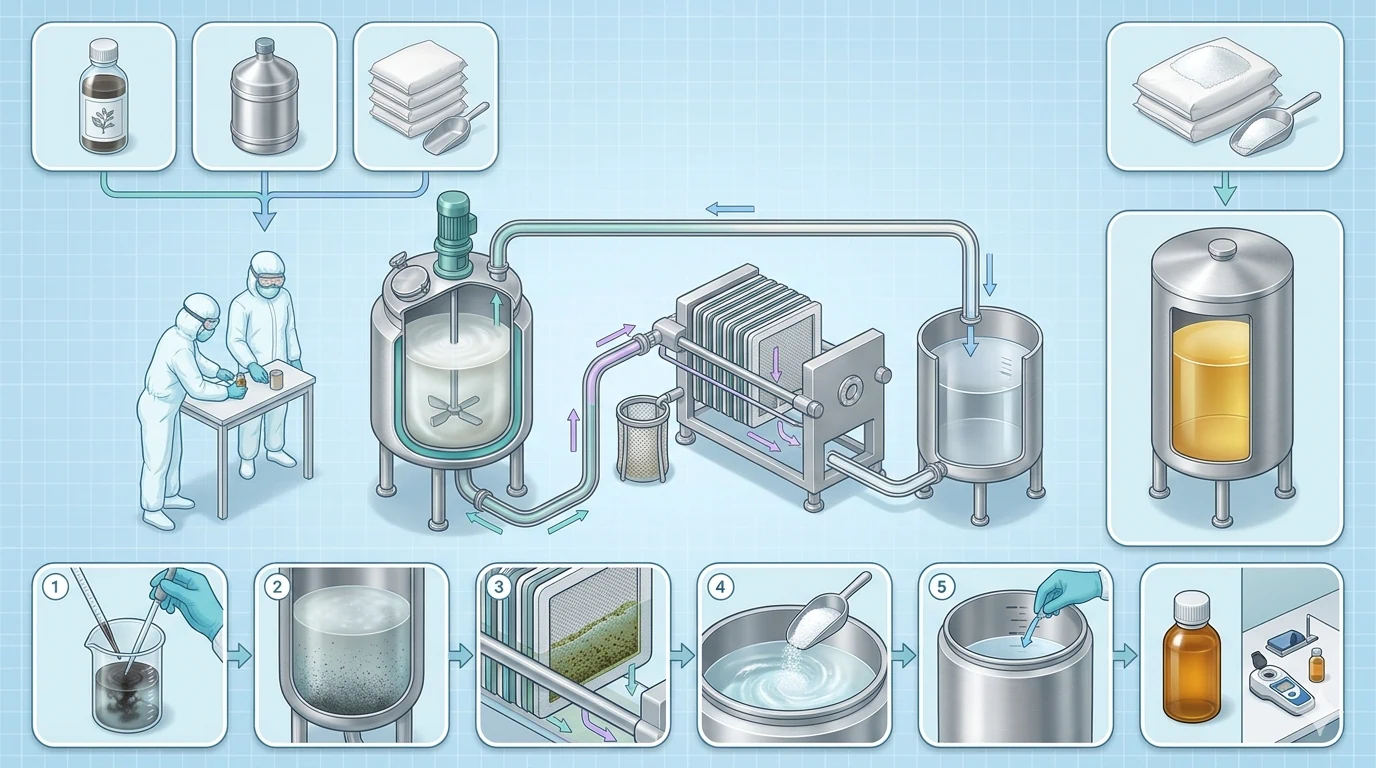
First, take line clearance from the (IPQA) officer, and put the “under process” status label on all equipment. Mix the dispense material (as per BMR) in water. operator records the time actually allowed, which is set in development by how quickly the haze settles.
The filter press, or a basket or bag filter, is vented. The first filtrate is recirculated until the clarity check passes, and only then is the outlet opened to the clear tank. After that, sucrose is added to the filtrate with stirring, and heat dissolves it faster, but heat-sensitive or volatile components are better handled by agitation without heat. Hot processes are generally kept below 70 °C.
Tinctures are flammable, so they are handled only in the permitted solvent area with the electrical equipment rating that the site’s explosion-protection rules (ATEX in the EU) require.
READ ALSO
Liquid Syrup Types and Manufacturing Process
Liquid syrup types and manufacturing process explained: simple, medicated and flavoured syrup, preparation methods, formulation.
What controls and records apply?
The production officer performs an in-process control for clarity on the filtrate and again on the finished syrup. record the all online actitvity in BMR, also records the final volume or weight, the yield and the reconciliation. Quality Assurance (QA) verifies these entries before release. The sucrose strength is checked after make-up. This is needed because the extract replaces part of the water and the filtrate volume differs from the volume used. For reference, the United States Pharmacopeia (USP) Simple Syrup monograph gives 850 g of sucrose per 1000 mL (85% w/v) with a specific gravity of not less than 1.30. The same base is discussed in simple syrup concentration as per IP and USP.
What problems occur, and how are they fixed?
Haze or sediment in the filtered syrup: the stand time was too short or the filter too coarse. Raise a deviation first, refilter after review, and then revise the stand time through change control.
Filter blockage: the diluted extract carries heavy resinous matter. Then replace the pads, and consider a filter aid after development and QA approval.
Low assay after filtration: the active was partly removed with the precipitate, so the active content before and after filtration should be compared during development. A water-insoluble active needs a different vehicle, such as a co-solvent, a suspension or a solubilizer.
Sediment on storage: late precipitation shows that separation was incomplete, so the label storage condition must come from stability data.
Frequently Asked Questions
A concentrated syrup is viscous, so it filters slowly, and it can hold fine precipitate in suspension, whereas filtering the thin, water-diluted extract is faster and gives a clearer filtrate.
Talc or kaolin can act as a filter aid for liquid preparations. It is added last, shaken and then filtered, and its use in a given syrup needs approval through development and change control.
Plants use basket or bag filters and a filter press with mesh and non-woven pads, and zero hold-up filters are also used. The filtrate is recirculated until clear. Only then does it move to the clear tank.
The method is not suitable when the water-insoluble fraction carries any of the activity, because filtration would remove part of the active and lower potency. Herbal extracts have no single active pharmaceutical ingredient (API), and the activity may be spread over several constituents. The resin should then be kept dispersed instead, for example by adding the tincture with rapid stirring or with a protective agent such as acacia mucilage.
References
- Syrups, Pharmaceutical Technology I, University of Basrah College of Pharmacy
- USP 32-NF 27 Syrup (Simple Syrup) monograph, USP
- USP-NF Aromatic Elixir (USP32), DrugFuture
- Elixir Department SOP for Preparation and Addition of Sugar Syrup v 2.0
- Ansel’s Pharmaceutical Dosage Forms and Drug Delivery Systems, Lippincott Williams & Wilkins
- 21 CFR Part 211, US FDA

Naresh Bhakar is the Founder and Author at Pharmaguddu.com, bringing his extensive expertise in the field of pharmaceuticals to readers worldwide. He has experience in Pharma manufacturing and has worked with top Pharmaceuticals. He has rich knowledge and provides valuable insights and data through his articles and content on Pharmaguddu.com. For further inquiries or collaborations, please don’t hesitate to reach out via email at [email protected].