
GMP & Pharmaceutical Manufacturing Expert
✓ Reviewed by: Naresh Bhakar
Reviewed for pharmaceutical accuracy
📅 Last Updated: November 22, 2026
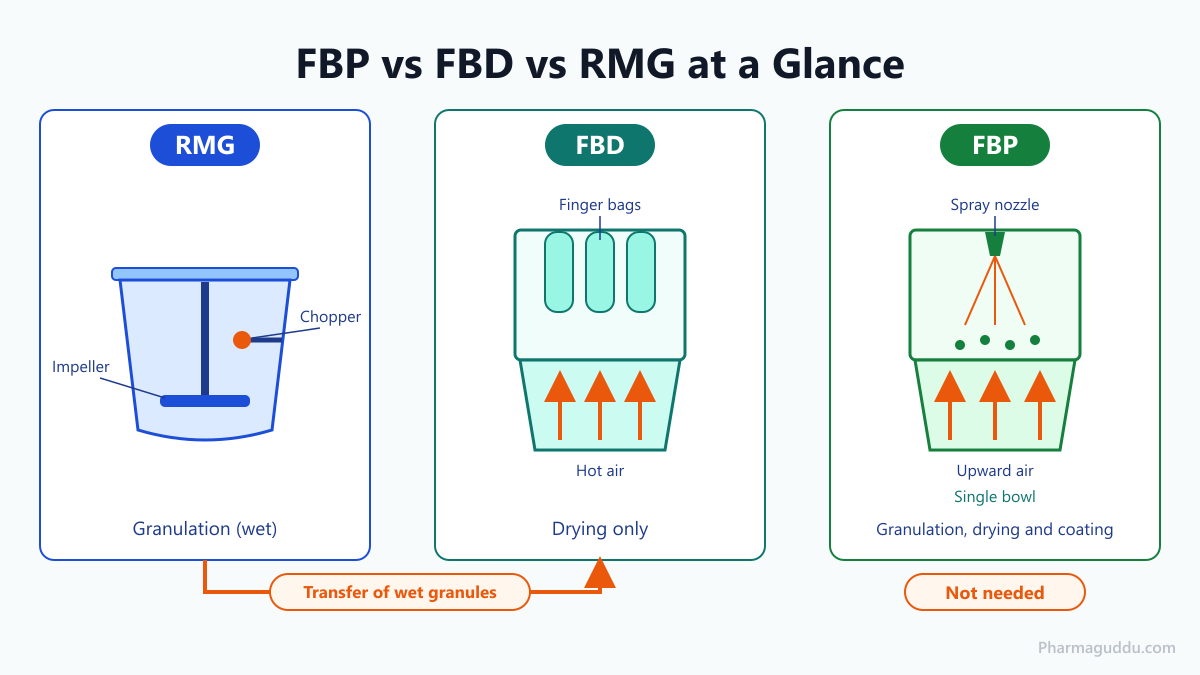
In the fluid bed processor vs FBD vs RMG comparison, a fluid bed dryer (FBD) only dries granules, and a rapid mixer granulator (RMG) only makes wet granules. A fluid bed processor (FBP) performs granulation, drying and coating in one bowl. The usual route is RMG followed by FBD, which needs one transfer of wet granules between two machines. An FBP removes that transfer. The saving in time, workforce and cost depends on the product, the batch size and the cleaning load.
What are a fluid bed dryer, an RMG and a fluid bed processor?
For the full overview of the processor, see fluid bed processor. The processor is compared here with the two machines it is most often measured against.
Fluid bed dryer (FBD)
An FBD dries wet granules or powder. Hot or dehumidified air flows upward through the product bowl at a velocity higher than the settling velocity of the particles, so the bed moves like a boiling liquid. The air surrounds every particle, meaning that heat transfer is high and the bed temperature is uniform. Lump formation and case hardening are therefore reduced.
Contact with low-temperature air is short, so an FBD suits heat-sensitive products. It is not suitable for liquids or pasty material, and the wet granules come from a separate granulator. Details are given in the post on the fluidized bed dryer (FBD).
Rapid mixer granulator (RMG)
A Rapid Mixer Granulator (RMG) is also called a high shear granulator. It has a bowl with a lid, a main impeller and a chopper. Others parts including; Separate motors, a discharge port and a filter. The impeller mixes the dry powder and the binder is then added. After that, the impeller and chopper knead the wet mass into dense granules. An RMG forms wet granules only, so a dryer is needed afterwards, most commonly an FBD. See the post on the rapid mixer granulator for its construction.
Fluid bed processor (FBP)
An FBP extends the FBD with spray nozzles, a binder system and interchangeable inserts. These inserts allow top, bottom or tangential spray. Granulation, drying and coating can therefore run in the same bowl.
Fluid bed processor vs FBD vs RMG: how do they compare side by side?
The table summarizes the main points. They can be vary as per the manufacturer and model.
| Point | RMG | FBD | FBP |
|---|---|---|---|
| Main function | Granulation (wet) | Drying only | Granulation, drying and coating |
| Granule formation | Impeller and chopper knead the wet mass | None | Spray of binder on a fluidized bed |
| Transfer of wet granules | Needed to the dryer | Receives them from the RMG | Not needed |
| Granule | Denser, stronger | As received | More porous, dissolves well |
| Parts to clean | Bowl, impeller, chopper, filter bag | Bowl, finger bags, distribution plate | FBD parts plus nozzles, tubing and inserts |
| End point | Impeller power or torque, or hand test | Exhaust air temperature and LOD | Spray end and LOD |
| Suited to | High-dose, poorly flowing API | Heat-sensitive granules | Low-to-medium dose products |
READ ALSO
Fluid Bed Processor (FBP), Principle, and Working
The fluid bed processor (FBP), principle, and working: hot filtered air fluidizes granules so granulation.
What are the key differences between FBP, FBD and RMG?
Material transfer between steps
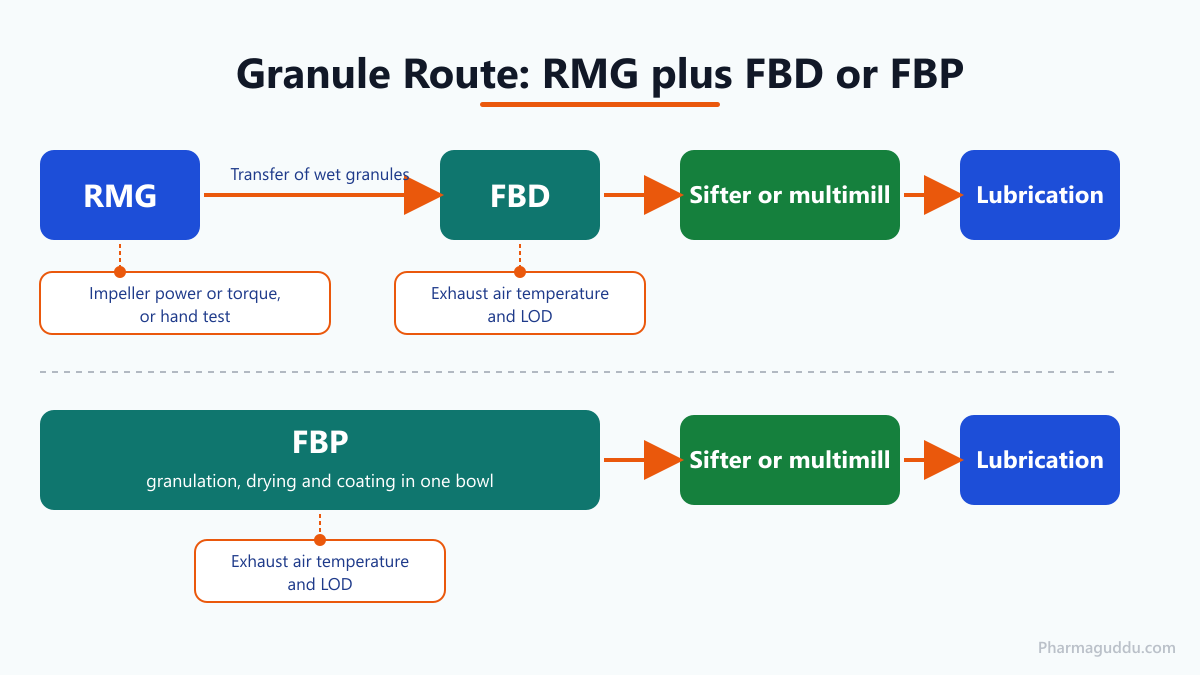
Wet granules are transferred directly into the FBD below the RMG outlet. In order to allow discharge, the FBD must be detected by the FBD sensor. The dried granules are then transferred to the sifter/multi-mill and lubrication. As the multi-mill and sifter operate independently, granulation of a second batch can occur in parallel with drying of the first batch. If an FBP is used, this transfer is avoided. However, the single vessel is occupied for the entire process.
Granule properties and formulation
Granules produced by fluid bed granulation will generally be more porous, with improved dissolution performance, but less mechanically strong. Granules produced by high shear have greater density and stability. The effect of granulation method on dissolution and compressibility should be confirmed in formulation development batches.
Scaling up Differences in scale up can occur. In RMG processes, impeller speeds depend on bowl size. However, at larger scales, tip speed becomes more important. In FBP processes, the spray rate and air flow must be scaled. For example, in a top spray process with a water binder, spray rates increased from 100-150mL/min (15kg) to 600-900mL/min (225kg).
End points and records
Endpoints for granulation are determined by monitoring amp load (impactor power/torque) or manual checking. As the wet mass becomes denser and stickier, the power will increase rapidly. Endpoints for drying are determined by achieving the target moisture content. This is confirmed by an in-process control (IPC) for loss on drying (LOD). It can be determined by monitoring product/bed temperature, which increases as evaporation reduces. There is no numerical endpoint given in any pharmacopoeia or by regulatory bodies, therefore endpoints are specific to products. Endpoints are determined during product development. Both endpoints are recorded in the batch manufacturing record (BMR) by the production officer.
An IPC result outside the limit in the BMR must be raised as a deviation. The batch must not move to the next step until quality assurance (QA) has reviewed it. See moisture content and loss on drying for the test itself.
Cleaning and bag handling
An RMG is cleaned at the bowl, impeller, chopper and filter bag. An FBD is cleaned at the bowl, finger bags and distribution plate. An FBP adds the nozzles, tubing and inserts. The cleaning validation protocol selects the swab points from the hardest-to-clean parts of each machine. FDA’s guide on validation of cleaning processes describes fluid bed dryer bags as equipment that is difficult to clean and is often dedicated to a specific product.
We have seen FBP cleaning validation as harder because of its geometry and inserts, but no independent source quantifies this. The protocol must therefore show it for each machine.
Both FBD finger bags and RMG filter bags follow the same routine in one plant’s procedure. They are cleaned and dried at 70–80 °C for 30–40 minutes, checked for integrity at issue and receipt, and stored dry in product-specific cabinets. Bags that fail the check go back to stores or are scrapped, as described in the standard operating procedure (SOP) for FBD bags (FBD bag SOP).
Qualification
The equipment is qualified through design qualification (DQ), installation qualification (IQ), operational qualification (OQ) and performance qualification (PQ). The process and the cleaning are validated as well. One manufacturer’s FBD can be upgraded to a top-spray processor with a modified main body, a spray nozzle, a peristaltic pump, silicone tubing, a liquid storage tank and changes to the PLC software. The DQ must show these items, as in the design qualification of an FBD.
When should each machine be used?
The choice depends on the dose, the flowability of the API, the granule strength needed and the validation package already available.
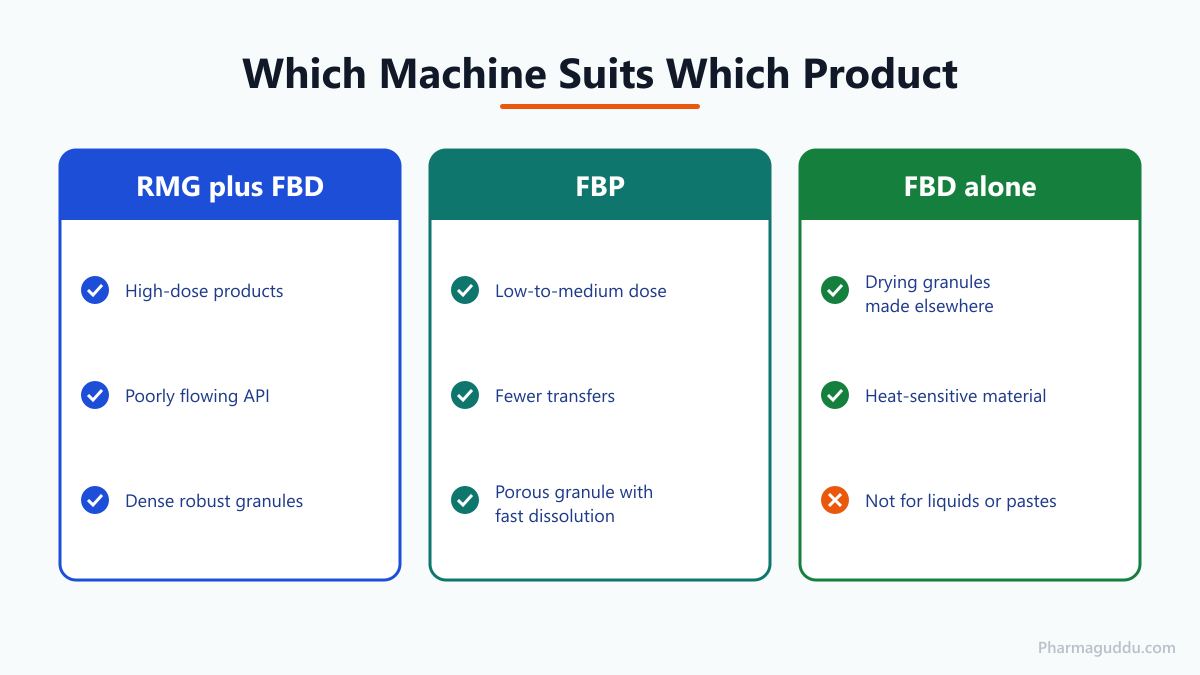
RMG plus FBD: that already hold a validated process and cleaning package for the two machines.
FBP: A porous granule with fast dissolution is a further reason to choose it.
FBD alone: this machine suits drying of granules made elsewhere, including heat-sensitive material. It cannot dry liquids or pastes.
What are the common mistakes with these machines?
- Using the terms interchangeably. An FBD only dries, while an FBP also granulates and coats. A batch record written for one cannot be used for the other.
- Running the RMG for a fixed time. The granulation end point is read from power or torque, or by a hand test.
- Discharging before the bowl is in position. The bowl sensor must detect the FBD bowl under the RMG discharge.
- Storing bags wet. Bags must be completely dry and stored in the product-specific cabinet, otherwise the next batch is exposed to residue and moisture.
- Ignoring faults in the fluid bed. Channelling or dead zones come from a poor distribution plate or an overloaded bowl. Wet lumps and torn finger bags (product loss or filter failure) also need attention.
- Overlooking FBP-specific faults. Nozzle blockage and over-wetting can stop or ruin a granulation run.
- Handling fine, dry material without caution. Static can build up in it during fluidization.
References
- GEA Fluid bed processors, GEA
- The Effect of the Chopper on Granules from Wet High-Shear Granulation Using a PMA-1 Granulator, PMC
- Fluid-bed granulation study, PMC
- ICH Q13 Continuous Manufacturing of Drug Substances and Drug Products, Step 5, EMA
- Procedures for cleaning, storage and material movement of FBD finger bags and RMG filter bags (internal documents)

Naresh Bhakar is the Founder and Author at Pharmaguddu.com, bringing his extensive expertise in the field of pharmaceuticals to readers worldwide. He has experience in Pharma manufacturing and has worked with top Pharmaceuticals. He has rich knowledge and provides valuable insights and data through his articles and content on Pharmaguddu.com. For further inquiries or collaborations, please don’t hesitate to reach out via email at [email protected].