
GMP & Pharmaceutical Manufacturing Expert
✓ Reviewed by: Naresh Bhakar
Reviewed for pharmaceutical accuracy
📅 Last Updated: November 20, 2026
Sucrose crystallization in syrup occurs when the sugar concentration is too close to its solubility limit and some of the water is lost or the temperature falls. Dissolved sucrose then leaves the solution as crystals, often at the bottle neck and cap. Crystals are prevented by controlling the concentration (°Brix), dissolving and filtering all the sugar, and adding stabilizers such as glycerin, sorbitol solution or propylene glycol. These polyols hold water and reduce the sucrose fraction, while surfactants only keep other ingredients dissolved.
Why does sucrose crystallize in syrup?
Syrup is a concentrated, viscous aqueous solution of sucrose or a sugar substitute. Syrup Indian Pharmacopoeia (IP) contains 66.7% w/w sucrose, and sucrose dissolves in water to about 200 g per 100 mL at 20–25 °C, which is also close to 67% w/w. Syrup is therefore close to saturation at room temperature, with very little margin. For the full overview of syrup types and manufacture, see liquid syrup types and manufacturing process. The preservation principle is explained in simple syrup concentration as per IP and USP.
How does crystallization start?
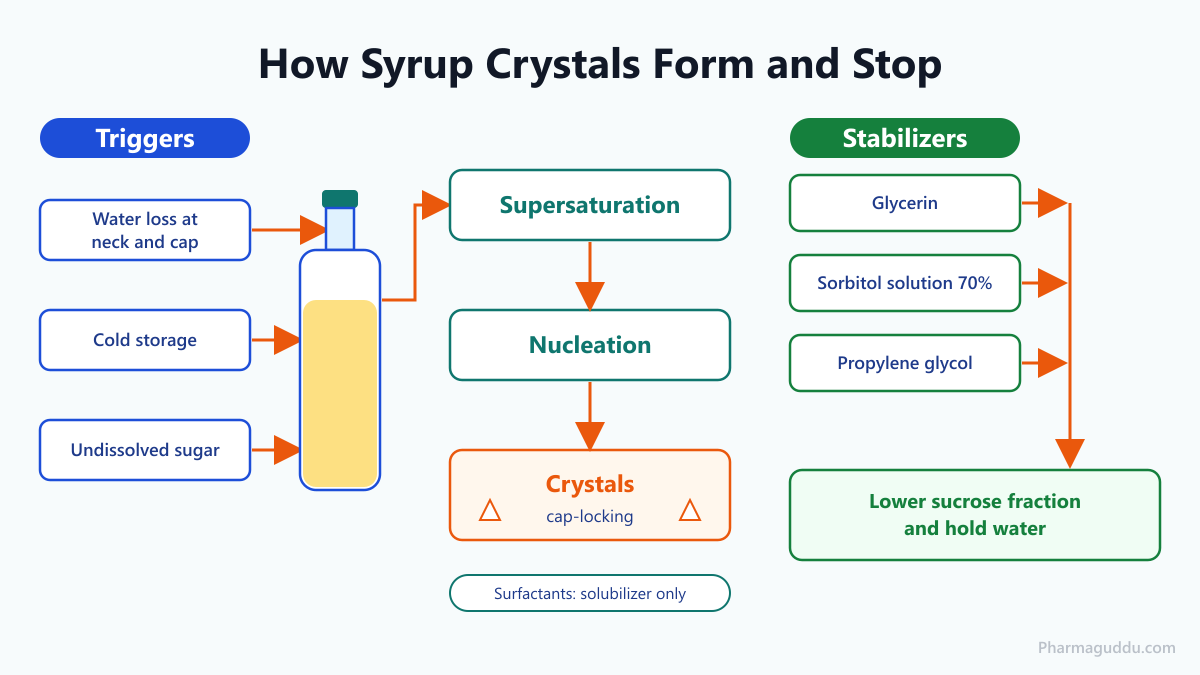
Crystals form in two stages. First, the solution becomes supersaturated, which means it holds more sucrose than it can keep dissolved. Then nucleation begins, and the first small crystals act as seeds on which more sucrose deposits.
Three situations trigger this in practice. Water evaporates at the bottle neck and cap, so the sugar concentration rises locally. Cold storage lowers the solubility of sucrose, because solubility rises with temperature. Undissolved sugar particles or dust also act as ready-made seeds. Crystals that grow in the thread and glue the cap to the bottle are called cap-locking.
How do glycerin, sorbitol and propylene glycol prevent crystals?
Stabilizers may be referred to as crystallization inhibitors, co-solvents, humectants or stabilizers depending on their function. As a group, they reduce the concentration of sucrose, retain moisture and increase the viscosity of the syrup, meaning less sucrose will come to supersaturation, and crystal growth will occur more slowly. The concentration used in formulations will depend on development work and will vary between different syrups.
| Excipient | Main function | Practical point |
|---|---|---|
| Glycerin | Humectant, co-solvent | Also reduces cap-locking; adds sweetness and viscosity |
| Sorbitol solution 70% (non-crystallizing grade) | Stabilizer, sugar replacer | A blend of polyols that resists crystallization; a supplier states it stays liquid to about −5 °C |
| Propylene glycol | Co-solvent, humectant | Can change taste, and its level in paediatric products needs care |
| Glucose syrup | Crystallization inhibitor | A supplier states that its polysaccharide part inhibits crystals; it is still a sugar |
Sorbitol that is not a non-crystallizing grade can itself crystallize, so the grade is a critical material attribute. Sorbitol can also cause a laxative effect at high intake. Every stabilizer changes water activity, so the preservative system must be re-evaluated whenever the sucrose level is reduced. Glycerin and sorbitol are used in the same way as humectants in toothpaste.
Do surfactants prevent crystallization?
No. Surfactants act as solubilizers, which dissolve poorly soluble actives or flavours and keep the syrup clear. They do not stop sucrose from crystallizing. They can also cause foaming during mixing and a change in taste, so only the minimum level found in development studies should be used.
How is a syrup prepared to avoid crystals?
The steps below describe the preparation as it is done on the floor.
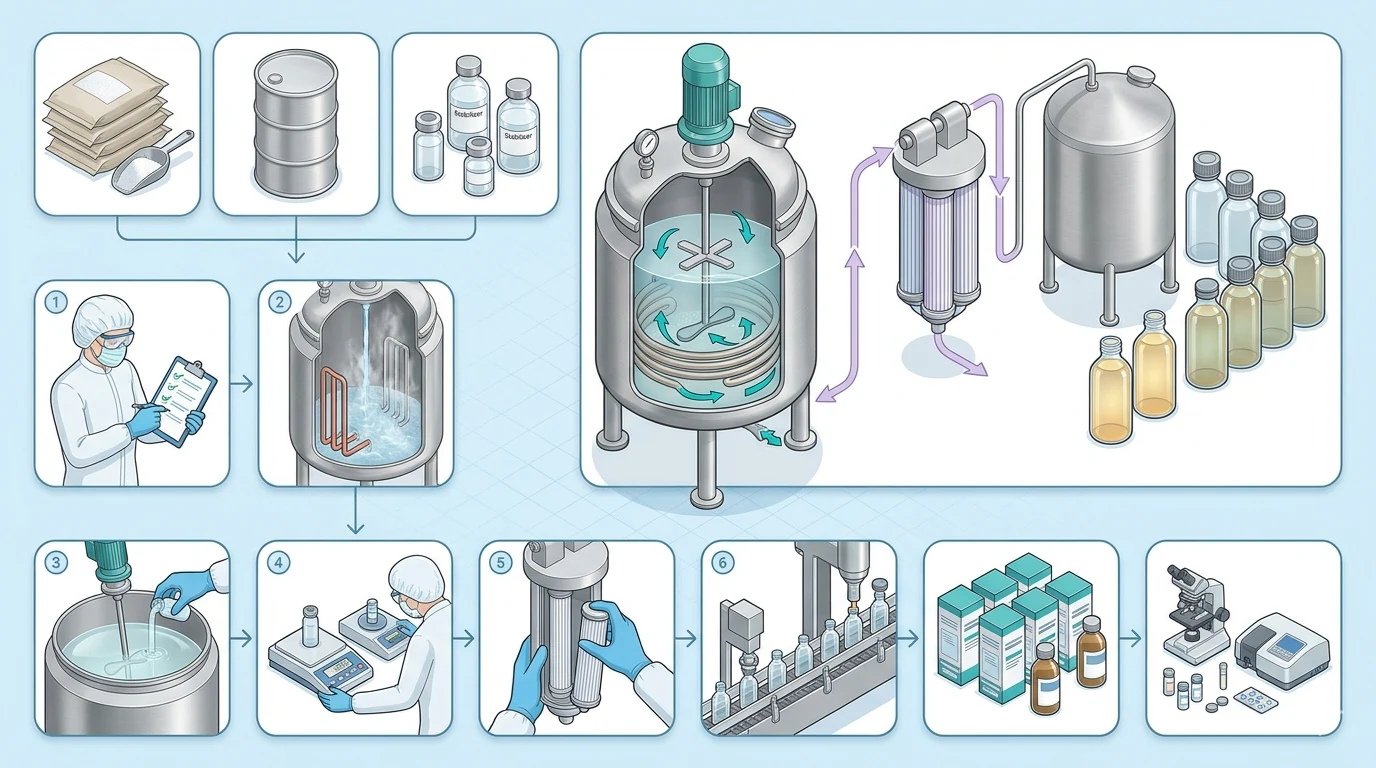
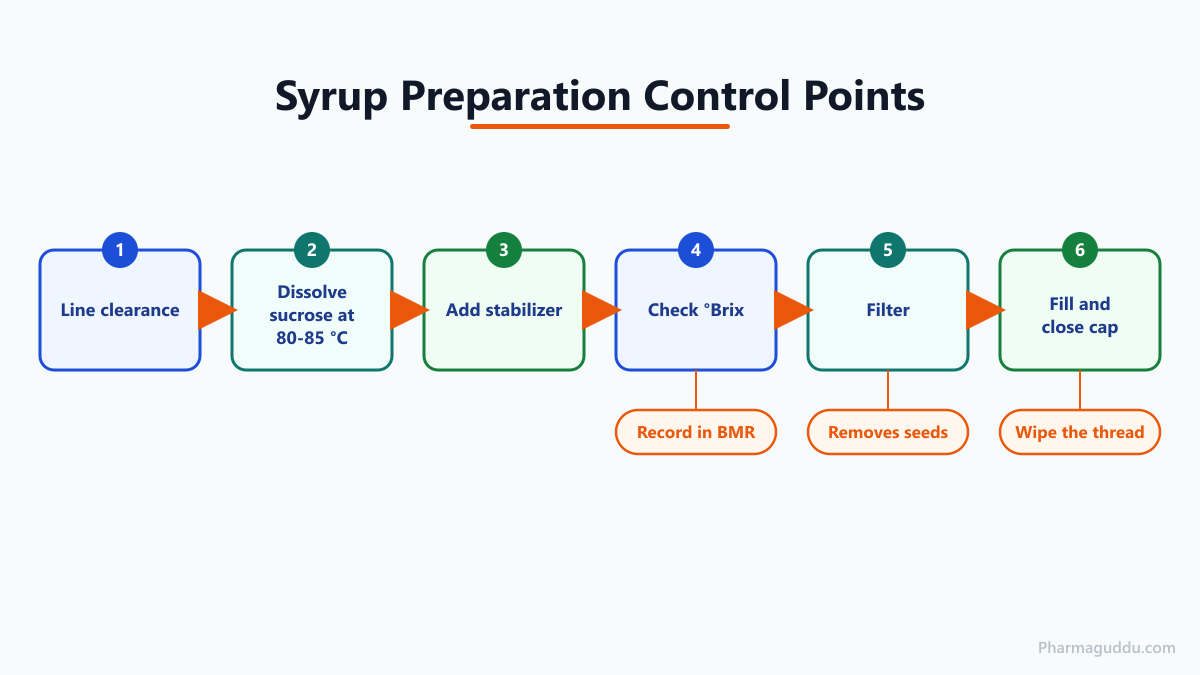
- First take line clearance from IPQA Officer and Affix the “under process” status labels on the dissolving tank, filter and storage tank.
- Heat the purified water to 80–85 °C, and add the sucrose slowly under stirring. Gentle heating is enough, and prolonged heating or acidic conditions cause inversion, which changes colour and taste.
- Add the stabilizer while the syrup is still warm, and continue stirring until the solution is clear.
- Cool the syrup and check °Brix or specific gravity. The reading is recorded in the batch manufacturing record (BMR). Silverson, a mixer manufacturer, states that heating and cooling can itself cause crystallization, and that its high-shear mixer makes a 66% sucrose syrup at ambient temperature.
- Filter the syrup through the sugar pre-filter or cartridge filter, so that undissolved particles that could seed crystals are removed.
- Fill the bottles, wipe the thread and close the cap tightly.
What are the controls and critical process parameters?
Quality attributes include clarity, lack of crystallisation, concentration of sucrose, pH and antimicrobial effectiveness. Critical process parameters include temperature of dissolution, time of dissolution and filtration. Critical material attributes include quality of sucrose and grade of sorbitol.
| Parameter | Typical setting or range | Why it matters | How it is monitored |
|---|---|---|---|
| Dissolution temperature | 80–85 °C for heat-stable components | Complete dissolution, but too much heat causes inversion | Temperature probe, BMR entry |
| Concentration | Finished syrup close to 66.7% w/w; vendor process range 60–75 °Brix | Overshooting towards saturation causes later crystals | Refractometer or specific gravity; inline refractometer where fitted |
| Filtration | Until the syrup is clear | Removes seeds | Visual clarity check, filter record |
| Storage | Below 25 °C, well-closed container, protected from light | Cold and evaporation promote crystals | Warehouse temperature record |
What are the common problems and fixes?
| Problem | Cause | Corrective action |
|---|---|---|
| Crystals at the cap | Evaporation at the neck, dirty thread, weak liner | Wipe the thread, replace the liner, store upright and tightly closed |
| Crystals after cooling | Concentration too close to saturation | Reduce the sucrose level or add a stabilizer, and recheck °Brix |
| Crystals after cold storage | Lower solubility in the cold | Store below 25 °C and not in a refrigerator |
| Crystals after filtration | Undissolved sugar passed the filter | Extend dissolution, check the filter and refilter |
| Dark colour, changed taste | Prolonged heating or acid causing inversion | Shorten heating time and check pH |
What are the regulatory points?
Stability studies follow International Council for Harmonisation (ICH) Q1A(R2), and the appearance of the product, including clarity and crystals, is checked against the specification at each stability time point.
Expert Tips
- Check the sorbitol grade at receipt. The store officer and the Quality Control (QC) analyst must confirm that the label reads non-crystallizing sorbitol solution, and the grade is recorded in the receipt record; the wrong grade can crystallize in the syrup.
- Confirm dissolution before filtering. The production officer checks that no sugar remains at the bottom of the tank, otherwise it reaches the filter and seeds crystals.
- Record °Brix with the temperature. The operator writes the reading and the temperature in the BMR, because QC cannot compare the result with the specification without it.
- Wipe the thread during filling. The filling operator removes syrup from the neck before capping, and a residue left there dries and causes cap-locking.
- Add a cold-cycle study during development. The formulation team keeps samples through cold and warm cycles and checks clarity and crystals, so that the problem is found before the market sees it.
References
- Production of cough mixtures and pharmaceutical syrups, Silverson
- Syrup plant, Engineering
- Sugar Solubility in Water, Engineering ToolBox
- Lachman and Lieberman, The Theory and Practice of Industrial Pharmacy

Naresh Bhakar is the Founder and Author at Pharmaguddu.com, bringing his extensive expertise in the field of pharmaceuticals to readers worldwide. He has experience in Pharma manufacturing and has worked with top Pharmaceuticals. He has rich knowledge and provides valuable insights and data through his articles and content on Pharmaguddu.com. For further inquiries or collaborations, please don’t hesitate to reach out via email at [email protected].