
GMP & Pharmaceutical Manufacturing Expert
✓ Reviewed by: Pankaj Sharma - Quality Control Specialist
Reviewed for Quality Control accuracy, laboratory practices, analytical methods, and technical relevance
📅 Last Updated: November 5, 2026
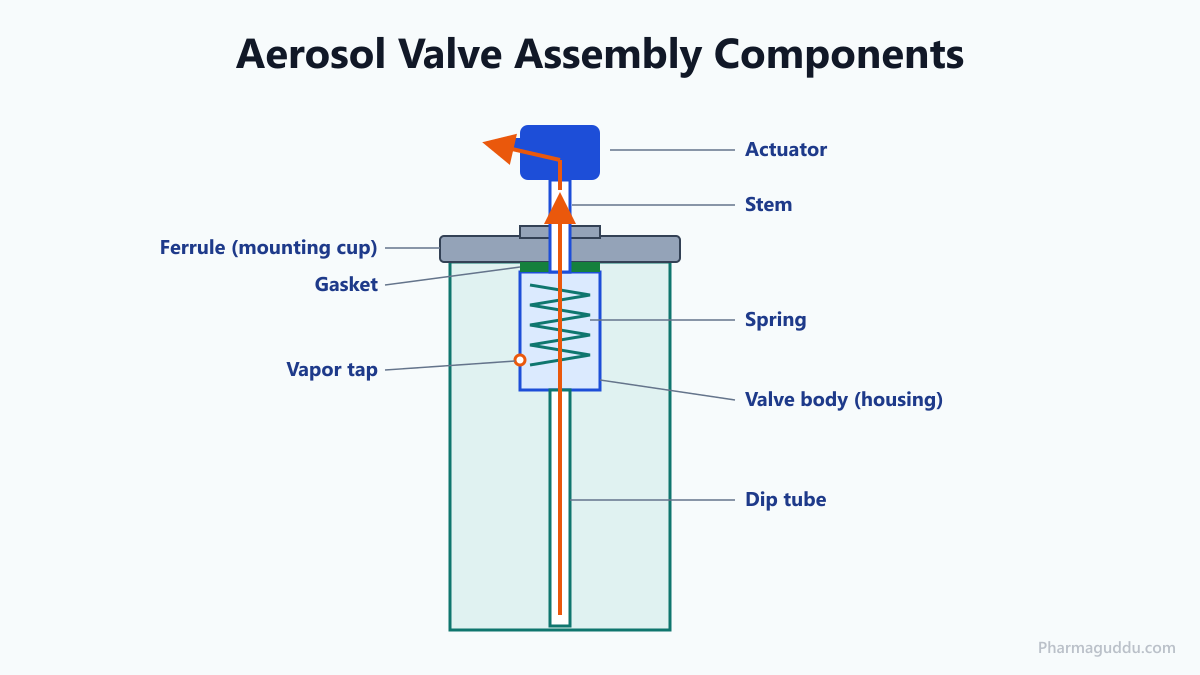
The aerosol valve and actuator components are the ferrule (mounting cup), valve body, stem, spring, gaskets, dip tube and actuator. The ferrule is crimped onto the container and holds the valve in place. The dip tube carries liquid from the container bottom to the valve body. The stem passes the product to the actuator, which shapes the spray. A metering valve adds a fixed-volume chamber with inner and outer seals, so that each actuation delivers one dose. Each part has a typical failure mode, such as leakage, clogging or loss of prime.
What Are the Aerosol Valve and Actuator Components?
A pharmaceutical aerosol is a pressurised container with a valve that releases the product when the actuator is pressed. The full overview is given in Aerosol in Pharma (Aerosols); Types, Container, Advantage, and Disadvantage. The present article describes the valve assembly part by part.
The valve assembly consists of a ferrule, valve body (housing), stem, gaskets, spring and dip tube. This list follows a published review of pressurised metered-dose inhaler (pMDI) valve components (PMC3969498). Metered versions also contain a metering chamber with inner and outer seals. The research for this article is mainly based on pMDI sources. The metering parts are therefore described for inhalation products, and the general valve is described separately.
Related topic: aerosol propellants in pharmaceuticals
Related topic: two-phase and three-phase aerosol systems
How Does the Valve Release the Product?
When the actuator is pressed, the stem moves down against the spring and opens the product path. The vapour pressure of the propellant pushes the liquid up the dip tube, through the valve body and out through the stem. The product leaves the actuator through its nozzle orifice. When the actuator is released, the spring returns the stem and the seals close the path again.
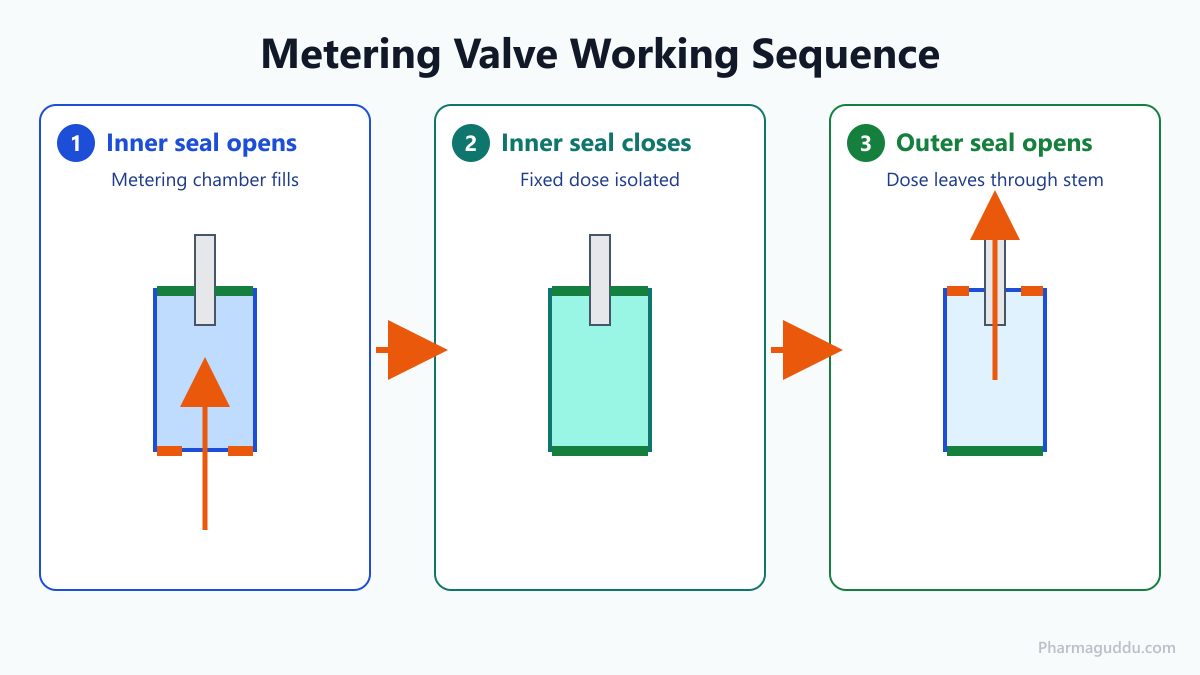
In a metering valve, the inner seal opens first and fills the metering chamber from the bulk formulation. It then closes and isolates a fixed dose. The outer seal opens next, and the propellant vapour pressure expels the isolated dose through the stem (PMC3969498).
Main Components and Their Functions
Ferrule (Mounting Cup)
The ferrule is the crimped metal part that holds the valve on the container neck. In this article, “ferrule” means the metal part, and “actuator” means the button or cap that the user presses.
Function: the ferrule gasket seals the valve against the container, so that propellant does not escape and moisture does not enter. The ferrule gasket and the diaphragm are the critical seals for leakage and moisture ingress (PMC3969498).
Valve Body (Housing) and Vapor Tap
The valve body is the housing that sits below the ferrule. It carries a hollow nipple that receives the dip tube.
In general (non-metered) aerosol valves, the housing may also have a small orifice called the vapor tap (vapour tap). The orifice lets some propellant vapour mix with the liquid before it reaches the stem (US4393984A). Our Aerosols article links this feature to a finer spray and a lower risk of valve clogging.
Stem, Spring and Gaskets
The stem is the channel that carries product from the valve body or metering chamber to the actuator. The spring keeps the stem closed and returns it after each actuation. The gaskets close the stem orifice and the housing. A metering gasket forms a face seal against the stem to isolate the dose in the chamber (US7748378). A retaining cup, where fitted, holds the formulation in the chamber and reduces loss of prime.
Dip Tube
The dip tube runs from the valve body to the bottom of the container. It carries liquid product and propellant up to the valve when the actuator is pressed. The dip tube is a plastic tube, which is made of polyethylene or polypropylene.
Actuator
The actuator is pressed onto the valve stem. The formulation passes from the stem into the actuator expansion chamber and leaves through the nozzle orifice (US7748378). The orifice dimensions influence the spray pattern and the particle size of the plume. Actuators are made in different forms, such as spray buttons, foam heads, and mouthpieces for metered inhalers. In an inhaler, the mouthpiece also directs the dose towards the patient.
What Is the Difference Between a Continuous Valve and a Metering Valve?
A continuous-spray valve releases product for as long as the actuator is held down. A metering valve releases one fixed volume per actuation.
| Feature | Continuous-spray valve | Metering valve |
|---|---|---|
| Typical use | Topical and space products | Inhalation products (pMDI) |
| Dose control | By the user, through spray time | By the metering chamber volume |
| Vapor tap | Often present | Not a typical feature |
| Extra parts | None | Metering chamber, inner and outer seals |
| Main failure mode | Clogging, leakage | Loss of prime, dose variability |
Metering chamber volume and orifice sizes differ with each valve model. Exact values depend on the manufacturer and model; always follow the OEM manual and site SOP. More on inhalation products is given in Inhalation Preparation | Aerosol | MDI and Standard Test.
How Are Valves Assembled and Crimped on the Filling Line?
The valve is fitted to the container in the following sequence:
- The valve is placed on the container neck by the valve placer.
- The ferrule is crimped onto the neck.
- The propellant is filled by cold fill or pressure fill, and in some processes the air is removed by vacuum crimping.
- The filled container is tested for leaks and checkweighed.
- The actuator is fitted, and the unit is packed.
The crimp diameter and crimp depth decide how far the ferrule gasket is compressed. An under-crimped valve leaks, and an over-crimped valve may damage the gasket. The limits are the valve-maker specified crimp dimensions. They are not a universal value. The production officer measures the crimp height at start-up and at intervals, and the results are recorded in the batch manufacturing record (BMR). Each such check is an in-process control (IPC). An out-of-range result is handled as a deviation.
Key Operating Parameters
| Parameter | Control point | Basis |
|---|---|---|
| Crimp diameter and depth | Crimping station | Valve-maker specification |
| Crimp height | IPC at start-up and at intervals | Valve-maker specification |
| Container leak test | After propellant filling | Product specification |
| Net weight | Checkweigher | Batch record limits |
| Delivered dose or shot weight | QC release testing | Product specification |
What Do the Regulations Say About Valve Components?
Regulation (EU) 2024/573 on fluorinated greenhouse gases was adopted on 7 February 2024 and started to apply on 11 March 2024 (European Commission, Climate Action). It states that HFCs used in metered dose inhalers have been integrated into the quota system. This moves pMDI makers towards low-GWP propellants, which affects valve seals.
The US FDA guidance on MDI and DPI drug products (docket FDA-2018-D-1098) gives recommendations on the development and manufacture of inhalation aerosols and powders. USP lists delivered-dose uniformity (USP <601>), spray pattern and leak rate (USP <5>) as quality tests for inhalation aerosols. These products deliver the dose through a metered valve system, so the results are influenced by valve performance. The tests apply to the whole product (valve, actuator and formulation), and leak rate also depends on the container closure.
Recent Technology Trends
The main change in the last two to three years is the move to low-GWP propellants. The EU F-gas Regulation 2024/573 (March 2024) placed metered dose inhalers in the HFC quota system. A propellant change needs a change record and re-qualification of valve materials.
In July 2025, Bespak described a hybrid valve with EPDM seats and a bromobutyl neck gasket for HFA-152a and HFO-1234ze (International Pharmaceutical Industry). This is a manufacturer claim. In May 2024, Bespak and DevPro announced the development of an albuterol pMDI with HFO-1234ze(E) (OINDP News). Bespak also lists actuators with integrated dose counters.
Common Problems and Troubleshooting
| Problem | Likely cause | Action |
|---|---|---|
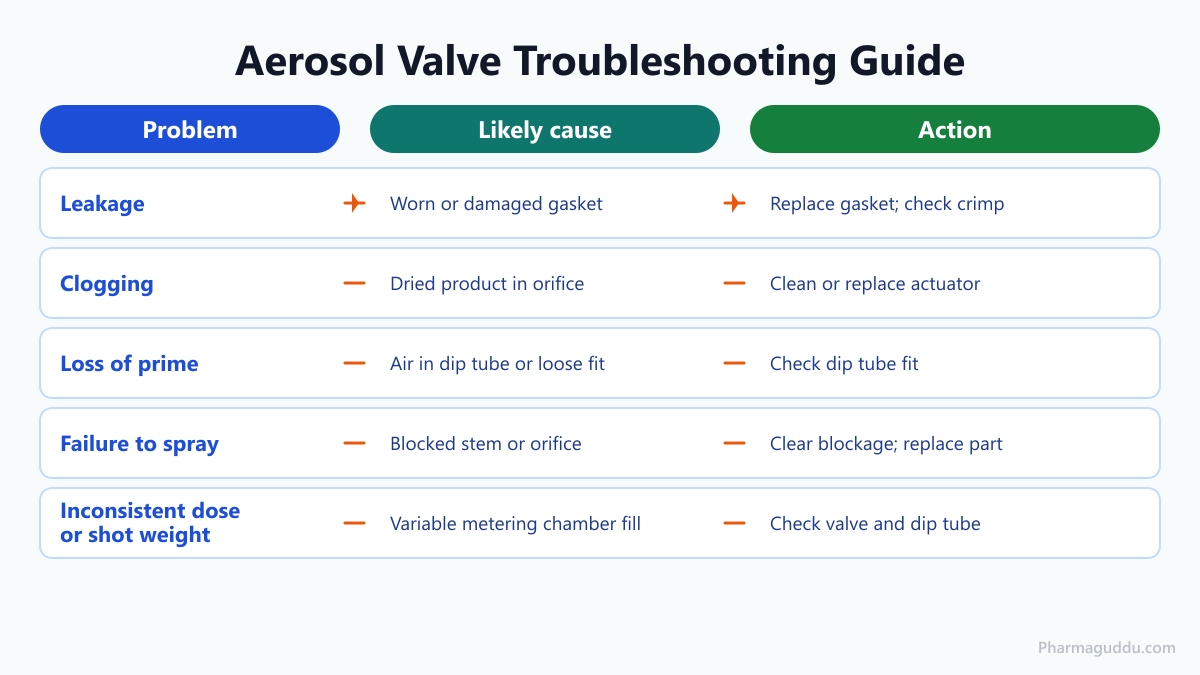
| Leakage | Worn or damaged gasket, wrong elastomer grade, incorrect crimp | Check crimp dimensions, replace the gasket, review the material |
| Clogging | Blocked vapor tap or actuator orifice | Clean the actuator, review the formulation |
| Loss of prime | Formulation drains from the metering chamber in storage, or vapour forms in temperature cycling | Review the metering design, retaining cup or inlet |
| Failure to spray | Blocked dip tube, stem or orifice, or an empty container | Inspect the dip tube and stem |
| Inconsistent dose or shot weight | Swollen seals, wrong elastomer, damaged chamber | Re-qualify the valve materials |
Elastomers such as EPDM, nitrile and chloroprene are used in pMDI valves, and the choice depends on the formulation and propellant. EPDM tends to swell less than nitrile in HFA formulations, and swelling changes the valve force and metering accuracy (PMC3969498).
Maintenance and Safety Requirements
Filling equipment is cleaned at changeover. The QA officer carries out line clearance so that valves, dip tubes and actuators of the previous product are removed. Valve type and dip tube length are checked, since a mix-up changes the delivery of the product.
Flammable propellants are handled in classified (ATEX) areas with grounded equipment. Pressurised containers are handled with care, because damaged cans can rupture.
Our Expert Tips
- Record the crimp. Enter crimp height results in the BMR at every interval.
- Follow the valve maker. Use only valve-maker specified crimp dimensions.
- Treat a propellant change as a change. Raise a change record and re-qualify the valve seals.
- Replace worn gaskets. Damaged gaskets cause leakage and dose variability.
- Keep parts segregated. Store valves and actuators of different products separately.
- Clean actuators. A blocked orifice changes the spray pattern.
Frequently Asked Questions
The ferrule is the metal cap crimped onto the container neck. It holds the valve in position. Together with its gasket, it seals the container, so that propellant does not leak out and moisture does not enter the product.
The dip tube runs from the valve housing to the container bottom. When the actuator is pressed, the propellant pressure pushes the liquid product up the dip tube, through the valve and out through the actuator. This lets an upright container dispense.
A metering valve has two seals that work in sequence. The inner seal opens, fills a fixed-volume chamber and closes. The outer seal then opens, and the propellant pressure expels the chamber contents through the stem. The chamber volume decides the dose.
Loss of prime occurs when the formulation drains from the metering chamber during storage, or when vapour forms during temperature cycling. The first actuation then delivers a low dose. Retaining cups and narrow inlets are used in valve designs to reduce it.
Rubber seals can swell in contact with the propellant or release extractables into it. Swelling changes valve force, dose and leachables. For this reason, the elastomer is selected for the specific formulation and propellant and is re-qualified when either changes.
Summary
The aerosol valve assembly works through the ferrule, valve body, stem, spring, gaskets and dip tube, with the actuator shaping the spray. A metering valve adds a fixed-volume chamber for dose control. Correct crimping, suitable elastomers and clean actuators prevent most failures.
References
- Review of pMDI valve components (PMC3969498), PubMed Central
- US6039306A Aerosol valve, Google Patents
- US4393984A Vapor tap valve for aerosols, Google Patents
- Metering valve for a metered dose inhaler providing consistent delivery, USPTO
- F-gas legislation, European Commission, Climate Action
- FDA: MDI and DPI Drug Products, Quality Considerations, US FDA
- Bespak IPI amended, International Pharmaceutical Industry
- Bespak and DevPro developing HFO-1234ze albuterol MDI, OINDP News

Naresh Bhakar is the Founder and Author at Pharmaguddu.com, bringing his extensive expertise in the field of pharmaceuticals to readers worldwide. He has experience in Pharma manufacturing and has worked with top Pharmaceuticals. He has rich knowledge and provides valuable insights and data through his articles and content on Pharmaguddu.com. For further inquiries or collaborations, please don’t hesitate to reach out via email at [email protected].