
GMP & Pharmaceutical Manufacturing Expert
✓ Reviewed by: Naresh Bhakar
Reviewed for pharmaceutical accuracy
📅 Last Updated: November 29, 2026
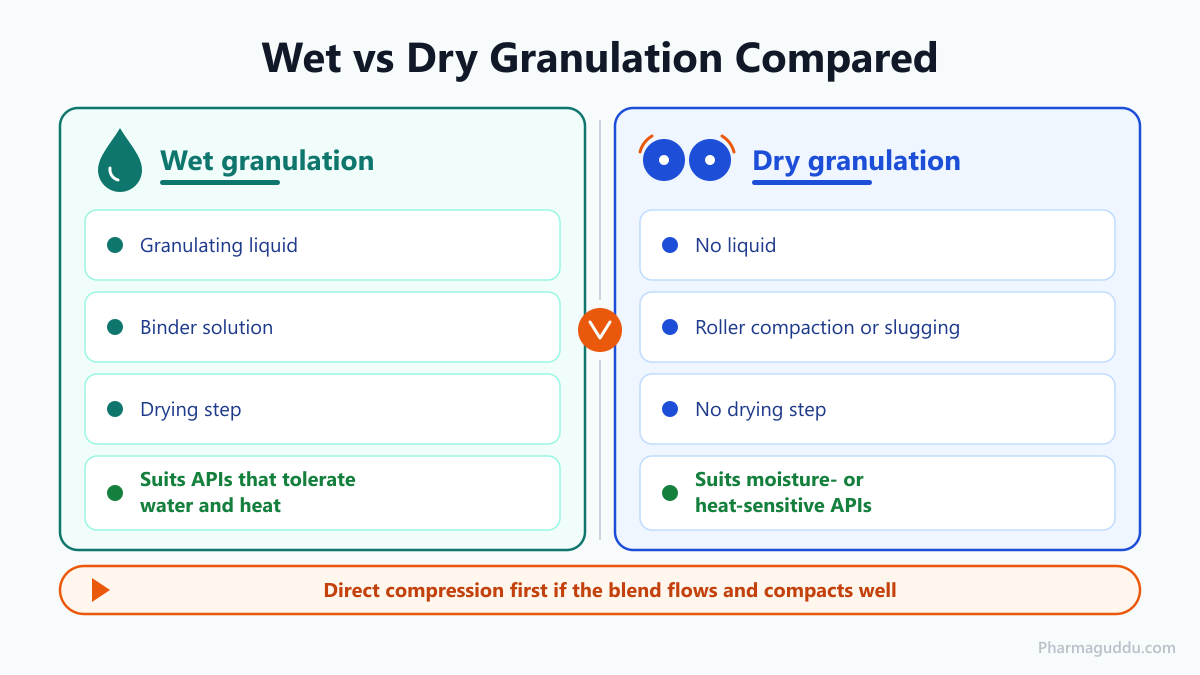
The choice in wet vs dry granulation depends on How API is sensivity with water and heat. Wet granulation produce dense mass of powder and tten finally dried using FBD. In case of Dry granulation, Roller compactor or Slugging is done without using binder solution and drying steps. Dry granulation helpfull for moisture-sensitive or heat-sensitive APIs that form strong compacts. Wet granulation helpful for APIs that tolerate water and heat, and it also usefull for formulations where a binder is needed. If the blend already flows and compacts well, direct compression should be considered first.
What Are Wet Granulation and Dry Granulation?
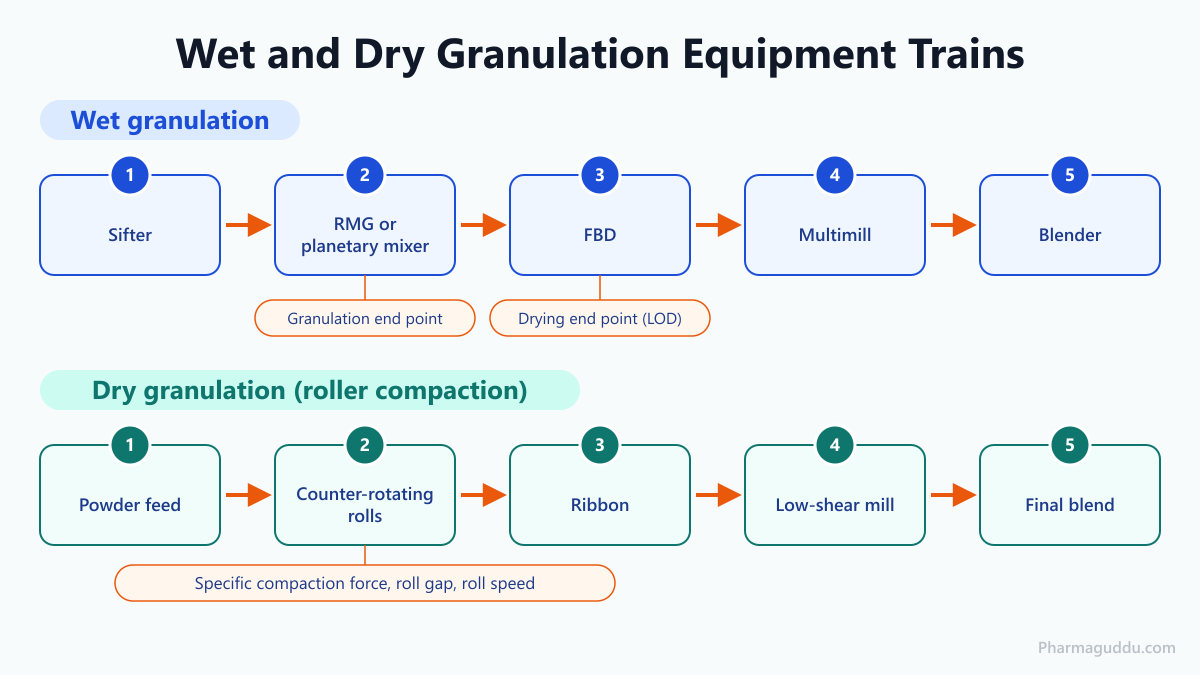
Wet granulation forms a mass of powder after adding solution, i.e. a binder solution or a solvent. The solvent bound particles tougher (called adhesion), after that it is dried using FBD and finally milled to get uniform size of powder. For the full overview of both types, see granulation technique in tablet manufacturing.
Dry granulation forms granules by compression, without using any liquid. In roller compaction, the main dry technique, the powder is pressed between two counter-rotating rolls, here we get the ribbon like mass. The ribbon is then milled using multi-mill before the final blend. Slugging is the older technique, in which large flat slugs/tablets are made on a compression machine.
Wet vs Dry Granulation: Comparison Table
| Criterion | Wet granulation | Dry granulation (roller compaction) |
|---|---|---|
| Granulating liquid | Water, ethanol or isopropyl alcohol (IPA) | None |
| Binder | Binder solution needed | No liquid binder; the powder must form strong compacts |
| Drying step | Required, in a fluidized bed dryer (FBD) or tray dryer | Not required |
| Moisture- or heat-sensitive API | Unsuitable with water; solvent route possible if the API is heat-tolerant | Suitable |
| Main equipment | Sifter, rapid mixer granulator (RMG) or planetary mixer, FBD, multimill, blender | Roller compactor with mill, blender |
| Utilities | Purified water, steam or hot air for drying | Power for the drives and force system |
| Critical process parameters (CPPs) | Binder amount and addition rate, impeller and chopper speed, wet massing time, drying end point | Specific compaction force, roll gap, roll speed |
How Do Wet and Dry Granulation Differ in Practice?
Moisture, heat and solvents
Roller compaction is a dry process and so is appropriate for compounds that become unstable in the presence of water. Wet granulation using heat and water is not appropriate for both thermolabile and hygroscopic APIs. For water sensitive but heat stable APIs, ethanol or IPA can be used in place of water. Apparatus used must be suitable for explosive atmospheres (ATEX) and solvent recovery is also necessary. Residual solvents should be within ICH Q3C guidelines.
Binder and compactibility
Generally, water is not an effective binder and so a binder such as povidone (PVP K-30) dissolved in water is commonly added. Dry granulation requires the powder to be highly compressible.
Energy, time and equipment
A 2024 peer-reviewed comparison found the roller compactor the most time-efficient method. In the high shear wet process around 84% of energy is consumed by the drying step and only around 15% by the granulator. The wet process requires a binder solution supply, high shear mixer, fluid bed drier and typically also an automatic clean in place system. Therefore, investment and running costs are increased. After equipment has been qualified, granulation is then validated in both processes.
Scale-up
Neither process can be directly scaled. Neither can impeller speed from a 10L vessel be applied to an RMG. Roller compacters are designed to apply a defined compaction force (kN/cm of roll width) and the gap between the rolls is changed to maintain this. Ribbon density is therefore more consistent.
When Should Each Method Be Chosen?
This is defined as part of product development and related to CQAs (ICH Q8(R2)). Tablet hardness, dissolution and content uniformity can be influenced by compression force, and binder used.
- If the blend already flows and compacts well, choose direct compression.
- If the API is moisture- or heat-sensitive but the blend compacts well enough, choose roller compaction.
- If the API is water-sensitive but heat-tolerant, choose wet granulation with ethanol or IPA.
- If the API tolerates water and heat, choose aqueous wet granulation. It is preferred when a binder is needed for flowability, density, the uniformity of a low-dose drug or the wetting of a poorly wettable API.
Potent APIs need containment in both methods to limit operator exposure to dust. For an approved product, a change of method and process must pass through change control, with impact assessment, revalidation and quality assurance (QA) approval before implementation.
What Mistakes Are Common in Each Method?
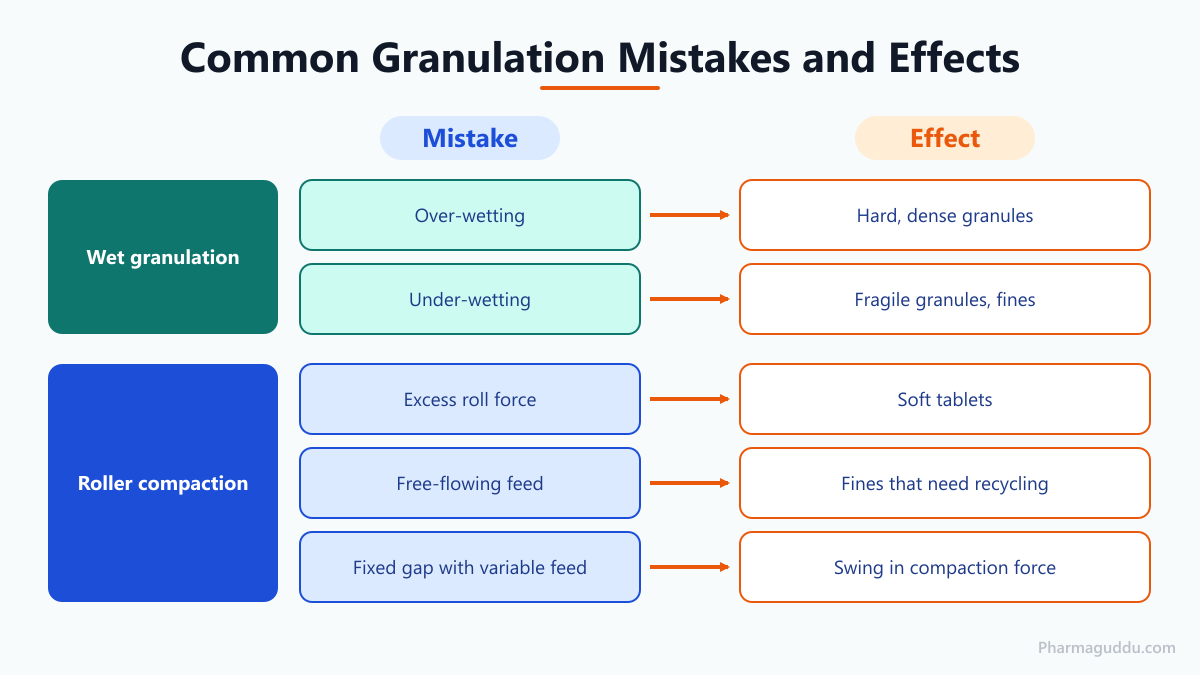
This image describe the wet and dry granulation mistakes and their effects on Granules.
Expert Tips for the Granulation Floor
Take line clearance before granulation. The production officer and the in-process quality assurance (IPQA) officer check the area, equipment, sieves, screens, status labels, temperature and relative humidity (RH), and both sign the checklist.
Record the granulation end point. During the process of wet massing, the operator records online activity such as granulation time and the final ammeter reading in the batch manufacturing record (BMR). The time comes from the process validation (PV) protocol, not from operator feel.
Confirm the drying end point by Limit of Detection (LOD). Check loss on drying (LOD) on an infrared (IR) moisture balance against the product limit. Inlet and outlet temperatures, such as 55–60 °C and 50–55 °C in one product, are product-specific.
Send in-process samples to Quality Control (QC). Quality control (QC) tests the wet granules for sieve analysis, bulk density and blend assay as per the PV sampling plan. For roller compaction, ribbon attributes and granule particle size are checked.
Reconcile the yield before handover. Record the material taken, the dry granules obtained and the granulation loss in the BMR. Then hold the labelled blend in double poly bags until QA clearance.
Frequently Asked Questions
No, granulating liquid or liquid binder is used in dry granulation. The powder must form compacts of enough strength on its own, and one 2015 review gives a minimum tensile strength of about 0.5 MPa. If the API compacts poorly, a dry binder such as microcrystalline cellulose (MCC) or povidone may be added to the blend.
Under the FDA guidance on Scale-Up and Postapproval Changes for immediate-release products (SUPAC-IR, 1995), a change in the type of process is a Level 3 change. Its only named example is wet granulation to direct compression. A Level 3 change needs a prior approval supplement, together with Case B dissolution and stability data. Unless a suitable in vitro/in vivo correlation has been verified, an in vivo bioequivalence study is also required.
References
- Granulation techniques and technologies: recent progresses, BioImpacts (Shanmugam, 2015)
- Comparing granulation techniques, GEA
- Roller compaction: stable, continuous production for oral solid dosage forms, Manufacturing Chemist / PCI Pharma Services (2026)
- Chopper effect on PMA-1 granulation, Briens and Logan (2011)
- Effects of granulation process variables on the physical properties of dosage forms, Asian Journal of Pharmaceutical Sciences (Thapa et al., 2018)
- Influence of equipment design and process parameters on granule breakage in a semi-continuous fluid bed dryer, Pharmaceutics (Ryckaert et al., 2021)
- Guidance for Industry: SUPAC-IR, Immediate Release Solid Oral Dosage Forms, US FDA CDER (November 1995)
- Q13 Continuous Manufacturing of Drug Substances and Drug Products, US FDA
- Considerations for Complying with 21 CFR 211.110 (draft guidance, January 2025), US FDA
- ICH Q8(R2) Pharmaceutical Development, International Council for Harmonisation
- ICH Q3C Impurities: Guideline for Residual Solvents, International Council for Harmonisation
- Master formula record and batch manufacturing record, lamivudine and stavudine tablets (wet granulation), internal documents.

Naresh Bhakar is the Founder and Author at Pharmaguddu.com, bringing his extensive expertise in the field of pharmaceuticals to readers worldwide. He has experience in Pharma manufacturing and has worked with top Pharmaceuticals. He has rich knowledge and provides valuable insights and data through his articles and content on Pharmaguddu.com. For further inquiries or collaborations, please don’t hesitate to reach out via email at [email protected].