
GMP & Pharmaceutical Manufacturing Expert
✓ Reviewed by: Naresh Bhakar
Reviewed for pharmaceutical accuracy
📅 Last Updated: November 29, 2026
Dry granulation is a method in which granules are formed by mechanical pressure alone, without any Liquid binder and without a drying step. So, it is suitable for drugs which are sensitive to moisture and heat. In slugging, the powder is compressed into large tablets on a compression machine, but the die filling is uneven. In roller compaction, an auger pushes the powder into the nip between two rolls and gives a ribbon of more uniform density. Hence, now days roller compaction has largely replaced slugging.
:::
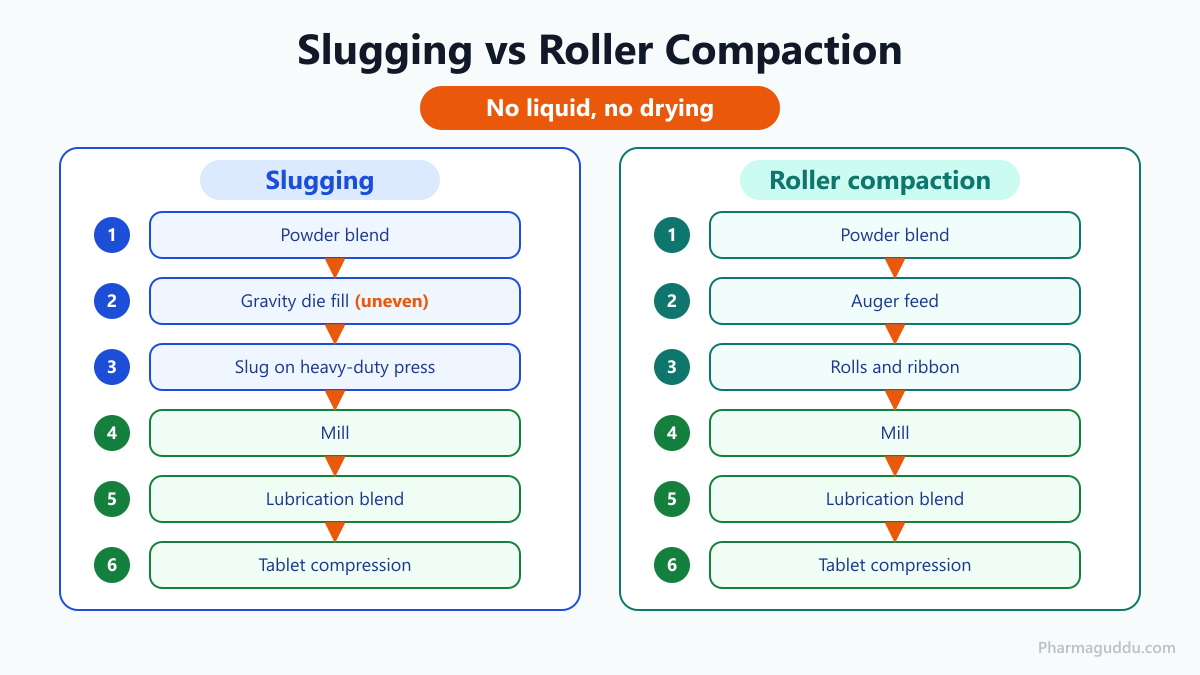
What is dry granulation and how do the two routes differ?
Dry granulation is a method in which the powder is first compressed into the tabelts (called slugging). After that, the tablets is milled into granules, then lubricated and compressed into tablets. Roller compaction does not use any moisture, so it is suitable for compounds which are unstable in contact with water, and there is no granule drying step. For the full overview of all methods, see granulation technique in tablet manufacturing.
Slugging (dry granulation on a heavy-duty tablet press) is done by compressing the powder into large, flat-faced tablets called slugs. After that, the slugs are milled. Here, slug tooling and force depend on the press and the product.
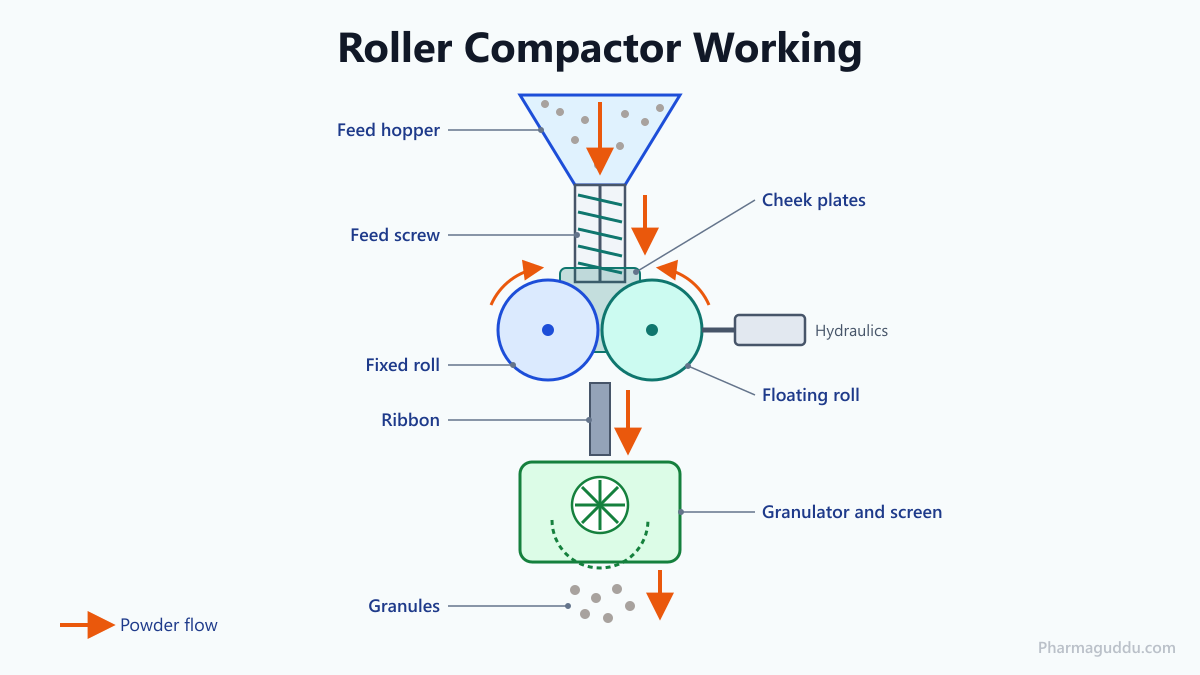
Roller compaction is done on a roller compactor. Here, the feed hopper and feed screw deliver the powder to two counter-rotating rolls, where one roll is fixed and the other floats on hydraulics. The powder is squeezed into a dense ribbon, and then an integrated low-shear granulator with a screen mills the ribbon.
How do slugging and roller compaction compare?
| Feature | Slugging | Roller compaction |
|---|---|---|
| Feed | Gravity fill of the die | Auger (screw) feed into the nip |
| Force control | Press compression force | Specific compaction force (kN/cm of roll width) with roll gap |
| Output | Discrete slugs | Continuous ribbon |
| Throughput | Slow, dedicated press | Higher, suits continuous lines |
| Dust | Dusty, higher cross-contamination risk | Lower with a contained design |
| Tooling wear | Punches and dies wear | Rolls, cheek plates and scrapers wear |
| Fines | From milling hard slugs | From edge leakage and weak ribbon edges |
| Scale-up | Needs a larger press | kN/cm carries across roll widths |
Key differences explained
The uneven feed problem of slugging
Powder falls from the hopper through the feed frame into the die (Gravity feeding), and then the knife blades scrapes off the extra powder. Fine and cohesive powders do not fill the die evenly, so the slug weight varies and each slug gets a different force. Because of this, the slugs have different strength, and the granules after milling vary in size and density. If an auger feed is fitted on the compression machine, then, it is treated as an equipment change and needs validation on tablet hardness and weight.
Force control and ribbon quality
In a roller compactor, the auger feeds the powder smoothly, so the ribbon density is more uniform. The critical process parameters are including; compaction force, roll gap, roll speed, feed screw speed, and granulator screen size and rotor speed. In a lab study on a BRC 25 compactor, when the compaction force was raised from 2 to 18 kN/cm, As a result, ribbon microhardness and granule failure load increased, while roll speed changed the throughput but not the granule hardness.
Process sequence and controls
The process is done in this order: dispensing, line clearance, slugging or roller compaction, milling, lubrication blend, compression, coating (if needed) and packing. First, Production and the in-process quality assurance (IPQA) officer check the area for line clearance as per the line clearance checklist attched with BMR. On starting compression, check the slug weight and hardness. On the compactor, check the ribbon thickness or solid fraction, and after the mill check the granule size distribution and bulk density. The BMR also records the screen size, speed and screen condition before and after milling. After that, samples go to quality control (QC), and the next step starts only after that.
Loss of compactability
Granules made by roller compaction give softer tablets than the original powder at the same force. This is called loss of compactability or loss of tabletability (sometimes work hardening). So the target ribbon solid fraction should not be higher than what the product needs.
When should these equipments be used?
Roller compaction is mainly used for drugs which are sensitive to moisture and heat. It also uses less energy than wet granulation.
Slugging is also used today. It is best for small batches when no compactor is available.
In general, dry granulation gives more fines than wet granulation. It does not work well with very cohesive or low bulk density drugs, and low-dose drugs or colour are distributed less uniformly. If you want to change from slugging to roller compaction, it needs change control and a validated dry granulation process.
Common mistakes
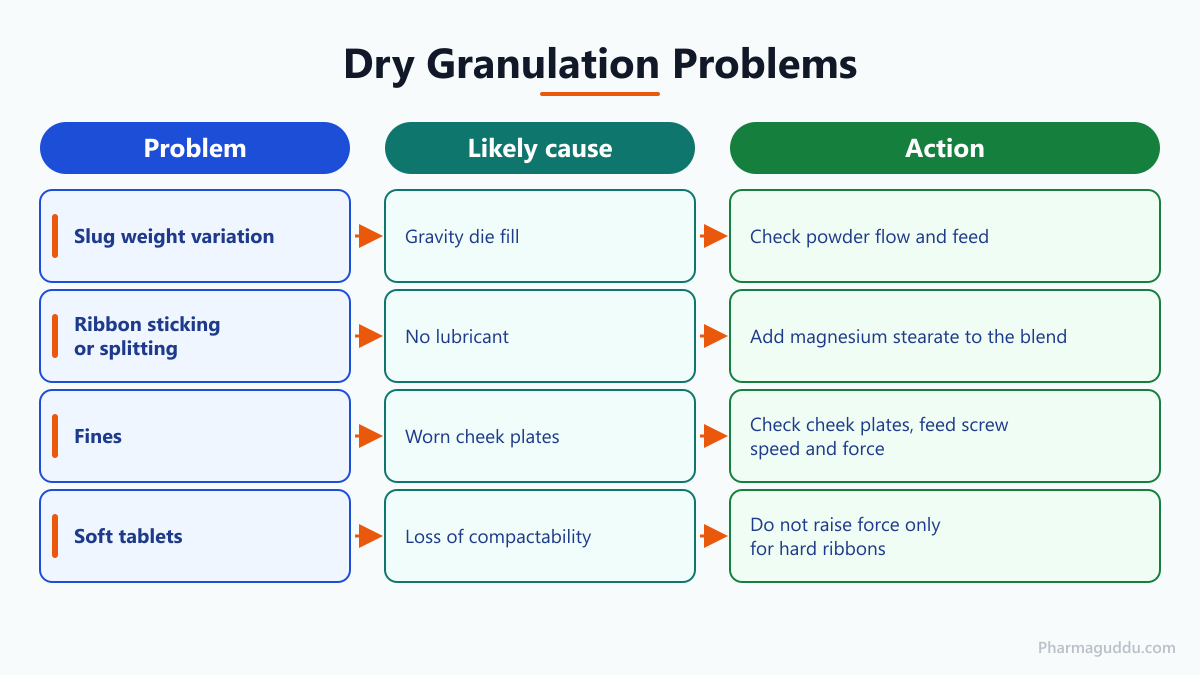
Above image is the description of dry granulation problem, causes and action against it.
If the force or gap is outside the approved range, the screen can be damaged or the slug weight is out of limits, then, raise a deviation.
Recent technology trends
Ribbon density can be monitored in real time using near-infrared (NIR) spectroscopy or roll torque trends. In September 2026, the contract manufacturer Rottendorf Pharma commissioned Gerteis roller compactors, as reported by Pharmaceutical Online. The ICH Q13 guidance on continuous manufacturing is listed by FDA as final (March 2023).
Frequently Asked Questions
It is the specific compaction force, i.e. The total roll force divided by the roll width. Because of this, machines with different roll widths can be compared and scaled. Lab studies have used about 2 to 18 kN/cm.
For brittle lactose the effect is negligible. For plastic materials like microcrystalline cellulose (MCC), a dwell time below about 100 ms, i.e. A higher roll speed, lowers the ribbon solid fraction.
For ribbon density NIR spectroscopy is used, or roll torque and throughput can be used to predict granule failure load in line.
References
- DQ CMB4D27 E14 (section 4), Plant library
- LAMISTAR 30 BMR Plant document’s
- Process validation change classes Plant documents

Naresh Bhakar is the Founder and Author at Pharmaguddu.com, bringing his extensive expertise in the field of pharmaceuticals to readers worldwide. He has experience in Pharma manufacturing and has worked with top Pharmaceuticals. He has rich knowledge and provides valuable insights and data through his articles and content on Pharmaguddu.com. For further inquiries or collaborations, please don’t hesitate to reach out via email at [email protected].