
GMP & Pharmaceutical Manufacturing Expert
✓ Reviewed by: Pankaj Sharma - Quality Control Specialist
Reviewed for Quality Control accuracy, laboratory practices, analytical methods, and technical relevance
📅 Last Updated: November 6, 2026
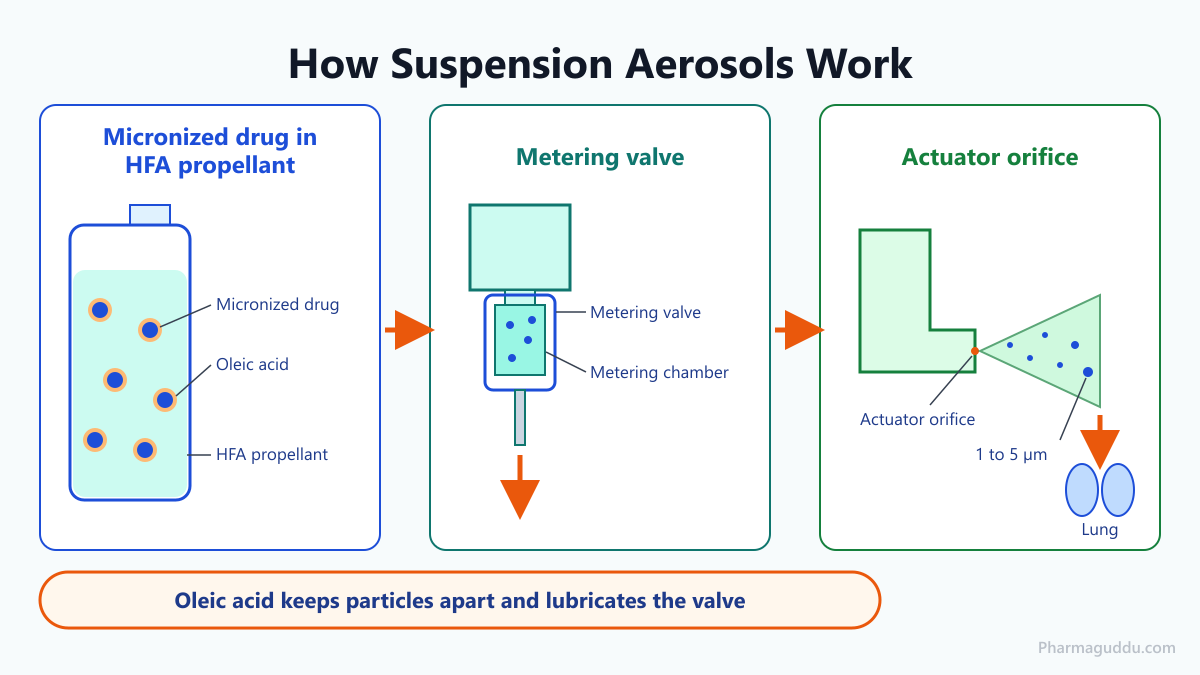
Suspension aerosols are pressurised metered-dose inhalers (pMDIs) in which micronized, insoluble drug is dispersed in a liquefied propellant. The drug particles must have an aerodynamic size of roughly 0.5 to 5 µm to reach the lung. Particles of this size tend to agglomerate, settle and stick to valve parts. A surfactant such as oleic acid adsorbs on the particle surface, keeps the particles apart and lubricates the metering valve. Moisture control, a uniform suspension during filling and in-process controls (IPC) keep the dose accurate and the valve free from clogging.
What Are Suspension Aerosols and Where Are They Used?
A suspension aerosol is a pressurised metered-dose inhaler (pMDI), also called an inhalation aerosol, in which solid drug particles are dispersed but not dissolved in a liquefied propellant. A metering valve releases a fixed volume of the suspension at each actuation, and the actuator directs the spray towards the patient’s mouth.
This form is chosen when the drug does not dissolve in the propellant or is unstable in solution. A solution pMDI holds the drug fully dissolved. A cosolvent is usually present. Aerosol in Pharma: Types, Container, Advantage and Disadvantage gives the full overview of aerosol types, containers and advantages. The classification of the systems is explained in Two-Phase vs Three-Phase Aerosol Systems. Only the formulation and filling problems that are specific to suspensions are described here.
How Does Particle Size Affect Lung Deposition and Dose Accuracy?
Aerodynamic size, not geometric size, decides where a particle deposits in the respiratory tract. It is expressed as the mass median aerodynamic diameter (MMAD), the diameter below which 50% of the dose mass lies. The full spread of sizes is the aerodynamic particle size distribution (APSD). It is measured with a cascade impactor.
Particles of roughly 0.5 to 5 µm (aerodynamic diameter) reach the lower airways, and the smaller ones penetrate deeper into the lung. Larger particles impact in the mouth and throat, and very small particles may be exhaled. For this reason the drug is micronized, usually in a jet or air-attrition mill. The general principles are described in Size Reduction: Significance, Mechanisms, Factors and Methods.
Particles of roughly 1 to 5 µm (MMAD) reach the lower airways. But Recent study and reasearch mentions it “below about 6 µm.
Fine particles carry high surface energy and attract each other. Two forms of association occur. In controlled flocculation, particles form loose clusters. These separate again on shaking. In agglomeration, particles bond firmly and form hard lumps that do not redisperse. Agglomerates are too large for deep lung delivery. They are the usual cause of valve blockage.
After actuation, the propellant evaporates from each spray droplet and leaves a residual particle. The size of the residual particle is influenced by the micronized drug size, the drug concentration and the initial droplet size, as shown in a study on suspension pMDIs published in PMC.
Settling is a further concern. Depending on the density of the drug relative to the propellant, particles sink or rise (creaming) when the canister stands. The suspension must redisperse quickly on shaking, because the metering chamber fills from the layer that sits at the valve inlet. An unshaken canister can therefore deliver a wrong dose.
What Are the Components of a Suspension pMDI and What Does Oleic Acid Do?
The formulation has few components, and each one affects particle behaviour or valve function.
| Component | Function |
|---|---|
| Micronized drug | Active ingredient, dispersed as solid particles |
| Liquefied propellant (HFA) | Carrier and source of pressure; supplies the energy for atomisation |
| Surfactant (for example oleic acid) | Stabilises the particles and lubricates the valve |
| Cosolvent (in some products) | Adjusts surfactant solubility and spray characteristics |
| Metering valve | Meters a fixed volume through the metering chamber |
| Canister and actuator | Hold the pack under pressure; the actuator orifice shapes the spray |
Oleic acid, together with sorbitan trioleate and soya lecithin, is a classic surfactant of suspension pMDIs. These surfactants were developed for CFC propellants and have very low solubility in HFA propellants, so marketed HFA suspensions use a cosolvent such as ethanol to dissolve the surfactant. Its action can be described in four points:
- It adsorbs on the drug particle surface, so the particles do not contact each other directly.
- Its hydrocarbon chain projects into the propellant and forms a barrier that keeps particles apart (steric stabilisation).
- It forms a thin film on the valve stem and seals, which reduces friction and sticking.
- It lowers drug adhesion to valve and canister surfaces, which protects the dose.
Too little surfactant allows coarse flocculation and drug deposition. The correct level is fixed during development. It depends on the drug, the propellant and the cosolvent, and the solubility of a surfactant in HFA propellants varies with the system, so the surfactant is selected and tested for each product.
For a pMDI, the parts that meet the suspension are the metering valve, the metering chamber and the actuator orifice, and they are described in Aerosol Valve, Actuator and Dip Tube: Components and Their Functions.
Which Filling Methods Are Used for Suspension Aerosols?
Two filling methods are used: cold fill and pressure fill. The choice depends on the product, the equipment and the validated process of the site.
| Feature | Cold fill | Pressure fill |
|---|---|---|
| Principle | Propellant and product are chilled below the propellant boiling point and filled at low temperature | Suspension is filled into the canister, the valve is crimped, and propellant is added through the valve under pressure |
| Moisture risk | Higher, because condensation forms on cold surfaces | Lower, because the line is not chilled |
| Propellant loss | Some evaporation during filling | Low |
| Typical use | Products tolerant of low temperature and humidity | Suspension products where moisture must be kept out |
HFA propellants are more polar than the older CFCs and take up water more easily. Water causes particle growth, hard agglomerates and corrosion or swelling of valve parts. Both methods therefore run in a controlled, low-humidity area.
How Is a Suspension pMDI Manufactured?
The sequence below shows the general flow:
- Micronized drug is dispensed under containment in a low-humidity area, and the particle size result is checked against the release record.
- Surfactant, and cosolvent where used, are prepared in the suspension vessel.
- The drug is added and dispersed under agitation, with the vessel temperature controlled.
- The suspension is recirculated continuously through the filling line during filling, so that every canister receives the same drug concentration.
- The canister is filled with the suspension or the cold propellant mixture, depending on the method.
- The valve is placed and crimped, and the crimp height is measured.
- Propellant is added through the valve in pressure filling.
- Canisters are weighed, leak tested, fitted with the actuator and packed.
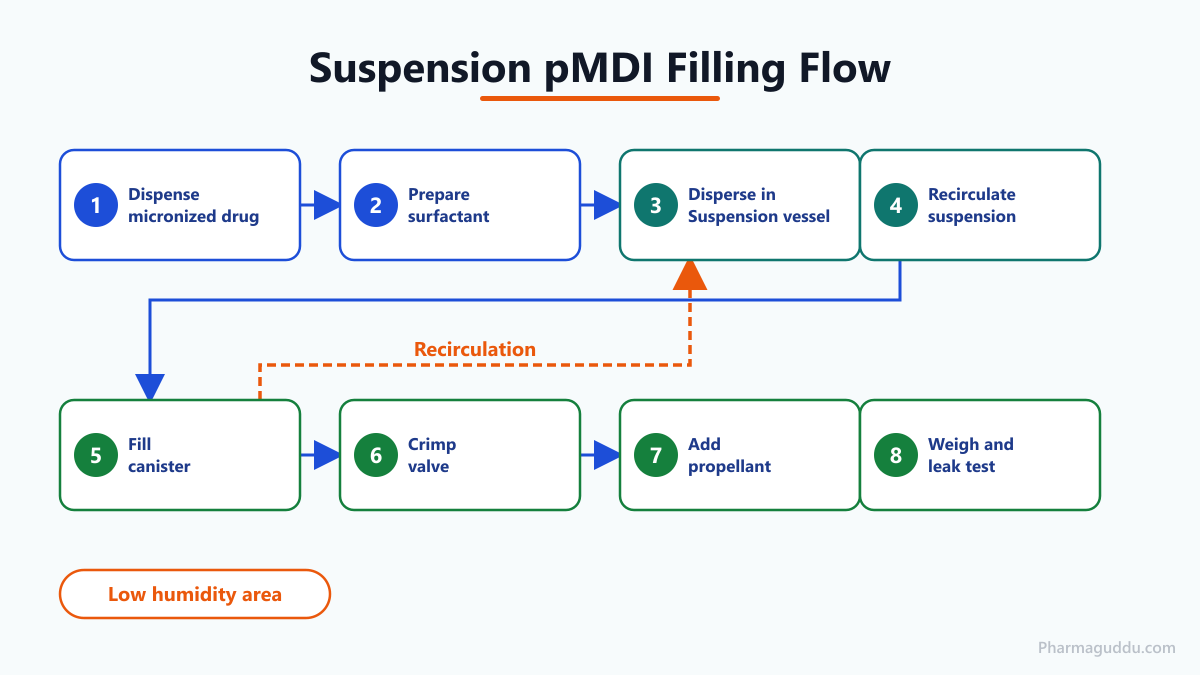
The production officer records vessel temperature, agitation time, hold time and recirculation in the batch manufacturing record (BMR). A suspension that stands without agitation beyond the hold time is a deviation. At the line, the in-process quality assurance (IPQA) officer verifies the weight checks and the crimp height records.
How Are Filling Lines Cleaned and Operators Protected?
Potent micronized drug is a dust hazard. Dispensing and vessel charging are carried out in a containment booth or isolator, and operators wear the protective equipment defined in the site standard operating procedure (SOP).
After the batch, the vessel, the recirculation loop, the filling needles and the valve feeder are cleaned by a validated procedure. The quality control (QC) analyst tests rinse or swab samples for the previous drug. Changeover between products is released by quality assurance (QA) only after the cleaning record is complete. Equipment is qualified and the process is validated. These records support the release.
What In-Process Controls and Tests Apply to Suspension pMDIs?
Limits come from the product specification and the pharmacopoeia, not from a fixed general value.
| Control | Method | Purpose |
|---|---|---|
| Fill weight | Checkweigher or manual weighing at set frequency | Confirms the quantity of suspension and propellant |
| Valve crimp height | Gauge measurement per valve maker’s specification | Prevents leaks and valve seal damage |
| Suspension uniformity | Samples from the recirculation loop | Confirms drug concentration is consistent |
| Moisture | Hygrometer in the area; moisture test on the drug and the suspension | Limits agglomeration and corrosion |
| Leak test | Weight loss or water bath | Finds poor crimps and damaged gaskets |
| Delivered dose uniformity | Dose collection apparatus, beginning and end of canister life | Confirms dose accuracy |
| APSD | Cascade impactor | Confirms the particle size reaching the lung |
| Shake and prime | Performance check of the first actuations | Confirms redispersion and valve function |
Entries in the BMR include the fill weights, the crimp height readings and any adjustment. A crimp height adjustment is recorded under a change record. A trend of weight rejects, leakers or a result outside the delivered dose limit triggers a deviation and a QA investigation.
What Causes Valve Clogging and Dose Variation?
Common causes of valve problems and dose variation are particle growth, moisture and drug deposition. The table lists the usual symptoms.
| Symptom | Possible cause | Check | Action |
|---|---|---|---|
| Blocked metering chamber or no spray | Agglomerated drug, moisture | Particle size and moisture of the suspension | Review micronization, humidity control and surfactant level |
| Sticking valve stem | Low lubrication, swollen elastomer | Seal condition and elastomer compatibility | Review surfactant level and seal grade |
| Low or high delivered dose | Poor redispersion, drug on canister wall, loss of prime | Recirculation record, delivered dose results | Improve agitation; assess canister coating; review valve design |
| APSD shifts to coarse | Flocculation, deposit at actuator orifice | Impactor profile, orifice condition | Correct the formulation; clean or replace the actuator |
| Leakage | Crimp height out of range, damaged gasket | Crimp gauge, gasket inspection | Adjust crimp height under change record |
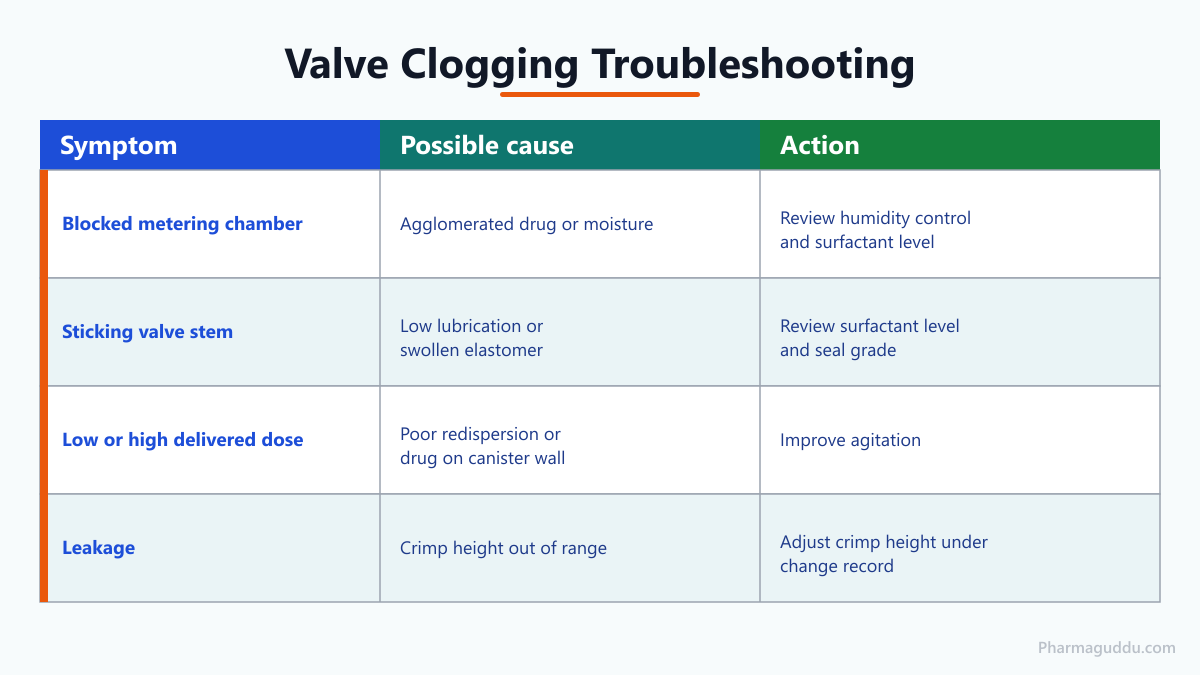
For example, a canister filled on a humid day may pass fill weight and leak tests, yet later show a blocked valve. The cause is water drawn into the suspension, which grows particles into hard lumps. The moisture record of the area is therefore part of the investigation.
What Do the Regulatory Say About Inhalation Aerosols?
The US FDA draft guidance “Metered Dose Inhaler (MDI) and Dry Powder Inhaler (DPI) Drug Products – Quality Considerations” (April 2018, docket FDA-2018-D-1098) gives recommendations on the development and manufacture of inhalation aerosols. Its recommendations can apply to products intended for local or systemic effect. It is a draft and does not bind the industry.
A change of propellant, surfactant or valve elastomer is treated as a change that needs revalidation of the suspension and of valve compatibility. The change is handled under the site change control procedure.
What Is Changing in Propellants for Suspension pMDIs?
The main change is the move to propellants with lower global warming potential (GWP). On 12 May 2025 the Medicines and Healthcare products Regulatory Agency (MHRA) announced approval of a Trixeo Aerosphere version in which HFA-134a is replaced by hydrofluoroolefin (HFO) HFO-1234ze(E). The International Fluorocarbons Association (October 2025) reports that the lower density and viscosity of hydrofluorocarbon (HFC) HFC-152a affect suspension stability and droplet size. Any such change calls for new formulation work. Propellant properties are explained in Aerosol Propellants in Pharmaceuticals.
Frequently Asked Questions
Particles are insufficiently coated. They form coarse flocs or hard agglomerates, and the suspension then settles faster and redisperses poorly. Drug also deposits on the canister wall and on the valve, so delivered dose and APSD move out of specification, and the metering chamber may block. The minimum level is established for each drug and propellant during development and is not a general figure.
Canister surface coatings are used for this purpose. A suitable surfactant level and moisture control also lower deposition, and the choice of coating is tested for each product during development.
The micronized drug size, the drug concentration and the size of the initial spray droplet influence the residual particle size. Agglomeration in the can enlarges the particles. Surfactant level and moisture therefore matter as well, and the delivered particle size is measured as APSD with a cascade impactor and is part of release testing.
Drug particles settle or cream when the canister stands. The metering chamber then fills from a layer that does not represent the full suspension. Shaking redisperses the particles. It restores a uniform concentration, and for this reason the redispersion behaviour is tested during development and the instruction to shake appears in the patient leaflet.
References
- Factors Influencing Aerodynamic Particle Size Distribution of Suspension pMDIs, PMC
- MDI and DPI Drug Products: Quality Considerations (draft), US FDA
- MHRA approves world’s first low-carbon version of COPD inhaler Trixeo Aerosphere, MHRA / GOV.UK
- Significant progress for lower-GWP propellants in pMDIs, International Fluorocarbons Association
- Improving drug stability and delivery by modification of MDI canister surfaces, ONdrugDelivery

Naresh Bhakar is the Founder and Author at Pharmaguddu.com, bringing his extensive expertise in the field of pharmaceuticals to readers worldwide. He has experience in Pharma manufacturing and has worked with top Pharmaceuticals. He has rich knowledge and provides valuable insights and data through his articles and content on Pharmaguddu.com. For further inquiries or collaborations, please don’t hesitate to reach out via email at [email protected].