
GMP & Pharmaceutical Manufacturing Expert
✓ Reviewed by: Naresh Bhakar
Reviewed for pharmaceutical accuracy
📅 Last Updated: November 4, 2026
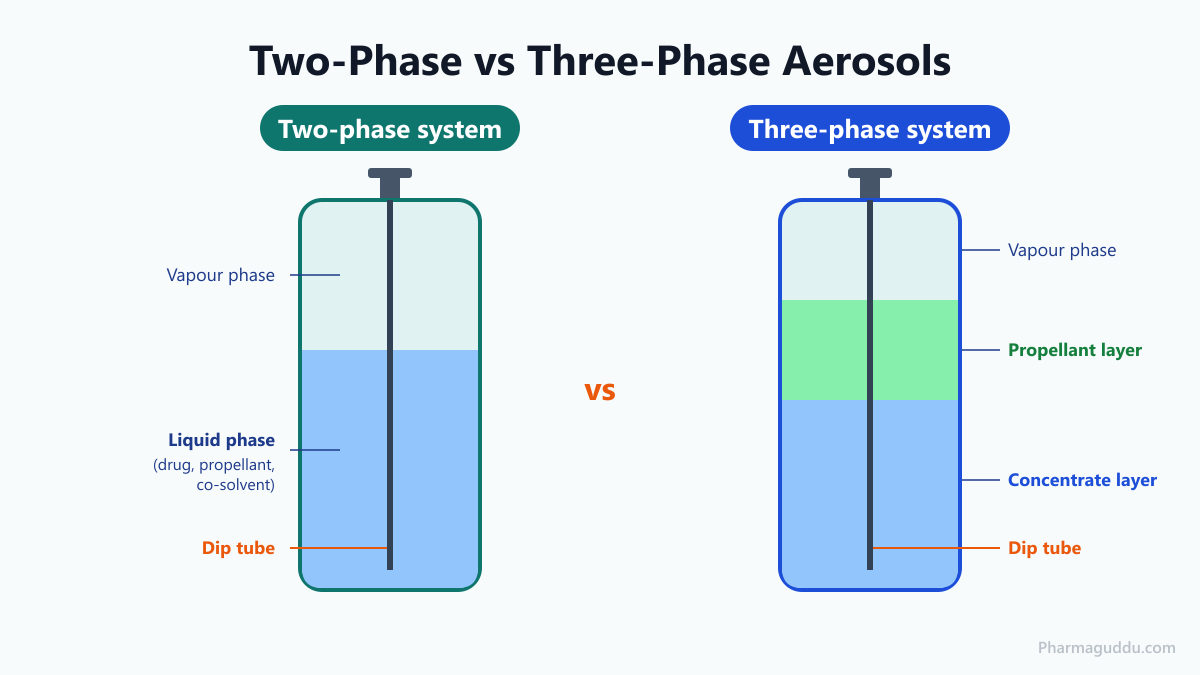
Two-phase and three-phase aerosol systems differ in the number of distinct layers inside the can. A two-phase aerosol has a vapour phase and one homogeneous liquid phase. In the liquid phase, the drug is dissolved in the propellant or in a propellant-miscible co-solvent. A three-phase aerosol has a vapour phase, a liquefied propellant layer and a separate immiscible layer of product concentrate. The concentrate may be a solution, suspension or emulsion. The choice depends on drug solubility, the vehicle and the required discharge form, such as spray or foam.
What Are Two-Phase and Three-Phase Aerosol Systems?
A pharmaceutical aerosol is a pressurised pack in which a liquefied propellant expels the product through a valve. The number of phases inside the container is decided by the mutual solubility of the product concentrate and the propellant. For the full overview of containers, valves and testing, see Aerosol in Pharma (Aerosols); Types, Container, Advantage, and Disadvantage.
A two-phase system consists of a liquid phase and a vapour phase. The liquid phase contains the drug, the propellant and any co-solvent. The co-solvent, such as alcohol or propylene glycol, is mixed into one homogeneous liquid. The vapour phase is the propellant gas above the liquid. USP general chapter <1151> Pharmaceutical Dosage Forms describes the two-phase aerosol as a solution of the active ingredient in liquefied propellant, with the vaporized propellant above it.
A three-phase system consists of a vapour phase, a layer of liquefied propellant and a layer of concentrate that does not mix with the propellant. The concentrate may hold the drug as a solution, suspension or emulsion. Water-based products with an insoluble propellant belong to this group.
Related topic: aerosol propellants in pharmaceuticals
How Does Each System Work?
Both systems work on the same principle. The liquefied propellant exerts vapour pressure inside the sealed can. When the valve is opened, this pressure pushes the product up the dip tube and out through the actuator.
As product leaves, some propellant evaporates from the liquid and refills the headspace. This keeps the pressure almost constant until the can is nearly empty.
In a two-phase system, the dissolved drug leaves together with the propellant. The propellant evaporates quickly outside the can and leaves fine drug particles or droplets. For inhalation, the particle size must be below about 5 micrometres. Other sprays may have much larger particles (USP <1151>, 2009 copy).
In a three-phase system, the dip tube draws the concentrate layer, and the propellant acts as the driving force. The position of the propellant layer depends on its density relative to the concentrate. A dip tube is used only when the product is drawn from the lower layer.
What Are the Main Components of the Formulation?
Product concentrate: the drug with its solvent or vehicle. Solvents include alcohol, propylene glycol and water.
Propellant: a liquefied gas that supplies the pressure. HFA-134a and HFA-227 are the propellants used in medical inhalation products. Hydrocarbons such as propane, butane and isobutane are used in topical and cosmetic aerosols. Dimethyl ether (DME) dissolves in water and is used in water-based products.
Surfactants and suspending agents: these keep solid particles dispersed or stabilise an emulsion. Wetting agents and carriers such as talc or silica are used for suspensions. Oleic acid or similar surfactants also lubricate the valve and reduce clogging.
Valve and dip tube: the valve controls discharge, and the dip tube carries liquid from the bottom of the can to the valve. The valve type is chosen to suit the product, whether continuous or metering, and whether it delivers a spray or a foam.
Two-Phase vs Three-Phase: Comparison
| Feature | Two-phase system | Three-phase system |
|---|---|---|
| Phases | Liquid and vapour | Vapour, propellant layer and concentrate layer |
| Drug location | Dissolved in propellant or co-solvent blend | Solution, suspension or emulsion in the concentrate |
| Solvent role | Keeps the drug dissolved in one liquid phase | Forms a separate layer that does not mix with the propellant |
| Propellant role | Solvent and driving force | Driving force only |
| Dispensing | Spray, usually from a metering or continuous valve | Spray or foam through the dip tube |
| Typical products | Solution MDIs, some topical sprays | Water-based sprays, foams, suspension aerosols |
Metered dose inhalers (MDIs) are classified as solution MDIs or suspension MDIs. They are not described as three-phase systems.
How Do Water-Based and Foam Aerosols Fit In?
Water-based aerosols are three-phase systems when the propellant does not dissolve in water. The aqueous concentrate and the liquid propellant then form separate layers. A water-soluble propellant such as DME can give one homogeneous liquid phase, so a two-phase water-based system is possible. The US patent 4,382,078 (1983) describes a DME-propelled water-based composition on this basis.
Water-based products are less flammable than solvent-based ones, because many organic solvents burn. This is the reason formulators choose water where the drug allows it.
A foam aerosol is an emulsion of the drug liquid, a surfactant and the liquefied propellant. The product is shaken before use to disperse the propellant evenly. The propellant share is typically about 5 to 15% w/w in foams and up to about 95% in inhalation solutions.
The location of the propellant decides the discharge. When the propellant is in the internal (discontinuous) phase, an oil-in-water type emulsion, a stable foam is produced. When it is in the external phase, a water-in-oil type, a spray or a quick-breaking foam is produced (USP <1151>, 2009 copy).
How Is the Choice Made Between the Two Systems?
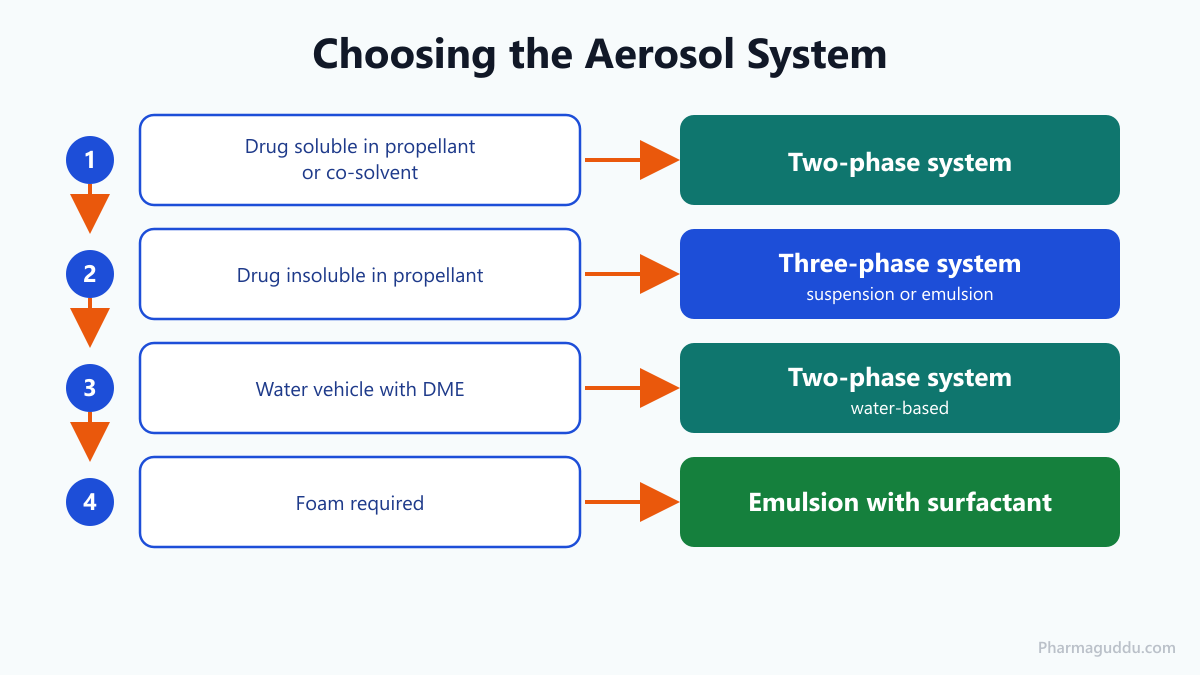
The choice follows the solubility of the drug and the intended discharge form.
- If the drug dissolves in the propellant or a propellant-miscible co-solvent, a two-phase system is used.
- If the drug is insoluble in the propellant, a three-phase system with a suspension or an emulsion is used.
- If a water vehicle is required, a three-phase system is formed with an insoluble propellant, or a two-phase system with DME.
- If a foam is required, an emulsion with a surfactant is prepared.
For example, a drug that is poorly soluble in the propellant and cannot be dissolved in a co-solvent is formulated as a suspension. A suspension is a dispersion of fine solid particles in a liquid. For its general theory, see Pharmaceutical Suspension.
Key Formulation Parameters
| Parameter | Role in the formulation |
|---|---|
| Vapour pressure | Governs spray force and particle size |
| Propellant share | Decides wetness of spray and foam quality |
| Particle size | Below about 5 micrometres for inhalation |
| Surfactant level | Controls suspension stability and foam structure |
| Moisture | Affects suspension stability and valve performance |
Propellant vapour pressure varies with the propellant and the temperature. The values found in the research were not consistent between sources, and exact figures depend on the propellant grade and manufacturer.
Which Regulations Apply?
The European Commission states that hydrofluorocarbons (HFCs) used in metered dose inhalers have been integrated into the quota system. HFA-134a is the pharma name for the propellant, and HFC is the regulatory class.
The US FDA draft guidance on MDI and DPI products (docket FDA-2018-D-1098) covers the development and manufacture of inhalation aerosols and inhalation powders.
Recent Technology advancement
In March 2024, the F-gas Regulation moved MDI propellants into the quota system, which increases pressure to replace HFC propellants (European Commission).
In October 2024, Bespak and H&T Presspart announced a GMP pilot line at Holmes Chapel (UK). The line is for MDIs with the low-GWP propellants HFA-152a and HFO-1234ze(E) (Manufacturing Chemist). GWP means global warming potential.
Slovenia’s regulator JAZMP reported in October 2024 that MDIs containing fluorinated gases need new labelling under Implementing Regulation (EU) 2024/2174. The deadline is 1 January 2025.
Common Problems and Troubleshooting
Valve clogging in suspension aerosols
Possible Causes:
Particle agglomeration, moisture, or too little surfactant.
Corrective Actions:
The formulation team reviews the surfactant level and moisture control. Oleic acid or a similar surfactant lubricates the valve.
Spray instead of foam
Possible Causes:
The propellant is in the external phase, or the emulsion is unstable.
Corrective Actions:
The emulsion composition and the surfactant are reviewed, and foam stability is tested.
Poor discharge when the can is used inverted
Possible Causes:
In a three-phase system with a dip tube, an inverted can draws vapour or propellant instead of concentrate.
Corrective Actions:
The user is instructed to hold the can in the labelled position. The valve and dip tube are selected to suit the dispensing position.
Maintenance Requirements
Filling lines for hydrocarbon and DME products are operated in classified hazardous areas with grounded, explosion-proof equipment. Crimping and filling stations are cleaned and inspected under the site SOP. Fill weight, crimp quality and leak tightness are checked as in-process controls (IPC) and recorded in the batch manufacturing record (BMR).
Expert Tips
- Match the phase to the drug. Solubility in the propellant decides the system before any other parameter.
- Use DME for water-based two-phase products. It dissolves in water and forms one liquid phase.
- Control moisture in suspensions. Water causes caking and valve clogging.
- Shake foam products. Shaking disperses the emulsified propellant.
- Record valve and dip tube details. The dispensing position depends on them.
Frequently Asked Questions
A two-phase aerosol has a liquid phase and a vapour phase. The drug is dissolved in the propellant or in a miscible co-solvent. A three-phase aerosol has a vapour phase, a propellant layer and a separate concentrate layer. The concentrate may be a solution, suspension or emulsion.
Yes. DME is soluble in water, so it can give one homogeneous liquid phase together with the vapour phase. A propellant that does not dissolve in water forms a separate layer, which makes the system three-phase.
DME dissolves in water and mixes with the aqueous concentrate. This produces a single liquid phase and avoids the need for a separate propellant layer. The US patent 4,382,078 (1983) describes a water-based DME-propelled composition.
A foam aerosol is usually a three-phase system. The liquefied propellant is emulsified in the drug liquid with a surfactant, and a vapour phase is present above it. Whether foam or spray is produced depends on the phase that holds the propellant.
Inhalation aerosols need particles below about 5 micrometres so that they reach the lower respiratory tract. Other sprays may have much larger particles. Topical products are an example (USP <1151>, 2009).
HFA-134a and HFA-227 are used in medical inhalation products. HFA-152a and HFO-1234ze(E) are low-GWP options under development, as reported by Manufacturing Chemist in October 2024.
Summary
The number of phases in an aerosol depends on how the concentrate and the propellant mix. Two-phase systems have one liquid phase plus vapour. Three-phase systems have a separate concentrate layer. Water-based products and foams are mostly three-phase, while DME allows a two-phase water-based system.
References
- USP <1151> Pharmaceutical Dosage Forms (USP 32 copy), USP via drugfuture.com
- Novel water-based, dimethyl ether-propelled aerosol composition (US patent 4,382,078), USPTO
- F-gas legislation, European Commission
- Bespak and H&T Presspart GMP pilot line, Manufacturing Chemist
- New labelling requirements for metered dose inhalers containing fluorinated greenhouse gases, JAZMP
- FDA: MDI and DPI Drug Products, Quality Considerations, US FDA

Naresh Bhakar is the Founder and Author at Pharmaguddu.com, bringing his extensive expertise in the field of pharmaceuticals to readers worldwide. He has experience in Pharma manufacturing and has worked with top Pharmaceuticals. He has rich knowledge and provides valuable insights and data through his articles and content on Pharmaguddu.com. For further inquiries or collaborations, please don’t hesitate to reach out via email at [email protected].