
GMP & Pharmaceutical Manufacturing Expert
✓ Reviewed by: Pankaj Sharma - Quality Control Specialist
Reviewed for Quality Control accuracy, laboratory practices, analytical methods, and technical relevance
📅 Last Updated: November 3, 2026
In the pharmaceutical industry, propellants are either liquefied or compressed gases that provide the force needed to push the product out of the device via the valve. Liquefied gases, such as HFA-134a, HFA-227ea, hydrocarbons and dimethyl ether (DME) remain at a constant pressure throughout use. Compressed gases, such as nitrogen and carbon dioxide will show pressure drop during use. CFCs have been replaced due to their damaging effects on the ozone layer. Inhalers use non-flammable HFAs and topical products use either flammable hydrocarbons or DME. HFA-134a and HFA-227ea are being replaced by lower GWP propellants.
What Are Aerosol Propellants in Pharmaceuticals?
A propellant is the gas, held inside a sealed container, that pushes the formulation out when the valve is opened. In some systems it also breaks the product into a fine spray or a foam. The propellant is chosen according to the dosage form, the route of administration, and the flammability that the plant can safely handle.
The pillar article covers containers, valves and system types. This article deals only with the propellant. For the full overview, see Aerosol in Pharma (Aerosols); Types, Container, Advantage, and Disadvantage.
How Do Liquefied and Compressed Gas Propellants Work?
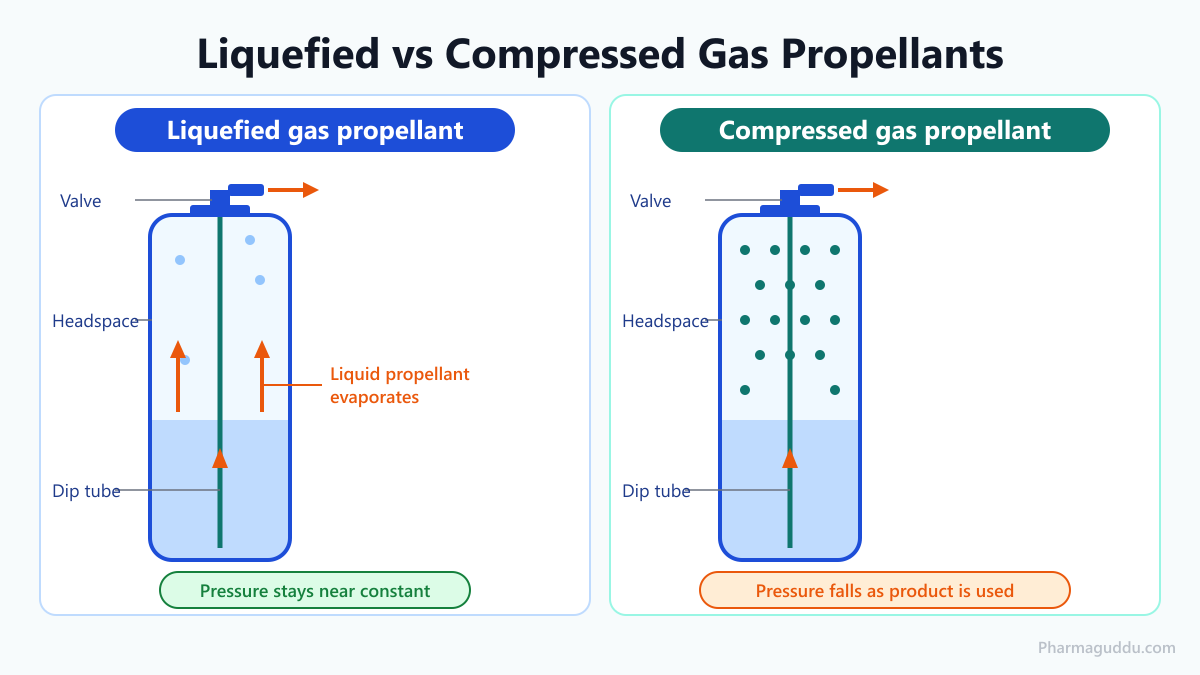
A liquefied gas propellant exists as liquid and vapour in the closed container. The vapour fills the headspace and creates the pressure. When the valve opens, this pressure drives the product up the dip tube and out of the actuator.
As product leaves, the headspace becomes larger and some liquid propellant evaporates to refill it. For this reason, the pressure remains nearly constant until the container is almost empty (Aulton’s Pharmaceutics).
A compressed gas such as nitrogen, carbon dioxide (CO2) or nitrous oxide (N2O) occupies the headspace only. No liquid reserve exists to refill it. Each actuation enlarges the headspace, so the pressure falls and the spray weakens toward the end of the container’s life. Compressed gases are therefore used in sprays and foams where steady pressure is less critical.
Why Were CFC Propellants Replaced?
CFCs release chlorine in the stratosphere, and this chlorine destroys ozone. The Montreal Protocol (1987) set the international framework for controlling CFCs. Its later amendments and adjustments, together with national rules, phased out CFC production and import in developed countries. In the US the ban took effect on 1 January 1996. Metered-dose inhalers (MDIs) received essential-use exemptions, so CFC inhalers stayed on the market until safe alternatives existed (US EPA, archived page).
The established replacements were HFA-134a and HFA-227ea. A hydrofluoroalkane (HFA) contains no chlorine and does not deplete ozone. It is still a greenhouse gas. Fluorocarbons.org gives the 100-year global warming potential (GWP) of HFA-134a as about 1,300 to 1,430. For HFA-227ea it is about 3,220 to 3,350. The range depends on the IPCC assessment report used.
The Kigali Amendment to the Montreal Protocol (2016, in force 2019) set a global phase-down of hydrofluorocarbons (HFCs). The treaty that removed CFCs therefore now also pressures HFA-134a and HFA-227ea.
Which Propellants Are Used and How Do They Differ?
HFA-134a and HFA-227ea
HFA-134a is 1,1,1,2-tetrafluoroethane and HFA-227ea is 1,1,1,2,3,3,3-heptafluoropropane. Both are non-flammable and are used in inhalers. EU labelling and F-gas texts use the name HFC-134a for the same substance.
According to the Koura brochure (2019), HFA-134a has a vapour pressure of 6.652 bara at 25 °C and boils at -26.1 °C at 1 atm. Orbia reports 4.544 bara at 25 °C for HFA-227ea, a boiling point of -16.5 °C and a liquid density of about 1.39 g/cm³. Orbia also states an autoignition temperature above 650 °C. The higher density of HFA-227ea suits suspensions of dense drug particles.
Hydrocarbons
Propane, isobutane and butane are used alone or as blends that set the vapour pressure. Suppliers name blends by their pressure at 70 °F, for example AP-48 (48 psig) and AP-70 (70 psig). The naming and composition differ between suppliers.
Dimethyl ether (DME)
DME is a flammable liquefied gas. It dissolves in water and is a stronger solvent than hydrocarbons, so it mixes with water-based formulations. For this reason, it is used in topical sprays and foams.
HFA-152a and HFO-1234ze(E)
HFA-152a has a GWP of about 124 to 138, roughly one tenth of HFA-134a, but it is flammable. HFO-1234ze(E) is a hydrofluoroolefin. It has a GWP of about 1.4 (Fluorocarbons.org, 2024). Both are lower-GWP candidates for inhalers.
How Are Propellants Filled into Containers?
The filling method depends on the propellant and the product. The general sequence on a filling line is as follows.
- The production officer and the QA officer complete line clearance, so that no material from the previous batch remains.
- The concentrate (drug formulation) is filled into the container.
- In cold fill, propellant chilled below its boiling point is added to the open container, and the valve is crimped at once.
- In pressure fill, the valve is crimped first and the propellant is forced through it under pressure. In under-the-cap filling, propellant is added beneath the valve cup just before the final crimp.
- The valve is crimped to the container. This step seals the pack, and the crimp dimensions decide whether the seal holds.
- In-process controls (IPC) are performed: net content, propellant weight, crimp dimensions and valve delivery.
- Filled containers pass through a leak test, commonly a warm water bath. Leaking units are rejected and segregated.
The actual propellant lot, weights and leak-test results are recorded in the batch manufacturing record (BMR). Rejects are handled under a deviation.
Cold fill and pressure fill need different equipment. A plant that moves between propellants therefore needs a hazard study and change control. The equipment is qualified for the new propellant, and the process is validated again. See process validation in pharmaceuticals for the validation stages.
What Controls Apply When Filling Flammable Propellants?
Hydrocarbons, DME and HFA-152a are flammable, so the filling area is treated as a hazardous area. Typical controls include the following.
- ATEX zoning (the EU classification of explosive atmospheres) of the filling room and storage
- Ventilation and gas detection with alarms
- Earthing and bonding of containers, hoses and equipment
- Explosion-proof electrical equipment
- Strict exclusion of ignition sources
- Lockout-tagout (LOTO) and work permits for maintenance
- Training of operators in emergency response
A review in PMC (2025) reports that HFA-152a forced manufacturers to build new filling lines in ATEX-classified areas. It also required dedicated storage and a new site for large volumes of flammable substances. A documented risk assessment is prepared before such a change.
On receipt, the store officer checks the delivery against the order. The QC analyst tests propellant identity and purity by gas chromatography. Moisture is tested by Karl Fischer titration, as it is described in our Aerosol article.
Key Properties of the Two Established HFAs
| Property | HFA-134a | HFA-227ea |
|---|---|---|
| Vapour pressure at 25 °C | 6.652 bara (Koura) | 4.544 bara (Orbia) |
| Boiling point at 1 atm | -26.1 °C (Koura) | -16.5 °C (Orbia) |
| Flammability | Non-flammable | Non-flammable (autoignition above 650 °C, Orbia) |
| GWP, 100-year | About 1,300 to 1,430 | About 3,220 to 3,350 |
These are manufacturer figures at stated conditions. Exact values depend on the manufacturer and grade; always follow the supplier specification and the site SOP.
How Do the Propellants Compare?
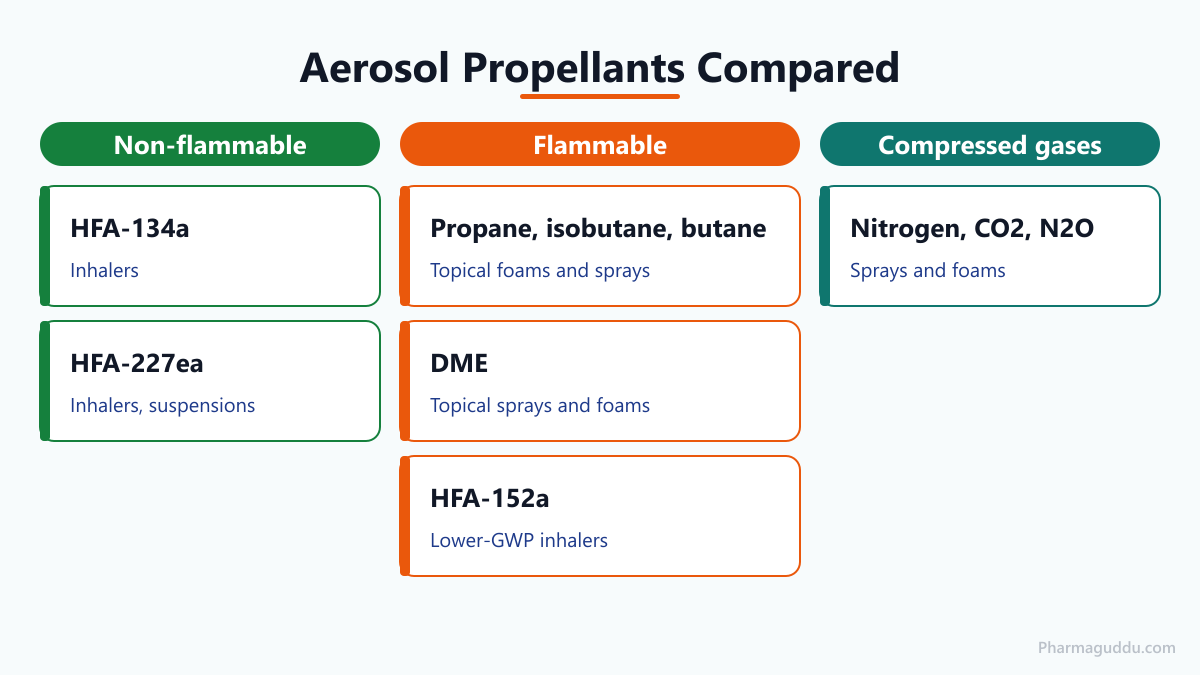
| Propellant | Type | Flammability | Typical use |
|---|---|---|---|
| HFA-134a | Liquefied gas | Non-flammable | Inhalers |
| HFA-227ea | Liquefied gas | Non-flammable | Inhalers, suspensions |
| Propane, isobutane, butane | Liquefied gas | Flammable | Topical foams and sprays |
| DME | Liquefied gas | Flammable | Topical sprays and foams |
| HFA-152a | Liquefied gas | Flammable | Lower-GWP inhalers |
| Nitrogen, CO2, N2O | Compressed gas | Nitrogen and CO2 do not burn | Sprays and foams |
Industry Standards and Regulatory Requirements
Regulation (EU) 2024/573 (F-gas Regulation) was adopted on 7 February 2024 and applies from 11 March 2024 (European Commission). HFCs used in MDIs are now part of the quota system, and HFCs are phased out in the EU in 2050.
The EMA Q&A (EMA/333735/2024, 13 September 2024) states that MDIs containing fluorinated greenhouse gases must comply from 1 January 2025. The labelling states “contains fluorinated greenhouse gases”. It also states the amount in each inhaler, the gas name (for example HFC-134a) and the tonne CO2 equivalent with the GWP value used.
Recent Technology on Aerosol Propellants
- March 2024: The F-gas Regulation (EU) 2024/573 began to apply and brought MDI HFCs into the quota system (European Commission).
- February 2025: A peer-reviewed review in PMC describes the manufacturing change that HFA-152a requires, including ATEX-classified filling lines and dedicated flammable-handling sites.
- May 2025: AstraZeneca reports that the MHRA approved Trixeo Aerosphere with HFO-1234ze(E). The company claims a 99.9 % lower GWP and targets its wider pMDI portfolio by 2030.
- September 2025: Chiesi completed its phase III TRECOS study of an HFA-152a inhaler in over 820 asthma patients. Chiesi reports up to 90 % lower carbon footprint.
- July 2026: The MHRA approved Chiesi’s Clenil Modulite 100 and 200 microgram beclometasone inhalers with HFA-152a. It described this as the world’s first authorisation of an HFA-152a inhaler (MHRA, 21 July 2026).
- 2024: Pilot-scale GMP filling lines and CDMO sites able to fill HFA-152a and HFO-1234ze in cold and pressure fill were announced (Pharmaceutical Manufacturer).
Common Problems and Troubleshooting
| Problem | Likely cause | Corrective action |
|---|---|---|
| Pressure loss or weak spray | Leaking crimp or valve; depleted compressed gas | Review crimp dimensions; reject leakers; investigate under a deviation |
| Low or variable dose | Wrong propellant weight; settling of suspension | Review fill weights and IPC records; check agitation of the concentrate |
| Valve clogging | Moisture or product residue in the valve | Test propellant moisture by Karl Fischer; review valve and line cleaning |
| Leakage during storage | Poor gasket seating; damaged crimp | Test with the water bath; segregate the batch |
| Moisture ingress | High moisture in the propellant or concentrate | Test incoming propellant lots; reject lots outside specification |
Expert Tips on Aerosol Propellants
- Name the propellant exactly. Write HFA-134a or HFA-227ea in batch records, never “fluorocarbon propellant”.
- Treat a propellant change as a change control. Cold fill and pressure fill need different equipment.
- Record the lot. The propellant lot number and weights must appear in the BMR.
- Segregate leakers. Leak-test rejects stay under QA control until the deviation closes.
- Train before permits. Operators and maintenance staff are trained before flammable-area work begins.
Frequently Asked Questions
A propellant supplies the pressure that forces the product out through the valve. In many systems it also breaks the product into a spray or foam. In a liquefied gas system, it keeps the pressure nearly constant until the container is almost empty.
CFCs release chlorine in the stratosphere and deplete the ozone layer. The Montreal Protocol phased them out. Inhalers received essential-use exemptions until HFA alternatives were available, and HFA-134a and HFA-227ea then replaced CFCs in MDIs.
No. HFA-134a is non-flammable. HFA-227ea is also non-flammable, and Orbia reports an autoignition temperature above 650 °C. The flammable propellants are the hydrocarbons, DME and HFA-152a, and these require classified filling areas.
HFA-134a has a higher vapour pressure: 6.652 bara at 25 °C against 4.544 bara for HFA-227ea (Koura and Orbia). HFA-227ea is denser, at about 1.39 g/cm³. It also has a higher GWP, so it is the more heavily targeted for replacement.
No. Inhalers use HFA propellants. Hydrocarbons are flammable and are used in topical products such as foams and sprays. Their filling requires ATEX-classified areas, gas detection and control of ignition sources.
DME dissolves in water and is a stronger solvent than hydrocarbons. It therefore mixes with water-based formulations, which suits topical sprays and foams. DME is flammable, so the same flammable-area controls apply during filling.
In cold fill, propellant is chilled below its boiling point and added to the open container, and the valve is then crimped. In pressure fill, the valve is crimped first and the propellant is added under pressure through the valve or under the cap.
Summary
Propellants are either liquefied gases, which hold pressure steady, or compressed gases, which lose pressure during use. CFCs were replaced by HFA-134a and HFA-227ea for inhalers. Hydrocarbons and DME serve topical products. Lower-GWP propellants and the EU F-gas Regulation now drive the next change.
References
- Developments gather pace for the use of HFC-152a and HFO-1234ze(E) in MDIs, Fluorocarbons.org (2024)
- Pharmaceutical, Clinical, and Regulatory Challenges of Reformulating pMDIs to Reduce Their Environmental Impact, PMC (2025)
- EU rules on fluorinated greenhouse gases, European Commission, Climate Action
- Questions and answers on labelling requirements for centrally authorised metered dose inhalers containing fluorinated greenhouse gases, EMA/333735/2024, European Medicines Agency
- Essential Uses of CFCs for Metered-Dose Inhalers (archived), US EPA
- Trixeo Aerosphere approved in the UK with next-generation propellant, AstraZeneca (2025)
- Chiesi completes its carbon-minimal pMDI programme, Chiesi (2025)
- MHRA approves world’s first lower carbon beclometasone inhalers for patients with asthma, MHRA (2026)
- Delivering the next leap in MDI sustainability, Pharmaceutical Manufacturer
- Aulton’s Pharmaceutics: The Design and Manufacture of Medicines, Elsevier

Naresh Bhakar is the Founder and Author at Pharmaguddu.com, bringing his extensive expertise in the field of pharmaceuticals to readers worldwide. He has experience in Pharma manufacturing and has worked with top Pharmaceuticals. He has rich knowledge and provides valuable insights and data through his articles and content on Pharmaguddu.com. For further inquiries or collaborations, please don’t hesitate to reach out via email at [email protected].