
GMP & Pharmaceutical Manufacturing Expert
✓ Reviewed by: Naresh Bhakar
Reviewed for pharmaceutical accuracy
📅 Last Updated: November 27, 2026
The wet granulation process is a method in which a sifted powder mix is converted into granules by adding a binder liquid to get uniform wet mass of granules, then drying and milling it. The steps including; sifting, dry mixing, binder preparation, liquid addition, wet massing, drying, milling and sieving. Each step is done as per the batch manufacturing record (BMR) and checks as per the given parameter.
What is the wet granulation process?
The wet granulation process is a size enlargement method in which powder particles are bound together after mixed with binder solution in RMG. Then it is dried using FBD. The aim is to get better flow and compress properties at compression stage to make tablets. For the full overview of all routes, see granulation technique in tablet manufacturing. This article explains the wet route step by step, along with the checks done on the floor.
How does wet granulation work?
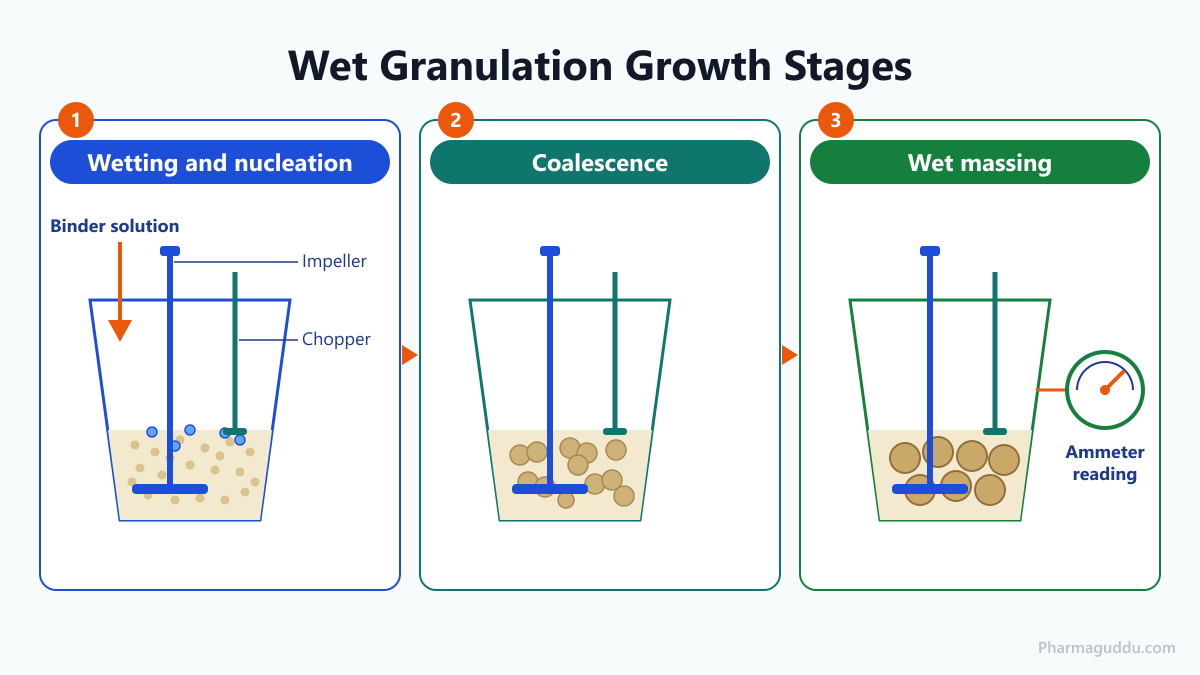
In wet granulation, we go through following stage: First, Inside RMG binder solution are added to get a wet mass of powder. Here powder nuclei collide with each other and join together (called coalescence), which happens fast. Finally, the mass is kept running so that the granules consolidate.
Here it is important to add required quantity as per given in BMR and note the mixing start and end time. After mixing completetion, examine the granules sample to make sure end point is reached (power, torque or hand test).
What are the steps of the wet granulation process?
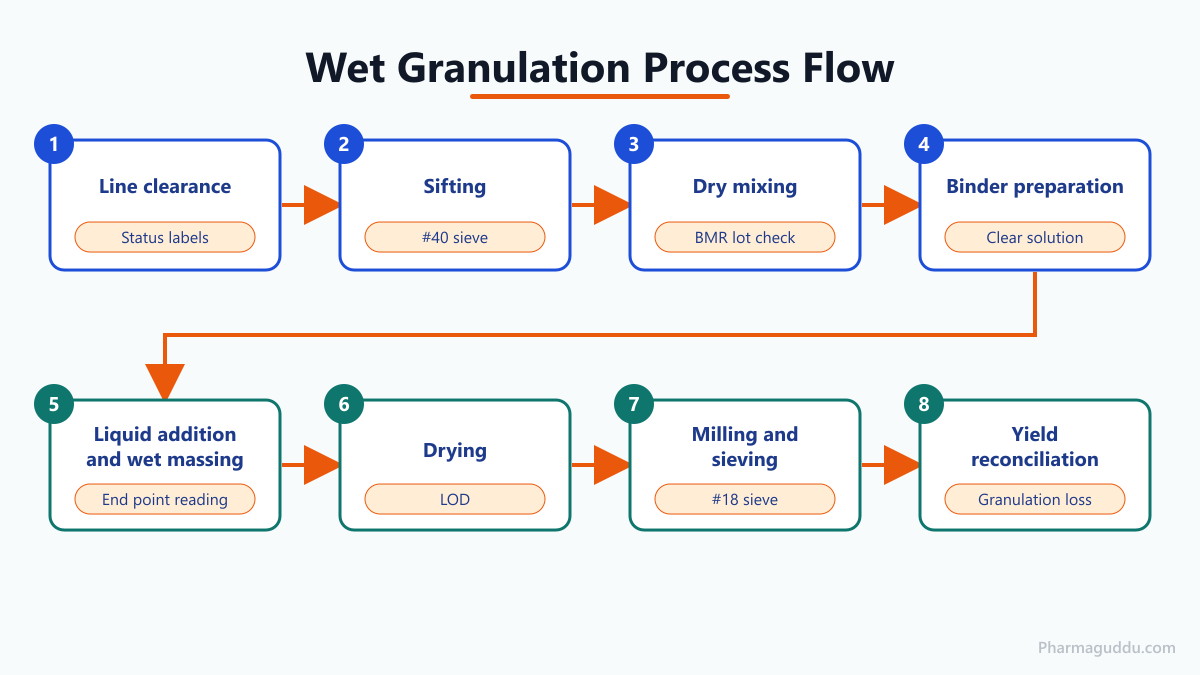
- Line clearance: Take Line clearance from IPQA officer and affix the “Under Process” label on all equipments which is under used.
- Sifting: The dry materials are sifted through a #40 sieve into double-layered poly bags with status labels. Pharma grade color should be sifted separately through #80.
- Dry mixing: The sifted material is mixed for the time given in the BMR/ process validation protocol. The sifted lots and their colour split are checked against the BMR.
- Binder preparation: The binder is dissolved in the solvent, usually purified water, under a stirrer until the solution is clear.
- Liquid addition and wet massing: The binder solution is added to the powder bed under the impeller, and chopper untile the granulation end point reached.
- Wet sieving or wet milling (if the BMR requires it): Lumps are broken so that drying is uniform.
- Drying: Now the Granules is loaded into the fluid bed dryer (FBD) bowl, or onto trays in a tray dryer, and dried until the target loss on drying (LOD) is reached.
- Milling and sieving: After drying we gets lumps of dried powder that need to be break in uniform size thats why we use milling and sieving method and finally weight it and entry to BMR for yield reconciliation.
After that, the granules go for blending and lubrication, and then for compression. These stages are covered in this article 3 types of tablet manufacturing process.
Which equipment is used for wet granulation?
A high-shear rapid mixer granulator (RMG) is used to wet and mass the powder with the help of an impeller and a chopper, as explained in RMG working and principle. Sometime, planetary mixer is used for the same step. In a fluid bed processor, the liquid is sprayed on the powder while it is suspended in air. The fluid bed processor, FBD and RMG are compared in a separate post.
Wet granulation can also be done as a continuous process. Here, a twin-screw granulator feeds continuous drying and milling, and ICH Q13 gives the framework for such lines.
How is the batch operated on the floor?
First, the operator will checks the sifted lots against the BMR.
Inside the solution prepartion ara, Operator prepare the binder solution, a axample product lamivudine and stavudine tablet), 1.25 kg PVP K-30 is added steadily into the vortex of 8.75 L purified water, which is about 12.5% w/w of the 10 kg solution. These values are for this product only and are not a general rule, so always follow the quantity given in your BMR.
After that, the binder is added to the powder in RMG. Make sure the bowl lid and discharge interlocks are working before starting the equipment. after mixing, operator examine the end point by the hand test and by the ammeter or torque method, and records all the activity in the BMR. The ampere value changes with raw material variation and wear, so always check the reading together with the hand test.
After it, wet granules are discharged into the FBD bowl. drying is done at an inlet air temperature of 55 to 60 °C and an outlet temperature of 50 to 55 °C, until the target LOD is reached using IR moisture balance. As the surface moisture goes, the outlet temperature starts to rise, which shows that drying is near the end point, You can confirm it by LOD test.
Finally, the dried granules pass through sieve #18, and the oversize goes through a multi mill with a 2.0 mm screen at medium speed in the forward direction. The milled granules are sifted through #18 again, and the screen start and end time must be recorded in BMR.
Which IPC and limits apply?
Here, the Operator records the actual times, binder quantity, impeller and chopper settings, the final ammeter reading, the LOD result and the sieve and screen conditions in BMR. The operator, the supervisor and the IPQA officer sign the BMR at their own steps.
At the end yield reconciliation is dobe by production officer, i.e. the total material taken for wet granulation, the dry granules obtained and the granulation loss in kg.
LOD % limit are kept as per the Product, becouse it depends on the product type.
What are the critical process parameters?
| Parameter | Typical setting or range | Why it matters | How it is monitored |
|---|---|---|---|
| Impeller and chopper speed | As per the validated BMR. One lab study (1.5 kg batch, 10 L bowl) found 700 rpm impeller with 1,000 rpm chopper gave the best granules | Controls shear and granule growth | Machine panel |
| Liquid-to-solid ratio and addition rate | As per the validated BMR | Decides lumps or fines | Weighed binder quantity |
| Wet massing time | As per the process validation protocol | Controls granule density and hardness | Timer and end point reading |
| Granulation end point | Ammeter or torque trend with the hand test | Prevents over-wetting | Recorded reading |
| FBD inlet and outlet air | 55 to 60 °C and 50 to 55 °C (one product) | Sets drying rate | Dryer panel |
| LOD | Per the BMR (blend NMT 6.0% w/w, one product) | Affects compression and stability | IR moisture balance |
| Multi mill screen | 2.0 mm, medium speed, forward (one product) | Decides granule size | Screen check before and after |
Above value are not fixed for every product, they may varies from prroduct to product or as per the process validation requirements.
What are the common problems and fixes?
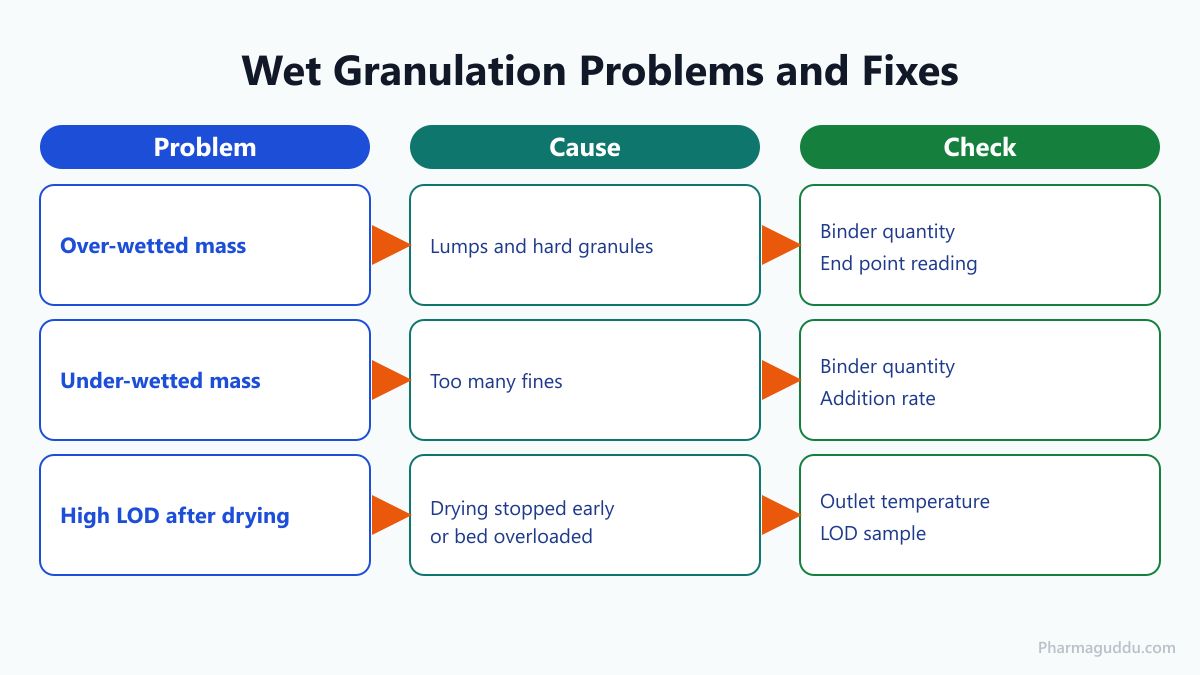
If the mass is over-wetted, then chances of lumps formation and the granules become hard after drying. If it is under-wetted, too many fines are produced. In both cases, check the binder quantity, the addition rate and the end point in BMR.
A hard dry mass can come from too much binder or too long a wet massing time. If the LOD is high after drying, it means the drying was stopped early or the bed was overloaded. So, continue the drying and recheck the LOD. A low LOD can make the granules brittle and increase the fines.
Any out-of-limit result is handled as per the site deviation or out-of-specification procedure, and QA reviews it before the batch moves to the next step.
What does the regulation expect?
21 CFR Part 211 requires written procedures for the in-process controls and tests done on samples of in-process material, and adequacy of mixing is one of the listed controls. Here, the equipment is qualified and the process is validated. Cleaning is verified against validated limits, and a visual check alone is not enough.
Frequently Asked Questions
Wet granulation uses a liquid binder and needs a drying using FBD. Dry granulation by roll compaction uses no moisture and needs no drying, so it is usefull for moisture-sensitive drugs and is usually more energy efficient.
The sieve removes oversize granules. in this step, dried granules pass through #18 first, and the milled oversize pass through #18 again. The sieve condition is recorded before and after the operation, so a damaged sieve is caught.
References
- High-shear granulation study (PMA-1), PMC
- 21 CFR 211.110, eCFR
- Q13 Continuous Manufacturing of Drug Substances and Drug Products, US FDA

Naresh Bhakar is the Founder and Author at Pharmaguddu.com, bringing his extensive expertise in the field of pharmaceuticals to readers worldwide. He has experience in Pharma manufacturing and has worked with top Pharmaceuticals. He has rich knowledge and provides valuable insights and data through his articles and content on Pharmaguddu.com. For further inquiries or collaborations, please don’t hesitate to reach out via email at [email protected].