
GMP & Pharmaceutical Manufacturing Expert
✓ Reviewed by: Naresh Bhakar
Reviewed for pharmaceutical accuracy
📅 Last Updated: November 18, 2026
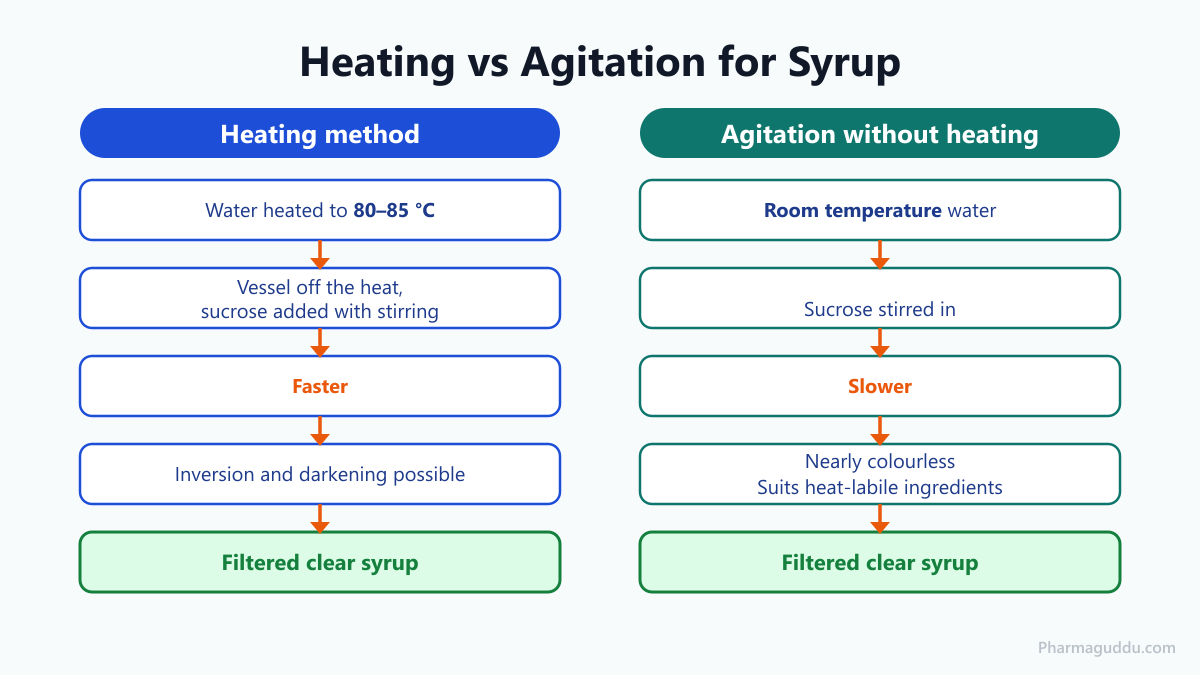
The simple solution method for syrup dissolves sucrose and other soluble ingredients in purified water has two methods which we will cover here. In the heating method, the water is heated, to about 80–85 °C. Sucrose is then stirred in. In agitation without heating, the sugar dissolves by stirring alone at room temperature. Heating is faster but can invert sucrose and darken the syrup, and it is unsuitable for volatile or heat-labile ingredients. The cold method protects such ingredients and keeps the syrup nearly colourless, but it takes longer.
For the full overview of syrup types, see liquid syrup types and the manufacturing process. The following sections compare only the two ways of dissolving in the simple solution method, and they cover the chemistry, the time taken, the operator work and the equipment.
What are the heating method and agitation without heating?
The simple solution method is the dissolving of sugar and other soluble ingredients in a solvent, for example; purified water, to make a syrup. Simple syrup is one product made this way, but the method is also used for medicated and flavoured syrups.
Heating method. Purified water is heated at 80–85 °C. The vessel is then taken off the heat, and sucrose is added with vigorous stirring. Heat-stable ingredients can go in while the syrup is hot, and the syrup is filtered afterwards.
Agitation without heating. Sucrose and the other ingredients are dissolved in purified water by stirring at room temperature. here, No heat is applied, so the method is chosen when an ingredient is volatile or degrades on heating, example is ferrous sulphate syrup.
Exact temperatures, times and speeds depend on the product, the vessel and the validated process. The values given here are for information only, not universal limits, and they should not be applied to a product without validation.
How do the two methods compare?
| Point | Heating method | Agitation without heating |
|---|---|---|
| Water temperature | Typically 80–85 °C, then off the heat | Room temperature |
| Dissolving time | Shorter | Longer |
| Sucrose inversion | Small part inverts to glucose and fructose | Avoided |
| Colour | May darken | Nearly colourless |
| Volatile or heat-labile ingredients | Added only after cooling | Can be added directly |
| Equipment | Jacketed vessel with steam or hot water | Vessel with an agitator; a jacket is not needed |
| Microbial point | Hot water gives some bioburden reduction | No heat step, so water quality and hold time matter more |
READ ALSO
Liquid Syrup Types and Manufacturing Process
Liquid syrup types and manufacturing process explained: simple, medicated and flavoured syrup, preparation methods, formulation.
What are the key differences between the two methods?
Chemistry and appearance
Heat speeds up dissolving because sucrose is more soluble in hot water. However, heating also inverts some of the sucrose to glucose and fructose, and acid (the hydrogen ion acting as a catalyst) speeds this inversion. Excessive acidity can also darken the syrup through caramelisation of the sugar. For this reason, syrup made without heat is nearly colourless.
Time and energy
The cold variant is slower because sugar dissolves slowly in cold water. high-shear mixers describe cold dissolving of a syrup of about 66 Brix (approximately 66% w/w sucrose) at ambient temperature in about 10 minutes or less, which is much shorter than paddle stirring.
Operator work in the heating method
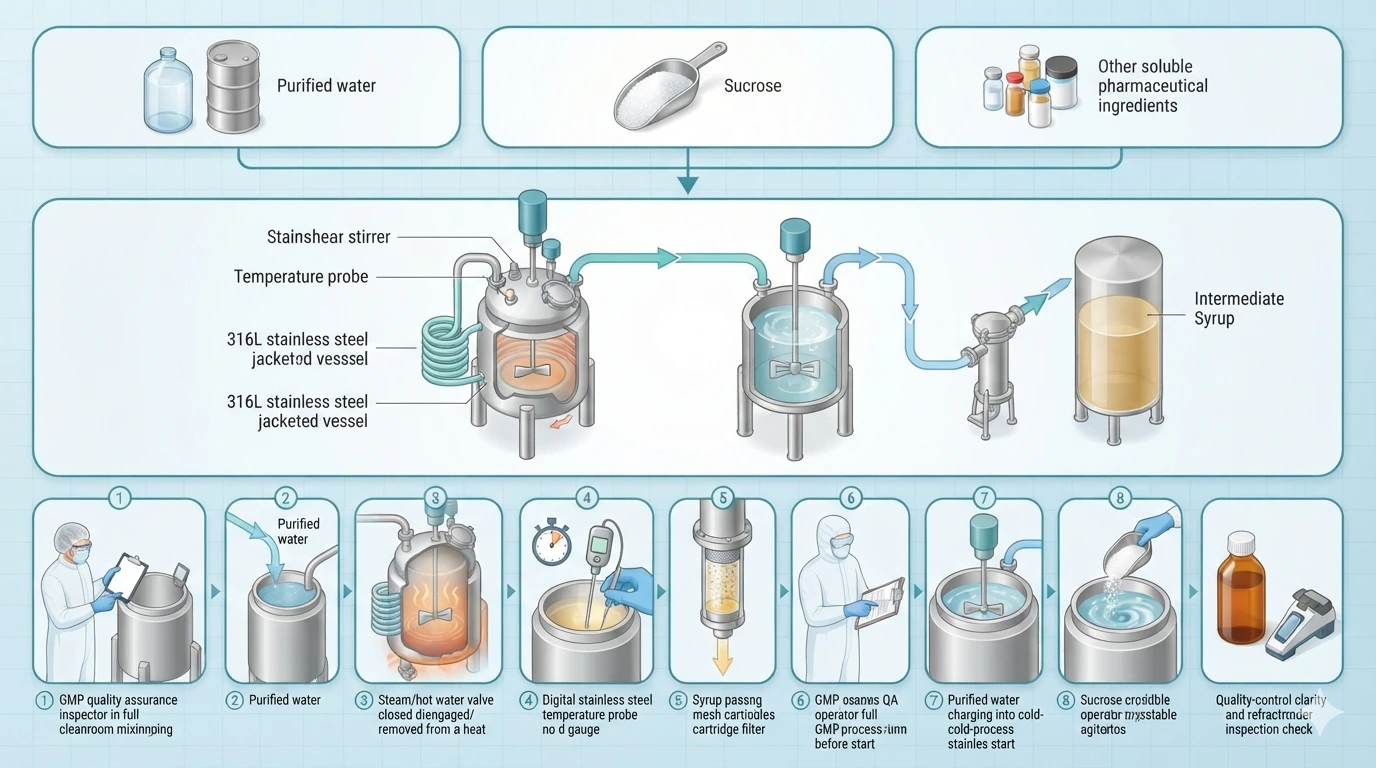
- Take line clearance from IPQA officer, and check the cleaned and calibration labels on the vessel.
- Take the purified water, and heat it to the temperature given in the batch manufacturing record (BMR).
- Remove the vessel from the heat, and add the sucrose while stirring. Line in-chanrge check the identity and quantity of each material before it is use.
- Record the actual temperature and the start and end times in the BMR.
- Filter the syrup, and let it cool before any volatile or heat-labile ingredient is added. Record the temperature at addition.
Operator work in agitation without heating
- Take line clearance, and check the labels as above.
- Pure the purified water and start the agitator.
- Add the sucrose and the other ingredients, and keep stirring until the solution is clear. Record the start and end times.
- Filter the syrup, and record clarity.
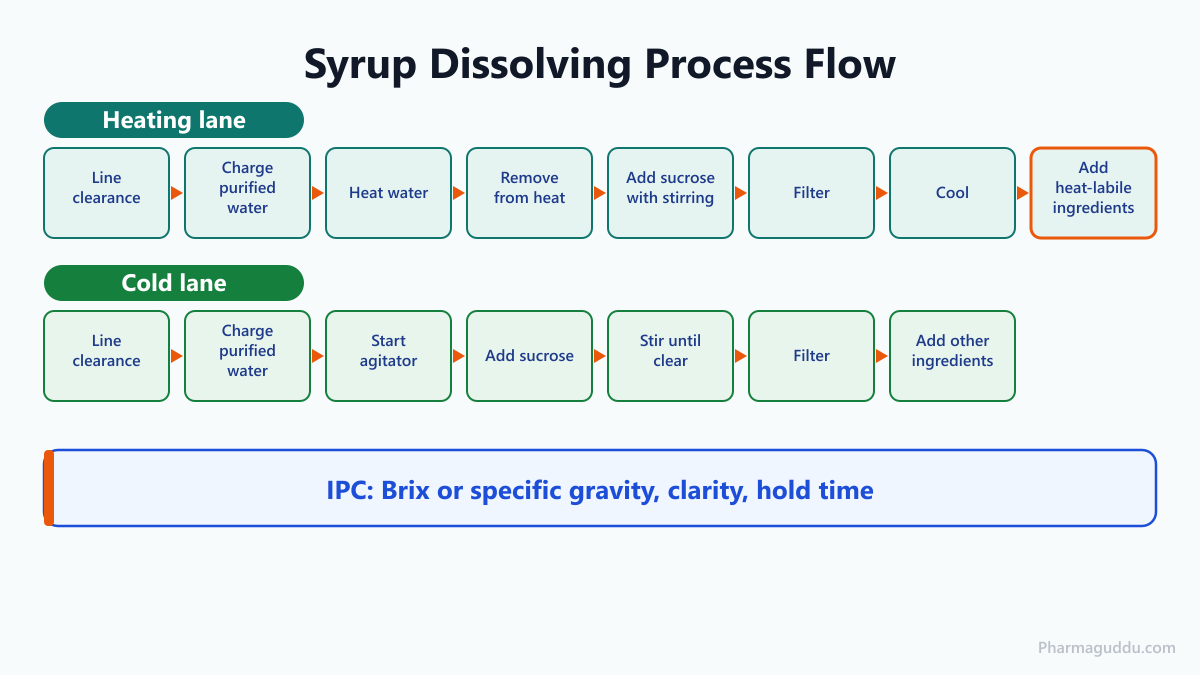
In both methods, the in-process control (IPC) checks are Brix or specific gravity, clarity after filtration, and the hold time of the syrup in the storage tank. The finished strength must reach the monograph strength, as explained in simple syrup concentration as per IP and USP. If the temperature or time is out of range, or the batch is not clear, the operator must inform the production officer, and a deviation is raised.
Equipment and safety
The heating method needs a jacketed vessel with steam or hot water supply, and hot surfaces and steam must be guarded. The cold method needs an agitator, and a high-shear mixer is one option. In both methods, the vessel should be qualified (IQ/Operational Qualification (OQ)), and the process validated. Engineering departmental person calibrate the temperature probe and inspect the agitator seals, gaskets and screens on preventive maintenance (PM) schedule. Under 21 CFR 211.65, surfaces that contact the product must not be reactive, additive or absorptive so as to alter its quality or purity.
When should each method be used?
The choice depends mainly on the ingredients, as the following points show.
- Heat-stable, non-volatile ingredients: the heating method is suitable because it saves time.
- Volatile or heat-labile ingredients: agitation without heating is preferred. Alternatively, such an ingredient is added to the heated syrup only after it has cooled to room temperature.
- Acidic formulations or a colourless product: the cold method avoids inversion and darkening.
- Short time and available steam: the heating method fits better.
Any change from one method to the other must go through change control and be supported by validation data.
What are the common mistakes?
- Adding sucrose to water that is still on the heat, which can overheat the syrup and darken it.
- Adding flavours, alcohol or heat-labile actives to hot syrup, so that they evaporate or degrade.
- Stopping the stirring too early in the cold method, so that undissolved crystals remain and the syrup is cloudy or below strength.
- Treating the values of a sample standard operating procedure (SOP), such as 30–45 minutes of stirring or a 100-mesh screen, as universal limits. These are set by process validation and equipment.
- Leaving the syrup in the storage tank beyond the validated hold time.
- Skipping the cleaning check, so that sugar residue remains in the vessel for the next batch. Cleaning must be validated, and the cleaned vessel should be stored dry (PIC/S PI 006-3).
Frequently Asked Questions
No. The cold method needs only a vessel with an agitator. A jacket is still useful when the same vessel is also used for the heating method, because chilled water in the jacket can then cool the syrup before heat-labile ingredients are added.
Taking the vessel off the heat limits overheating of the syrup, which would otherwise increase inversion and caramelisation. The teaching practice is to heat the water first and then stir in the sugar, and the actual temperature is recorded in the BMR.
Hot water gives some reduction in bioburden.
100-mesh stainless steel screen or an inline filter. A mesh size is not a clarity specification, so each production unit fixes the filter through validation and checks clarity and Brix or specific gravity after filtration.
References
- Production of cough mixtures and pharmaceutical syrups, Silverson
- Take the heat out of your sugar dissolving process, Silverson
- Elixir departmental in house SOP
- 21 CFR 211.65 Equipment construction, Cornell LII
- PIC/S PI 006-3, Recommendation on Validation Master Plan, Installation and Operational Qualification, Non-Sterile Process Validation, Cleaning Validation, PIC/S, 2007

Naresh Bhakar is the Founder and Author at Pharmaguddu.com, bringing his extensive expertise in the field of pharmaceuticals to readers worldwide. He has experience in Pharma manufacturing and has worked with top Pharmaceuticals. He has rich knowledge and provides valuable insights and data through his articles and content on Pharmaguddu.com. For further inquiries or collaborations, please don’t hesitate to reach out via email at [email protected].