
GMP & Pharmaceutical Manufacturing Expert
✓ Reviewed by: Naresh Bhakar
Reviewed for pharmaceutical accuracy
📅 Last Updated: November 13, 2026
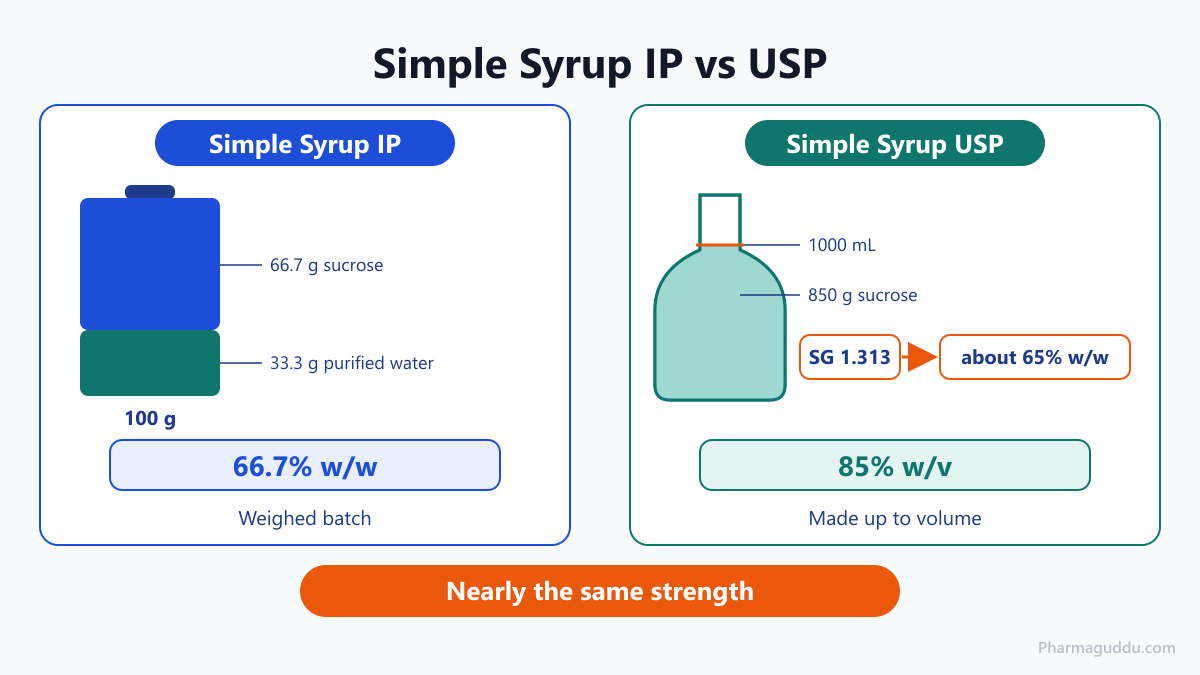
Simple syrup is a solution of sucrose in purified water without any medicament. Simple Syrup of the Indian Pharmacopoeia (IP) contains 66.7 g of sucrose in 100 g of syrup (66.7% w/w). The simple syrup of the United States Pharmacopeia (USP) contains 850 g of sucrose made up to 1000 mL (85% w/v), which is about 65% w/w at a specific gravity of 1.313. The two strengths are therefore almost the same, stated on different bases. At this sugar level, high osmotic pressure and low water activity prevent microbial growth, so no added preservative is needed.
What Is Simple Syrup and How Is Its Concentration Expressed?
Simple syrup is a concentrated aqueous solution of sucrose in purified water, with no medicament and no flavour. It is used as a sweet, viscous vehicle for medicated syrups and as the base of flavoured preparations. For the full overview of syrup types and the general manufacturing route, see the guide on liquid syrup types and manufacturing process.
Concentration is stated by weight or by volume. Weight per weight (w/w) means grams of sucrose in 100 g of finished syrup, whereas weight per volume (w/v) means grams of sucrose in 100 mL of finished syrup. Syrup is much denser than water, so the same syrup gives two quite different figures, and this is why the IP and USP values look unlike each other.
Syrups in general carry about 60 to 80% sucrose, as described by The Pharmapedia. Simple syrup lies at its upper end.
How Does a High Sugar Concentration Preserve Simple Syrup?
Simple syrup is self-preserving because its sucrose content creates high osmotic pressure and low water activity. Water activity is the measurable share of water that is free for microbial use. Dissolved sucrose holds most of the water, so bacteria, yeasts and moulds cannot take up enough of it to grow, and microbial cells placed in such a solution also lose water to it by osmosis.
A dilute sucrose solution behaves differently. It can ferment, turn turbid and change colour, because microbes grow in it. Our some facts checks found that 65% w/w as the minimum sucrose level that preserves a neutral syrup. This is a our figure and not a pharmacopoeial limit, and the IP strength of 66.7% w/w lies just above it.
The protection depends on the concentration of the final product, not on the concentration of the starting syrup. If an aqueous solution of a drug or buffer is added to simple syrup, the sugar fraction falls. For example, mixing 90 g of 65% w/w syrup with 10 g of a sugar-free aqueous solution gives about 58.5% w/w, which is below the teaching minimum. The formulation of such a medicated syrup must therefore be assessed for microbial risk, and a preservative is often added.
What Are the Stages of Simple Syrup Manufacture?
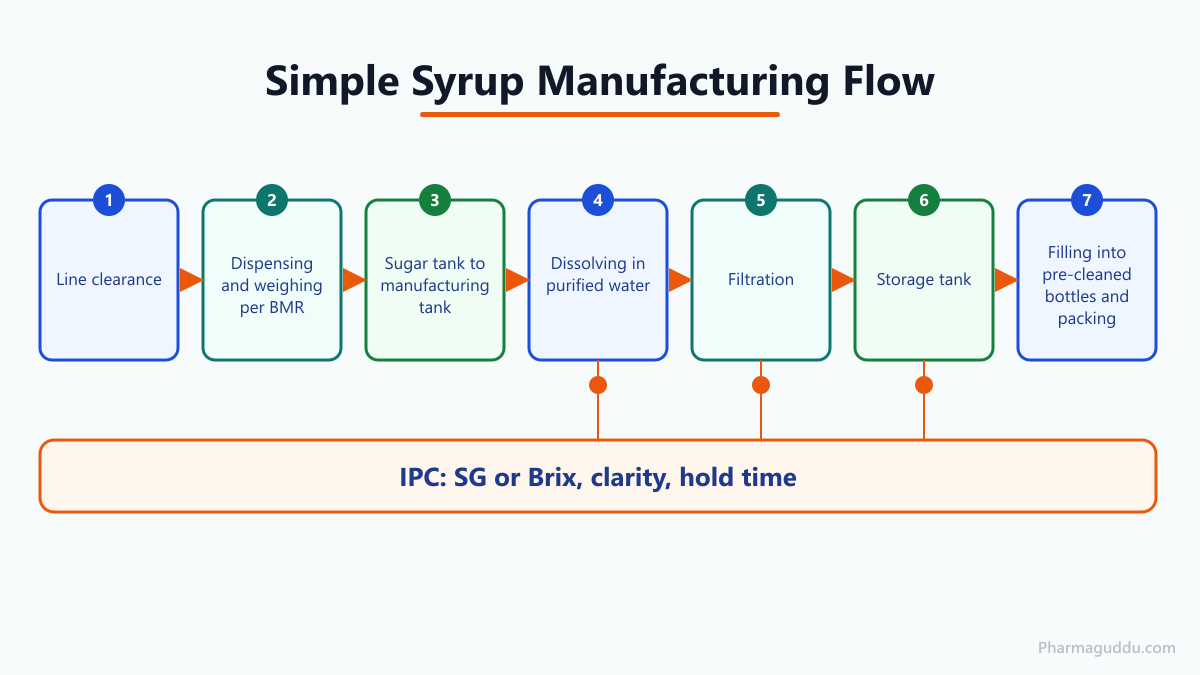
In a pharmaceutical plant, simple syrup is made in a fixed sequence of stages that are recorded in the batch manufacturing record (BMR). The sugar tank, the manufacturing tank and the storage tank are connected by dedicated pipelines.
- Line clearance is completed in the dispensing and manufacturing areas, and Quality Assurance (QA) checks that no material, label or record of the previous batch remains.
- Sucrose and purified water are dispensed and weighed as per the BMR.
- Sucrose is transferred from the sugar tank to the manufacturing tank, where it is dissolved in purified water.
- The syrup is filtered to remove particles and precipitates.
- The filtered syrup is held in the storage tank.
- The syrup is filled into pre-cleaned bottles and packed.
In-process controls (IPC) are carried out at the dissolving, filtration and holding stages, as described in the control section below. The equipment in this route (dissolver, tanks and filter housing) must be qualified. The process, the cleaning procedure and the test methods are also validated.
The operator weighs the materials and runs the dissolving step, while the production officer or shift in-charge supervises the stages and checks the entries in the BMR. The QA officer verifies each stage against BMR. Besides this, the QA officer collects or witnesses the IPC samples and approves any deviation. The store officer and Quality Control (QC) analyst are responsible for the sucrose, which must be received and released against the specification before it is dispensed.
How Do Simple Syrup IP and USP Differ, and How Are They Converted?
Simple Syrup IP is reported as 66.7 g of sucrose with purified water to make 100 g, which is 66.7% w/w. This is about 2 parts of sucrose to 1 part of water by weight, and the water portion is 33.3 g. An IP batch is therefore weighed.
Simple syrup USP is 850 g of sucrose in enough purified water to make 1000 mL, which is 85% w/v, and the batch is made up to volume. The specific gravity is taught as 1.313, so 1000 mL of the syrup weighs about 1313 g.
The conversion of USP syrup from w/v to w/w uses the weight of 100 mL of syrup.
- Weight of 100 mL of syrup = 100 mL × 1.313 = 131.3 g.
- Sucrose in 100 mL = 85 g.
- Percentage w/w = 85 ÷ 131.3 × 100 = about 64.7%, which textbooks round to 65% w/w.
- Water in 100 mL = 131.3 − 85 = about 46.3 g.
The table gives both syrups on both bases. The USP per-100 g values are calculated from the figures above, and the IP volume basis is not given because no specific gravity is available for it.
| Syrup | Basis | Sucrose | Water | Total |
|---|---|---|---|---|
| Simple Syrup IP | Per 100 g | 66.7 g | 33.3 g | 100 g |
| Simple syrup USP | Per 100 mL | 85 g | about 46.3 g | about 131.3 g |
| Simple syrup USP | Per 100 g | about 64.7 g | about 35.3 g | 100 g |
The two strengths differ by only about 2 percentage points on the weight basis, so IP and USP simple syrups are nearly equal in strength. For production planning, a 1000 kg IP batch needs 667 kg of sucrose and 333 kg of purified water. A 1000 L USP batch needs 850 kg of sucrose made up to 1000 L, and the syrup then weighs about 1313 kg.
READ ALSO
Liquid Syrup Types and Manufacturing Process
The syrup is a Liquid Dosage form generally taken orally.
How Is Simple Syrup Prepared in Practice?
Three methods are described for preparing syrup: solution with heat, agitation without heat, and percolation. Heat is the fastest method, but it is unsuitable for heat-labile ingredients. Agitation without heat takes longer and suits ingredients that must not be warmed.
In the heat method, purified water is warmed gently in a jacketed manufacturing tank, and sucrose is added with continuous stirring until it dissolves. Overheating must be avoided, because it causes caramelisation and darkening. The syrup is then cooled and brought to the final weight or volume. It is filtered after that.
The basis of the pharmacopoeia decides how the batch is finished. For a w/w syrup (IP), sucrose and purified water are weighed in the stated proportion, so the final weight is controlled directly. For a w/v syrup (USP), 850 g of sucrose per litre is dissolved and the syrup is made up to the final volume mark of a calibrated tank. Once the volume is adjusted, the specific gravity of the batch is checked against its intended strength.
A slight excess of water over the saturation amount keeps the syrup stable when the temperature changes. The UNC teaching page states that about 425 mL of water is enough to dissolve 850 g of sucrose, while the USP syrup holds about 450 mL per litre. This small margin helps to prevent crystallisation during cold storage.
Which In-Process Controls and Records Apply?
The strength of the syrup is verified by specific gravity at a stated temperature or by refractometer Brix. Brix is the percentage of sucrose by weight, so about 65 to 66.7 °Brix corresponds to the USP and IP syrups, although the equivalence is approximate. The result must be recorded in the BMR against the specification, together with the temperature at which it was read.
The IPC checks and BMR entries for a syrup batch normally include the following:
- SG or Brix of the finished syrup, compared with the specification.
- Clarity of the syrup after filtration.
- Filter identity and the integrity check recorded before use.
- Hold time in the storage tank, from the end of filtration to the start of filling.
- Yield and reconciliation of sucrose, purified water and bottles.
- The signatures of the operator, the production officer and the QA officer.
A deviation is raised whenever a result falls outside the specification or the hold time is exceeded. It is also raised if the syrup is turbid or discoloured, or if the yield and reconciliation do not agree. The batch stays on hold until QA completes the investigation.
The quality of the inputs also needs control. Purified water must meet the specification of its grade, and its microbial control depends on the water system, as explained in types of water in pharmaceutical use and water system validation and phases. The sugar tank and the storage tank must also be kept free from microbial growth.
What Are the Critical Process Parameters?
No pharmacopoeial or manufacturer value is available for temperature, mixing time or filter rating of a pharmaceutical syrup tank. These parameters are therefore listed without a value. They are set in the BMR from process validation and from the equipment qualification of the dissolver. Exact values depend on the manufacturer and model; always follow the Original Equipment Manufacturer (OEM) manual and site Standard Operating Procedure (SOP).
| Parameter | Setting or range | Why it matters | How it is monitored |
|---|---|---|---|
| Sucrose quantity | USP: 850 g per 1000 mL; IP: 66.7 g per 100 g | Decides the strength and the preservation | Weighing record in the BMR |
| Specific gravity of finished syrup | USP: 1.313 (teaching value) | Confirms that the syrup is at full strength | SG or Brix check against the specification |
| Water temperature | Set in the BMR from validation | Speeds up dissolving, but excess heat darkens the syrup | Tank temperature indicator, recorded by the operator |
| Heating limit | Set in the BMR from validation | Prevents caramelisation and darkening | Temperature record and visual colour check |
| Mixing time | Set in the BMR from validation | Ensures complete dissolution of sucrose | Visual check of clarity, IPC record |
| Final volume or weight | Per batch size in the BMR | Controls the batch strength | Calibrated tank or balance, with reconciliation |
What Are the Common Problems in Simple Syrup and How Are They Fixed?
Crystallisation at the Neck and Cap
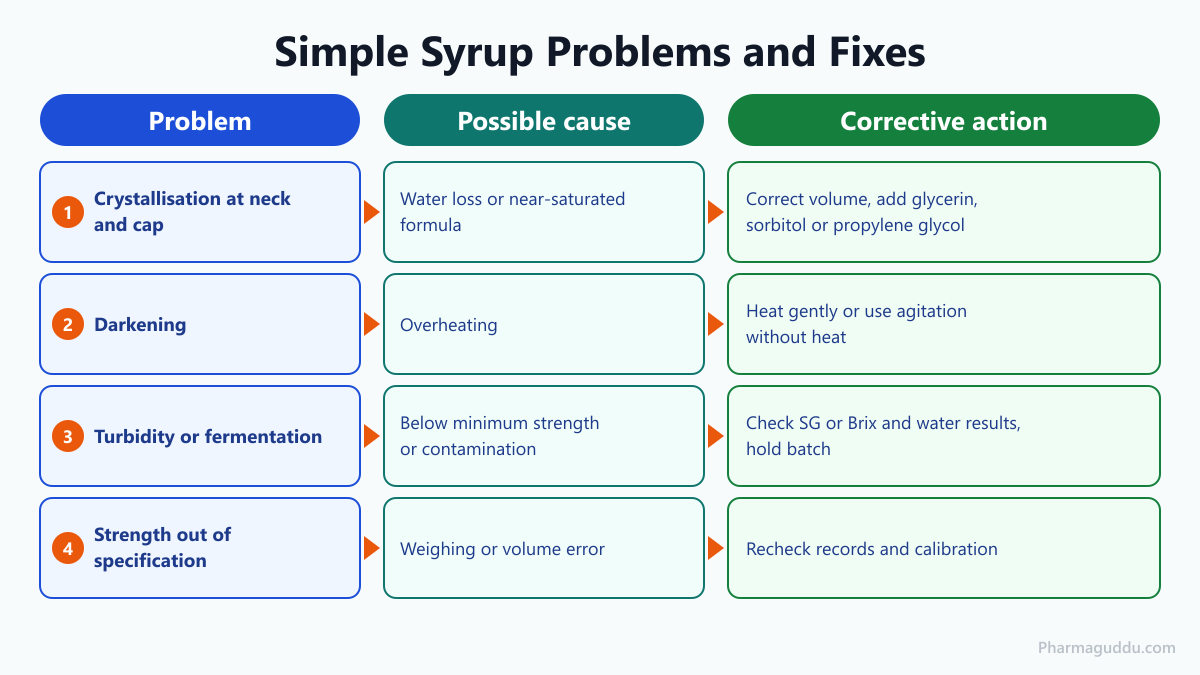
Possible causes: loss of water by evaporation, a formula close to saturation, or cooling during storage.
Corrective actions: make up to the correct volume or weight. Add a small amount of glycerin, sorbitol or propylene glycol to hinder crystallisation (cap-locking), as described by The Pharmapedia.
Darkening of the Syrup
Possible causes: overheating while dissolving, which causes caramelisation.
Corrective actions: heat gently and only as long as dissolving needs, or use agitation without heat when the formula contains heat-labile ingredients.
Turbidity or Fermentation
Possible causes: a syrup below the minimum strength or dilution after medicament addition. Microbial contamination from purified water, tanks or lines can also cause it.
Corrective actions: check SG or Brix, review the purified water results and hold the batch under a deviation until QA completes the investigation.
Sugar Residue and Microbial Growth in Tanks and Lines
Sugar residue left in the syrup tank, pipelines and filter housing can support microbial growth in the next batch. After each batch and especially at a product changeover, the tank, lines and filters must be cleaned as per the approved procedure. The equipment is released only after QA verifies the cleaning record. Wet equipment should be allowed to drain and dry so that no residual water dilutes the next batch.
Strength Out of Specification
Possible causes: weighing error, wrong final volume, or water left in the lines.
Corrective actions: recheck the weighing record and the calibration of the balance and the tank, then correct the batch only as per the approved procedure.
What Do the Regulations Say About Simple Syrup?
The strength of simple syrup is defined by the monographs of the Indian Pharmacopoeia (IP) and of the United States Pharmacopeia and National Formulary (USP-NF). The IP 2022 edition came into effect on 1 December 2022, as stated in the salient features published by the Indian Pharmacopoeia Commission.
Co-solvents such as glycerin, sorbitol solution and propylene glycol are high-risk components for contamination with diethylene glycol (DEG) and ethylene glycol (EG). The FDA guidance “Testing of Glycerin, Propylene Glycol, Maltitol Solution, Hydrogenated Starch Hydrolysate, Sorbitol Solution, and Other High-Risk Drug Components for Diethylene Glycol and Ethylene Glycol” (May 2023) alerts manufacturers to this hazard.
It reports fatal poisonings from liquid drug products made with contaminated components, and it expects DEG and EG testing with a safety limit of NMT 0.10% on a representative sample from all containers of all lots of each high-risk component. Where the DEG/EG test is not part of the identification test in the USP-NF monograph, the manufacturer should use a suitable equivalent method. A syrup plant that adds these components should therefore test them before use.
Frequently Asked Questions
Small amounts of glycerin, sorbitol or propylene glycol are added to hinder crystallisation of sucrose during storage, which prevents hard crystalline crusts at the bottle neck and cap. These components are high-risk for DEG and EG contamination, so each one must be tested before it is used in a batch.
A saturated syrup is at the limit of what the water can hold, so a fall in temperature makes sucrose crystallise out. A small excess of water keeps all the sucrose in solution across the storage temperature range. The UNC teaching page quotes about 425 mL of water for dissolving 850 g of sucrose against about 450 mL in the syrup.
Excess heat darkens the syrup by caramelisation, and the colour change is a quality defect. Heat is also unsuitable for heat-labile ingredients. The jacketed tank is therefore heated gently, and only for as long as complete dissolution needs, with the temperature recorded in the BMR.
Purified water is used, as stated in both the IP and USP descriptions of simple syrup. The plant must therefore control the purified water system, and the QC analyst checks that the water meets its specification before use. The SOP for water purifier covers the operation of such a unit.
References
- Testing of Glycerin, Propylene Glycol, Maltitol Solution, Hydrogenated Starch Hydrolysate, Sorbitol Solution, and Other High-Risk Drug Components for DEG and EG, US FDA, May 2023
- Salient Features of Indian Pharmacopoeia 2022, Indian Pharmacopoeia Commission
- Lachman/Lieberman, The Theory and Practice of Industrial Pharmacy, textbook
- Aulton’s Pharmaceutics: The Design and Manufacture of Medicines, textbook

Naresh Bhakar is the Founder and Author at Pharmaguddu.com, bringing his extensive expertise in the field of pharmaceuticals to readers worldwide. He has experience in Pharma manufacturing and has worked with top Pharmaceuticals. He has rich knowledge and provides valuable insights and data through his articles and content on Pharmaguddu.com. For further inquiries or collaborations, please don’t hesitate to reach out via email at [email protected].