
GMP & Pharmaceutical Manufacturing Expert
✓ Reviewed by: Naresh Bhakar
Reviewed for pharmaceutical accuracy
📅 Last Updated: November 12, 2026
Mouthwash is a liquid preparation that is rinsed around the mouth and then spat out. Cosmetic mouthwashes freshen the breath for a short time, whereas therapeutic products carry active agents such as fluoride, chlorhexidine, cetylpyridinium chloride (CPC) or essential oils. Reviews describe a therapeutic rinse as an adjunct to brushing and flossing, because mechanical removal of plaque remains the basic method. A mouthwash formulation needs a solvent, a humectant, a preservative system, a flavour with a solubiliser and a buffer. Therapeutic products also need a defined active.
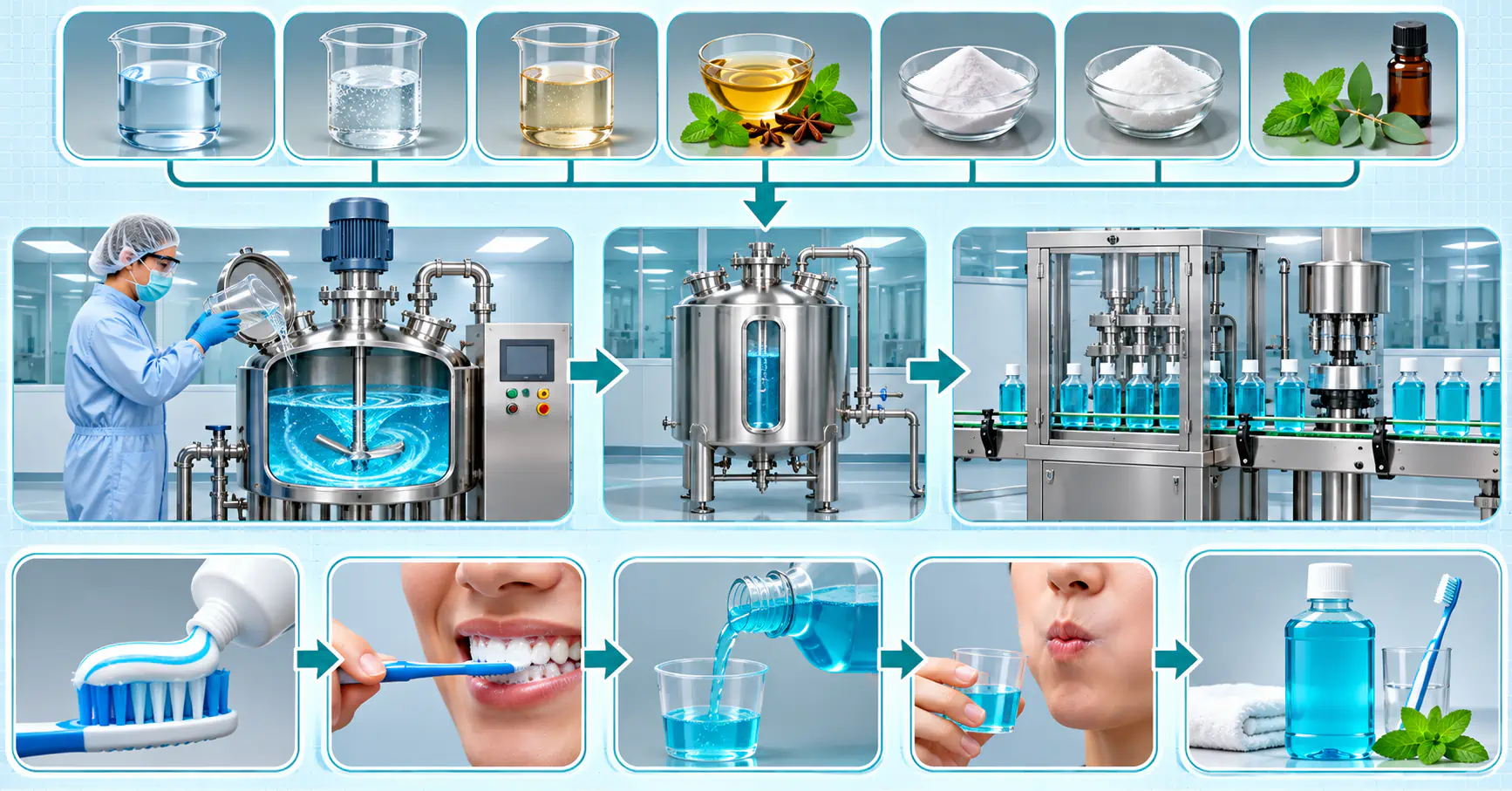
What Is Mouthwash and Where Does It Fit in Oral Care?
A mouthwash is an aqueous or hydro-alcoholic liquid that is held in the mouth, swished between the teeth and then spat out. Its purpose is to freshen the breath, to deliver an active agent to the teeth and gums, or to do both. For the full overview of toothpastes, powders and related products, see Dentifrices; Types, Formulation, and Evaluation.
A dentifrice cleans the teeth by abrasion. A mouthwash contains no abrasive. A rinse can reach areas that a brush reaches poorly, but it cannot remove plaque by itself, so mouthwash is positioned as a supplement to brushing and not as a replacement for it.
The word “mouthwash” is not always used for a drug. In the United States, the Food and Drug Administration (FDA) anticaries monograph uses the term “rinse” for fluoride products. It allows the word “mouthwash” in place of “rinse” only if the product also has a cosmetic use (OTC Monograph M021, section M021.50). The terms “treatment rinse” and “cosmetic mouthwash” are therefore used separately in the text below.
What Is the Principle Behind a Mouthwash?
A mouthwash works by bringing a dissolved agent into contact with the teeth, the gums and the mucosa for a short time, usually about one minute. The liquid also moves mechanically between the teeth when it is swished, which helps to loosen debris.
The action depends on the type of active agent:
- Fluoride from a treatment rinse is taken up by the tooth surface and aids the prevention of dental caries (decay).
- Chlorhexidine gluconate, CPC and essential oils act against the bacteria in dental plaque and so reduce plaque and gingival inflammation.
- Flavour and cooling agents give a fresh taste and a short masking effect on bad breath, without any treatment action.
A review published in 2018 on PubMed Central states that mechanical plaque removal is the basic approach and that chemical control is an adjunct, mainly where mechanical cleaning is difficult. A Cochrane review of 51 randomised trials with 5,345 participants, summarised by the National Institute for Health and Care Research (NIHR), found that chlorhexidine rinse added to usual care lowered plaque and gingivitis scores in mild gum disease. The same review recorded more tooth staining and calculus, and these effects became clear after about 4 weeks of use. The evidence for moderate to severe disease was insufficient.
The sequence of use is stated in the FDA monograph for fluoride rinses. The rinse is used after brushing with a toothpaste, 10 mL is swished between the teeth for 1 minute and spat out, and the user should not eat or drink for 30 minutes afterwards (section M021.50(d)(2)). The rinse must not be swallowed.
What Are the Components of a Mouthwash Formulation?
A mouthwash formulation is a solution in which every component has a defined role, and the formulation below is illustrative and follows an alcohol-free example described in a US patent (9192565). It is not a marketed or regulatory formula.
| Component | Typical class or example | Role |
|---|---|---|
| Vehicle | Purified water | Main solvent and carrier |
| Humectant and sweetener | Glycerin | Adds body and mouthfeel, and sweetens |
| Preservative | Sodium benzoate | Controls microbial growth |
| Active agent | CPC, chlorhexidine, essential oils, fluoride | Antiplaque, antigingival or anticaries action |
| Acid or buffer | Citric acid | Adjusts and holds the pH |
| Sweetener | Xylitol | Improves taste |
| Flavour | Mint and similar flavours | Gives a fresh taste |
| Colour | Permitted colourant | Gives appearance and product identity |
| Solubiliser | Poloxamer 407 | Keeps flavour or essential oils clear in water |
| Co-solvent | Ethanol (conventional products) | Dissolves flavour oils and assists preservation |
The ranges published in patents are claimed ranges and not market norms. A patent for an essential-oil rinse describes total oils of about 0.001 to 0.35% w/v with poloxamer 407 at about 0.1 to 4.5% w/v to solubilise them. Each product must be set at its own product-specific level during development.
The reviewed literature lists chlorhexidine gluconate at 0.05, 0.06, 0.1, 0.12 and 0.2% in different products. CPC is listed from 0.05%. Fluoride is listed at 225 to 900 ppm F in rinses, compared with about 5,000 ppm in dentifrices. The US monograph states treatment-rinse strengths in another form, for example sodium fluoride 0.05% aqueous solution with a pH of approximately 7 (section M021.10(a)(3)). The two systems should not be mixed.
Why Is Alcohol Used in Some Mouthwashes?
Ethanol acts as a solvent for flavour oils and actives. It also helps to preserve the product. A patent for conventional rinses mentions ethanol up to about 27% v/v, whereas alcohol-free versions replace it with other preservatives, such as sodium benzoate or CPC, and with a solubiliser.
What Are the Types of Mouthwash?
Mouthwashes are divided into cosmetic and therapeutic types. The classification follows the claim made and the active agent present.
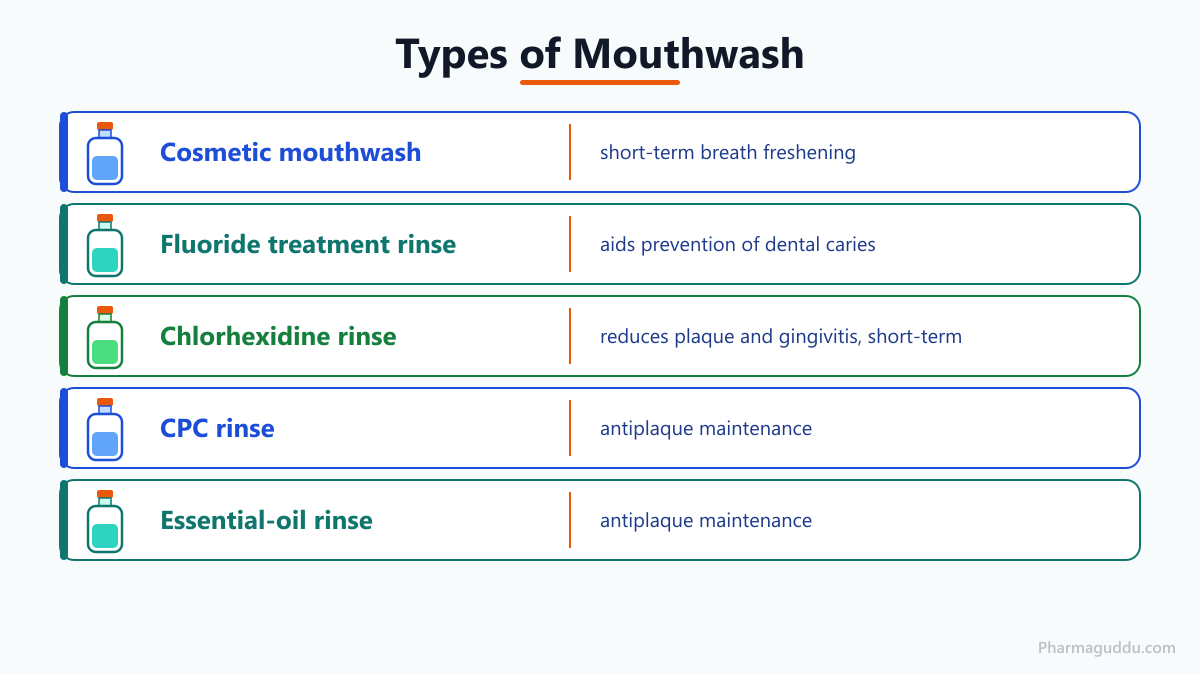
| Type | Active or main component | Purpose | Notes |
|---|---|---|---|
| Cosmetic mouthwash | Flavour, humectant, no treatment active | Short-term breath freshening | Not a drug if no drug claim is made |
| Fluoride treatment rinse | Sodium fluoride, acidulated phosphate fluoride or stannous fluoride | Aids prevention of dental caries | OTC drug under monograph M021 in the US |
| Chlorhexidine rinse | Chlorhexidine gluconate | Reduces plaque and gingivitis | Prescription product in the US; short-term use |
| CPC rinse | Cetylpyridinium chloride | Antiplaque maintenance | Suited to long-term use |
| Essential-oil rinse | Essential oils with a solubiliser | Antiplaque maintenance | Suited to long-term use |
Systematic reviews report a small but significant extra reduction in plaque and gingival inflammation when CPC or essential-oil rinses are added to brushing. Chlorhexidine is regarded as the most effective but is kept for short-term use because of staining, and in the United Kingdom chlorhexidine mouthwashes are licensed for about 30 days.
Fluoride treatment rinses are also supplied as concentrated solutions, powders or effervescent tablets that are mixed with water before use. The user must not use these before mixing. The monograph also requires a stannous fluoride rinse to be used immediately after it is prepared.
How Is Mouthwash Manufactured?
Mouthwash is made by the standard route for a non-sterile liquid: water is charged to a stainless-steel tank, the components are added in a defined order, the batch is mixed, checked, filtered and then filled. The sequence below describes the usual operations, and the parameters are set for each product and recorded in the batch manufacturing record (BMR).
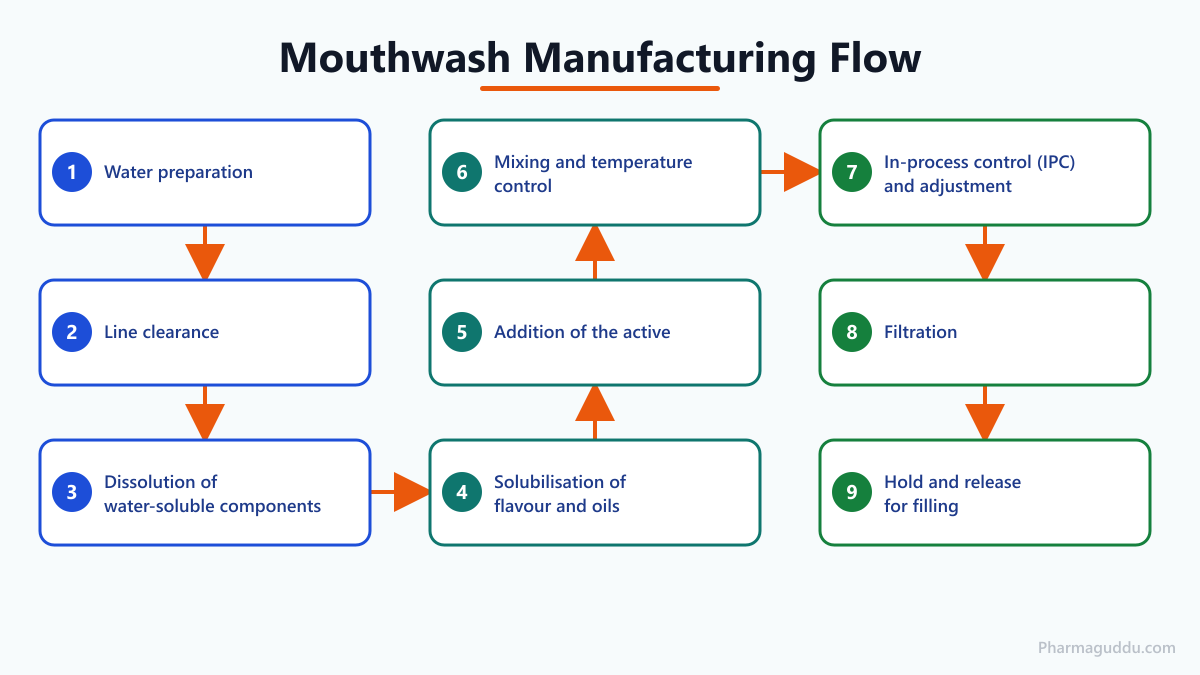
- Water preparation. Purified water is drawn from a controlled loop. Water is the main component, so its microbial quality governs the quality of the batch.
- Line clearance. The production officer and the quality assurance (QA) officer check that the area, tank and filling line are free from material and labels of the previous batch.
- Dissolution of water-soluble components. The humectant, sweetener, buffer and preservative are added to the water in the order given in the BMR, with stirring until dissolved.
- Solubilisation of flavour and oils. The flavour or essential oils are first mixed with the solubiliser (a surfactant such as poloxamer 407 or a polysorbate), and this premix is then added to the main batch. Adding oils directly to water leads to cloudiness.
- Addition of the active. Fluoride, chlorhexidine or CPC is added at the stage fixed by the master formula, and the colour is added last.
- Mixing and temperature control. The tank is stirred until the batch is homogeneous. Temperature is controlled only as far as the components require, and an ethanol-containing batch is kept in a closed vessel.
- In-process control (IPC) and adjustment. Appearance, pH and viscosity are checked, and the pH is adjusted if required.
- Filtration. The batch is passed through a filter to give a clear solution before it is transferred to the filling hopper.
- Hold and release for filling. The bulk is held in a closed tank for the time allowed by the validated hold time, and the Quality Control (QC) analyst releases it for filling after the bulk tests.
How Are Filling, Packaging and Labelling Carried Out?
After release from QC, the bulk is filled into bottles, closed and labelled. The packaging must suit the product type. For example, the prescription chlorhexidine rinse in the FDA recall notice was supplied in amber bottles with a childproof cap, safety seal and a 15 mL metered dosage cup. A fluoride rinse must also carry the warning to keep it out of reach of children. More on pack types is given in pharmaceutical packaging.
On the filling line, the following checks are performed at a set frequency:
- Fill volume is checked against the label claim.
- Cap torque or seal integrity is checked, together with the tamper-evident seal and the child-resistant closure where fitted.
- Label identity, batch number and expiry date are checked against the BMR.
- Dosing cups are checked to ensure that they are clean and that the correct cup is used for the product.
At the end of the run, label reconciliation is done. The quantity of labels issued, used, destroyed and returned must match. The difference is then explained before the batch is released. The filling and packing details are entered in the batch packaging record (BPR) and signed by the production officer and the in-process quality assurance (IPQA) officer.
For a fluoride treatment rinse, the monograph limits each package to 120 mg total fluorine (section M021.20), so the pack size must be selected within this limit unless the product is marketed for professional office use only.
What Controls and Limits Apply During Production?
Control of a mouthwash batch covers the raw materials, the process and the finished product. Limits are product-specific. They come from the approved specification.
| Stage | Check | Purpose |
|---|---|---|
| Water | Microbial count and conductivity as per the water system programme | Prevents contamination at source |
| Bulk, during mixing | Appearance and clarity | Detects undissolved material or separated oil |
| Bulk, after mixing | pH | Maintains stability and preservative action |
| Bulk, after mixing | Viscosity or specific gravity | Confirms the batch composition |
| Bulk | Assay of the active | Confirms fluoride, chlorhexidine or CPC level |
| Bulk and finished product | Microbial testing | Confirms the preservative system and process control |
| Filling | Fill volume, cap seal, label | Confirms the pack |
The fluoride rinse monograph gives a clear example of the pH control. The sodium fluoride 0.02% and 0.05% solutions have a pH of approximately 7, and the acidulated phosphate fluoride solutions have a pH of 3.0 to 4.5 or 3.5, depending on the type (section M021.10(a)(3)).
The preservative system is the main defence against microbial growth in a water-based product. It must be effective at the product pH, and a failure of it is a quality defect. An extra safeguard is the water system, because purified water that carries bacteria can contaminate every batch made with it.
The results of IPC are entered in the BMR at the time of the check. A result outside the limit is reported to the QA officer and handled through the deviation procedure.
What Are the Common Problems and How Are They Fixed?
Cloudy or Separated Product
Possible causes: the flavour or oils were added without the solubiliser, the solubiliser level is too low for the oil level, or the batch was filtered or cooled in a way that the oil came out of solution.
Corrective actions: the oils should be premixed with the surfactant before addition, the order of addition in the BMR should be followed, and the solubiliser level should be reviewed in the formulation development records.
Microbial Contamination
Possible causes: poor-quality water, an ineffective preservative at the product pH, or residual moisture and biofilm in the tank and lines.
Corrective actions: the water system must be controlled and trended, tanks and lines must be dried after cleaning, and the preservative system must be reviewed. Stagnant water must not remain in equipment after cleaning (PIC/S PI 006-3).
The Paroex recalls show the seriousness of the risk. Sunstar Americas announced a voluntary recall of Paroex Chlorhexidine Gluconate Oral Rinse, United States Pharmacopeia (USP) 0.12% on 27 October 2020 because the product might be contaminated with Burkholderia lata. Related notices followed from Lohxa, LLC (9 November 2020) and Precision Dose, Inc. (31 December 2020). Sunstar also issued an expansion on 28 December 2020. The FDA notices state that use of the product can lead to oral and, potentially, systemic infections, and life-threatening infections such as pneumonia in the most at-risk groups. The December 2020 expansion reported 29 adverse events, and the Lohxa product was an alcohol-free rinse. Water-based rinses should therefore be treated as microbial-risk products.
Colour or Taste Change During Storage
Possible causes: interaction between the colour, flavour and other components, or an unsuitable pH.
Corrective actions: the affected batch is investigated through stability data, and the formulation or the pack is reviewed.
Carry-Over Between Products
Possible causes: residues of flavour, colour or an active may remain after a changeover. The tank, pump, hose or filler can hold them.
Corrective actions: a changeover between flavours, colours or between a cosmetic and a drug product (fluoride or chlorhexidine) requires line clearance and a validated cleaning process. Direct surface (swab) sampling and indirect rinse sampling are both accepted, and a combination of the two is generally the most desirable (PI 006-3). Defined limits for detergent residues and validated analytical methods are also required. Equipment must be qualified. The process and cleaning must also be validated. For the qualification stages, see qualification and types of qualification. For validation, see process validation in pharmaceuticals.
What Are the Regulatory Points for Mouthwash?
In the United States, the regulatory status depends on the claim. A cosmetic mouthwash makes no drug claim. A fluoride treatment rinse is an over-the-counter (OTC) drug, and it must meet the conditions of OTC Monograph M021 (posted 2 May 2023), which is a final administrative order effective on 27 March 2020 under the CARES Act. The monograph covers statement of identity, indication, warnings, directions and the principal display panel statement “IMPORTANT: Read directions for proper use.”
Antigingivitis and antiplaque products fall under a different part. The FDA rulemaking history lists oral health care drug products for antigingivitis and antiplaque (21 CFR part 356) as a pending final monograph. Prescription chlorhexidine rinse is sold through healthcare professionals, as the recall notices show.
Manufacture of drug rinses must comply with current good manufacturing practice (cGMP), and the BMR and BPR must be kept for every batch.
Expert Tips
- Premix the oils. The flavour or essential oil should always be dissolved in the solubiliser before it is added to the water phase.
- Respect the order of addition. The sequence in the BMR must not be changed without a documented change control.
- Treat water as a raw material. The purified water used for the batch must be within its microbial limits on the day of use.
- Dry the equipment. Tanks and hoses must be left dry after cleaning.
- Segregate drug and cosmetic products. A changeover between a fluoride or chlorhexidine product and a cosmetic rinse needs documented line clearance.
- Reconcile labels. Label reconciliation should be completed before the batch is released.
- Keep the actives at the specified level. Product-specific levels must come from the approved master formula, and patent ranges should not be used as limits.
Frequently Asked Questions
No. Reviews describe therapeutic rinses as an adjunct to brushing and flossing, because mechanical removal of plaque is still the basic method. A rinse is also not an abrasive product, so it cannot lift plaque from the tooth surface. The fluoride monograph directs the rinse to be used after brushing with a toothpaste.
Chlorhexidine is intended for short-term use. The Cochrane evidence summarised by NIHR shows that staining and calculus build-up become clear after about 4 weeks of use, and UK chlorhexidine mouthwashes are licensed for about 30 days. CPC and essential-oil rinses are regarded as better suited to long-term maintenance.
No. A cosmetic rinse that only freshens the breath is not a drug. In the United States, a product that makes an anticaries claim is an OTC drug under monograph M021, and a prescription chlorhexidine rinse is also a drug. The label wording matters, because “mouthwash” may replace “rinse” in a fluoride product’s statement of identity only if the product also has a cosmetic use.
Glycerin is a humectant, a sweetener and a body-giving agent. It adds mouthfeel to the rinse and makes the taste of an alcohol-free product more acceptable. A patent example of an alcohol-free formula lists glycerin with sodium benzoate, CPC and citric acid. It also lists xylitol, flavour and colour.
Yes. A water-based rinse can support bacterial growth if the water, the preservative system or the cleaning of tanks and lines is inadequate. The chlorhexidine recalls announced in October to December 2020 for possible Burkholderia lata contamination are the documented example, and the FDA notices describe the infection risk for at-risk patients.
References
- Mouthwash review (PMC6354555), PubMed Central, 2018
- NIHR Evidence: Chlorhexidine mouthwash is useful short term for people with mild gum disease, NIHR, 2017
- OTC Monograph M021: Anticaries Drug Products for OTC Human Use, US FDA, 2023
- Sunstar Americas recall of Paroex chlorhexidine gluconate oral rinse, US FDA, 2020
- Lohxa LLC recall of chlorhexidine gluconate oral rinse USP 0.12%, US FDA, 2020
- Sunstar Americas expands recall of Paroex, US FDA, 2020
- Precision Dose recall of Paroex, US FDA, 2020
- Rulemaking History for OTC Oral Healthcare Drug Products, US FDA
- Long-term effect of an essential-oil mouthrinse on plaque and gingivitis: a systematic review, PubMed, 2007
- Alcohol-free mouthwash (US patent 9192565), USPTO
- Oral compositions containing a zinc compound (US patent 6121315), USPTO
- Mouthwash: History, Composition, Production, and Future Innovations, mfgrobots.com
- GEA Personal Care: Oral Care, GEA
- PIC/S PI 006-3: Recommendations on Validation Master Plan, Installation and Operational Qualification, Non-Sterile Process Validation, Cleaning Validation, PIC/S, 25 September 2007

Naresh Bhakar is the Founder and Author at Pharmaguddu.com, bringing his extensive expertise in the field of pharmaceuticals to readers worldwide. He has experience in Pharma manufacturing and has worked with top Pharmaceuticals. He has rich knowledge and provides valuable insights and data through his articles and content on Pharmaguddu.com. For further inquiries or collaborations, please don’t hesitate to reach out via email at [email protected].