
Quality Control, Quality Assurance Specialist | Industry Experience
✓ Reviewed by: Pankaj Sharma - Quality Control Specialist
Reviewed for QC, QA accuracy, laboratory practices, analytical methods, and technical Documents
📅 Last Updated: November 16, 2026
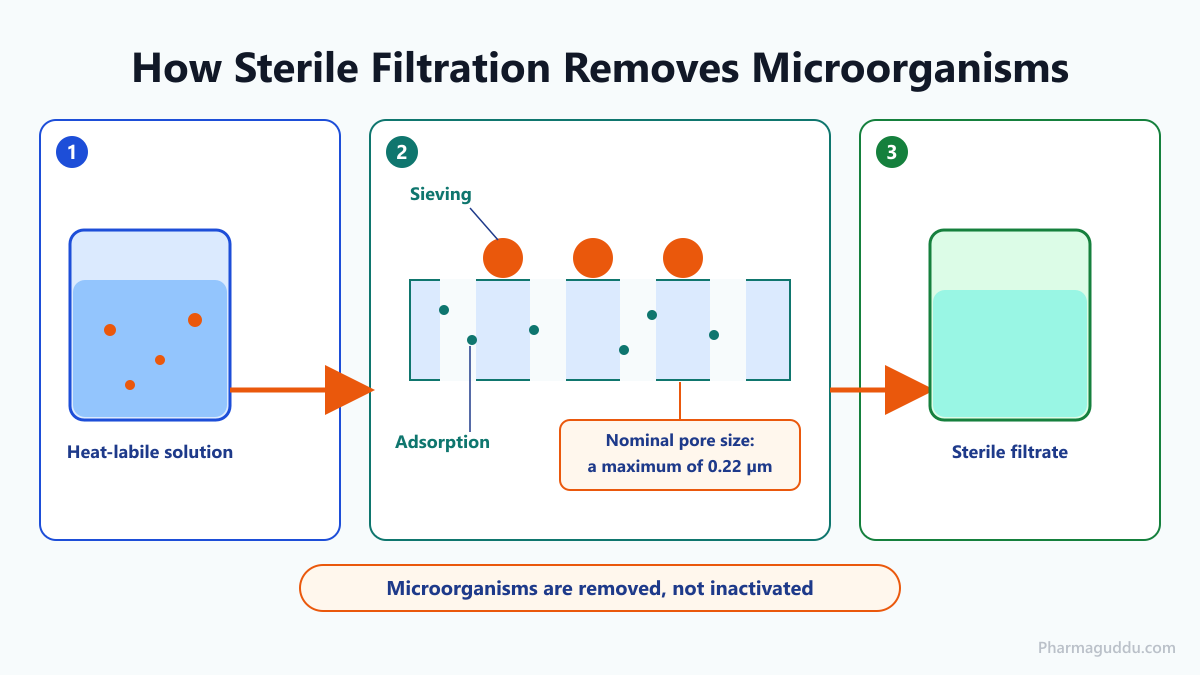
Sterilization by filtration removes microorganisms from a liquid or gas by passing it through a sterilising grade filter, which has a nominal pore size of a maximum of 0.22 µm and is validated to give a sterile filtrate. No heat is applied, so the method suits solutions that heat would damage. As per EU GMP Annex 1 (2022) it allows when a product cannot be sterilised in its final container, and the filter must pass an integrity test before and after use.
What is sterilization by filtration and when is it used?
Sterilization by filtration is a physical process in which a solution or gas passes through a membrane that holds back microorganisms and gives a sterile filtrate. It is used for active ingredients and preparations that degrade at autoclave temperatures, because heat can damage the active, the preservative or the excipients. Examples include vaccine additives, buffers and adjuvant emulsions.
EU GMP Annex 1 (2022), paragraph 8.34, states that terminal sterilisation in the final container gives greater assurance of sterility than sterile filtration or aseptic processing. Filtration is therefore chosen only for products that cannot be terminally sterilised. The filtrate is then filled aseptically into previously sterilised containers. For the full overview of methods, see sterilization, method of sterilization, and objective in labs.
How does a 0.22 µm membrane filter remove microorganisms?
A membrane filter removes microorganisms mainly by sieving, and adsorption supports it. Particles larger than the pore are stopped at the membrane surface or inside its matrix.
Adsorption is like as a second mechanism: microorganisms stick to the polymer inside the pores through hydrophobic or charge interactions, so a filter can retain particles smaller than its rating.
The size printed on a filter is a nominal (rated) pore size. The FDA guidance on aseptic processing (2004) tells that a filter can contain some pores larger than the nominal rating, and that 0.22 µm and 0.2 µm are interchangeable ratings. The pore rating alone therefore does not make a product sterile. Validated bacterial retention and a passed integrity test make the filter sterilising grade.
Filtration removes microorganisms and does not kill them. Endotoxin control depends on the raw materials and water used upstream, and the FDA guidance does not address virus removal. For the difference between these goals, see depyrogenation versus sterilization.
What are the parts of a sterile filtration system?
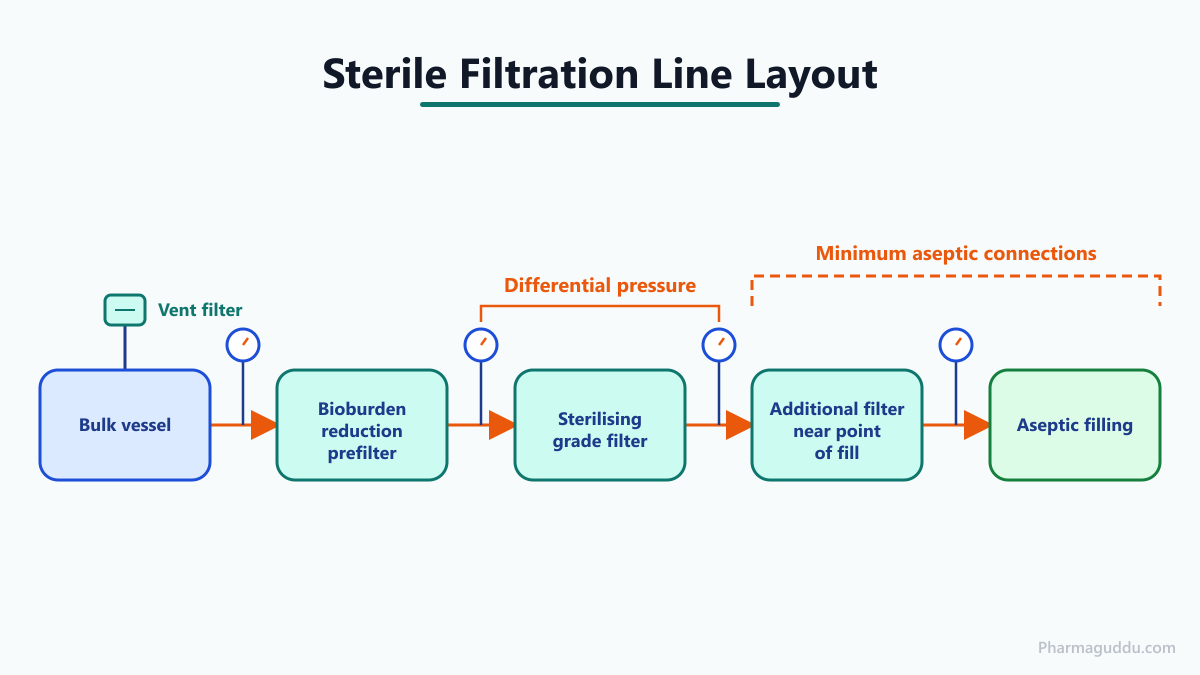
A product filtration line consists of a bulk vessel and one or more filters in housings. It also has pressure gauges upstream and downstream, together with flow and differential pressure monitoring. One plant description uses stainless steel (SS 316L) housings with tri-clover joints, arranged for in-place cleaning, sterilisation and integrity testing.
- Bioburden reduction prefilter: Annex 1 (paragraph 8.80) allows prefilters at several points to keep the bioburden of the liquid low and controlled before the final filter. One plant Standard Operating Procedure (SOP) uses a 0.45 µm polyethersulfone (PES) prefilter ahead of 0.22 µm PES filters.
- Final sterilising grade filter: This filter must permit in-place integrity testing, preferably as a closed system, both before and after filtration.
- Additional filter near the point of fill: Annex 1 states that a further sterilising grade filter, as close to the point of fill as possible, should be considered as part of the contamination control strategy (CCS). The number of aseptic connections after the final filter should be kept to a minimum.
- Vent and gas filters: Critical sterile gas and vent filters are integrity tested after use while they remain in the housing. Gas filters must not become wet unintentionally.
One site places the prefilter and first filter in a controlled room and the last filter in the aseptic zone near the filling point. The filter housing should be cleaned and assembled under an approved procedure, as in the SOP for disassembling, cleaning and assembling filter housing.
Which membrane and filter types are used?
Filters are grouped by function into bioburden reduction prefilters, sterilising grade liquid filters and vent or gas filters. Membranes are grouped by their behaviour towards water. Polyethersulfone (PES), polyvinylidene fluoride (PVDF) and nylon membranes are hydrophilic and are used for aqueous liquids, whereas polytetrafluoroethylene (PTFE) membranes are hydrophobic and are used for gases, tank vents and solvents.
Plant practice shows both groups: a 0.2 µm PTFE membrane for a 2-phenoxyethanol solution and a 0.2 µm PVDF membrane for a dilution fluid. The membrane must suit the product, because Annex 1 requires adsorption of product components and extraction of filter components to be evaluated. Exact choices depend on the manufacturer and the product.
READ ALSO
Sterilization, Method of sterilization, and Objective in Labs
Sterilization, method of sterilization and objective in labs: physical, chemical and mechanical methods.
How is sterile filtration carried out on the floor?
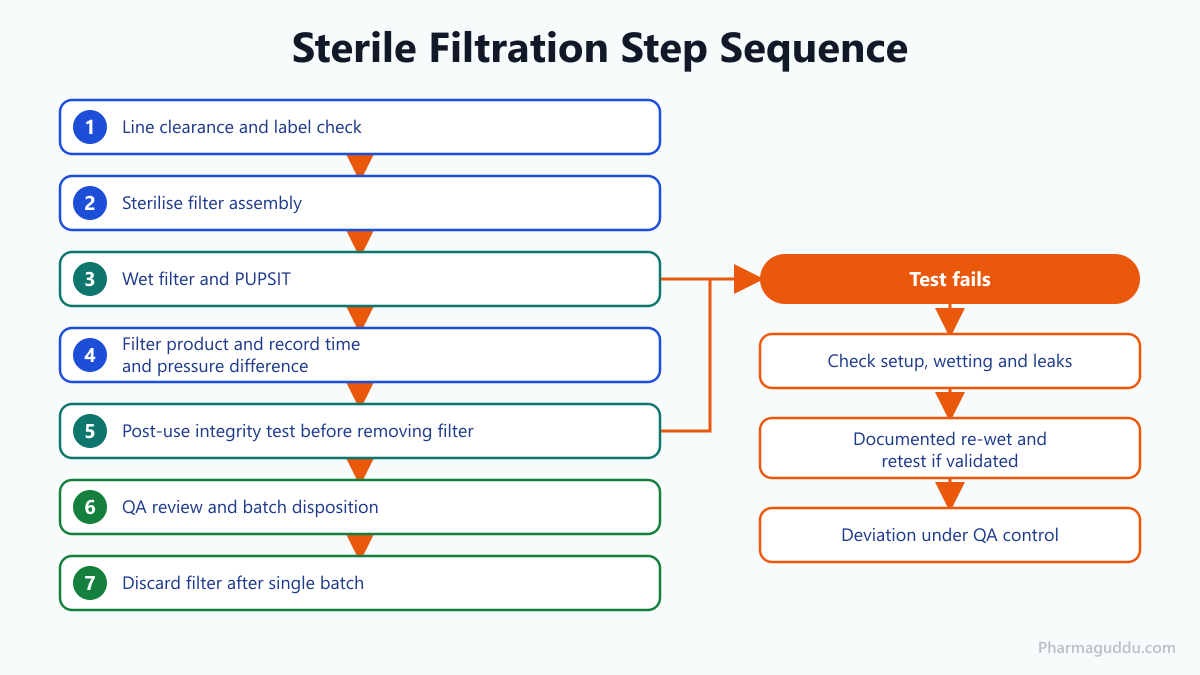
- First, take line clearance from the in-process quality assurance (IPQA) officer and check the status labels on the housing. The operator checks that the filter matches the validated filter named in the batch manufacturing record (BMR).
- Sterilise the filter assembly by the validated method, in place where the system is designed for it, and record the cycle.
- Wet the filter with the validated wetting fluid and perform the pre-use post-sterilisation integrity test (PUPSIT). The filter must not be used if the test fails.
- Start filtration within the validated limits. While the product passes, the operator records the time taken to filter a known volume and the pressure difference across the filter.
- After filtration, perform the non-destructive integrity test before the filter is removed from its housing, and record the result.
- The Quality Assurance (QA) officer reviews the integrity results and the process parameters before the batch is dispositioned. The liquid sterilising grade filter is then discarded after the single batch.
What controls and limits apply during filtration?
A bioburden sample is taken from the bulk product immediately before the final sterile filtration (Annex 1), and the maximum time between the start of preparation and filtration is validated.
The bubble point is the differential pressure at which a steady stream of gas bubbles leaves a wetted membrane. Liquid is held in the pores by surface tension, so a larger pore or a flaw gives a lower bubble point. Annex 1 gives bubble point, diffusive flow, water intrusion and pressure hold as examples of integrity tests, and water intrusion applies to hydrophobic filters.
A failed integrity test or a significant difference from a critical parameter is documented and investigated as a deviation under QA control.
Which parameters are critical in sterile filtration?
| Parameter | Setting or range | Why it matters | How it is monitored |
|---|---|---|---|
| Nominal pore size | A maximum of 0.22 µm; 0.2 µm and 0.22 µm interchangeable (FDA) | Sets the retention rating of the membrane | Filter certificate and validation report |
| Challenge level in validation | At least 10^7 organisms per cm² of filtration area, generally, with no passage (FDA) | Shows a margin of safety beyond production conditions | Validation study with the product |
| Time to filter a known volume | Validated value, no general range | A change may show a blocked or damaged filter | Recorded in the BMR |
| Pressure difference and maximum operating pressure | Validated value, no general range | Excess pressure can force microorganisms through | Gauges upstream and downstream |
| Flow rate, temperature, maximum filtration time and volume | Validated values, no general range | Each can change filter performance | Recorded in the BMR |
| Integrity test value | Use validated limit from supplier | Confirms the filter is integral | Integrity tester record |
What problems occur in filtration, and how are they fixed?
Failed integrity test
A failed integrity test can result from system leaks or incomplete wetting. It may also be caused by a wrong wetting fluid or temperature, too short a stabilisation time, wrong test limits, damaged O-rings or a defective filter. The operator first checks the setup, the wetting and the connections for leaks. A documented re-wet and retest is allowed only if the validated procedure provides for it. If the filter still fails, the result is handled as a deviation by QA.
Loss of active or preservative
Adsorption of product components on the membrane or leaching of filter components can change the product. The cause is found during compatibility evaluation, and any change of filter or membrane goes through change control.
Flaw masking
During filtration a flaw can become blocked, so the post-use test may pass although the filter was damaged. PUPSIT is performed to detect damage before filtration. If PUPSIT is not possible, Annex 1 permits a documented risk assessment with other controls.
Rising pressure or slow flow
A high particle or bioburden load can block the filter, so a prefilter is used to reduce the load, and any pressure or time excursion beyond the validated limit is investigated.
Frequently Asked Questions
No. The filter holds microorganisms back by sieving and adsorption, and they remain on the upstream side. The filtrate is sterile only if the filter is validated and integral, and it must still be handled aseptically after filtration, for example during filling into sterilised containers.
Brevundimonas diminuta (ATCC 19146) is a common challenge organism for 0.2 µm rated filters because its mean diameter is about 0.3 µm. FDA states that a bioburden isolate may be used if justified as equivalent or better, and Annex 1 requires the choice of organism to be justified. Direct inoculation of the product is preferred.
PUPSIT is the pre-use post-sterilisation integrity test. It is performed on the sterilised filter assembly before filtration to detect damage from preparation. The post-use integrity test is a separate test performed after filtration. Annex 1 expects both.
A hydrophobic PTFE filter is used for gases, tank vents and organic solvents. One plant uses a 0.2 µm PTFE membrane for a 2-phenoxyethanol solution under positive pressure, and the filter integrity is tested afterwards. The solution is used only if the test passes.
References
- EU GMP Annex 1: Manufacture of Sterile Medicinal Products, C(2022) 5938 final, European Commission
- Guidance for Industry: Sterile Drug Products Produced by Aseptic Processing, cGMP (2004), US FDA
- Site master file and plant SOPs on filtration lines and membrane use, internal library, undated
- Other references: 8.82, 8.88, 8.90, 8.86
- EU GMP Annex 1: 8.81, 8.93, 8.87, 8.79, 8.94
- 21 CFR 211.113(b)

Pankaj Sharma — Quality Control Specialist
Pankaj Sharma is a pharmaceutical QC professional who reviews our technical content for GMP accuracy, laboratory practices, and regulatory relevance.