
Microbiologist & Regulatory Specialist
✓ Reviewed by: Pankaj Sharma - Quality Control Specialist
Reviewed for QC, QA accuracy, laboratory practices, analytical methods, and technical Documents
📅 Last Updated: November 14, 2026
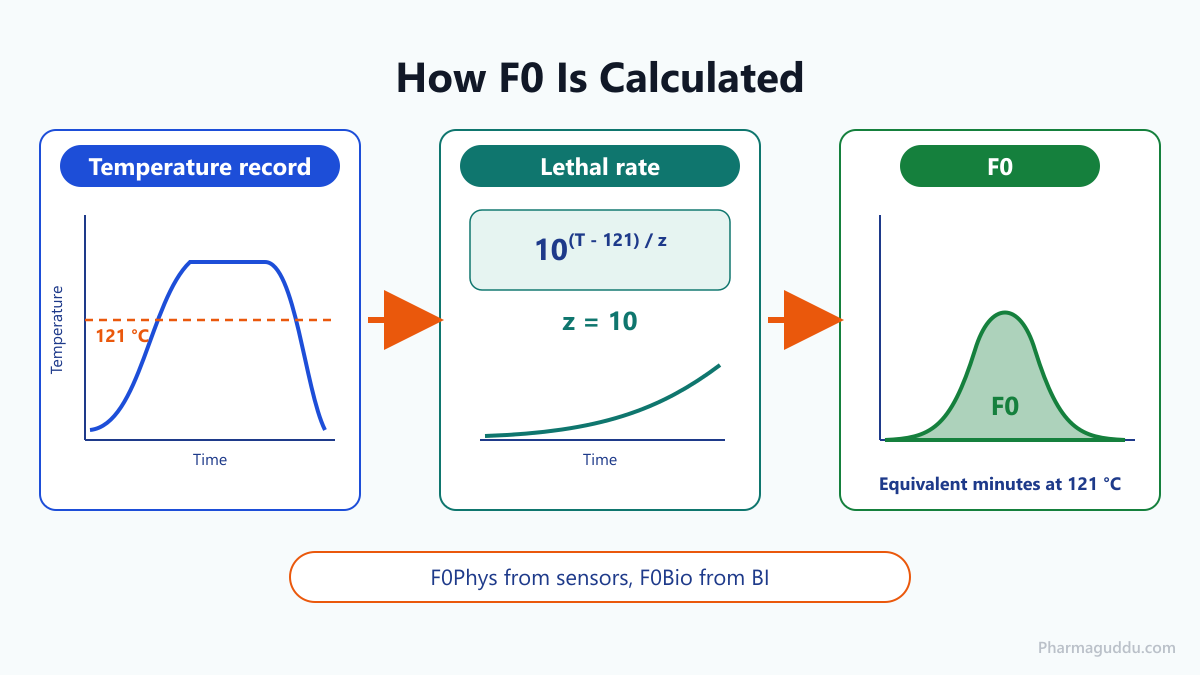
The F0 value in steam sterilization is the lethality delivered to a load, expressed as the equivalent time in minutes at 121 °C for micro-organisms with a theoretical z-value of 10. It is calculated from the recorded temperature and is therefore not the same as the hold time. In cycle design, F0 connects the chosen time and temperature to the required sterility assurance level (SAL) of 10^-6. As per EMA guideline, it requires a minimum lethality of F0 ≥ 8 minutes and a minimum process hold temperature of 110 °C for steam sterilisation.
What is the F0 value in steam sterilization?
F0 is a measure of the total killing effect of a moist-heat cycle. The EMA guideline on sterilisation defines it as the lethality expressed as the equivalent time in minutes at 121 °C, delivered by the process to the load in its container, for micro-organisms with a theoretical z-value of 10. Some texts use 121.1 °C (250 °F) as the reference. The difference in the result is therefore small.
The value is used because a real cycle never holds one fixed temperature. Heat-up and cool-down also kill organisms. F0 therefore converts every minute at every temperature into one comparable figure. For the full overview of methods and objectives, see sterilization, method of sterilization, and objective in labs.
F0 is a setting on the steriliser, so two cycles with different hold times and temperatures can deliver the same F0, and one cycle can deliver different F0 values at different positions in the load.
How do D-value, z-value and SAL connect to F0?
The D-value (decimal reduction value) is the time at a given temperature needed to reduce the number of viable organisms to 10 per cent, and D121 is the D-value of the relevant spores at 121 °C. The z-value is the temperature change needed to alter the D-value by a factor of 10.
The sterility assurance level (SAL) is the probability that a micro-organism survives in a product item after the process. An SAL of 10^-6 means not more than 1 non-sterile item in 1,000,000 sterilised items, and the guideline treats sterility as an SAL equal to or less than 10^-6.
The calculation of F0 follows from these terms. For each temperature reading, the lethal rate is 10^((T – 121) / z), where T is the temperature in °C and z is 10. F0 is the sum of the lethal rate multiplied by the time interval, taken over the whole temperature record. A reading of 121 °C gives a lethal rate of 1, so one minute counts as one minute of F0. A reading of 111 °C gives a lethal rate of 0.1, so ten minutes are needed for one minute of F0.
SAL is linked to F0 through the biological side. The required F0 equals D121 multiplied by the log reduction needed, so a 12-log reduction of a spore with a D121 of 1.5 minutes needs an F0 of 18 minutes. The EMA definition of overkill uses a minimum D-value of 1 minute, which gives the 12-minute threshold.
How is an F0-based steam cycle designed?
Cycle design starts from the product and ends with routine acceptance criteria. The steps below applies to terminal sterilisation of aqueous products and fluid loads.
- The product heat stability, container type and load pattern are defined, together with the maximum and minimum load configurations.
- The bioburden before sterilisation is characterised, and its limit is set. For aqueous solutions, the EMA guideline accepts 100 CFU/100 ml for the cycles in its Table 1 without further justification.
- The cycle type is selected from the decreasing-lethality list in the guideline, and the first feasible process is chosen.
- Heat penetration studies and load mapping find the slowest to heat locations, and temperature sensors are placed there.
- The target F0 and the time and temperature combination are fixed, and the hold temperature is set at or above the guideline minimum.
- At least three sterilisation runs are performed, with F0Phys from the sensors and F0Bio from biological indicators, and the SAL is calculated.
- The routine acceptance criteria for time, temperature, pressure and F0 are written into the batch manufacturing record (BMR) and the cycle specification.
For a steriliser that is still to be installed, the qualification stages are described in the installation qualification of a steam sterilizer cum bung processor and the operation qualification of a steam sterilizer cum bung sterilizer. The steriliser must be qualified before the sterilisation cycle is validated.
What are F0Phys and F0Bio, and which cycle types exist?
F0Phys is the physical F0, calculated from the temperature sensors in the load. F0Bio is the biological F0, derived from the log reduction of a biological indicator (BI) placed in the same load. The EMA guideline requires validation of both F0Phys and F0Bio for cycles that do not follow the reference condition, and it also asks for the relationship between physical and biological validation to be shown.
The guideline lists the cycles in Table 1 in order of decreasing lethality. The first feasible cycle should be selected.
| Cycle (EMA Table 1) | Process hold temperature | Bioburden | Dossier validation data |
|---|---|---|---|
| Ph. Eur. reference cycle | ≥ 121 °C for ≥ 15 min | Not characterised | Confirmation only |
| Overkill cycle, F0Bio > 12 min | ≥ 121 °C | Not characterised | Required |
| F0 > 8 min | > 115 °C | Not characterised | Required |
| F0 > 8 min | > 115 °C or > 110 °C | Characterised, with control of heat resistance | Required, with additional data |
| F0 < 8 min, post-aseptic terminal heat treatment | > 110 °C | Characterised before the filtration step | Required |
A process hold temperature below 115 °C in the finished product is an exceptional case in the guideline. It has to be scientifically justified and supported by additional data. A post-aseptic terminal heat treatment must never compensate for poor aseptic practice.
How do time and temperature combine at a fixed F0?
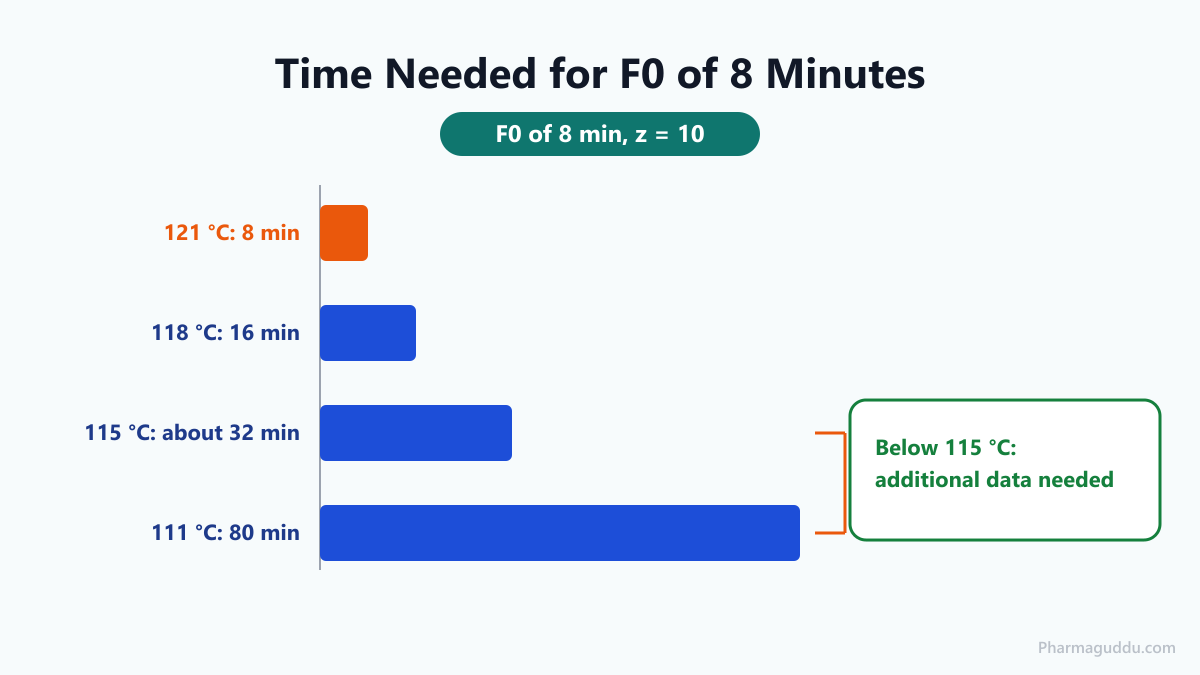
At z = 10, the time needed for a fixed F0 changes tenfold for every 10 °C. The table below shows an illustration calculated from the formula for an F0 of 8 minutes, and the values in it are arithmetic examples. They are not regulatory limits.
| Hold temperature | Lethal rate | Time for F0 of 8 min |
|---|---|---|
| 121 °C | 1.0 | 8 min |
| 118 °C | 0.50 | 16 min |
| 115 °C | 0.25 | about 32 min |
| 111 °C | 0.10 | 80 min |
A higher temperature therefore shortens the hold time. The product and container must tolerate it. A lower temperature protects heat-labile products, but it needs a much longer exposure and a bioburden that is well characterised, so the guideline asks for extra data when the hold temperature is below 115 °C.
READ ALSO
Sterilization, Method of sterilization, and Objective in Labs
Sterilization is the killing or removal of micro-organisms and their spores from the substance, material.
How is the F0 calculation controlled in routine operation?
The F0 record is limited to the temperature sensors placed in the load. For routine control, the sensor that controls exposure time sits at the slowest to heat location found during heat penetration studies, so the whole load receives at least the target F0. The same studies also find hotter points. These have a higher F0, which matters for heat-labile products.
Annex 1 of EU GMP (2022) requires the whole load to reach the required temperature before measurement of the sterilising period starts. The position of the probes used for control and recording must be determined during validation. An independent monitoring probe at the same position is used to verify the function and location of those probes.
The following rules apply to the calculation itself, as stated in the EMA guideline.
- When F0 is used as an additional control, the F0 value is stated together with the lowest temperature measured by the sensors used to determine it.
- If temperatures below 110 °C during heat-up and cool-down are included in F0, this must be justified.
- Where a low-energy process or a BI with D121 below 1.5 minutes is used, the start point of the sterilisation phase must be justified.
Each cycle is recorded in the BMR with its time, temperature, pressure and F0. A cycle that does not meet the validated parameters must be aborted or failed, and a deviation is raised. Annex 1 requires duplex or double probes connected to independent control and monitoring systems, so that such a cycle is detected.
Where does the F0 concept reach its limits?
F0 assumes that micro-organisms are killed at a log-linear rate and that z equals 10. The EMA guideline notes that the change in lethal effect in relation to temperature may not be log linear at lower sterilisation temperatures. For that reason, cycles at low temperature need more validation data and BIs with suitable resistance.
The concept applies to saturated steam on aqueous preparations, which is the scope of Ph. Eur. 5.1.5. Annex 1 also accepts F0 for fluid loads in superheated water and similar cycles. It states that validation of fluid cycles should include temperature, time and/or F0.
For porous loads and wrapped hard goods, air removal and steam penetration decide sterility. Annex 1 requires time, temperature and pressure to be monitored and recorded for porous cycles, with an air removal test (normally daily) or an air detector. F0 alone must not be used to release such a load.
A BI result must also not override other critical parameters. Annex 1 states that BI results in isolation should not be used to override other critical parameters and process design elements.
Which parameters control an F0-based cycle?
| Parameter | Typical setting or range | Why it matters | How it is monitored |
|---|---|---|---|
| Process hold temperature | ≥ 110 °C minimum (EMA); ≥ 121 °C for the reference cycle | Sets the lethal rate and the time needed | Control and independent probes, chamber drain temperature on prevacuum cycles |
| Lethality F0 | ≥ 8 min minimum; > 12 min for overkill (F0Bio) | Delivers the required log reduction | Sensors at the slowest to heat locations, calculated per cycle |
| Reference cycle time | ≥ 15 min at ≥ 121 °C | Gives a standard cycle without dossier data | Cycle recorder, BMR |
| SAL | ≤ 10^-6 | Defines the sterility target | Calculated from maximum bioburden per container and BI D-value |
| BI resistance | D121 ≥ 1.5 min (at least three runs) | Challenges the cycle sufficiently | BI results per run, positive controls |
| Heat-up and cool-down below 110 °C | Counted only if justified | Can inflate F0 | Review of the temperature record |
| Leak test | Normally weekly, for cycles with a vacuum phase | Prevents air and contamination ingress | Test record |
| Air removal test | Normally daily, for air-purging cycles | Ensures steam reaches the load | Test cycle result or air detector |
| Site F0 acceptance value | Site decision | Reflects product and load needs | Cycle specification, BMR |
Values such as an F0 of 12 minutes for a freeze-dryer cold curve or an F0 of 15 for a purified water loop are site decisions. They must not be read as general limits. Exact values depend on the load, the steriliser and the registered dossier, and the site procedure must be followed.
What problems affect F0 and how are they corrected?
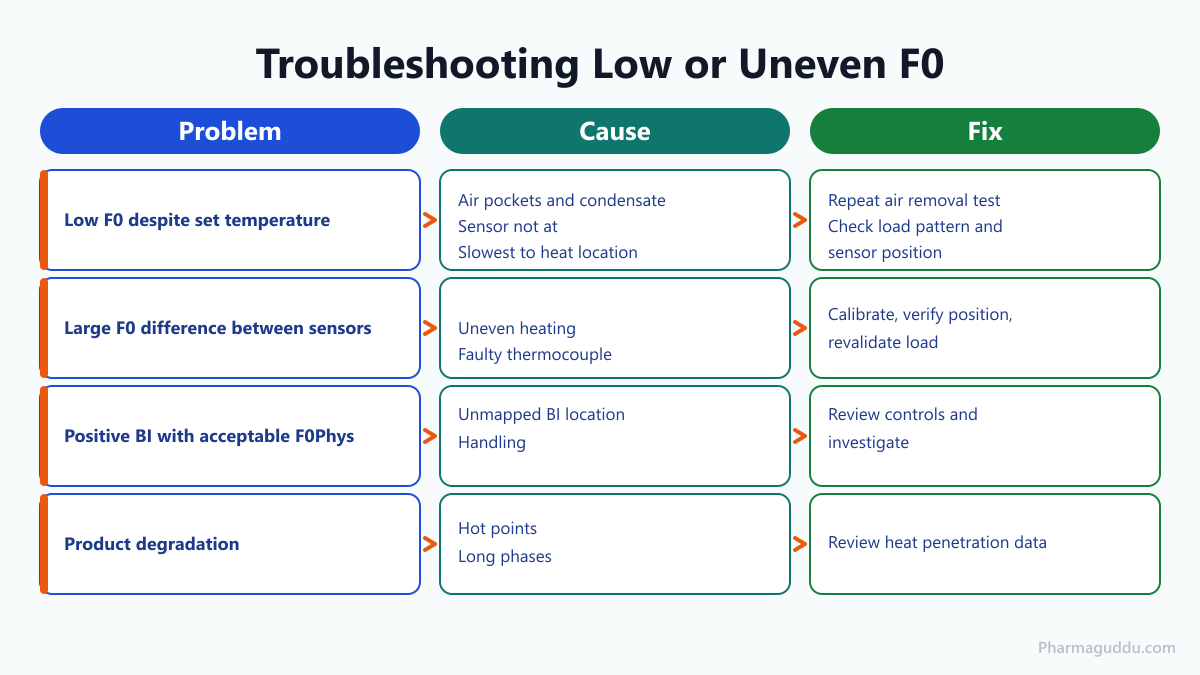
Low F0 although the chamber reached the set temperature
Possible causes:
Trapped air pockets and condensate build-up are possible causes. A load that is not free draining, a sensor not placed at the slowest to heat location or a load pattern that differs from the validated one can also lead to it.
Corrective actions:
The cycle must be handled as a deviation. The load must not be released until Quality Assurance (QA) has reviewed the record. The load pattern is compared with the validated pattern, the air removal test is repeated, and the sensor position is checked against the load mapping.
Large F0 difference between sensors in one cycle
Possible causes:
Uneven heating inside the load, a faulty or poorly calibrated thermocouple, or a load configuration outside the validated maximum or minimum load.
Corrective actions:
The sensor is calibrated again and its position is verified. If the spread remains outside the accepted temperature difference and F0 variability, the load pattern is revalidated.
Positive biological indicator with acceptable F0Phys
Possible causes:
A BI placed in a location that was not mapped, a BI batch of unverified population or resistance, or contamination during handling.
Corrective actions:
Positive controls and the BI certificate are reviewed. The investigation also covers handling of the BI, and under Annex 1 the BI result is assessed together with the physical parameters and not on its own.
Product degradation from overheating
Possible causes:
Hotter points in the load with a much higher F0 than the slowest to heat location, or an unnecessarily long cool-down or heat-up phase.
Corrective actions:
Heat penetration data are reviewed to find the hot points, and the hold time is reduced to the validated minimum. A lower hold temperature with a longer time may be assessed. It needs the additional data described above.
Frequently Asked Questions
No. The hold time is a measured duration, while F0 is a calculated lethality in equivalent minutes at 121 °C. A cycle held for 20 minutes at 118 °C delivers a lower F0 than 20 minutes at 121 °C, and heat-up and cool-down add some F0 when they are counted. The temperature record therefore decides the result.
An F0 of 15 means the load received the lethality of 15 minutes at 121 °C, even if the actual temperatures varied during the cycle. Whether 15 is acceptable depends on the product and load. A site may set an acceptance value of its own, for example for a purified water loop, and such a value is a site decision.
Spores of Geobacillus stearothermophilus (formerly Bacillus stearothermophilus) are the usual challenge for moist heat. Clostridium sporogenes is also used. The EMA guideline asks for a BI described in Ph. Eur. 5.1.2 with a D121 of at least 1.5 minutes. The spore load is selected from the bioburden and the D-values to challenge an SAL of 10^-6.
F0 applies to terminal sterilisation and to post-aseptic terminal heat treatment, where F0 may be below 8 minutes. Aseptic processing itself is verified by other means, as described in media fill interventions and worst-case design. Dry heat cycles use lethality in a similar way but are not expressed as F0.
References
- Guideline on the sterilisation of the medicinal product, active substance, excipient and primary container (EMA/CHMP/CVMP/QWP/850374/2015), EMA, 6 March 2019
- EU GMP Annex 1, Manufacture of Sterile Medicinal Products, European Commission, 25 August 2022
- European Pharmacopoeia, general chapters 5.1.1, 5.1.2 and 5.1.5, EDQM
- Validation of a steam sterilizer, internal validation standard operating procedure, reference library
- PDA Technical Report 1, moist heat sterilization in autoclaves, Parenteral Drug Association
- EU GMP Annex 1: 8.50, 8.42, 8.54, 8.55, 8.65
- Other references: 4.1.1

Satpal Singh — Quality Assurance & Regulatory Specialist
Satpal Singh is an experienced pharmaceutical Quality Assurance and Regulatory professional with expertise in GMP compliance, quality systems, technical documentation, and regulatory requirements. He reviews our pharmaceutical content to ensure accuracy, industry relevance, and alignment with current quality and regulatory standards.
Expertise: QA Systems | GMP Compliance | Regulatory Documentation | Audits | Quality Management