
Microbiologist & Regulatory Specialist
✓ Reviewed by: Pankaj Sharma - Quality Control Specialist
Reviewed for QC, QA accuracy, laboratory practices, analytical methods, and technical Documents
📅 Last Updated: November 15, 2026
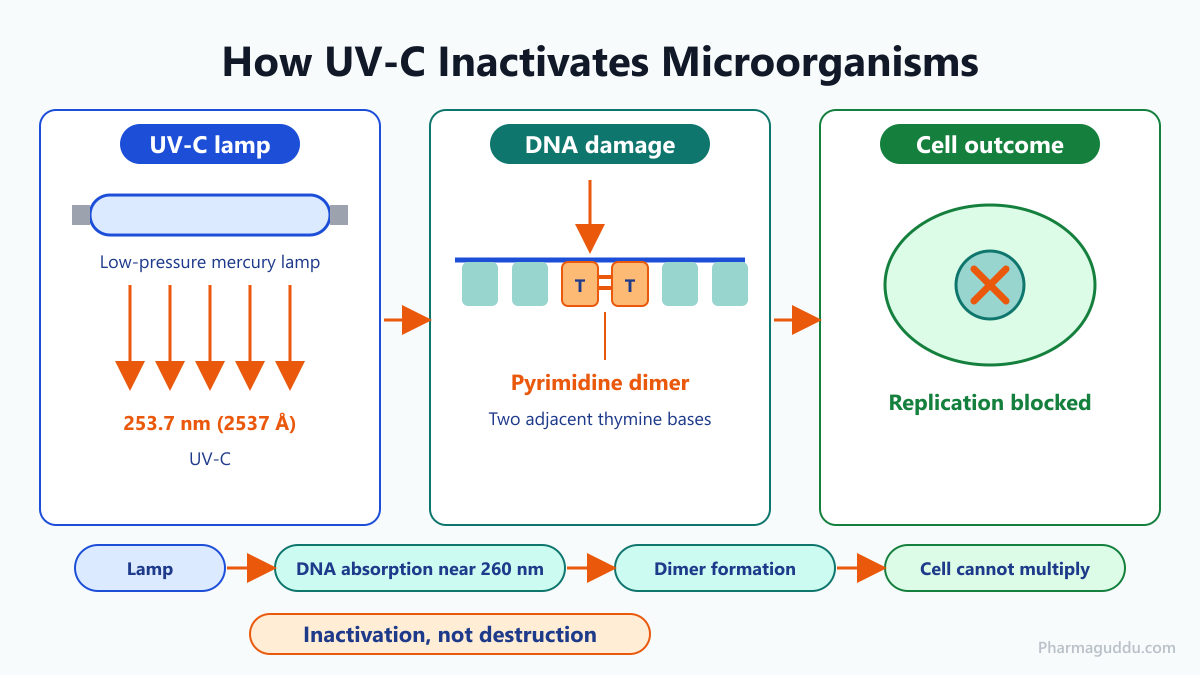
Ultraviolet (UV) light is used for UV radiation sterilization in laboratories and plants, at the UV-C wavelength of 253.7 nm (2537 Å), the main output line of a low-pressure mercury lamp. The light is absorbed by nucleic acids and inactivates microorganisms, so they cannot multiply. UV-C does not penetrate solids, packaging or shadowed areas, and it gives no validated sterility assurance level. It is therefore used for surface, air and water disinfection. Its role is that of an adjunct to validated chemical disinfectants, not a replacement for them.
What is UV radiation sterilization, and is it true sterilization?
UV radiation sterilization is the common name for the use of germicidal ultraviolet light (UV-C) to reduce microorganisms on exposed surfaces, in air and in water. In the pharmacopoeial sense, sterilization requires a validated process that delivers a defined sterility assurance level (SAL) throughout the load. UV-C cannot do this. It acts only where the light reaches, so the process is better described as UV-C disinfection or decontamination, and the title phrase is kept as a search term.
UV is non-ionizing radiation, unlike gamma rays and electron beam, which are ionizing and are covered separately. For the full overview of physical, chemical and mechanical methods, see sterilization, method of sterilization, and objective in labs.
How does UV-C inactivate microorganisms?
Low-pressure mercury lamps emit mainly at 253.7 nm. DNA absorbs UV most strongly near 260 nm, so this wavelength lies close to the absorption peak (Scientific Reports, 2022).
Once a nucleic acid absorbs the photon, two neighbouring pyrimidine bases (thymine or cytosine) on the same strand bond to each other, which forms cyclobutane pyrimidine dimers and (6-4) photoproducts. These lesions block replication and transcription, so the cell cannot multiply. UV-C therefore inactivates microorganisms by damaging nucleic acids, and the cell is not physically destroyed.
Some microorganisms can repair the damage. Photoreactivation uses the enzyme photolyase, and dark repair works without light. A sub-lethal dose may therefore allow recovery, which is why the delivered dose must be validated.
The delivered dose is calculated as irradiance (mW/cm²) multiplied by exposure time (s), and the result is expressed in mJ/cm². Dose is not the same as log reduction, because the effect also depends on the organism and the surface.
What are the parts of a UV-C disinfection system?
A UV-C system consists of the following parts:
- Lamp: a low-pressure mercury lamp in a quartz tube that transmits 253.7 nm light.
- Fixture and reflector: these hold the lamp and direct the light toward the target area.
- Power supply and timer: these control the exposure time of each cycle.
- Interlock and warning signage: the interlock switches the lamps off when a door is opened.
- Radiometer: a sensor calibrated at 254 nm that measures irradiance.
Cycle records are kept in the equipment logbook or the batch manufacturing record (BMR), together with the lamp hours.
Where is UV-C used in labs and plants?
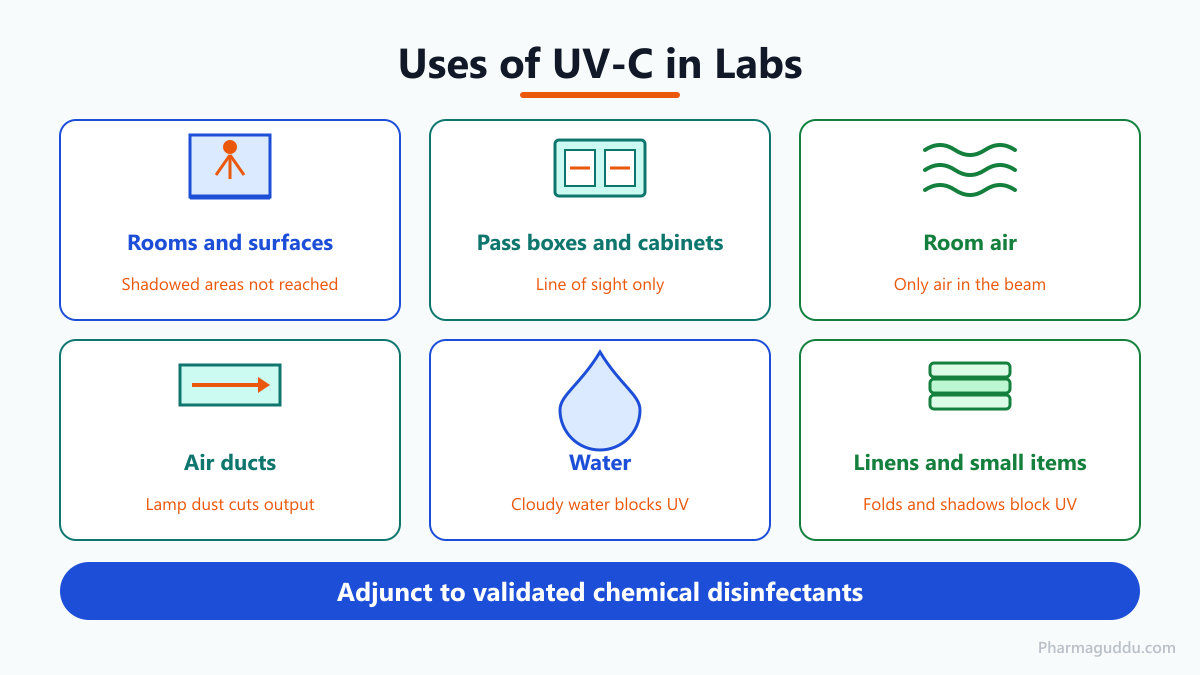
The uses differ in how the light reaches the target.
| Use | How it works | Main limit |
|---|---|---|
| Rooms and surfaces | Lamps irradiate an unoccupied room | Shadowed, wet or dusty surfaces receive no dose |
| Pass boxes and cabinets | Lamps irradiate items and inner surfaces | Surfaces facing away from the lamp are not treated |
| Room air | Upper-room lamps treat air above the occupied space | Supplement to ventilation, not a replacement |
| Air ducts | Lamps irradiate air moving past the lamp | Dose depends on air velocity and lamp output |
| Water | Water passes through a reactor around the lamps | Dose depends on flow rate and UV transmittance |
| Linens and small items | Exposed surfaces are irradiated | Folds and layers are not reached |
For water, UV leaves no residual disinfectant in the system. The US drinking-water rule (40 CFR 141.720) gives 3-log credit doses at 254 nm of 12 mJ/cm² for Cryptosporidium, 11 mJ/cm² for Giardia lamblia and 143 mJ/cm² for viruses, and it requires that the reactors are validated. In pharmaceutical use, UV water treatment does not replace filtration.
How is a UV-C disinfection cycle carried out?
- Production staff remove or cover the materials that must not be exposed, and the area is cleaned with cleaning agent so that dust and residues do not shield the surfaces.
- The operator places the items so that all surfaces face the lamps, with no overlapping.
- The operator checks that the room is empty and closes the doors, so that the interlocks remains active.
- The lamps are started for the validated exposure time, and the start time is recorded in logbook.
- The lamps switch off at the end of the cycle, or immediately if a door is opened.
- The operator records the cycle, the lamp hours and the radiometer reading in the logbook, and the shift in-charge reviews the entry.
Dust on the lamp tube reduces output. The tube must be cleaned only when the power is off and the lamp is isolated.
READ ALSO
Sterilization, Method of sterilization, and Objective in Labs
Sterilization, method of sterilization and objective in labs: physical, chemical and mechanical methods.
What controls and limits apply to UV-C systems?
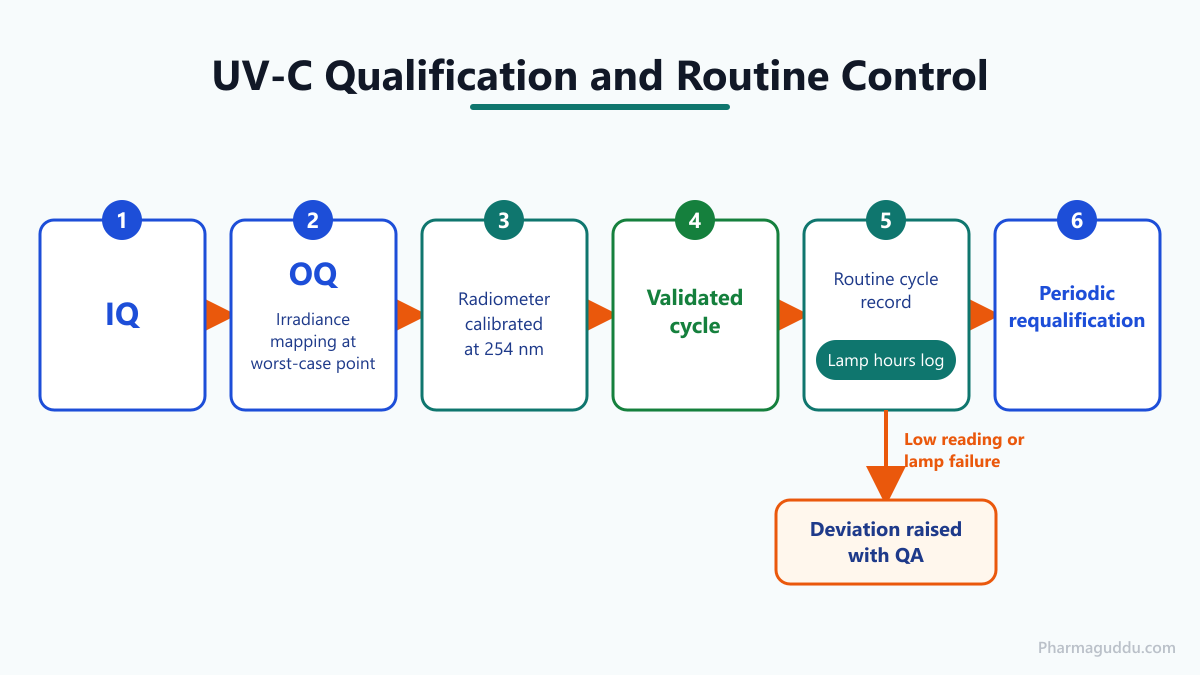
UV equipment is qualified through installation qualification (IQ) and operational qualification (OQ), and the disinfection process is validated. During qualification, irradiance is mapped at the worst-case point, for example the surface farthest from the lamps, and the radiometer is calibrated at 254 nm. At our site we have proper procedure for periodic requalification and a lamp hours log.
Roles are defined as follows:
The operator runs the cycle and records it.
The supervisor reviews the record.
Quality assurance (QA) ensure that procedure is followed.
If system deviate from original SOP then, A deviation is raised for further investigation. The investigation follows the site corrective and preventive action (CAPA) system, as described in CAPA in pharmaceutical.
What are the critical process parameters?
| Parameter | Typical setting or range | Why it matters | How it is monitored |
|---|---|---|---|
| Wavelength | About 253.7 nm (2537 Å) | Close to the DNA absorption peak | Lamp specification, 254 nm radiometer |
| Irradiance | Set by qualification, no general value | Determines the dose at the target | Radiometer at the mapped worst-case point |
| Exposure time | Set by validation, no general value | Dose equals irradiance multiplied by time | Timer and cycle record |
| Distance and angle | Set by validation | Dose falls with distance, and shadowed surfaces get none | Item placement diagram |
| Lamp age | Replacement by measured output | Output falls with use | Lamp hours log |
| Human exposure at 254 nm | 6 mJ/cm² per 8-hour day (ACGIH, ISO 15858:2016) | Protects skin and eyes | Interlocks, signage, access control |
In one AstraZeneca bench study (EN 13697 surface test, 254 nm robot, nine organisms), vegetative bacteria and yeast reached at least a 3-log reduction at about 100 mJ/cm². Bacillus spores needed about 200 mJ/cm², and resilient moulds up to about 500 mJ/cm². These values belong to one robot and one study, so they are not validated cycle doses for other equipment.
What problems occur with UV-C systems, and how are they corrected?
Low radiometer reading
Possible causes: an aged lamp, dust on the tube or a failing power supply.
Corrective actions: the tube is cleaned with the power off and the reading is repeated, and if the reading is still low, the lamp is replaced and the event is recorded.
Shadowed or untreated surfaces
Possible causes: items placed behind other items, wet or dusty surfaces, and opaque covers.
Corrective actions: the loading pattern is corrected and the surfaces are cleaned first. UV-C does not reach shadowed, wet, dusty or opaque surfaces.
Exposure of a person
Possible causes: a bypassed interlock or an unannounced entry.
Corrective actions: the lamps are switched off, the exposure is reported to QA, inform to maintenance department, and the interlock is repaired. UV directed or reflected into an occupied zone can cause temporary eye and skin injury.
Lamp breakage
A broken mercury lamp must be cleaned up as hazardous waste by following proper procedure, with the area ventilated. Lock-out is applied for lamp changes. A face shield and gloves are also worn.
Material damage
Repeated UV-C exposure can degrade plastics and rubber over time. Sensitive materials should be shielded or exposed only as long as validated.
How are UV-C lamps maintained?
Lamps are cleaned with the power off, and the output is measured with the 254 nm radiometer. NIOSH gives a replacement interval of about one year, sometimes two years, for upper-room lamps. In a Good Manufacturing Practice (GMP) area, replacement is tied to measured output and to the lamp hours log, not only to the calendar.
Frequently Asked Questions
No. UV-C is non-ionizing, low-energy light that acts on surfaces, air and water. Gamma rays and electron beam are ionizing and penetrate packaged product. UV-C stops at the first opaque layer, so it cannot treat the inside of sealed packs.
Yes. Some organisms repair UV damage by photoreactivation with the enzyme photolyase or by dark repair. A dose that is too low may allow recovery, so the dose is set by validation and the radiometer reading is checked before each cycle.
No. UV-C acts only on exposed surfaces and gives a log reduction, not sterility. It is used as an adjunct, and its performance is qualified against the validated chemical disinfectants that remain in the programme.
No. NIOSH treats germicidal UV as a supplement to ventilation. Upper-room fixtures are shielded so that the light stays above the occupied space, and the ventilation system continues to control air changes.
References
- Germicidal mechanisms of 222 nm vs 254 nm UV, Scientific Reports via PMC
- UV contamination control robot shows pharma cleanroom promise, European Pharmaceutical Review
- About Germicidal Ultraviolet (GUV), CDC/NIOSH
- ISO 15858:2016 UVC devices safety information, UV Medico
- UV-C surface disinfection review, PMC
- Commission Delegated Directive (EU) 2022/280, EUR-Lex
- 40 CFR 141.720 Inactivation toolbox components, Cornell LII
- Norwegian drinking water utility moves forward with UV-C LED, Water Online

Satpal Singh — Quality Assurance & Regulatory Specialist
Satpal Singh is an experienced pharmaceutical Quality Assurance and Regulatory professional with expertise in GMP compliance, quality systems, technical documentation, and regulatory requirements. He reviews our pharmaceutical content to ensure accuracy, industry relevance, and alignment with current quality and regulatory standards.
Expertise: QA Systems | GMP Compliance | Regulatory Documentation | Audits | Quality Management