
Quality Control Specialist | Industry Experience
✓ Reviewed by: Pankaj Sharma - Quality Control Specialist
Reviewed for Quality Control accuracy, laboratory practices, analytical methods, and technical relevance
📅 Last Updated: November 14, 2026
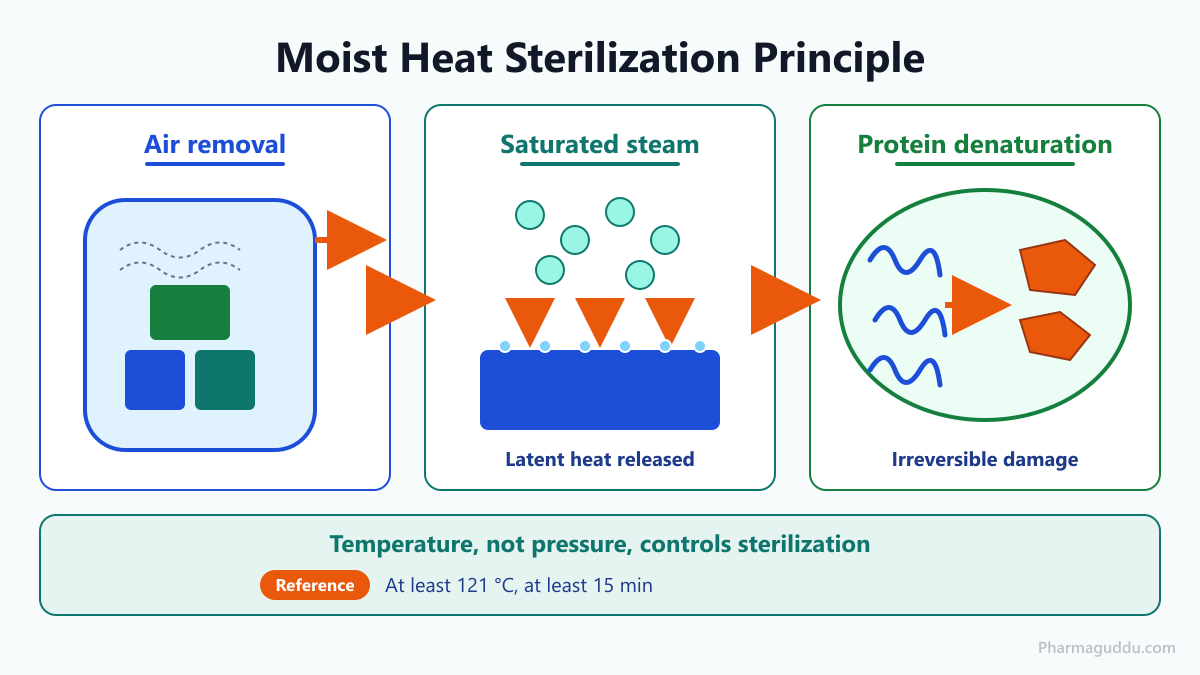
Moist heat sterilization uses saturated steam under pressure to destroy microorganisms, including bacterial spores, by irreversible denaturation of their proteins. The condition for aqueous preparations is at least 121 °C for at least 15 min in all units. Other cycles are accepted when adequate lethality is validated (F0 of at least 8 min). Fluid loads and porous loads need different cycles: fluids depend on heat transfer through the container wall, and porous loads depend on air removal, steam penetration and drying. Temperature, not pressure, is the controlling parameter.
What is moist heat sterilization in an autoclave?
Moist heat sterilization is the destruction of all viable microorganisms, including spores, by steam at a 121 °C for 15 min using autoclave or steriliser. The cycle type must therefore be named (porous or hard goods, fluid, superheated water), because each load behaves differently.
EU GMP Annex 1 (2022), clause 8.55, states that moist heat can be applied with steam by direct or indirect contact. It also covers superheated water systems (cascade or immersion cycles) for containers that other cycle designs can damage, such as Blow-Fill-Seal containers and plastic bags.
The method is used for aqueous injectables in sealed containers, culture media, glassware, filters, rubber stoppers, garments and equipment parts.
For the full overview of methods and objectives, see the pillar article on sterilization methods and objectives in labs. Heat applied without moisture is covered in the SOP for dry heat sterilization in the injection section.
How does moist heat kill microorganisms?
Moist heat kills by irreversible coagulation and denaturation of enzymes and structural proteins. Moisture is essential for this effect. Once these proteins lose their shape, the cell cannot metabolise or repair itself. Dry heat acts mainly by oxidation and needs a much higher temperature and a longer exposure than moist heat.
Why the steam must be saturated
Saturated steam is steam at the exact temperature that matches its pressure. When it meets a cooler surface, it condenses and releases its latent heat, so the surface is heated quickly and wetted at the same time. Superheated steam is hotter than saturated steam at the same pressure. It behaves like a hot gas and transfers heat poorly. It also does not deliver the moisture needed for protein denaturation (ISPE, Introduction to Steam Quality and Testing, 2022).
Why air must be removed
Air left in the chamber forms a steam-air mixture. This mixture reaches a lower temperature than pure steam at the same pressure and also creates cold pockets that insulate the load surface. Annex 1 (8.61) therefore requires adequate assurance of air removal before and during sterilisation when the process includes air purging, for example in porous autoclave loads.
Pressure is not the sterilising agent
Pressure only makes the sterilising temperature reachable. Saturated steam at about 1.0 bar gauge is at 121 °C, and at about 2.1 bar gauge it is at 134 °C (standard steam tables). A pressure reading alone does not prove that the load reached temperature, because trapped air also raises pressure. Annex 1 (Annex 1) therefore requires the correlation of pressure and temperature to be part of validation.
Lethality
Lethality is expressed as F0, the equivalent time in minutes at 121 °C, calculated with a Z value of 10 °C. Heat-resistant spore formers such as Geobacillus (Bacillus) stearothermophilus are used as biological indicators (BI). The sterility assurance level (SAL) target for terminally sterilised products is 10^-6, which means a probability of not more than one non-sterile unit in a million.
What are the parts and stages of an autoclave cycle?
A steam steriliser for pharmaceutical use is a pressure vessel with a double-door, interlocked chamber, a steam jacket and a control system. It has the following parts.
- Chamber and steam jacket: the chamber consists of stainless steel, and the insulated jacket keeps the chamber wall hot so that steam does not condense on it.
- Door and interlock: the door lock prevents opening under pressure, and double-door units separate the loading side from the unloading side.
- Thermostatic steam trap: it is open when cool and closes on contact with steam, so air and condensate leave the chamber and jacket.
- Vacuum system: prevacuum units use a vacuum pump or ejector to remove air before steam enters.
- Vent filter: a sterilising-grade filter on the vacuum-break line filters the air that re-enters the chamber.
- Condensate line: it carries a check valve and a steam trap.
- Instruments: temperature probes, a pressure transmitter or indicator, a cycle timer, a temperature controller and a recorder or printer.
The cycle of a porous load runs in the following stages.
- Air removal: vacuum and steam pulses remove the air from the chamber and the load.
- Heat-up: steam enters and raises the chamber and load to the sterilising temperature.
- Equilibration: all parts of the load reach the set temperature. (Annex 1) requires the whole load to reach temperature before the sterilising time is measured.
- Exposure: the load is held at the set temperature for the validated time.
- Drying and cooling: steam is removed, a vacuum may be applied, and filtered air is admitted. Any cooling liquid or gas that contacts the product must be sterile (Annex 1).
Fluid cycles have no air removal stage for the chamber, and the cooling stage is controlled to protect the containers.
Which autoclave cycles suit aqueous preparations and porous material?
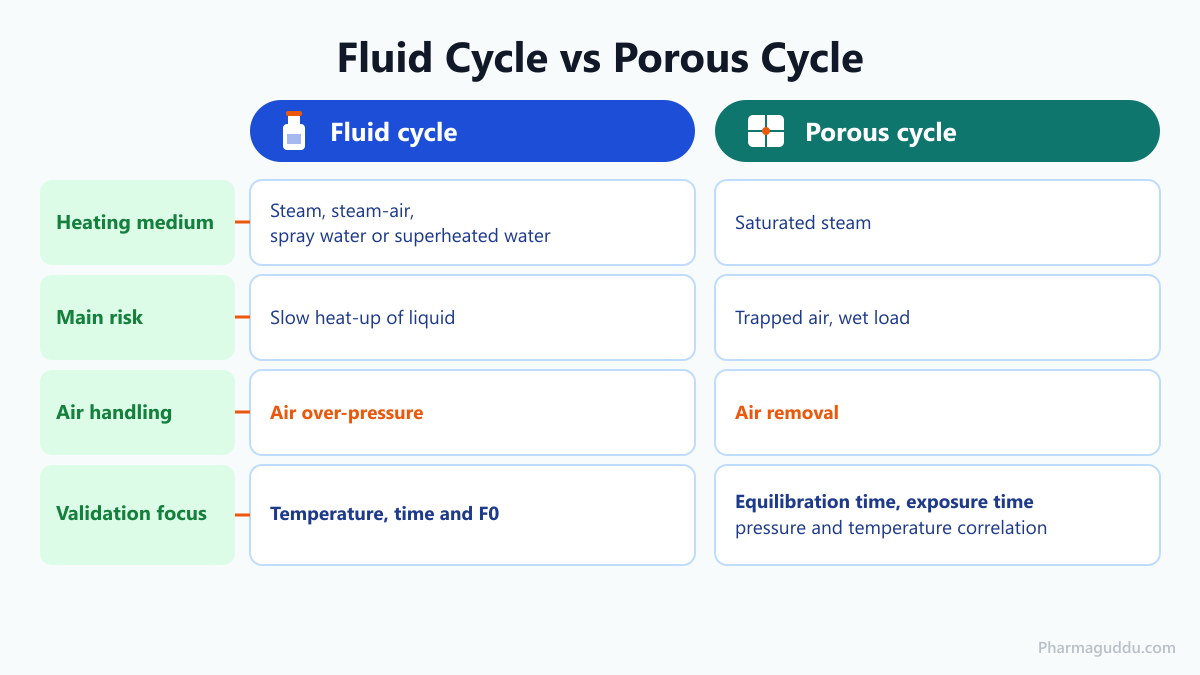
The load decides the cycle. Aqueous liquids in sealed containers are heated through the container wall, so the slowest point is the liquid in the coldest container. Porous or hard-goods loads (garments, filters, stoppers, instruments, wrapped glassware) are heated by steam that must first reach every surface.
| Feature | Fluid cycle (aqueous preparations) | Porous or hard-goods cycle |
|---|---|---|
| Heating medium | Saturated steam, steam-air mixture, spray water or superheated water | Saturated steam only |
| Main risk | Slow heat-up of the liquid, container damage | Trapped air, wet load |
| Air handling | Air over-pressure protects the containers | Air removal before and during exposure |
| Validation focus | Temperature, time and F0 (Annex 1, 8.59) | Equilibration time, exposure time, pressure and temperature correlation, min/max temperature (Annex 1, 8.59) |
| End of cycle | Controlled cooling | Drying; items must be dry on removal |
Porous loads can be processed in two types of unit. In a gravity displacement unit, steam pushes the air out through the drain. In a prevacuum unit, a vacuum pump removes the air before steam enters, so porous loads are penetrated almost at once. Prevacuum cycles are therefore preferred for porous loads. As an indication of healthcare practice (not a pharmaceutical requirement), the CDC gives minimum exposures for wrapped supplies of 30 min at 121 °C in a gravity unit and 4 min at 132 °C in a prevacuum unit.
For liquids, the United States Pharmacopeia (USP) chapter on moist heat sterilization of aqueous liquids (<1229.2>) describes air over-pressure to protect containers and accepts steam-air, water spray and superheated water as heating media. (Annex 1) adds that distortion of non-rigid containers must be prevented by cycle design, for example through the correct pressure, heating and cooling rates and loading pattern.
READ ALSO
Sterilization, Method of sterilization, and Objective in Labs
Sterilization is the killing or removal of micro-organisms and their spores from the substance, material.
How is a moist heat sterilization cycle operated?
The sequence below follows the roles on the floor. Exact steps is described in the SOP on operation and calibration of autoclave.
- The production officer checks the equipment status label, the previous cycle record and the availability of steam, water and compressed air.
- The daily air removal test is run on a prevacuum unit before the first production load, and the result is recorded. For the test itself, see the Bowie Dick test for autoclave validation.
- The load is prepared in the validated loading pattern. Items other than sealed product containers must be dry and packaged in a protective barrier system that allows air removal and steam penetration.
- The operator loads the baskets or trays, which are labelled with the product name, batch number and a “not sterilised” status (Annex 1). The load must be free draining so that condensate does not collect.
- The validated cycle is selected, and the unit is started. Each cycle receives a unique identifier (Annex 1).
- The operator monitors the cycle. In prevacuum cycles, the chamber drain temperature must be recorded throughout the exposure.
- After the cycle, the printout is checked against the validated parameters. Any non-conforming or deviating cycle is stopped as failed and investigated.
- The load is unloaded on the sterile side. Each item is inspected for damage, packaging integrity and moisture, and dryness is confirmed visually.
- The label is changed to “sterilised”. Indicators such as autoclave tape show only that the cycle occurred. They do not show that the load is sterile.
- The Quality Assurance (QA) officer reviews the cycle record, and it is attached to the batch manufacturing record (BMR) or sterilisation record. Annex 1 requires its conformity to be reviewed as part of batch certification.
Sterilised items that are not used at once must be stored in sealed packaging, and a maximum hold time must be set.
What are the controls and limits of a steam sterilization cycle?
Below table covers the control limits of a steam sterilization cycle:
| Parameter | Control |
|---|---|
| Sterilising temperature | At least 121 °C for the reference condition, or a validated alternative with F0 of at least 8 min and hold above 110 °C |
| Exposure time | Measured only after the whole load reaches temperature (equilibration) |
| Chamber pressure | About 1.0 bar gauge at 121 °C, correlated with temperature during validation |
| Load probes | Duplex probes connected to independent control and monitoring systems |
| Air removal | Daily air removal test cycle or air detector (prevacuum cycles) |
| Leak test | Normally weekly when a vacuum phase is part of the cycle |
| Steam quality | Non-condensable gases, dryness value and superheat |
| Load dryness | Visual inspection on removal |
The leak rate limit depends on the validated specification and the manufacturer. One manufacturer (Priorclave) describes about 0.013 bar rise over 10 min (about 1 mmHg per min) as a commonly acceptable leak rate. The autoclave qualification tests post lists the full set of qualification tests, and the autoclave validation probes post covers probe studies.
What are the common problems in an autoclave cycle and how are they fixed?
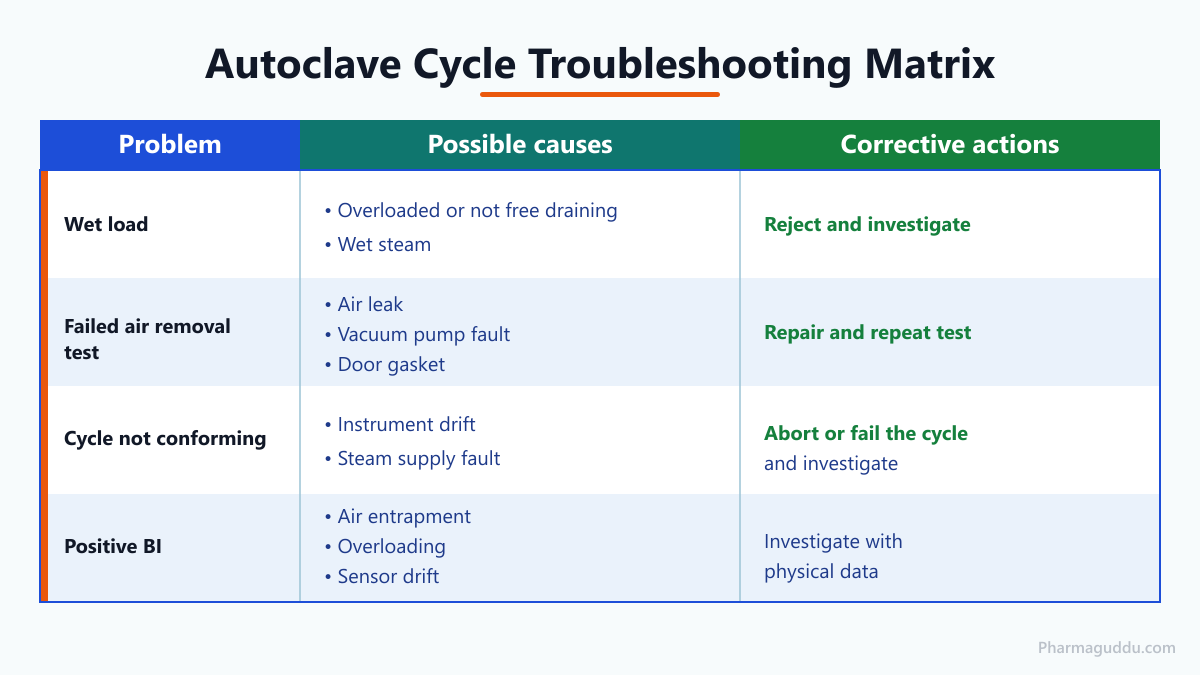
Most failures trace back to air, steam quality, loading or instrumentation. Any failed cycle or deviation from the validated process must be investigated. The guideline also states that a BI result must not override other critical parameters (Annex 1).
| Problem | Possible causes | Corrective actions |
|---|---|---|
| Wet load | Overloaded or poorly arranged load, load not free draining, wet steam, short drying phase, unsuitable packaging | Reject the load on visual inspection, investigate, correct the loading pattern, and assess steam dryness with the engineering team |
| Failed air removal test | Air leak, vacuum pump fault, door gasket damage, non-condensable gases in steam | Do not release the unit for production, repair, repeat the test and record the result |
| Failed vacuum leak test | Worn door gasket, leaking valve or fitting | Repair, repeat the test, and review the cycles run since the last passed test |
| Cycle not conforming to validated parameters | Instrument drift, steam supply fault, a longer or shorter phase | Abort or fail the cycle, investigate, and do not release the load |
| Positive BI | Air entrapment, overloading, sensor drift, BI handling error | Investigate with the physical data, check the BI positive control, and review the cycle record |
| Distorted containers | Wrong pressure, heating or cooling rate for non-rigid containers | Adjust cycle design and loading pattern through change control |
If a deviation is confirmed, the production officer informs the QA officer, and a deviation is raised. For the corrective and preventive action (CAPA) process, see CAPA in pharmaceutical. For example, if packs from one shelf are repeatedly wet, the loading pattern of that shelf is reviewed first. The steam dryness is then reviewed.
What do the regulations require for moist heat sterilization?
EU GMP Annex 1, Manufacture of Sterile Medicinal Products (2022 revision), entered into operation on 25 August 2023. The European Commission lists it as fully applicable since 25 August 2024. The moist heat requirements are in section 8 (EU GMP Annex 1), supported by the general sterilisation clauses (EU GMP Annex 1) and heat sterilisation clauses (EU GMP Annex 1).
Annex 1 requires validated loading patterns (Annex 1) and revalidation of heat sterilisation cycles at least annually for worst-case load patterns (Annex 1). The autoclave is qualified, and the sterilisation process and cycle are validated. The EMA sterilisation guideline (EMA/CHMP/CVMP/QWP/850374/2015) sets the F0 and SAL approach for dossiers.
How is an autoclave maintained?
Maintenance supports the validated state. It requires a weekly leak test for cycles with a vacuum phase (Annex 1) and a daily air removal test (Annex 1). Ellab lists annual sensor calibration and recalibration after repairs or suspected drift. Door gaskets and steam traps need regular inspection, and the intervals are set by the site SOP and the manufacturer’s manual.
Expert Tips
- Name the cycle: The record should state whether the cycle is porous, fluid or superheated water, because the acceptance criteria differ.
- Start the timer on the load: The sterilising time counts only after the whole load reaches temperature, so the slowest point decides the cycle.
- Do not read pressure as temperature: The temperature probes and the chamber drain record are the evidence, not the pressure gauge.
- Respect the validated load: A new load pattern needs a validated basis before routine use.
- Keep tape in its place: Indicators show that a cycle occurred, and the batch is released only on the reviewed cycle record.
Frequently Asked Questions
The standard cycle for aqueous solutions is a hold at 121 °C for at least 15 min in all units (the Ph. Eur. Reference condition). Another time and temperature pair is acceptable when the lethality is validated with F0 of at least 8 min and the hold temperature stays above 110 °C. Products that are heat labile may need a bioburden-based approach instead of overkill.
No. Temperature in saturated steam kills the organisms, and pressure only makes that temperature reachable. Air in the chamber can raise the pressure without raising the temperature, so pressure alone is not accepted as proof of sterilising conditions.
Spores of Geobacillus (Bacillus) stearothermophilus are the usual indicator for steam. Clostridium sporogenes is also used for challenge studies. Annex 1 (Annex 1) requires BI suppliers to be qualified and the population, purity and identity of each new lot to be verified.
Other load patterns follow the frequency justified in the contamination control strategy, while the worst-case load patterns need revalidation of the heat sterilisation cycle at least annually (Annex 1). Sensor calibration is separate from validation and is commonly annual.
References
- Steam Sterilization, CDC
- Introduction to Steam Quality and Testing, ISPE Pharmaceutical Engineering
- Guideline on the sterilisation of the medicinal product, active substance, excipient and primary container, EMA
- EU GMP Annex 1, Manufacture of Sterile Medicinal Products (2022), European Commission
- EudraLex Volume 4, European Commission
- British Pharmacopoeia Vol. V (2012 mirror), drugfuture.com
- USP <1229.2> Moist Heat Sterilization of Aqueous Liquids, USP (mirror)
- Steam sterilization, Ellab
- Steam Autoclave Testing Methods and Maintenance: Leak Testing and the Bowie-Dick Test, Priorclave
- Validation standard operating procedure and site master file excerpts, owner library, internal documents
- EU GMP Annex 1: 8.34, 8.37, 8.59, 8.52, 8.53, 8.62, 8.56, 8.44, 8.45, 8.58, 8.41, 8.50, 8.57, 8.46, 6.17, 8.51, 8.42, 8.55, 8.65, 8.49, 8.54, 8.38, 8.39, 8.60, 8.61, 8.43
- Ph. Eur.: 5.1.1

Pankaj Sharma — Quality Control Specialist
Pankaj Sharma is a pharmaceutical QC professional who reviews our technical content for GMP accuracy, laboratory practices, and regulatory relevance.