
Quality Control Specialist | Industry Experience
✓ Reviewed by: Pankaj Sharma - Quality Control Specialist
Reviewed for Quality Control accuracy, laboratory practices, analytical methods, and technical relevance
📅 Last Updated: November 13, 2026
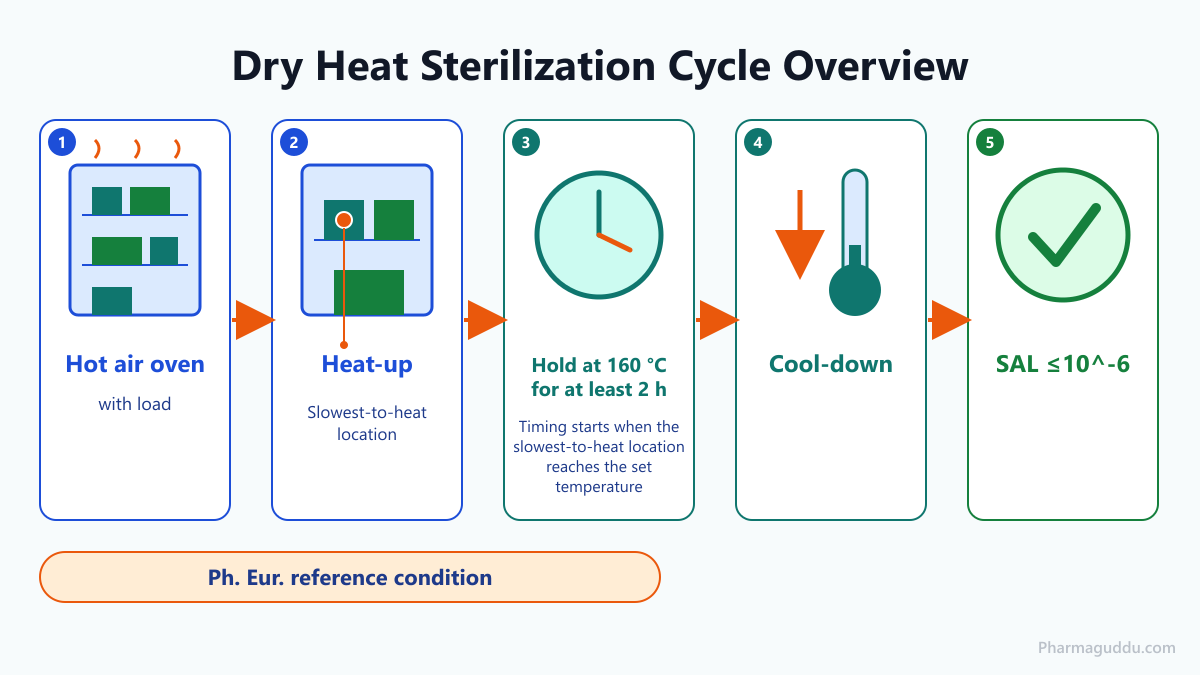
Dry heat sterilization destroys microorganisms with hot air, usually in a hot air oven or a sterilizing and depyrogenation tunnel. The Ph. Eur. Reference condition is a minimum of 160 °C for at least 2 hours, and cycles that use it need no validation data in the quality dossier. Shorter or cooler cycles must be validated to a sterility assurance level (SAL) of 10^-6 or better. The method suits glassware, metal parts, non-aqueous liquids and heat-stable powders. Depyrogenation, which removes endotoxins, is a separate validated process.
What is dry heat sterilization?
Dry heat sterilization is a physical sterilization method in which microorganisms are killed by exposure to hot, moisture-free air for a defined time. It is used where steam cannot reach the item or where moisture would damage it. For the full overview of all methods, see sterilization, method of sterilization, and objective in labs.
In pharmaceutical plants, dry heat is applied to glassware, metal components, canisters and sampling aids. It is also applied to non-aqueous liquids, semi-solids and heat-stable powders. The European Medicines Agency (EMA) guideline on sterilisation (dated 6 March 2019, in effect from 1 October 2019) routes dry powder, non-aqueous liquid and semi-solid products through its own decision tree. Heat sterilization of the finished product in its final container is preferred whenever it is possible.
Dry heat is slower than steam. Because air transfers heat poorly, the cycles are longer and the temperatures are higher than those of an autoclave.
How does dry heat kill microorganisms?
Dry heat kills microorganisms by damaging their cell constituents at high temperature in the absence of moisture. Spores are far more resistant to heat when they are dry than when they are well hydrated, and this is the reason dry heat needs higher temperatures and longer exposure than moist heat (Xing et al., 2014).
Microorganisms becomes inactive/kill due to oxidation of cell constituents, especially proteins and enzymes, with slower protein denaturation and irreversible dehydration as secondary effects. Work on spores heated rapidly in the dry state shows accumulated DNA damage, including strand breaks from depurination. Wet heat acts differently because it inactivates critical enzymes.
Killing follows an exponential law. Survival is therefore always a probability and never an absolute. The EMA guideline defines the sterility assurance level (SAL) as the probability of a micro-organism surviving in a product item after the process. An SAL of 10^-6 means not more than 1 non-sterile item in 1 × 10^6 sterilised items.
Three terms are used to describe lethality:
- D-value (decimal reduction value): the exposure time that reduces viable organisms to 10 per cent of the original population.
- z-value: the temperature change needed to alter the D-value by a factor of 10.
- Slowest-to-heat location: the point in the load that stays coldest or heats slowest.
What are the parts of a hot air oven and a depyrogenation tunnel?
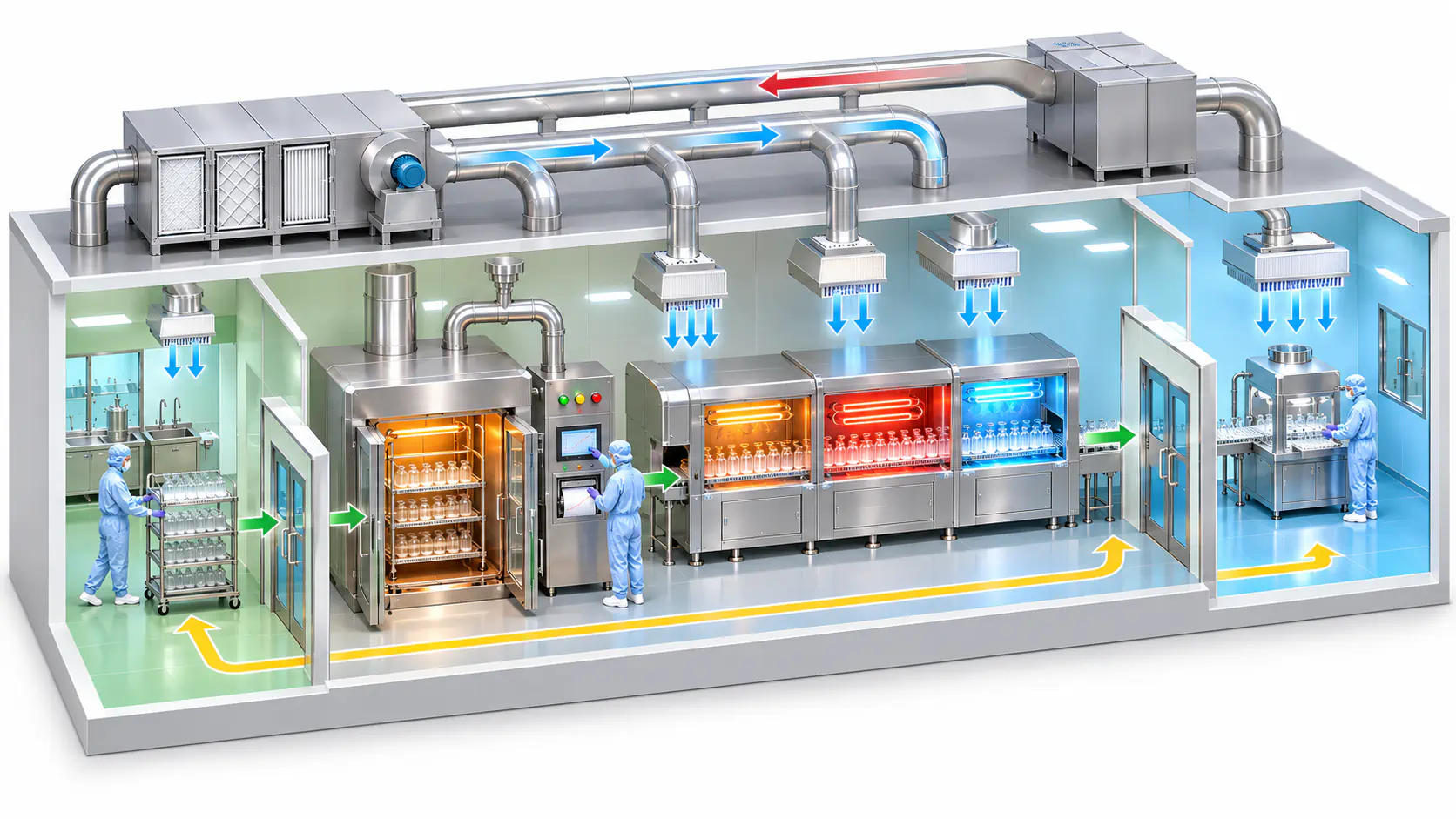
A batch hot air oven is an insulated chamber with electric heaters and a circulation fan. It also has High-Efficiency Particulate Air (HEPA) filtered air, temperature probes and a control system. The chamber and trays are the product-contact parts, so they are made of stainless steel. A site master file for an injectable plant describes a sterilizer with an SS316L mirror-polished chamber and SS304 outer parts.
hot air oven has a class 100 interlocked double-door batch oven that heats HEPA-filtered air up to 260 °C with a temperature uniformity of ±5 °C. The figures are one site’s design values and differ between manufacturers. A series of electric heaters supplies the heat, and probes at several chamber locations feed a programmable logic controller (PLC). A strip chart recorder gives a continuous record of every cycle.
The oven is installed in a pass-through layout. One door opens into the washing and sterilization room (class 100,000), and the other opens into the class 100 aseptic zone. Because the doors are interlocked, they cannot be open together.
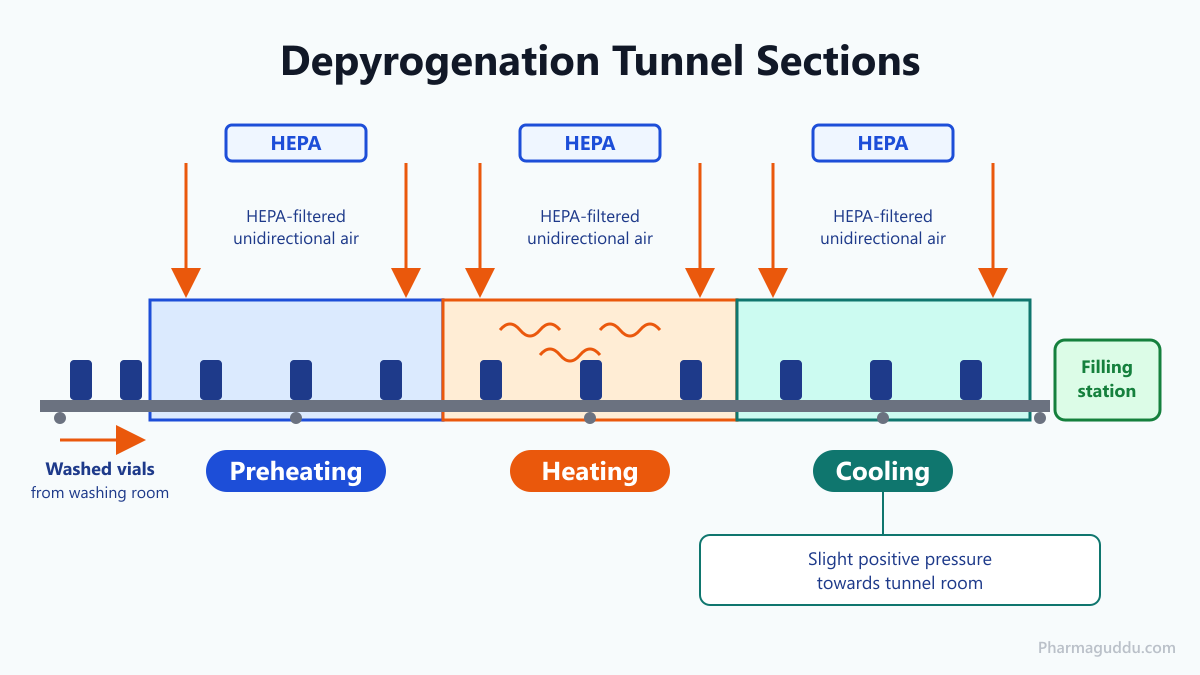
A tunnel has three sections: preheating, heating and cooling. Washed containers move through on a conveyor under HEPA-filtered unidirectional air. The cooling section is held at a slight positive pressure towards the tunnel room, so that the containers stay sterile up to the filling station. A higher overpressure would cool the heating section. It would also reduce the efficiency of that section.
What types of dry heat sterilizers are used?
Dry heat sterilizers are classified by how air moves and how the load is handled.
| Type | How it works | Typical use |
|---|---|---|
| Static-air (gravity convection) oven | Heated air rises by natural convection | Small laboratory loads |
| Forced-air batch oven | A fan circulates the air, which reduces cold spots | Glassware, canisters, metal parts |
| Tunnel sterilizer | Containers move on a conveyor through preheat, heat and cool zones | Continuous sterilization and depyrogenation of washed vials |
A forced-air oven gives a more uniform temperature and shorter cycles than a static oven, so it is the usual choice in industry. Batch ovens and tunnels often coexist in one injectable plant. An equipment list from an injectable block, for example, shows two batch dry heat sterilizers and a tunnel sterilizer rated at 250 containers per minute beside the vial washer.
The cycle itself also differs by purpose. A sterilization cycle is judged by the SAL. A depyrogenation cycle is judged by a 3-log reduction in heat-resistant endotoxins. The EMA guideline states that dry heat above 220 °C for a validated time is frequently used for both purposes on glassware and heat-resistant container materials such as aluminium crimps.
What time and temperature cycles are used?
The only reference condition is a minimum of 160 °C for at least 2 hours, as stated in Ph. Eur. 5.1.1 and quoted in the EMA guideline. The hold time starts when the slowest-to-heat location of the load reaches the set temperature. A chamber air reading alone is not enough to start the clock.
Other combinations, such as 170 °C for 60 minutes or 150 °C for 150 minutes, are validated alternative cycles and not reference conditions. Any cycle with a shorter time or a lower temperature than the reference needs physical and biological validation to show an SAL of 10^-6 or better. Such cycles are rarely chosen for finished products because the validation work is larger.
The EMA guideline lists the data expected for such a cycle:
- Load mapping of the chamber and of the items in it, including the slowest-to-heat locations.
- A physical and biological confirmation of at least three sterilisation runs.
- Acceptable temperature differences between the sensors in the load.
- Acceptable lethality variability within the load.
- A SAL calculated from the maximum bioburden per container.
READ ALSO
Sterilization, Method of sterilization, and Objective in Labs
Sterilization, method of sterilization and objective in labs: physical, chemical and mechanical methods.
How is a hot air oven operated?
Operation follows the site SOP and the standard cycle parameters approved for each load. A typical dry heat sterilizer procedure, as used in a vaccine plant, is described here in general terms.
Roles: trained line staff operate and clean the oven, the supervisor oversees the work, the manager is responsible for implementing the procedure, and the head of quality assurance (QA) is responsible for compliance.
Safety rules: the door safety switches and door-obstruction switches must never be bypassed. Operators must wear safety goggles. When the door is opened, they must stand at a distance, because hot air and hot surfaces can cause burns.
The sequence on the floor is as follows:
- Check that the chamber and trays are clean and the items are dry.
- Load the trolley only in the validated loading pattern. Trays must not be overloaded and airflow must not be blocked, because heat penetrates slowly in air.
- Close and lock the door, then select the sterilization process on the control panel according to the standard parameter annexure.
- Print the cycle parameters and check them against the standard before starting.
- Start the strip chart recorder, then start the cycle.
- When the display shows the process end, wait a few seconds and acknowledge it on the panel.
- Open the sterile-side door only after the cycle is complete and the load has cooled to the safe temperature given in the procedure.
- Unload the sterile items and hold them under unidirectional airflow in the buffer zone.
The printout and strip chart are attached to the batch record or entered in the equipment log. The oven chamber and trays are cleaned with a soft, lint-free mop or cloth. The standard operating procedures for dry heat sterilization in the injection section and for hot air oven operation and calibration show how these steps are written in a controlled document.
Sterile glassware and containers prepared in this way are used before aseptic filling. The QA officer checks the records before the items are released to the filling line.
What controls and limits apply to a dry heat cycle?
Control starts before the cycle and continues through qualification and routine monitoring.
Bioburden. The bioburden limit must be stated before sterilization. The EMA guideline accepts a maximum of 100 CFU/100 g or 100 CFU/100 ml for parenteral finished products without further justification. For non-parenteral products and active substances, 10 CFU/g or 10 CFU/ml is accepted. A justified bioburden limit is also needed for empty containers.
Qualification of the equipment. The oven or tunnel is qualified through installation qualification (IQ) and operational qualification (OQ). OQ includes an empty-chamber heat distribution study that identifies the hottest and coldest zones, the mean and range of temperatures, and the heat-up and cool-down times. A loaded heat distribution and heat penetration study follows. Probes are placed in the container cold zone, and at least one penetration probe must cover each hot or cold zone found in the empty-chamber run. The related protocols are available for the installation qualification and the operation qualification of a sterilizing and depyrogenation tunnel.
Alarm and safeguard checks. Each alarm is challenged during OQ: door-open, high and low temperature, fan-on, power interruption and timer alarms.
Process validation. The sterilisation cycle is validated with a biological indicator. The British Pharmacopoeia text that reproduces Ph. Eur. 5.1.2 names Bacillus atrophaeus spores, with more than 1 × 10^6 viable spores per carrier and a D-value at 160 °C of not less than 2.5 minutes. For depyrogenation, endotoxin indicators are used to show the 3-log reduction.
Deviation triggers. A hold time shorter than the set time, a temperature below the set value, an alarm or a power failure during the cycle is treated as a deviation. The load is not released until QA has reviewed it.
What are the critical process parameters?
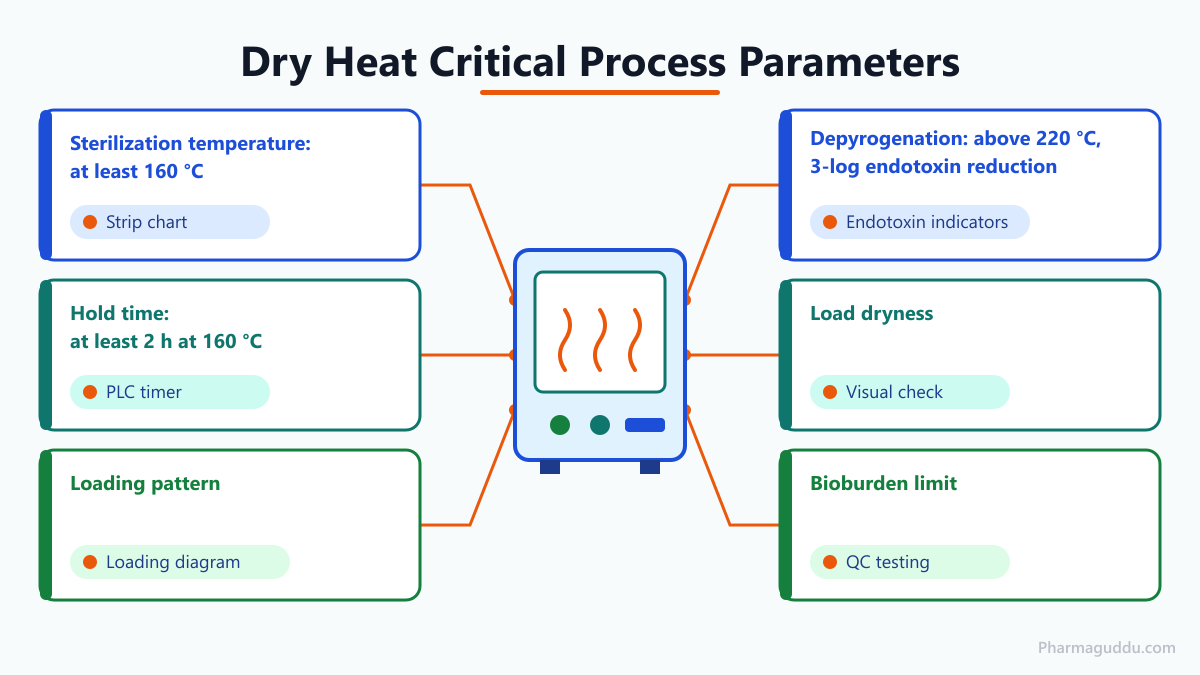
The table lists the parameters that decide the lethality of a dry heat cycle.
| Parameter | Typical setting or range | Why it matters | How it is monitored |
|---|---|---|---|
| Sterilization temperature | At least 160 °C (Ph. Eur. reference condition) | Lower temperature reduces lethality | Load probes and chamber probes, strip chart |
| Hold time | At least 2 h at 160 °C; shorter cycles need validation | Determines the SAL achieved | PLC timer, started when the slowest-to-heat location reaches the set temperature |
| Depyrogenation temperature | Above 220 °C for a validated time | Needed for a 3-log endotoxin reduction | Probes, endotoxin indicators in validation |
| Chamber temperature uniformity | ±5 °C in one site master file design (varies by manufacturer) | Cold zones may receive less lethality | Empty and loaded heat distribution studies |
| Loading pattern | Validated pattern for each load | Dense or blocked loads heat slowly | Loading diagram, supervisor check |
| Load dryness | Items dry before loading | Moisture interferes with the process | Visual check before loading |
| Bioburden before sterilization | 100 CFU/100 g or ml (parenteral); 10 CFU/g or ml (non-parenteral) | Sets the starting population used for the SAL | Bioburden testing by quality control (QC) |
| Airflow and fan | No sourced value | Gives a uniform temperature in the chamber | Fan-on alarm, qualification |
Exact values depend on the manufacturer and model, so the Original Equipment Manufacturer (OEM) manual and the site SOP must be followed.
What are the common problems and how are they fixed?
Cold spots in the load
Cold spots appear when trays are overloaded, containers are too dense or air circulation is blocked, and the load then fails to reach the set temperature at the slowest-to-heat location. The hold time is therefore not valid.
Corrective actions: the loading pattern is reviewed against the heat penetration study, probes are placed in the container cold zone, and the load is reduced to the validated configuration.
Temperature not reaching the set value
Possible causes are a failed heater, a weak fan, a blocked HEPA filter or a drifted probe. The engineering staff therefore check the heaters, the fan and the filter. The probes are also checked against calibrated standards.
Corrective actions: the cycle is treated as a deviation, the load is not released, and the equipment is repaired and requalified where required.
Biological indicator failure
A failure can follow a cold zone, a wet load or a cycle shortened without validation. The investigation then compares the strip chart, the probe data and the indicator placement.
Corrective actions: the batch is held, the root cause is found through a deviation investigation and the validated cycle is confirmed again.
Wet items
Items loaded wet release moisture during heating, which interferes with the process and can leave cold zones through evaporation. Glassware must therefore be dried completely after washing and before loading.
Door opened during the cycle
An open door causes a sudden temperature drop and breaks the sterile barrier of the pass-through design. The door-open alarm records the event. The cycle is then treated as a deviation, and the load is not released unless it is re-run or justified through a documented assessment.
Power failure or alarm during the hold
The hold time is not valid once the temperature falls below the set value. The QA officer reviews the strip chart, and the load is re-sterilized or rejected according to the procedure.
What regulatory points apply?
The EMA guideline on sterilisation (EMA/CHMP/CVMP/QWP/850374/2015) covers dry heat in the guidance. It requires time, temperature and a bioburden limit to be stated, and it confirms that the Ph. Eur. Reference condition needs no validation data in the dossier.
EU GMP Annex 1, Manufacture of Sterile Medicinal Products, has been fully applicable since 25 August 2024. For US plants, 21 CFR Part 211 requires written procedures to prevent microbiological contamination of drug products that purport to be sterile, and these must include validation of all aseptic and sterilization processes.
For empty containers sterilized by a third party, the EMA guideline accepts certification that the process was validated to ISO 20857 as sufficient assurance when no GMP certificate is available. ISO 20857 covers the development, validation and routine control of dry heat sterilization of health care products, and it does not replace the Ph. Eur. For medicinal products.
Frequently Asked Questions
No. Rubber and most plastics degrade at the temperatures used in dry heat cycles. Rubber stoppers are sterilized in a steam sterilizer, which is why a plant keeps both an autoclave and a dry heat sterilizer in the washing and sterilization room. Dry heat is kept for glass, metal and other heat-resistant items.
No. Sterility and endotoxin removal are separate goals with separate criteria. A sterilization cycle is judged by an SAL of 10^-6 or better, while depyrogenation is judged by a 3-log reduction in heat-resistant endotoxins. The EMA guideline mentions dry heat above 220 °C for a validated time for this purpose, so the 160 °C reference cycle is not used to claim depyrogenation.
The door should not be opened until the load has cooled to the safe temperature set in the procedure. An early opening can cause burns to the operator, and it exposes the load to the room air. Unloading is done from the sterile-side door, and the items are held under unidirectional airflow in the buffer zone.
Moisture interferes with dry heat action, and its evaporation can leave cold zones in the load. Wet glassware also changes the heat penetration that was measured during validation. Items must be fully dried after washing, and the drying step is part of the loading preparation.
References
- Guideline on the sterilisation of the medicinal product, active substance, excipient and primary container (EMA/CHMP/CVMP/QWP/850374/2015), European Medicines Agency, 2019
- EudraLex Volume 4, Annex 1 Manufacture of Sterile Medicinal Products, European Commission
- Methods of Sterilisation, British Pharmacopoeia Volume V, Appendix XVIII, 2012
- Xing Y, Li A, Felker DL, Burggraf LW. Nanoscale structural and mechanical analysis of Bacillus anthracis spores inactivated with rapid dry heating, Applied and Environmental Microbiology, 2014
- 21 CFR 211.113 Control of microbiological contamination, US FDA (eCFR)
- Site master file, Block B, sections 22 and 25, plant reference library
- List of production equipments, D block, plant reference library
- Operation and cleaning of dry heat sterilizer, standard operating procedure, plant reference library
- Ph. Eur.: 4.1.2, 5.1.1, 5.1.2
- Other references: 4.1.2
- 21 CFR 211.113(b)

Pankaj Sharma — Quality Control Specialist
Pankaj Sharma is a pharmaceutical QC professional who reviews our technical content for GMP accuracy, laboratory practices, and regulatory relevance.