
Quality Control Specialist | Industry Experience
✓ Reviewed by: Pankaj Sharma - Quality Control Specialist
Reviewed for Quality Control accuracy, laboratory practices, analytical methods, and technical relevance
📅 Last Updated: June 16, 2026
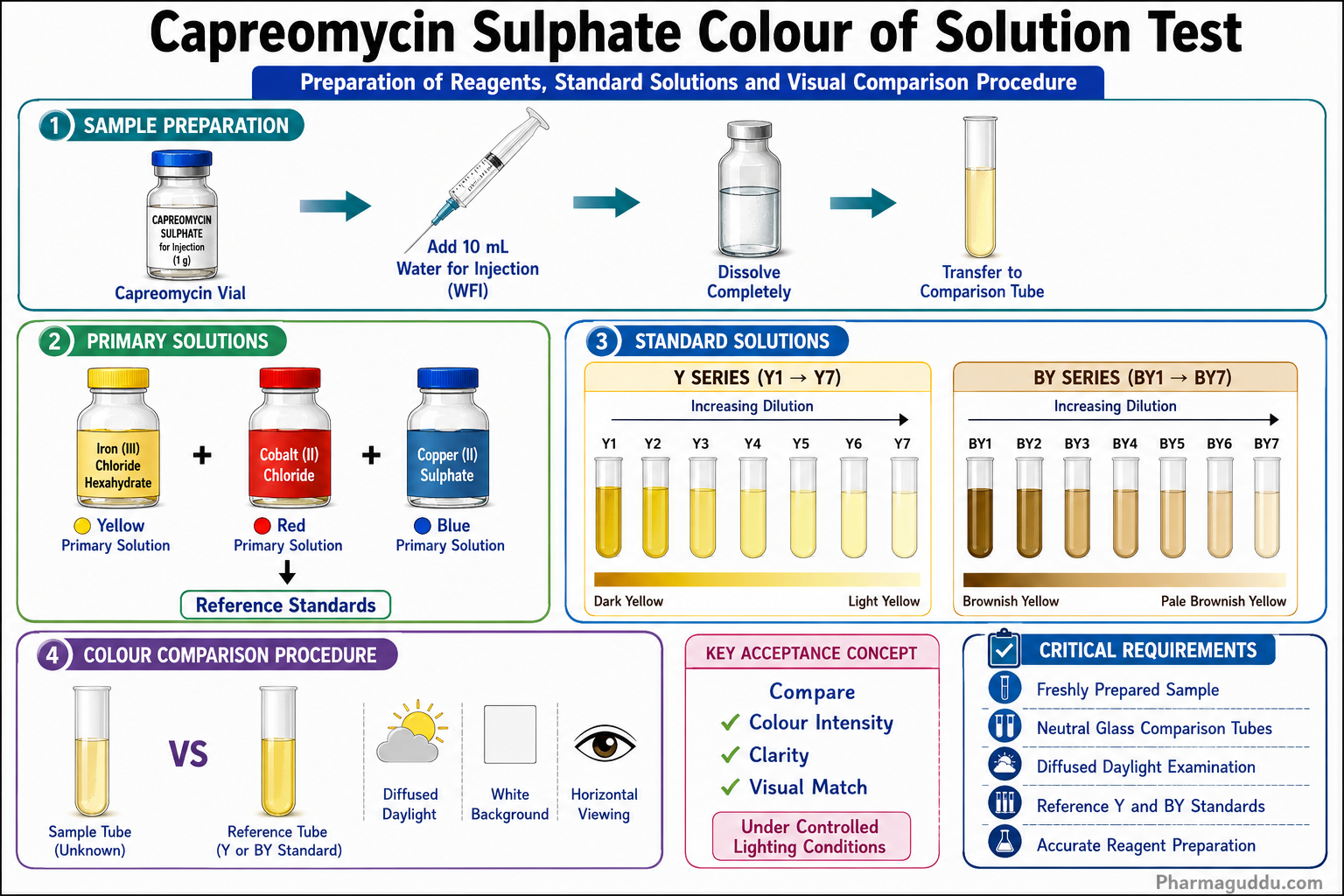
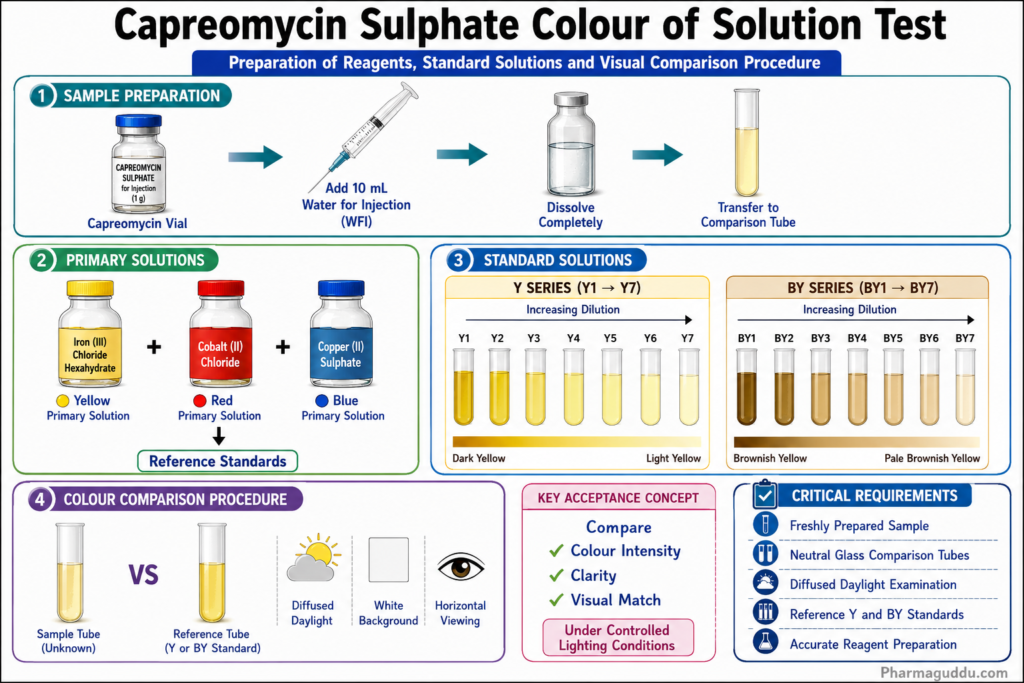
Capreomycin Sulphate Colour of Solution Test is a pharmacopoeial quality control test to check the appearance and colour intensity of a solution of capreomycin after it is reconstituted. This test helps ensure that the product complies with specified visual standards and does not contain excessive coloured impurities or degradation products that could indicate quality issues. The method is to prepare the sample solution with Water for Injection (WFI), match it to a set of reference colour solutions of Yellow (Y) and Brownish Yellow (BY) and then measure the colour under controlled viewing conditions. Routine pharmaceutical quality testing requires accurate preparation of reagents, appropriate lighting and visual comparison methods to ensure reliable and repeatable results.
1.0 Scope: This procedure is applicable to check the colour of sample solution of Capreomycin Sulphate.
2.0 Apparatus
- Test tube
- 5 ml graduated pipette
- 2 ml graduated pipette
- 100 Volumetric flask
- 25 ml measuring cylinder
- 10 ml graduated pipette
- Colourless, transparent Flat bottomed colour comparison test-tubes of neutral glass and 12 mm in external diameter
- 5 ml syringe with needle
3.0 Reagents
- Iron (III) chloride hexahydrate AR grade
- Cobalt (II) chloride AR grade
- Copper (II) sulphate AR grade
- Concentrated hydrochloric acid AR grade
- Potassium Iodide AR grade
- Starch
- Sodium thiosulphate AR grade
- Hydrogen peroxide solution (10 volume)
- Sodium hydroxide AR grade
- Sulphuric acid AR grade
- Acetic acid AR grade
4.0 Preparation of Reagents
Starch Solution
Triturate 1.0 g of soluble starch with 5 ml of distilled water and add, stirring continuously, to 100 ml of boiling distilled water containing 10 mg of mercury (II) iodide.
Hydrogen Peroxide Solution (10 Volume)
Dilute hydrogen peroxide solution (20 vol) with an equal volume of distilled water.
Hydrogen Peroxide Solution (20 Vol)
Dilute 1 volume of hydrogen peroxide solution (100 vol) with 4 volumes of distilled water.
Hydrogen Peroxide Solution (100 Vol)
Hydrogen peroxide solution (100 vol) is strong hydrogen peroxide solution containing about 30% w/v of hydrogen peroxide.
1 M Sulphuric Acid
Add slowly, with stirring, 60 ml of sulphuric acid to about 1000 ml of water, allow it to cool 25°C.
2 M Acetic Acid
Dilute 11.5 ml of glacial acetic acid to 100 ml with distilled water.
Preparation of 0.1 M Sodium Thiosulphate
Preparation
Dissolve 25 g of sodium thiosulphate and 0.2 g of sodium carbonate in carbon dioxide-free water and dilute to 1000 ml with the same solvent.
Standardization
Dissolve 0.200 g of potassium bromate, weighed accurately, in sufficient purified water to produce 250.0 ml. To 50.0 ml of this solution add 2 g of potassium iodide and 3 ml of 2 M hydrochloric acid and titrate with the sodium thiosulphate solution using starch solution, added towards the end of the titration, as indicator until the blue colour is discharged.
Each ml of 0.1 M sodium thiosulphate is equivalent to 0.002784 g of KBrO₃.
Calculation
N = (W × 50 × 0.1) / (V × 250 × 0.002784)
Where:
| Parameter | Description |
| N | Molarity of sodium thiosulphate solution |
| W | Weight of potassium bromate in g |
| V | Volume of 0.1 M sodium thiosulphate in ml |
5.0 Preparation of Primary Solutions
A. Yellow Primary Solution
Dissolve 4.6 g of iron (III) chloride hexahydrate in about 90.0 ml of a mixture of 2.5 ml of hydrochloric acid and 97.5 ml of distilled water and dilute to 100 ml with the same mixture.
Assay the solution and dilute it with the dilute hydrochloric acid mixture to contain 45 mg of FeCl₃·6H₂O per ml.
The solutions should be stored protected from light.
Assay (Yellow Primary Solution)
To 10 ml of the solution add 15 ml of distilled water, 5 ml of hydrochloric acid and 4 g of potassium iodide, close the flask, allow to stand in the dark for 15 minutes and add 100 ml of distilled water.
Titrate the liberated iodine with 0.1 M sodium thiosulphate using 0.5 ml of starch solution, added towards the end of the titration, as indicator.
Each ml of 0.1 M sodium thiosulphate is equivalent to 27.03 mg of FeCl₃·6H₂O.
Calculation
mg of FeCl₃·6H₂O per ml = (BR × M × 27.03) / (0.1 × 10)
Where:
| Parameter | Description |
| BR | Volume of 0.1 M sodium thiosulphate consumed in the titration |
| M | Actual molarity of sodium thiosulphate |
B. Red Primary Solution
Dissolve 6.0 g of cobalt (II) chloride in about 90.0 ml of a mixture of 2.5 ml of hydrochloric acid and 97.5 ml of distilled water and dilute to 100 ml with the same mixture.
Assay the solution and dilute it with the dilute hydrochloric acid to contain 59.5 mg of CoCl2,6H2O per ml.
Assay (Red primary solution):
To 5 ml of the solution add 5 ml of hydrogen peroxide solution (10 volume) and 10 ml of a 30% w/v solution of sodium hydroxide.
Boil gently for 10 minutes, allow to cool and add 60 ml of 1M sulphuric acid and 2 g of potassium iodide.
Close the flask and dissolve the precipitate by shaking gently. Titrate the liberated iodine with 0.1M sodium thiosulphate using 0.5 ml of starch solution, added towards the end of the titration, as indicator.
The end point is reached when the solution turns pink.
Each ml of 0.1M sodium thiosulphate is equivalent to 23.79 mg of CoCl2,6H2O.
Calculation:
mg of CoCl2,6H2O per ml = BR X M X 23.79/ 0.1 X 5
where
BR = Volume of 0.1 M sodium thiosulphate consumed in the titration
M = Actual molarity of sodium thiosulphate.
From the calculation, dilute the red primary solution with dilute hydrochloric acid mixture to contain 59.5 mg of CoCl2,6H2O per ml.
C. Blue Primary Solution
Dissolve 6.3 g of copper (II) sulphate in about 90.0 ml of a mixture of 2.5 ml of hydrochloric acid and 97.5 ml of distilled water and dilute to 100 ml with the same mixture.
Assay the solution and dilute it with the dilute hydrochloric acid to contain 62.4 mg of CuSO4,5H2O per ml.
Assay (Blue primary solution):
To 10 ml of the solution add 50 ml of distilled water, 12 ml of 2M acetic acid and 3 g of potassium iodide .
Titrate the liberated iodine with 0.1M sodium thiosulphate using 0.5 ml of starch solution, added towards the end of the titration, as indicator.
The end point is reached when the solution exhibits a slight pale brown colour.
Each ml of 0.1M sodium thiosulphate is equivalent to 24.97 mg of CuSO4,5H2O.
Calculation:
mg of CuSO4,5H2O per ml = BR X M X 24.97/ 0.1 X 10
where
BR = Volume of 0.1 M sodium thiosulphate consumed in the titration
M = Actual molarity of sodium thiosulphate.
From the calculation, dilute the blue primary solution with dilute hydrochloric acid mixture to contain 62.4 mg of CuSO4,5H2O per ml.
Preparation of Standard Solution Y
Take 24 ml of Yellow primary solution into a 100 ml volumetric flask. Add 6 ml of Red primary solution and dilute to 100 ml with 1% w/v of Hydrochloric acid.
Reference Solutions of Y Series for Comparisons
| Reference Solution | Volume of Standard Solution Y (ml) | Volume of Hydrochloric Acid (1% w/v) (ml) |
| Y1 | 100.0 | 0.0 |
| Y2 | 75.0 | 25.0 |
| Y3 | 50.0 | 50.0 |
| Y4 | 25.0 | 75.0 |
| Y5 | 12.5 | 87.5 |
| Y6 | 5.0 | 95.0 |
| Y7 | 2.5 | 97.5 |
Preparation of Standard Solution BY
Take 24 ml of Yellow primary solution into a 100 ml volumetric flask. Add 10 ml of Red primary solution, 4 ml of Blue primary solution and dilute to 100 ml with 1% w/v of Hydrochloric acid.
Reference Solutions of BY Series for Comparisons
| Reference Solution | Volume of Standard Solution BY (ml) | Volume of Hydrochloric Acid (1% w/v) (ml) |
| BY1 | 100.0 | 0.0 |
| BY2 | 75.0 | 25.0 |
| BY3 | 50.0 | 50.0 |
| BY4 | 25.0 | 75.0 |
| BY5 | 12.5 | 87.5 |
| BY6 | 5.0 | 95.0 |
| BY7 | 2.5 | 97.5 |
6.0 Sample Preparation
To the content of the vial (containing Capreomycin Sulphate equivalent to 1g capreomycin) add 10 ml of water for injection. Shake to dissolve the contents and transfer the same to a colour comparison tube is colourless, transparent, neutral glass 12 mm in external diameter.
Note: Use freshly prepared solution of drug sample.
Standard Preparation
Transfer 10 ml of the required series of Reference solution to a colour comparison tube.
Procedure
Compare the colour intensity of sample and reference solution under the diffused day light examining horizontally against white background.
Related Pharmaceutical SOPs

Pankaj Sharma — Quality Control Specialist
Pankaj Sharma is a pharmaceutical QC professional who reviews our technical content for GMP accuracy, laboratory practices, and regulatory relevance.