
Microbiologist & Regulatory Specialist
✓ Reviewed by: Pankaj Sharma - Quality Control Specialist
Reviewed for QC, QA accuracy, laboratory practices, analytical methods, and technical Documents
📅 Last Updated: November 5, 2026
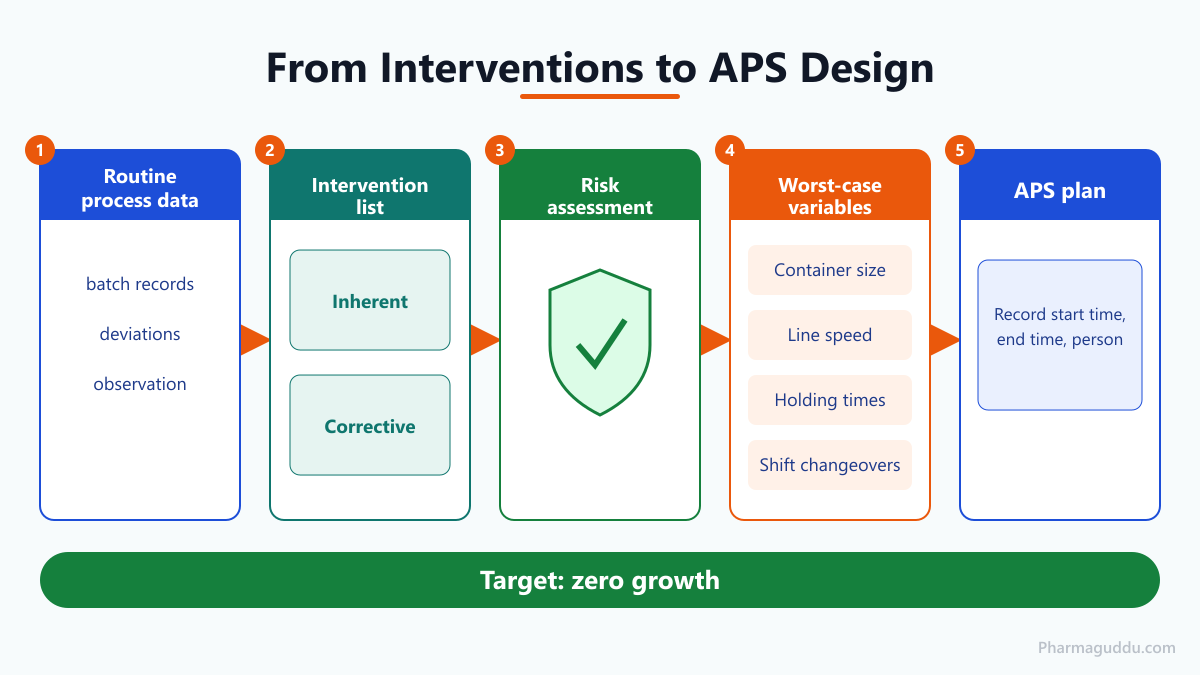
Media fill interventions are those actions performed by the operator during the aseptic process simulation (APS) or media fill. You should design inherent and corrective interventions to be performed in a similar way and frequency to routine production (EU GMP Annex 1, 9.34). The interventions should be based on the risk to sterility of the product. Worst case scenarios should be used to cover all relevant variables such as container size and line speeds. Justification for the variables chosen should be provided (9.36). All interventions should be recorded including start time, finish time and operator (9.47).
What Are Media Fill Interventions in an aseptic process simulation?
Media fill interventions are actions that interrupt normal aseptic processing. Sterile nutrient media is used instead of the product. Interventions can be clearing up a blockage, topping up the stopper bowl or replacing a component. Contamination of the open units will cause the media to become cloudy during incubation.
For a complete overview please see What is Media fill in Pharmaceutical. This article will focus on the questions of what interventions are performed, how often, how long, who performs them and how to justify them.
APS is a periodic check on the controls, it is not the main validation tool (Annex 1 9.32). Validation of the aseptic process comes from the design of the process, training and monitoring data. The aseptic process simulation demonstrates that these controls are maintained by actual people working on the line. If you want to understand the basic concepts first please see Aseptic and Sterile in Pharmaceutical and the SOP on aseptic handling, operation and aseptic connection.
What Is the Difference Between Inherent and Corrective Interventions?
There are two types of intervention described in Annex 1 9.34 – inherent interventions and corrective interventions. Inherent interventions are part of the normal process and occur with every batch. Corrective interventions are for a non planned issue. Annex 1 does not specify any definitions or examples; however the examples below are a typical example of industry practice. ISPE have listed removing jammed stoppers and toppled vials as inherent interventions. Each site should consider what interventions would be classed as inherent based on their process history and risk assessments.
| Feature | Inherent intervention | Corrective intervention |
|---|---|---|
| Trigger | Planned step in the routine process | Unplanned event or fault |
| Typical examples | Aseptic set-up, stopper bowl refill, in-process weight check, settle plate change | Clearing a jam, replacing a needle or tubing, removing fallen vials |
| How often in the APS | Same frequency as routine production | Based on assessed risk and real batch history |
| Main risk | Repeated exposure | Unusual, longer, closer to open product |
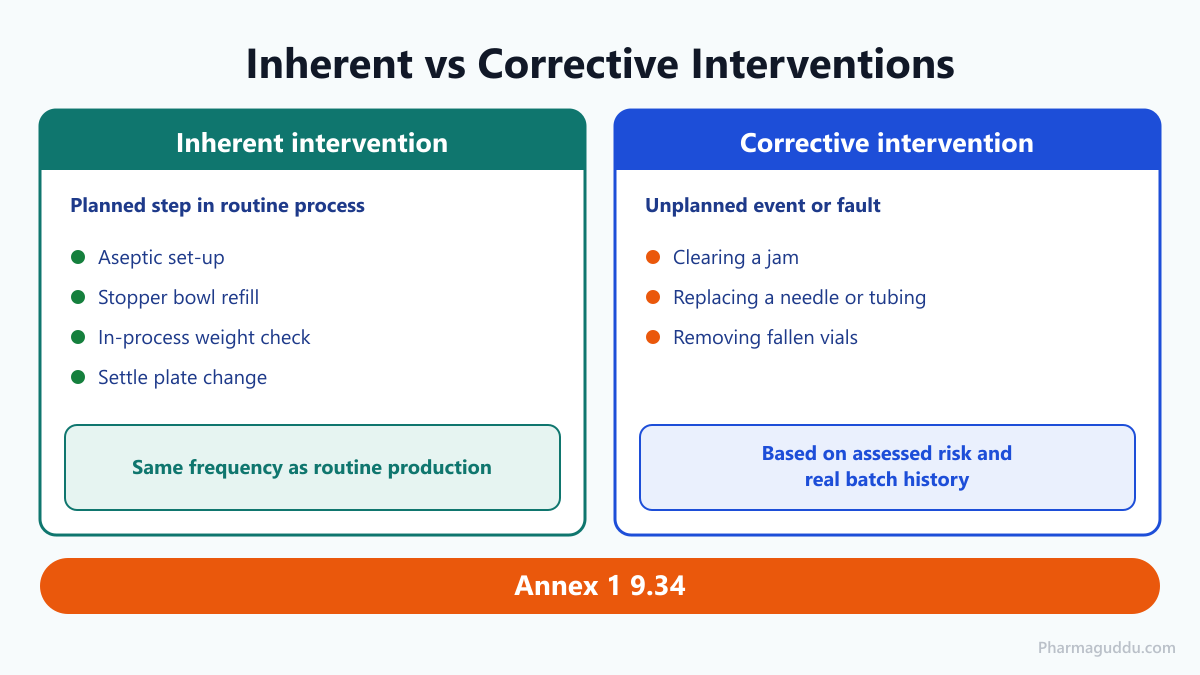
Both should be typical of normal practice and carried out in the manner that operators use in production (9.34 i). The APS should not be used to support practices that carry unnecessary risk of contamination (Annex 1 9.35). If a corrective action causes an operator to have to lean over open vials then this should be corrected by either changing the technique or equipment.
How Do You Justify Worst-Case Conditions Through Risk Assessment?
Annex 1 9.36(i) Identify worst case conditions for all relevant variables (container size, line speed etc). Justify your choice of these variables by providing the outcome of their assessment. Worst case conditions are a defined choice. The reader of the protocol should be able to understand why certain variables have been chosen and why others have not.
Variables to consider:
- Representative container and closure sizes. A bracketing or matrix approach can be used if there is scientific justification for process equivalence (9.36 ii).
- Maximum allowable holding times for sterile product and exposed equipment (9.36 iii)
- Fill volumes to ensure all surfaces that could cause contamination are covered by the media (9.36 iv).
- Routine stoppages e.g. shift changes, filling vessels being refilled and additional equipment brought in (9.36 x).
- Factors relating to variable or extended shifts e.g. maximum time operator can be in cleanroom (9.36 ix).
- Start and end of campaign if campaign manufacturing is being performed (9.36 xii).
For lyophilised products, 9.33 vi adds that the simulation should cover filling, transport, loading, a representative chamber dwell, unloading and sealing under documented worst-case operating parameters. For sterile powders, 9.33 iv asks for an acceptable surrogate in the same containers. This matters on a line such as the one described in the SOP on sterilized powder filling machine.
A practical way to build the justification, based on common industry practice rather than a fixed Annex 1 method:
- Collect every intervention seen in batch records, deviation reports and line observation or video.
- Rank each by risk: closeness to open product, duration, operator skill needed and how often it happens.
- Set the APS frequency from real routine data, as 9.34 requires.
- Add rare, higher-risk corrective interventions to the run as the risk assessment dictates.
- Write down every intervention you leave out, with the reason.
- Send the final list to QA for approval under change control.
On the shop floor, the intervention nobody writes down is usually the one that later causes the problem. A catalogue built only from the SOP misses it.
How Often and How Long Should Interventions Be Simulated?
Frequency should follow the normal process and risk assessment (9.34). Time should be honest. If you can perform an intervention in 2 minutes then you shouldn’t simulate it for 20 seconds.
The overall duration should challenge the process, people carrying out interventions, shift change and the capability of the environment (9.36 viii). The table below provides a summary of the numbers from Annex 1.
| Parameter | Annex 1 expectation | Clause |
|---|---|---|
| Initial validation | At least 3 consecutive satisfactory aseptic process simulation covering all working shifts | 9.38 |
| Periodic revalidation | Normally twice a year (approximately every six months) per aseptic process, filling line and shift | 9.38 |
| Operator participation | Each operator in at least one successful aseptic process simulation annually | 9.38 |
| Manual operations | Each operator in at least 3 consecutive successful APS initially, then about every 6 months | 9.39 |
| Run size | Typically a minimum of 5,000 to 10,000 units; small batches at least equal the production batch | 9.40 |
| Target | Zero growth; any contaminated unit fails the APS | 9.46 |
| Incubation | Conditions and duration scientifically justified and validated; no fixed values | 9.44 |
Section 9.40 also says the number of units must be justified in the contamination control strategy (CCS), the site’s documented plan for controlling contamination risk.
Who Takes Part in the Interventions?
All personnel will be involved in testing. Each operator will perform at least one successful aseptic process simulation per year (9.38). For manual processes (e.g. aseptic compounding/filling), each operator will perform at least three consecutive successful APS for each type of container/closure/equipment train. They will then perform the test approximately every 6 months (9.39).
Planning the schedule to ensure operators performing the interventions during the APS that they perform during production. If only the most experienced personnel are used during the APS then little can be learnt about how the night shift would perform.
Gloves should be monitored after critical interventions. If the process requires then the outer gloves or gown should be changed before continuing (9.25). This should be performed in the same way as in normal production. If the root cause of the failure indicates that an operator was involved then their work should be restricted until they have been retrained and requalified (9.46 vi).
How Do You Record Interventions and Handle Units?
The APS must be fully documented. This includes reconciling the number of units filled, incubated and not incubated. Any units not incubated must have an explanation for why. All interventions are documented with start/end times and the operator. Microbial monitoring and other data will be included in the APS batch documentation. Environmental monitoring will be performed as per normal production throughout the simulation (9.36 xi). Data from AHU performance qualification will support the cleanroom aspect.
Unit handling needs discipline:
- Units must be agitated, swirled or inverted prior to incubation. All integral units including those with cosmetic defects must be incubated (9.41).
- Units must only be discarded if they are to be removed under the same conditions from production as per SOP. No more units should be removed than would be removed during production (9.41).
- Material to be discarded e.g. product flushes must be simulated using media and incubated unless it can be shown that the waste procedure will not impact on sterility (9.42).
- APS runs can only be aborted if they are treated the same as commercial lots as per written procedures. An investigation must be documented (9.48).
What Does QC Control Before and After the Run?
The QC analyst will ensure that media used contain the appropriate reference strains as listed in the pharmacopoeia and appropriate local isolates (9.36 vi). The fill volume should provide sufficient headspace to allow growth and visibility of turbidity (9.36 iv).
Following incubation, trained and qualified personnel will examine units under appropriate conditions. Samples will have a positive control containing reference strains and local isolates (9.45). Samples will be incubated in clear containers or using a validated detection method if clear containers cannot be used. If possible, organisms on contaminated units should be identified to species level (9.43).
What Do the Regulations Say?
Annex 1 was published on 25 August 2022 and came into operation on 25 August 2023, except point 8.123, which followed on 25 August 2024. Its revision was jointly recommended by the GMP/GDP Inspectors Working Group and the PIC/S Committee. Section 9.32 to 9.49 is the backbone for everything above. In the United States, FDA’s 2004 guidance, Sterile Drug Products Produced by Aseptic Processing, is the matching reference for media fill expectations.
Recent Technology Trends
- Annex 1 in operation (2023 to 2024). All APS clauses discussed here, including the intervention recording rule in 9.47, now apply across the EU.
- PDA Technical Report No. 22 revised (October 2025). PDA’s bookstore lists a revised process simulation report that reflects Annex 1 and a CCS view of APS.
- Intervention data analysis (A3P, January 2025). An A3P article argues for intervention frequencies drawn from real manufacturing data and for statistical alert limits with trend analysis. This is one author’s proposal, not a requirement.
- AI vision monitoring (ISPE, May 2023). A case study describes machine-learning detection of operator intrusions into the critical zone. The authors suggest continuous monitoring might reduce reliance on media fills. Annex 1 still expects periodic APS (9.32, 9.38) and a record of every APS intervention (9.47).
Common Problems and Troubleshooting
A contaminated unit means a failed APS. Annex 1 9.46 sets out the response, shown below.
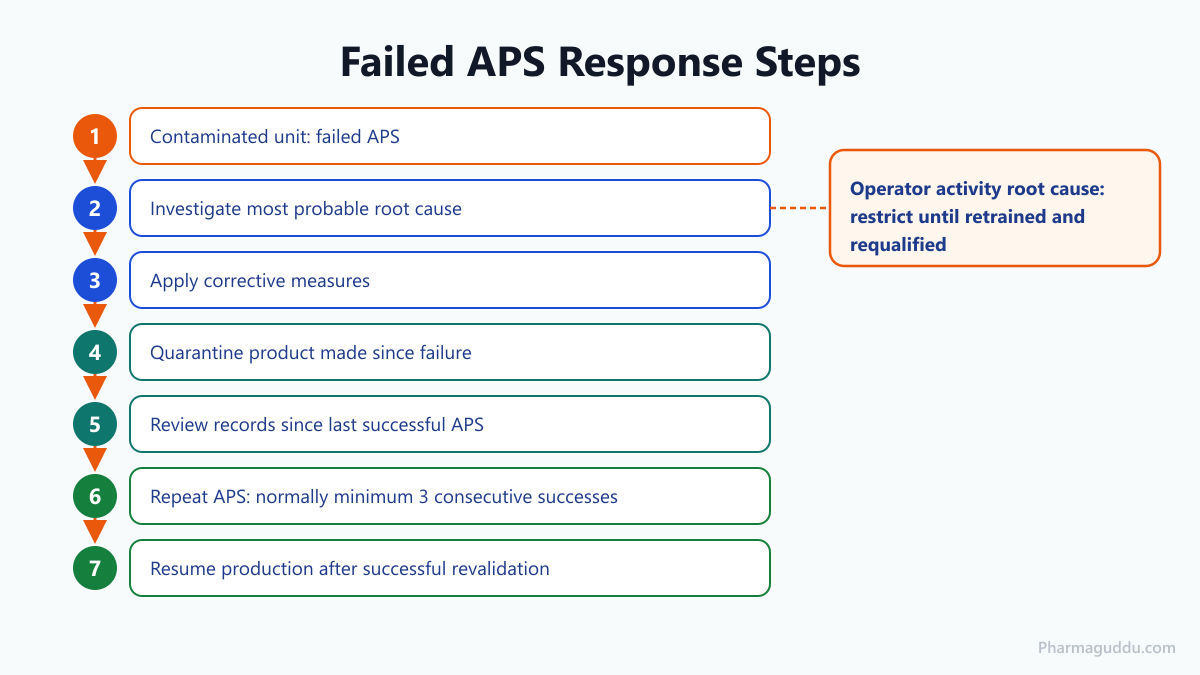
The QA manager initiates a deviation. The team will find the most likely root cause, implement corrective actions and perform a sufficient number of consecutive successful repeat APS (usually a minimum of 3). Data since the last successful APS is reviewed and a risk assessment is performed to identify potential breaches of sterility. Product manufactured on the line since the failure will be quarantined until successful re-validation. A CAPA effectiveness check will also be added to ensure this cause does not recur.
Intervention list copied from an old protocol
Possible Causes: no review after a line change, new container or new equipment.
Corrective Actions: rebuild the catalogue from current batch records, and send changes through change control. Annex 1 9.49 requires a repeat of the initial validation after a change that could affect the process, or a new container or closure combination.
Units removed that production would not remove
Possible Causes: operators clearing extra vials during an intervention to stay safe.
Corrective Actions: match removal to the production SOP and justify the numbers (9.41). Incubate set-up units separately where needed.
Incomplete intervention records
Possible Causes: no one assigned to time and log interventions during the run.
Corrective Actions: assign a recorder, such as a QA officer, and log start time, end time and person for each intervention (9.47).
Expert Tips
- Build the list from evidence. Use batch records, deviations and observation, not the SOP alone.
- Time real interventions. Use measured durations from production, not convenient ones.
- Name the person. Record who performed each intervention, because 9.47 asks for it.
- Justify exclusions in writing. A missing intervention with no reason invites questions.
- Rotate roles. Let each operator perform the interventions they do in routine work.
- Tie the list to change control. Any new routine intervention triggers a review of the APS plan.
- Keep set-up units visible. Incubate them separately so they give learning without distorting acceptance.
Frequently Asked Questions
Create a list of interventions based on batch records, deviations and observations. Order these by risk and ensure that the frequency is based on real data. The inclusion of interventions and the frequency should be based on an evaluation of the risk to the sterility of the product (Annex 1 9.34). Record why interventions are not included and ensure this has been approved by QA.
A minimum of 3 consecutive successful simulations should be performed during initial validation. Periodic validation should be carried out normally twice a year (every 6 months) for each aseptic process, filling line and shift (9.38). Each operator will be involved in at least one successful APS per year.
Yes if they occur during normal operations. The duration should be sufficient to cause a challenge to the shift changes (Annex 1 9.36 viii). Normal interruptions such as shift changes should be simulated (9.36 x). If different or long shifts are required then risk factors should be considered (9.36 ix).
The aseptic process simulation has failed. The root cause will be investigated and corrective actions taken. Product produced on the line will be quarantined from the point of failure. Records will be reviewed from the last successful APS. Operations can only resume once a successful revalidation has been performed. This should be a minimum of 3 consecutive successful repeats (9.46).
Only if the production SOP specifies that units should be rejected in this situation. Never reject more units during a media fill intervention than would be rejected during a production run (9.41). Units should be similar to those rejected during normal operations. Any units filled but not incubated must be justified (9.47).
References
- EU GMP Annex 1: Manufacture of Sterile Medicinal Products (2022), European Commission
- EudraLex Volume 4, European Commission
- Sterile Drug Products Produced by Aseptic Processing: CGMP (guidance page), US FDA
- A3P article on APS interventions (January 2025), A3P
- Technical Report No. 22 (Revised 2025), PDA
- Enhanced Intervention Detection in Aseptic Fill Using AI/ML, ISPE Pharmaceutical Engineering
Satpal Singh — Quality Assurance & Regulatory Specialist
Satpal Singh is an experienced pharmaceutical Quality Assurance and Regulatory professional with expertise in GMP compliance, quality systems, technical documentation, and regulatory requirements. He reviews our pharmaceutical content to ensure accuracy, industry relevance, and alignment with current quality and regulatory standards.
Expertise: QA Systems | GMP Compliance | Regulatory Documentation | Audits | Quality Management