
GMP & Pharmaceutical Manufacturing Expert
✓ Reviewed by: Naresh Bhakar
Reviewed for pharmaceutical accuracy
📅 Last Updated: November 11, 2026
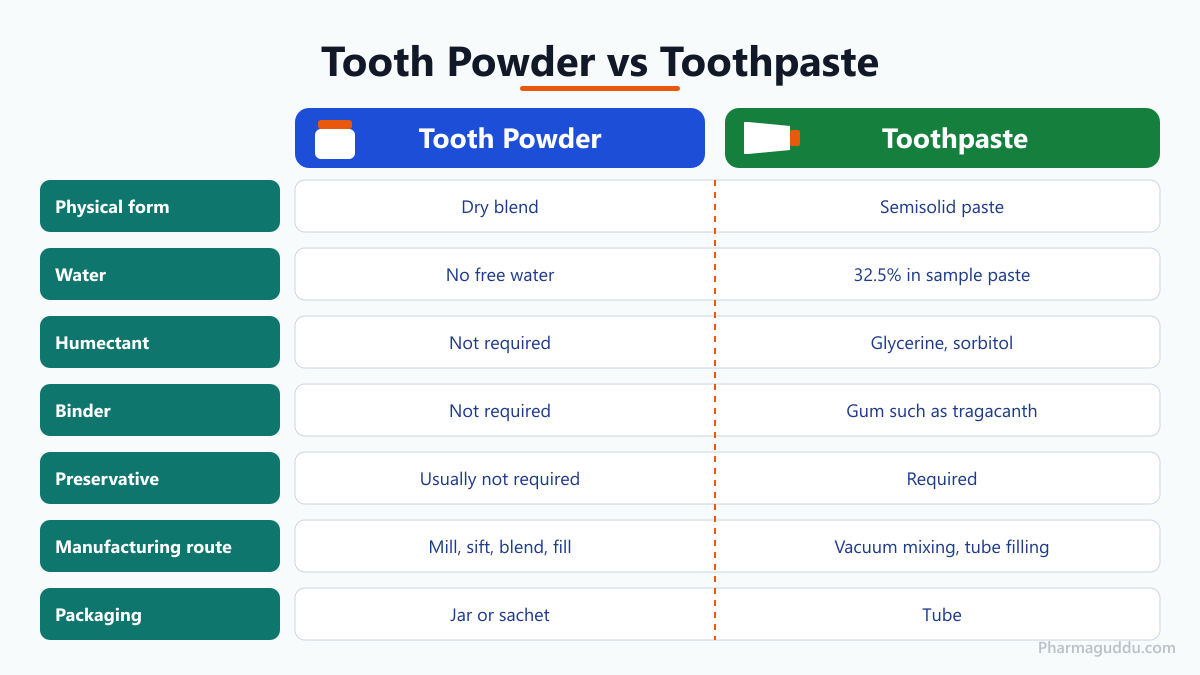
Tooth powder vs toothpaste is mainly a question of water. A tooth powder is a dry blend of abrasive, surfactant, sweetener and flavour with little or no water, so it generally does not need the humectant and binder system of a paste. A toothpaste carries water, so it also needs a humectant to stay soft, a gum binder to hold the solid abrasive in suspension and a preservative to control microbial growth. The paste is mixed under vacuum and filled into tubes. The powder is milled, sifted, blended and filled dry.
What Are Tooth Powder and Toothpaste?
A dentifrice is a preparation used with a toothbrush to clean the teeth. Under 21 CFR 355.3 (US FDA), a dentifrice is an abrasive-containing dosage form, which may be a gel, paste or powder, that is used to deliver an anticaries drug to the teeth. For the full overview, see Dentifrices; Types, Formulation, and Evaluation.
Tooth powder is the dry form. It is a homogeneous blend of an abrasive such as calcium carbonate with a surfactant, a sweetener and a flavour, and Colgate notes that powders lack the thickeners and humectants found in pastes.
Toothpaste is the semisolid form. The sample paste contains precipitated calcium carbonate 39.5%, glycerol 20%, sodium lauryl sulphate (SLS) 6.3%, gum tragacanth 0.4%, sodium saccharin 0.1%, peppermint oil 1.2% and water 32.5%. This is a teaching formula, so it is incomplete as a commercial product because it lists no preservative and no fluoride.
Tooth Powder vs Toothpaste: Comparison Table
| Feature | Tooth powder | Toothpaste |
|---|---|---|
| Physical form | Dry, free-flowing blend | Smooth semisolid paste |
| Water | No free water | 32.5% in the sample paste |
| Humectant | Not required | Glycerine, sorbitol or propylene glycol (10-30% of the formula, as given in the pillar post) |
| Binder | Not required | Gum such as tragacanth (0.4% in the sample) |
| Preservative | Usually not required | Required in a commercial paste (parabens are the pillar’s examples) |
| Abrasive | Calcium carbonate or similar | Calcium carbonate (39.5% in the sample) or similar |
| Surfactant | Dry surfactant | SLS (6.3% in the sample) |
| Flavour | Dry or adsorbed flavour | Oil such as peppermint (1.2% in the sample) |
| Manufacturing route | Milling, sifting, blending, filling | Staged mixing under vacuum, then tube filling |
| Packaging | Jars or sachets | Collapsible tubes |
How Do the Formulations Differ in Practice?
Water, humectant, binder and preservative
Water makes the paste a different system from the powder. At 32.5% water and 20% glycerol, the sample paste has high water activity (aw), which means the water is available to microorganisms. The humectant holds water in the paste and prevents a dry crust at the tube opening. Further detail is given in Humectants and Binding Agents in Toothpaste.
The gum binder forms a gel network, so that the 39.5% solid abrasive stays suspended and the paste does not separate. A dry powder has little or no water, so it generally does not need the humectant and binder system of a paste. A powder with little or no water also gives microorganisms little chance to grow, which is why a preservative is usually not added.
Surfactant and abrasive
Both forms need a surfactant (foaming agent) such as SLS, which is also called a detergent. In a paste the surfactant also creates foam during mixing, which is a manufacturing problem. In a powder the surfactant is blended dry. Selection of the abrasive is covered in Abrasives and Polishing Agents in Dentifrices, and surfactant choice in Detergents and Foaming Agents in Toothpaste.
Fluoride
Fluoride can be present in either form. The US monograph (21 CFR 355.10) lists sodium fluoride at 0.188 to 0.254 percent for 850 to 1,150 ppm theoretical total fluorine in a gel or paste, with available fluoride ion of at least 650 ppm. For a powder, the same sodium fluoride range is listed with at least 850 ppm available fluoride, for products with a sodium bicarbonate abrasive and a poured-bulk density of 1.0 to 1.2 g/mL.
The difference between theoretical and available fluoride shows why the abrasive must be compatible with the fluoride salt. Fluoride must also be distributed uniformly through the batch, which is checked by assay of samples. The sample paste is fluoride-free. Fluoride actives are described in Anticaries, Antibacterial and Desensitizing Agents in Toothpaste.
Manufacturing route and equipment
The paste is made in a vacuum mixer. According to Silverson, powders carry air and the surfactant increases foaming, so mixing is usually done under vacuum. One typical sequence is the liquid base (water, sorbitol or glycerine), the gum, the sweetener and preservative, the abrasive, and then the flavour, colour and surfactant under slow agitation, although the order varies by formula.
Ross describes staged mixing, in which a high-speed disperser wets out the powder and hydrates the gum, and a multi-shaft or double planetary mixer finishes the thick paste. Air left in the paste causes weight variation and voids during tube filling.
The powder route is typically dry: the solids are milled, optionally screened, blended, sieved and then packed, and a small amount of liquid such as flavour oil may be sprayed onto the agitated powder bed in the blender, so “dry” means there is no water-based paste stage. It needs no vacuum mixer, gum hydration or tube filler, so changeover also differs from the paste line. Powder lines need dust control and a visual check of all product-contact parts at line clearance, while paste lines need removal of sticky residue from mixer, pipework and filler.
| Parameter | Setting or range | Effect on the product | Monitoring |
|---|---|---|---|
| Mixing time | Per validated process | Hydration of gum, uniformity | Production officer records in the batch manufacturing record (BMR) |
| Vacuum | Per validated process | Air removal, fill weight | Mixer gauge, recorded in the BMR |
| Viscosity (paste) | Finished paste about 70,000-100,000 cP (Ross, vendor figure) | Extrusion, suspension | In-process control (IPC) by QC analyst |
| pH (paste) | Per specification | Stability, preservative action | IPC by QC analyst |
| Particle size | Per specification | Cleaning action, abrasivity | Sieve or laser test |
| Blend uniformity (powder) | Per specification | Even surfactant and fluoride content | Samples tested by QC |
| Moisture (powder) | Per specification | Caking, microbial growth | Moisture test |
| Fill weight | Per specification | Dose accuracy | IPC by IPQA officer |
Exact values depend on the manufacturer and model; always follow the Original Equipment Manufacturer (OEM) manual and the site Standard Operating Procedure (SOP). A result outside its limit must be raised as a deviation to Quality Assurance (QA).
When to Use Which Form
Toothpaste is the choice when a fluoride, antibacterial or desensitizing active is needed and when consistent foam and tube dispensing are required. The paste is also the form for which the US monograph gives general brushing directions for ages 2 years and older.
Tooth powder suits a product where a preservative system is unwanted or where a light, dry pack is preferred. Under 21 CFR Part 355, a fluoride powder is applied to a wet toothbrush, all bristles are covered, and the teeth are brushed for at least 30 seconds, after which the powder is applied again and brushing is repeated.
Evidence that powder cleans better than paste is limited. Colgate cites one 2017 clinical study in which a powder group controlled plaque and gingivitis better over six months, and states that more research is needed.
Common Mistakes in Formulating and Making Each Form
- Adding a gum binder or humectant to a powder, which introduces moisture and invites caking.
- Leaving a paste without a preservative because the sample formula lists none.
- Adding the surfactant early in paste manufacture, which increases foam and air entrapment.
- Skipping vacuum, so that air causes voids and weight variation in tube filling.
- Pairing a fluoride salt with an abrasive that binds it, so that available fluoride falls below the label claim.
- Starting a new batch before line clearance, so that powder dust or paste residue carries over.
Recent Technology Trends
Pharmacy Times (January 2026) describes solid toothpaste tablets that use microhydroxyapatite as a fluoride-free option. The article quotes a single company, so its performance claims are company statements. Tablets are dry, so they avoid the water and preservative questions that arise in pastes.
Frequently Asked Questions
A dry powder has little or no water, so microbial growth is limited and a preservative is usually not added, but moisture pick-up during storage is the exception, which is why moisture content and pack closure are controlled. A paste needs a preservative as a basic part of the formula, because its water activity is high.
Yes. The US anticaries monograph covers powders as well as gels and pastes, and for a powder with a sodium bicarbonate abrasive it lists sodium fluoride 0.188 to 0.254 percent with at least 850 ppm available fluoride. Uniform blending is therefore a critical step, because fluoride is present at a very low level.
Powders carry air into the batch, and the surfactant increases foam. Vacuum removes this air. This gives a smooth, dense paste and more accurate tube filling, whereas without it, trapped air causes voids and weight variation in the filled tubes, and these can lead to rejected fills.
A toothpaste tablet is neither. It is a compressed solid dentifrice that is chewed and then brushed. As a dry solid it avoids water and the preservative system a paste needs. Pharmacy Times notes that many tablets use hydroxyapatite instead of fluoride.
References
- Tooth Powder vs. Toothpaste: What’s Right for You?, Colgate
- eCFR 21 CFR Part 355 (355.3, 355.10, 355.50), US FDA
- Manufacture of Toothpaste, Silverson
- Recommended Mixing Equipment for Toothpaste, Ross
- Key considerations for pharmacists on hydroxyapatite toothpaste tablets, Pharmacy Times
- EVS-EN ISO 11609:2026 Dentistry, Dentifrices, Requirements, test methods and marking, EVS
- 21 CFR 355.50

Naresh Bhakar is the Founder and Author at Pharmaguddu.com, bringing his extensive expertise in the field of pharmaceuticals to readers worldwide. He has experience in Pharma manufacturing and has worked with top Pharmaceuticals. He has rich knowledge and provides valuable insights and data through his articles and content on Pharmaguddu.com. For further inquiries or collaborations, please don’t hesitate to reach out via email at [email protected].