
Microbiologist & Regulatory Specialist
✓ Reviewed by: Pankaj Sharma - Quality Control Specialist
Reviewed for QC, QA accuracy, laboratory practices, analytical methods, and technical Documents
📅 Last Updated: November 2, 2026
Media fill is an aseptic process simulation (APS). This involves filling sterile growth medium in place of the product and simulating the entire aseptic process including any interventions. These filled units are then incubated and checked for growth. Ideally there should be no growth during this process (EU GMP Annex 1). This is a periodic check and not the primary evidence of a validated aseptic process. The following sections detail how to design the run, acceptance criteria, re-test schedule and what to do if there is a failure.
What Is Media Fill in Pharmaceutical?
A media fill is a complete simulation of a sterile fill. Instead of filling with product, the line is filled with an easily cultivated growth medium. The line, personnel, gowning and interventions are identical to the process used during production. If any microorganisms enter the unit, the medium will become cloudy during incubation.
In many sterile products it is impossible to heat treat them in their final container, so they must be filled using aseptic techniques. This means the sterility is reliant on the air quality, equipment and personnel. A media fill will show if these sterility controls are maintained throughout the whole process.
Definition of Aseptic Process Simulation (APS)
Aseptic Process Simulation (APS) or Media Fill is a technique used to assess the efficacy of aseptic manufacturing processes by using a sterile microbiological growth medium (typically Soybean-Casein Digest Medium/ Tryptic Soy Broth) in place of the product.
How Does Media Fill Work?
Media Fill or Aseptic Process Simulation (APS) is carried out in order to confirm that an aseptic process can consistently prevent microbial contamination during sterile production.
The product is replaced by a sterile media which can support the growth of any microorganisms if there has been contamination. Step by Step Process
1. Preparation of Growth Media
The appropriate sterile media (usually Soybean-Casein Digest Medium (SCDM/TSB)) is prepared. This media should be able to support the growth of microorganisms.
2. Preparation of Equipment and Area
Equipment, filling line, containers and closures are all cleaned and sterilised using approved methods.
3. Aseptic Process Simulation
The sterile media is run through the real equipment. All aseptic activities are simulated. Material transfer, filling, container handling and routine and representative non-routine activities will be performed.
4. Filling
The media is filled into sterile vials, ampoules or other appropriate containers and sealed using the actual or representative closure system.
5. Inspection
The filled units are checked for container integrity issues. They are checked for any defects, leakage and other factors that may compromise the simulation. Any defective units are dealt with using the approved protocol.
6. Incubation
Accepted units are incubated for the required time under validated conditions. This allows any microorganisms to grow. The incubation conditions should be suitable for detecting a wide range of relevant microorganisms.
7. Inspection and Evaluation
All incubated units are inspected for any visible growth. Any units showing microbial growth will be investigated using the approved method.
Read more: media fill interventions and worst-case design
Main Components of a Media Fill Run
Culture Medium
Purpose: Provides a medium within which any microbes will be able to grow, allowing easy detection of contamination.
A common example of this is Soybean Casein Digest Medium (SCDM) or Tryptic Soy Broth (TSB). This medium can support the growth of a wide variety of microbes and is clear so can easily be seen growing. This is listed in the FDA (2004) guidelines as a typical medium. It is supplied by the supplier ready for use at around a 3% concentration (w/v) and has a typical pH given in the certificate of around 7.3 ± 0.2 (at 25 oC). There are no limits set on the pH of media used under either Annex 1 or the FDA. The limit is set at the site using information from the SOP given by the supplier in their certificate.
The medium will have undergone a growth promotion test before use. Annex 1 states that a rationale should be provided for the selection of a suitable set of reference organisms including representative local isolates (Annex 1 Para 10.9). PIC/S PI 007-6 also states that low numbers should be recovered (10-100 CFU/unit or less) (PIC/S PI 007-6 5.2.3). Only anaerobic media such as Fluid Thioglycollate should be used in exceptional circumstances.
Read more: SCDM, TSB and growth promotion in media fill
Units and Containers
Purpose: carries the medium through the same filling and closing steps as the product.
Use the production container-closure and a fill volume set in the protocol. Choose clear containers, not amber or opaque ones, so growth can be seen. Invert or agitate the units before incubation so the medium touches every inner surface, closure included.
People and Interventions
Purpose: tests the human part of the process, usually the largest contamination risk.
Operators who normally work on the line do the run. Record every intervention with its start time, end time and the person involved. A QC analyst or quality unit representative observes the run, and FDA notes that video recording can help show poor personnel practice.
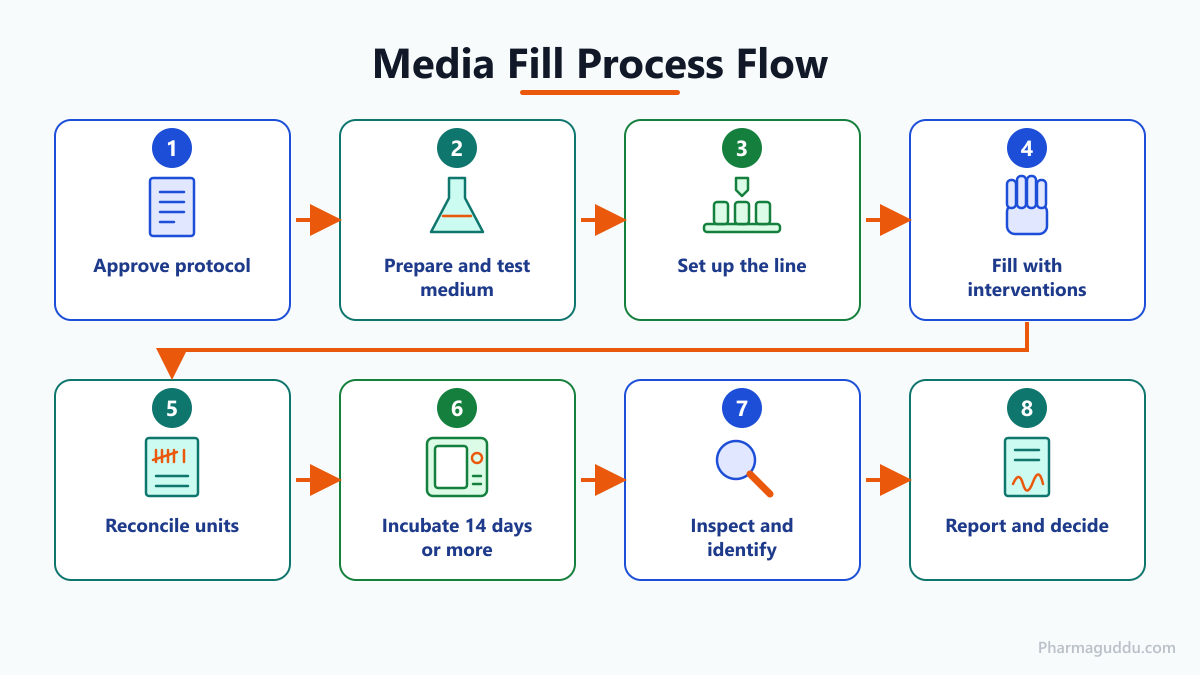
How Is a Media Fill Done? Step-by-Step Process Flow
- Approve the protocol. The QA officer signs the protocol listing line, shifts, container sizes, fill volume, interventions, unit count and acceptance criteria.
- Prepare and test the medium. Prepare the SCDM. Perform growth promotion testing (GPT) using reference organisms and environmental isolates. Media must be qualified before use, with units from the start and end of the filling run validated for GPT post-incubation.
- Set up the line. Gown and prepare the area as for routine production and start environmental and personnel monitoring.
- Fill with interventions. Run the line for the planned duration and perform each listed intervention.
- Reconcile units. Account for every unit filled, rejected or removed. Annex 1 para 9.47 requires this, and no more units may be removed than in routine production.
- Incubate. FDA 2004 says incubation should not be less than 14 days. If two temperatures are used, hold at least 7 days at each, lower first, within 20-35 °C.
- Inspect and identify. Trained, qualified staff inspect the units. Samples undergo positive control (Annex 1, 9.45(ii)), and isolates are identified to species level.
- Report and decide. QA approves the report, and the quality unit decides on batch disposition for the line.
Read more: media fill procedure and protocol, step by step and incubation conditions and inspection
Where Is Media Fill Used?
Every aseptic filling process needs it. That covers liquids in vials, ampoules and syringes, products such as vaccines (see the vaccine filling procedure), lyophilised products, powders and semi-solids.
Powders and semi-solids can’t flow like broth, so the simulation uses a surrogate. Lyophilised products need the loading and transfer steps simulated. If production uses nitrogen or another inert gas, Annex 1 (9.33(iii) and 9.36(v)) expects air in the APS unless an anaerobic simulation is intended.
Isolator and RABS lines still need APS. ISO 13408-6:2021 covers isolator systems, and FDA lets isolator-based operations simulate a lower proportion of units.
Read more: media fill for powders, lyophilized products, isolators and RABS
What Are the Benefits of Media Fill?
The media fill test ensures that the whole process is performed on floor. This will identify any weaknesses in interventions and training. The documentation provides evidence to inspectors to show the CCS (the overall plan to prevent microbial contamination at the site) is working.
What Are the Limitations of Media Fill?
A clean run doesn’t prove that every batch is sterile. It samples one period of performance with a limited number of units. Annex 1 (9.1) warns that viable monitoring, non-viable monitoring and APS data are each limited when taken alone. Treat APS as one strand of evidence beside process validation and routine monitoring.
Key Operating Parameters for Media Fill
| Parameter | Typical requirement | Source |
|---|---|---|
| Initial qualification | At least 3 consecutive satisfactory runs covering all working shifts | Annex 1, 9.38 |
| Repeat frequency | Normally twice a year (about every 6 months) for each aseptic process, filling line and shift | Annex 1, 9.38; FDA 2004 semi-annual; PI 007-6 5.5 |
| Operator qualification | At least 1 successful APS per operator each year; manual operations: 3 consecutive initially, then about every 6 months | Annex 1, 9.38 and 9.39; FDA annual for each person authorised to enter |
| Run size | 5,000-10,000 units as a starting point; a batch under 5,000 units needs a run at least equal to the maximum batch size | FDA 2004 |
| Incubation | At least 14 days; two temperatures: at least 7 days each, lower first, within 20-35 °C | FDA 2004; PI 007-6 5.3.1 gives 20-25 °C then 30-35 °C |
| Acceptance | Target is zero growth | Annex 1, 9.46 |
Worked example: a site fills 10,000 units. Under the FDA table, zero contaminated units passes. One contaminated unit means investigation and consideration of a repeat. Two mean revalidation after investigation. Under Annex 1, that single unit already fails the APS.
Read more: media fill acceptance criteria and media fill frequency and requalification
Industry Standards and Regulatory Requirements
| Document | Status | What it says about APS |
|---|---|---|
| EU GMP Annex 1 (revised August 2022, applicable 25 August 2023) | Part of EU GMP | Section 9: zero growth target, 3 initial runs, six-monthly repeats, failure actions |
| FDA, Sterile Drug Products Produced by Aseptic Processing (September 2004) | Non-binding guidance | Unit-count table, run size, 14-day incubation; supports 21 CFR 211.113(b) |
| PIC/S PI 007-6 (2011) | Inspectorate recommendation | Worst case, growth promotion, incubation, same unit-count criteria in section 6.2 |
| WHO TRS 1044, Annex 2 (2022) | WHO GMP for sterile products | Reference text for WHO-aligned markets |
| ISO 13408-1:2023 | International standard | General requirements for aseptic processing of health care products |
Recent Technology Trends
August 2023: Annex 1 became applicable on 25 August 2023, with the lyophiliser paragraph 8.123 following a year later. It ties APS to the CCS, and inspectors now judge APS against it.
August 2023: ISO 13408-1:2023 was published and replaced the 2008 edition and its 2013 amendment, according to the AFNOR listing.
October 2022: WHO published TRS 1044, Annex 2, its current GMP text for sterile pharmaceutical products.
October 2025: PDA’s bookstore lists Technical Report No. 22 (Revised 2025), Process Simulation for Aseptically Filled Products, as replacing the 2011 edition.
January 2026: A vendor brochure on Pharmaceutical Online describes robotic, recipe-driven filling workcells with gloveless isolators. Fewer manual interventions would leave fewer to simulate. This is vendor material, not a regulator view.
Common Problems and Troubleshooting in Media Fill
What Happens When a Media Fill Fails?
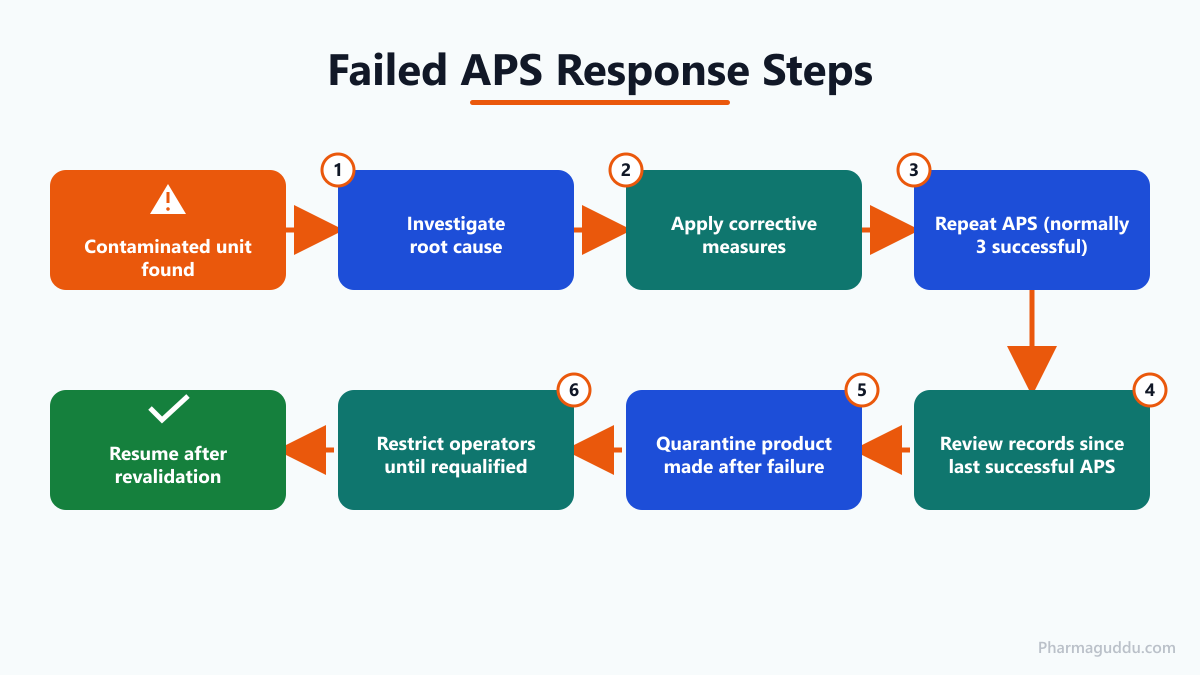
Any contaminated unit fails the APS under Annex 1 (9.46). A failed APS leads to investigation, corrective measures, repeat APS and batch impact assessment, not just a rerun. The QA officer opens a deviation, and CAPA tracks the fixes.
- Investigate the root cause. Identify isolates to species level and compare them with environmental and personnel monitoring isolates.
- Apply corrective measures.
- Repeat the APS. Annex 1 normally expects a minimum of three consecutive successful repeats.
- Review records since the last successful APS. FDA expects the impact on commercial product made since the last media fill to be assessed.
- Quarantine product made on the line after the failure.
- Restrict the operators involved until they are retrained and requalified.
- Resume production only after revalidation.
Other Frequent Problems
| Problem | Likely cause | Action |
|---|---|---|
| Unit count doesn’t reconcile | Units dropped or discarded at line end without a record | Count at each stage and justify every unit not incubated |
| Incubator outside range | Door openings, faulty controller | Review the temperature log, assess the run, and keep the temperature within the validated range (FDA: ±2.5 °C of target) |
| Run judged unrepresentative | Interventions missing from the record or protocol | Update the intervention list from the risk assessment and repeat |
In practice, the missing intervention is rarely an exotic one. It’s usually the routine stopper refill that nobody wrote down.
Read more: media fill failure investigation, root cause and CAPA
How Do You Keep Media Fill Status Current?
Schedule repeats well ahead of the six-month point for each line and shift. Annex 1 (9.38 and 9.49) and FDA also call for repeat qualification after significant changes to HVAC, equipment, process, shifts or personnel. They also call for it after an extended shutdown and for a new container-closure. Route these triggers through change control.
Keep protocols, intervention lists, incubation logs and inspection records to ALCOA+ standards: attributable, legible, contemporaneous, original and accurate, plus complete, consistent, enduring and available. Operator qualification records belong in the training records.
Expert Tips
- Match the real shift. Use the same crew size, gowning and break pattern as production.
- List every intervention first. Include rare corrective ones from the risk assessment, and record start time, end time and person.
- Keep the area routine. Don’t add extra cleaning and sanitisation before the run.
- Reconcile as you go. Count units at the filling machine, at inspection and at the incubator.
- Use clear containers. Amber or opaque units hide early turbidity.
- Treat incubation logs as GMP records. Gaps in temperature data weaken an otherwise clean run.
Frequently Asked Questions
Aseptically filled products have no final sterilisation step to remove contamination, so the process itself must be shown to keep microbes out. Media fill gives that evidence under realistic conditions. EU GMP Annex 1 requires APS, and the FDA guidance, which supports 21 CFR 211.113(b), sets matching expectations for US manufacturers.
Annex 1 para 9.38 asks for three consecutive satisfactory runs covering all working shifts at initial validation. After that, repeat normally twice a year, about every six months, for each aseptic process, filling line and shift. Each operator needs at least one successful APS annually. Major changes and failures trigger extra runs.
SCDM (TSB) is the usual medium because it supports many organisms, dissolves well and stays clear. About 3% w/v is the standard strength suppliers use when preparing the broth. Annex 1 and FDA don’t set a concentration, so the site records the strength in its approved protocol and media specification.
Annex 1 para 9.46 sets a zero growth target, and any contaminated unit fails the APS. FDA’s non-binding table is graded by run size. For 5,000-10,000 units, one contaminated unit means investigation and possible repeat, and two mean revalidation. Over 10,000 units, one means investigation and two mean revalidation.
FDA 2004 says incubate for not less than 14 days within 20-35 °C. With two temperatures, hold at least 7 days at each, lower first. PIC/S PI 007-6 describes 20-25 °C for at least 7 days, then 30-35 °C, for 14 days in total. Annex 1 para 9.44 requires justified and validated conditions.
No regulator sets one. The limit comes from the medium supplier’s certificate of analysis, and for SCDM powder a typical value is about 7.3 ± 0.2 at 25 °C. The site writes the limit into its SOP. Growth promotion testing then shows that the prepared medium performs as intended.
A sterility test examines a small sample of finished product and can’t prove a whole batch is sterile. Media fill challenges the process itself, using growth medium across many units with realistic interventions. The two answer different questions, and neither replaces the other.
Read more: media fill interview questions and answers
Summary
Media fill, or aseptic process simulation, runs sterile nutrient medium through the whole aseptic process to show it keeps microbes out. Annex 1 targets zero growth, expects repeats about every six months, and requires a full investigation after any failure. Treat it as periodic verification, supported by monitoring and good practice.
References
- EU GMP Annex 1: Manufacture of Sterile Medicinal Products (2022), European Commission
- Sterile Drug Products Produced by Aseptic Processing: Current Good Manufacturing Practice (2004), US FDA
- PI 007-6 Recommendation on the Validation of Aseptic Processes (2011), PIC/S
- TRS 1044, Annex 2: WHO good manufacturing practices for sterile pharmaceutical products, WHO
- ISO 13408-1:2023 Aseptic processing of health care products, Part 1 (AFNOR listing)
- ISO 13408-6:2021 Aseptic processing of health care products, Part 6: Isolator systems (AFNOR listing)
- Technical Report No. 22 (Revised 2025), PDA
- Meet the Aseptic Filling Workcell, Pharmaceutical Online (vendor brochure)
- Aseptic Process Simulation (APS), Merck/Sigma-Aldrich

Satpal Singh — Quality Assurance & Regulatory Specialist
Satpal Singh is an experienced pharmaceutical Quality Assurance and Regulatory professional with expertise in GMP compliance, quality systems, technical documentation, and regulatory requirements. He reviews our pharmaceutical content to ensure accuracy, industry relevance, and alignment with current quality and regulatory standards.
Expertise: QA Systems | GMP Compliance | Regulatory Documentation | Audits | Quality Management