
Quality Control Specialist | Industry Experience
✓ Reviewed by: Pankaj Sharma - Quality Control Specialist
Reviewed for Quality Control accuracy, laboratory practices, analytical methods, and technical relevance
📅 Last Updated: November 5, 2026
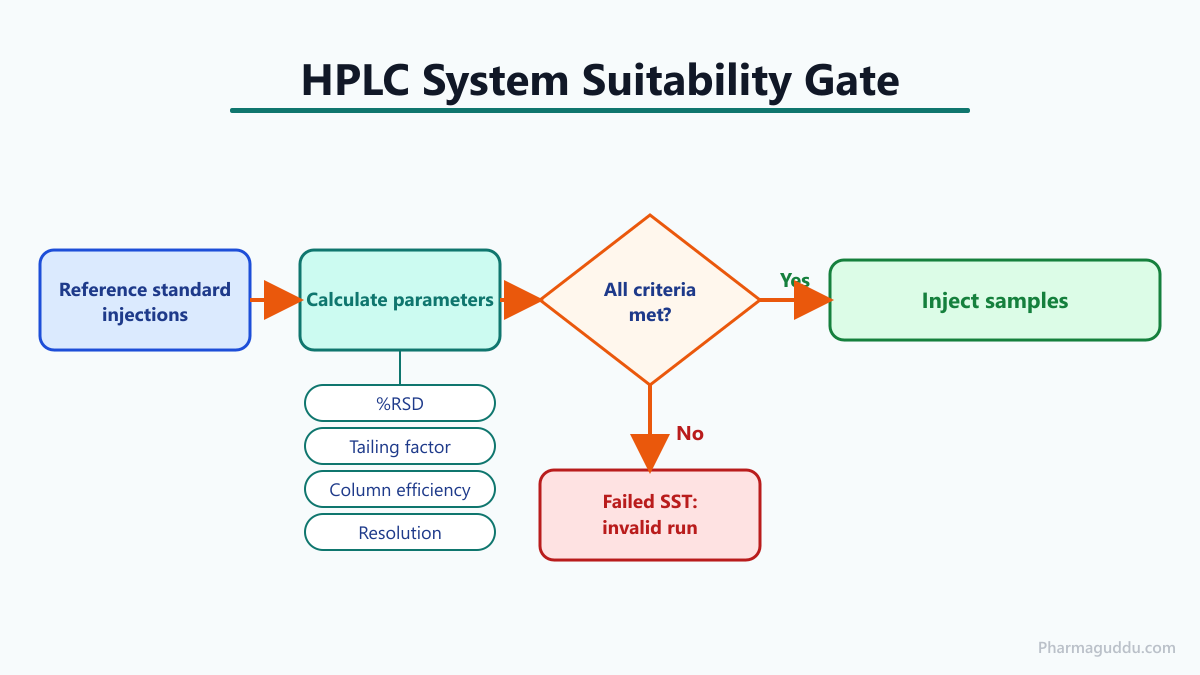
System suitability tests are performed during HPLC analysis to ensure that the whole system (instrument, column, mobile phase, method and analyst) will produce valid results. A reference standard solution is injected multiple times and calculations are made to determine parameters such as %RSD, tailing factor, column efficiency and resolution. These should be within the limits provided in the monograph or validated method. Only once all the criteria are met will injections of the sample be performed. If the system suitability test (SST) fails then the run will be considered invalid and the data from the samples will not be reported.
What Is System Suitability in HPLC?
System suitability in HPLC is documentation that the chromatographic system is performing adequately today. The system suitability test (SST) is an integral part of the analysis process. This provides evidence of adequate performance for every run.
Think of it as the pre-flight checks that a pilot will carry out. The aircraft is known to have a valid maintenance history. However, the pilot still performs checks on the controls.
It is not a replacement for instrument qualification or calibration. Qualification (DQ, IQ, OQ, PQ) and regular calibration demonstrate that the HPLC is suitable as an instrument (see HPLC calibration SOP). System suitability demonstrates that the whole method performed adequately on that day using that column and mobile phase. It should also be noted that this is different to method validation (ICH Q2(R2)) which proves that the method is suitable for its intended purpose once. This article can be found in our guide to high performance liquid chromatography.
How Does the System Suitability Test Work?
The SST acts as a guard for your samples. The QC analyst will inject the reference standard solution (usually in duplicate) and the data system will calculate each parameter from the peaks. If all parameters are within the limits the sequence will continue, if any of the parameters are out of limit then the run will stop.
The IP monograph states that ‘the test is not valid if the requirements are not met’ (Amendment List 02 to IP 2022). Some methods will require you to inject the reference standard at set points throughout the run or at the end of the run. This is to ensure any drift can be detected. The FDA OOS guidance states that this can be used to determine drift, noise and repeatability throughout the run. How often the reference standard needs to be injected is determined by the method.
Which Parameters Does SST Measure?
Common parameters are given below. The limits shown are taken from the monograph or validated method. There is no one table that can be used for all tests. For example, some typical parameters from IP include a tailing factor of up to 2.0, column efficiency of at least 2000 theoretical plates, resolution of between 1.5 and 3.0 and %RSD limits of between 1.5% and 10.0% depending on the test.
| Parameter | What it tells you | Formula |
|---|---|---|
| %RSD of replicate injections | Injection and system precision | (SD ÷ mean) × 100 |
| Tailing factor (T) | Peak shape | T = W0.05 ÷ 2f |
| Column efficiency (theoretical plates, N) | Sharpness of peaks | N = 5.54 × (tR ÷ W1/2)² |
| Resolution (Rs) | Separation of the critical pair | Rs = 2(tR2 − tR1) ÷ (W1 + W2) |
| Capacity factor (k′) | Retention relative to the void time | k′ = (tR − t0) ÷ t0 |
| Signal-to-noise (S/N) | Sensitivity, mainly in impurity tests | Peak height ÷ noise |
Tailing factor and symmetry factor are mentioned separately in the monograph. The symmetry factor range has been amended in chapter 2.4.14 of Amendment List 02 to IP 2022. From 0.8-1.5 it has been changed to 0.8-1.8.
Worked example (illustrative figures)
Five injections of a reference standard gave peak areas of 100.2, 99.8, 100.5, 99.6 and 100.1 (thousand units).
| Value | Calculation | Result |
|---|---|---|
| Mean | 500.2 ÷ 5 | 100.04 |
| SD | √(0.492 ÷ 4) | 0.35 |
| %RSD | (0.35 ÷ 100.04) × 100 | 0.35% |
| Tailing | 0.24 ÷ (2 × 0.11) | 1.09 |
| Resolution | 2 × (7.4 − 6.2) ÷ (0.40 + 0.44) | 2.86 |
| Column efficiency | 5.54 × (7.4 ÷ 0.20)² | about 7,580 |
Compared with a monograph asking for %RSD of 1.0% or less, tailing of 2.0 or less and resolution of at least 2.0, this system passes. These figures are for Reference only.
How Do You Run SST in a Sequence?
- Prepares the mobile phase and reference standard solution.
- Condition the column until a stable baseline is obtained.
- Inject blank and replicate reference standard.
- Parameters are calculated using the validated CDS.
- Results are compared against the limits by the QC Analyst and confirmed by the reviewer.
- If all criteria are passed inject the samples. If the method requires bracketing standards these should be added.
Only begin sample preparation and injection once SST has passed.
What Do the Regulations Say?
FDA Guidance (Rev 1 May 2022) states that systems failing to meet SST requirements should not be used. The guidance references 21 CFR 211.160(b)(4) which states equipment should be used that meets performance specifications and has been calibrated and 21 CFR 211.194(a)(2) which states methods should be documented to ensure they are suitable for use in real conditions.
Repeating testing until a pass is achieved is described as undesirable in CGMP. This teaches us that we should not attempt to achieve a passing SST by trial injections or repeating until we achieve a pass. Audit trails should be reviewed and a CDS should be in place to alert or prevent a failed SST.
Chromatographic parameters can be adjusted within defined limits as per pharmacopoeia chapters such as USP <621> and Ph. Eur 2.2.46 to ensure the SST is still passed. Any changes outside these defined limits will require re-validation or change control.
Recent Technology Trends
- ICH Q14 (adopted November 2023): European Pharmaceutical Review reports that it treats SST as part of the analytical procedure and its control strategy, so limits should rest on development and robustness data.
- ECA question-and-answer session (18 December 2025): the European Compliance Academy advises laboratories not to copy every Ph. Eur. 2.2.46 criterion. Document a rationale for the parameters that matter for each method.
- Automated SST processing: Mestrelab introduced Chrom SST in 2025 to give quick pass or fail results across instruments. This is the vendor’s own description. CDS software can also calculate SST values and flag sequences, which cuts manual calculation.
What Should You Do When SST Fails?
A failed SST is not an OOS (out of specification) result. An OOS result is where the sample result is outside of specification. The FDA guidelines state that if it can be shown that the reference standards are not responding due to the system not functioning, data from the suspect period should be identified and not used. The cause should be identified and rectified if possible before deciding on using previous data.
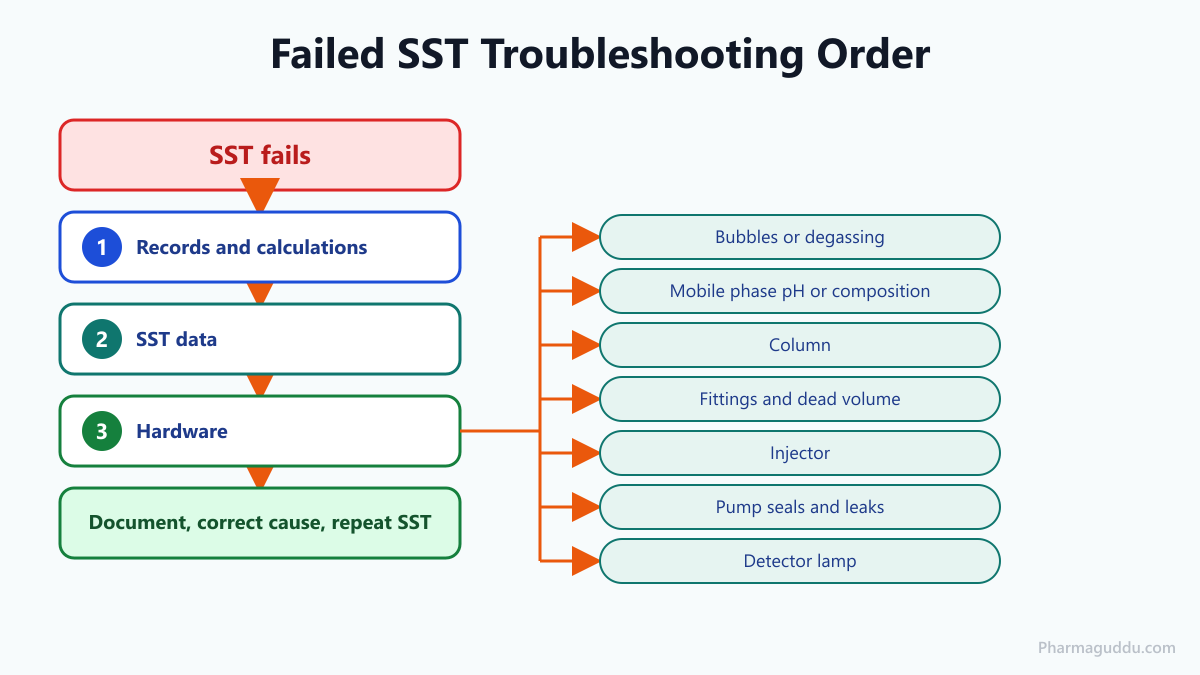
Stop the run. Document the failure and identify the cause. Do not include any sample data from the failed system. First look at the records and calculations, then the SST data and finally the hardware.
| Symptom | Likely causes | Fix |
|---|---|---|
| High tailing | Degraded column, wrong mobile phase pH, dead volume | Replace or regenerate the column; remake the mobile phase; refit connections |
| Low column efficiency | Old column, loose fittings, wrong flow | Replace the column; tighten or replace fittings |
| %RSD above limit | Air bubbles, injector fault, worn pump seal, leak | Degas the mobile phase; service the injector or pump |
| Resolution lost | Wrong composition or pH, column ageing | Prepare fresh mobile phase; fit a new column |
| Noisy baseline, poor S/N | Failing detector lamp, bubbles | Replace the lamp; purge the system |
The false OOT results post covers the same checks for trend problems. For bubbles, see degassing of the HPLC mobile phase, and for column choice see types of HPLC columns.
Expert Tips
- Know your monograph limits. Write the exact limits into the worksheet; never reuse a limit from another product.
- Keep a column history. Record injection counts and SST values so slow decline shows before a failure.
- Never rescue a failing SST. Extra trial injections or manual reintegration create a data-integrity finding.
- Use fresh standard. Old or poorly stored reference standard solutions cause %RSD drift that looks like a hardware fault.
- Look at the chromatogram. Numbers can pass while a split or fronting peak warns of trouble.
- Keep records together. File the SST printout and audit-trail review with the raw data.
Frequently Asked Questions
Method validation proves that the method is suitable for its intended purpose (ICH Q2(R2)). System suitability testing (SST) is performed during each analytical run to prove that the system is suitable as per the validation on the day of analysis. Method validation focuses on the method and system suitability focuses on the system, column, mobile phase and analyst on the day.
No, calibration and qualification are carried out on a schedule to prove the instrument works. System suitability testing focuses on the entire method including the column and mobile phase. A calibrated HPLC can still fail system suitability due to a fatigued column or poorly prepared mobile phase.
This will depend on the monograph. For example IP monographs will have a maximum value of 2.0 for tailing factor. IP chapter 2.4.14 states that after List 02 of amendments to IP 2022 the symmetry factor should be between 0.8-1.8. The term to use will depend on what your monograph says.
The number of injections will be given in the method. Many laboratories will perform 5 or 6 replicate injections of the reference standard. The number of injections and %RSD will be given in the monograph or validated method. This varies between 1.5%-10.0% depending on the example from IP.
You can only make adjustments as per the adjustments allowed in the pharmacopoeia chapter. The system suitability must still pass. If you are making changes outside of what is allowed you will need to revalidate or put in a change control. If you are making adjustments just to get the system suitability to pass then this is considered to be testing to pass and should be documented.
You should stop the run, make a note that it has failed and investigate why. The agencies view is that if the system does not meet the system suitability criteria it shouldn’t be used. The data from the sample should not be reported. You should repeat the test once the cause has been rectified.
No, OOS means that the sample has failed to meet its specification. A failed system suitability means that the run is invalid as it has not been proven that the system was working. It should be treated as a deviation in the lab. Only sample results should be treated as OOS.ults.
Summary
System suitability in HPLC proves, before each run, that the system can give valid results. Use the limits in your monograph or method, run SST before samples and keep the records and audit trail clean. If SST fails, stop, document, correct the cause and report no data from that run. The HPLC interview questions give extra practice.
References
- Investigating Out-of-Specification (OOS) Test Results for Pharmaceutical Production, Guidance for Industry, Revision 1, US FDA CDER
- Amendment List 02 to IP 2022, Indian Pharmacopoeia Commission
- ICH Q14 – latest guideline on analytical procedure development, European Pharmaceutical Review
- Questions and Answers on System Suitability Tests (SST) – Part 1, ECA / gmp-compliance.org
- Introducing Chrom SST, Mestrelab / Bruker
- System suitability Requirements for a USP HPLC Method, MTC USA
- USP General Chapter <621> Chromatography, United States Pharmacopeia

Pankaj Sharma — Quality Control Specialist
Pankaj Sharma is a pharmaceutical QC professional who reviews our technical content for GMP accuracy, laboratory practices, and regulatory relevance.