
GMP & Pharmaceutical Manufacturing Expert
✓ Reviewed by: Naresh Bhakar
Reviewed for pharmaceutical accuracy
📅 Last Updated: November 6, 2026
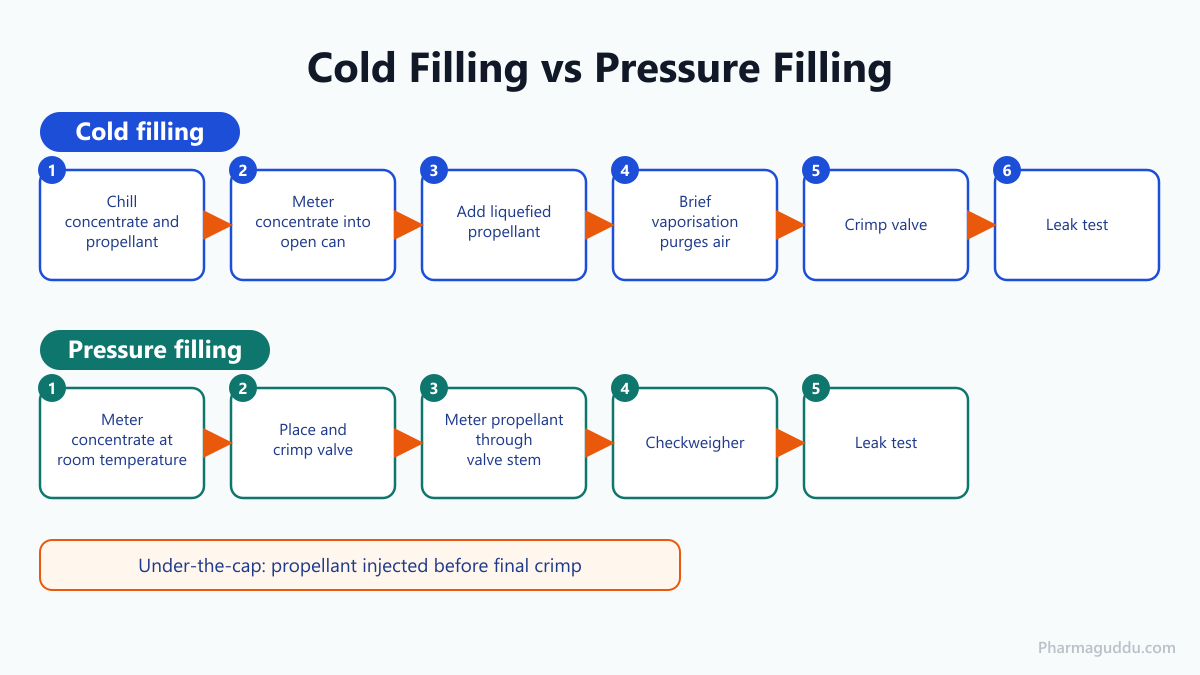
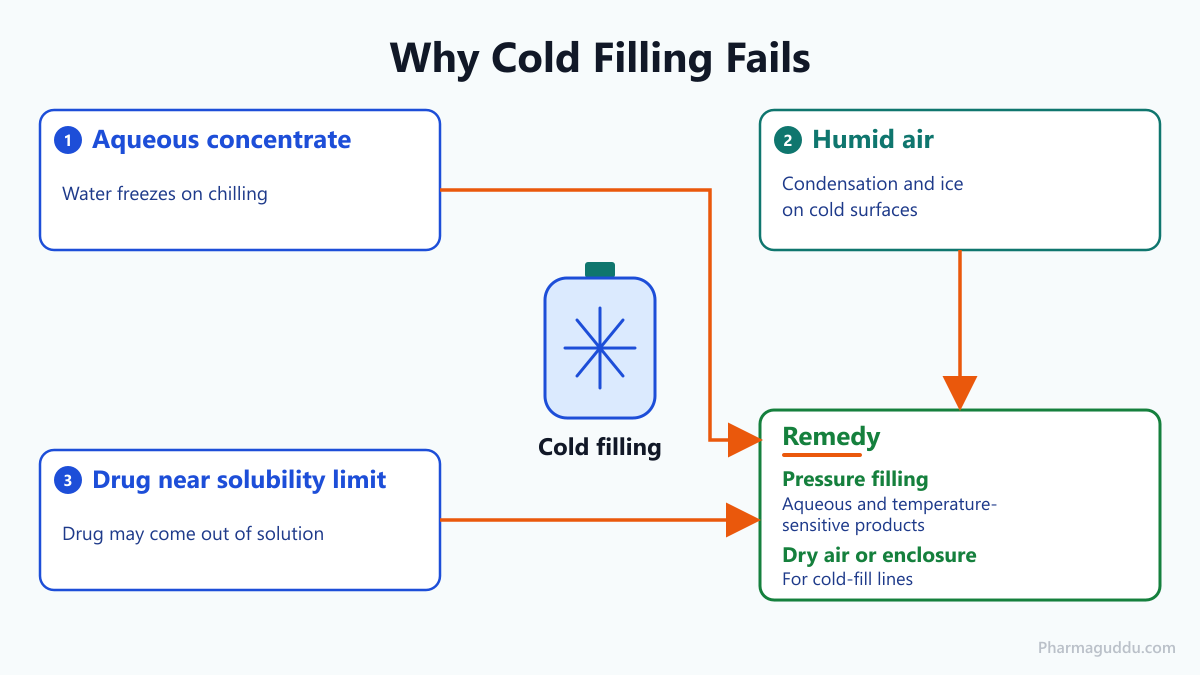
Cold filling and pressure filling aerosols are the two ways of charging a container with liquefied propellant. In cold filling, the concentrate and propellant are chilled and then filled into an open container at atmospheric pressure. The valve is crimped afterwards. In pressure filling, the valve is crimped first (or held above the can). The propellant is then forced in under pressure. Cold filling is unsuitable for aqueous and temperature-sensitive preparations because water freezes, moisture condenses as ice on cold parts and a drug near its solubility limit may crystallise. Such products are pressure filled.
What are cold filling and pressure filling aerosols?
Both methods place a measured quantity of concentrate and liquefied propellant into a valved container, but they differ in the temperature of filling and in the point at which the valve is sealed. The overview of aerosol types, containers and systems is given in Aerosol in Pharma: Types, Container, Advantage and Disadvantage. The propellants themselves are covered in Aerosol Propellants in Pharmaceuticals.
Cold filling
Cold filling is a method in which the concentrate and the propellant are chilled before filling. The concentrate is the drug, solvent and other ingredients without propellant. The chilled concentrate is metered into a cold, open container, and the liquefied propellant is then added. The propellant stays liquid at atmospheric pressure because its temperature is below its boiling point.
A brief vaporisation of propellant displaces air from the headspace. The valve is then crimped, and the sealed pack is tested, commonly in a hot water bath.
The chill temperature is set below the boiling point of the propellant in use. The actual temperature depends on the boiling point of the propellant and is fixed in the validated procedure for each product.
Pressure filling
Pressure filling is a method in which the concentrate is filled without chilling and the liquefied propellant is forced into the container under pressure. The concentrate is first metered into the can. The valve is then placed and crimped, and the propellant is metered through the valve stem into the sealed can. This is called through-the-valve filling.
In the under-the-cap variant, a filling head seals on the shoulder of the container and holds the valve above the can. Propellant is injected under pressure, and the valve is crimped immediately afterwards. Both are variants of pressure filling and not separate methods.
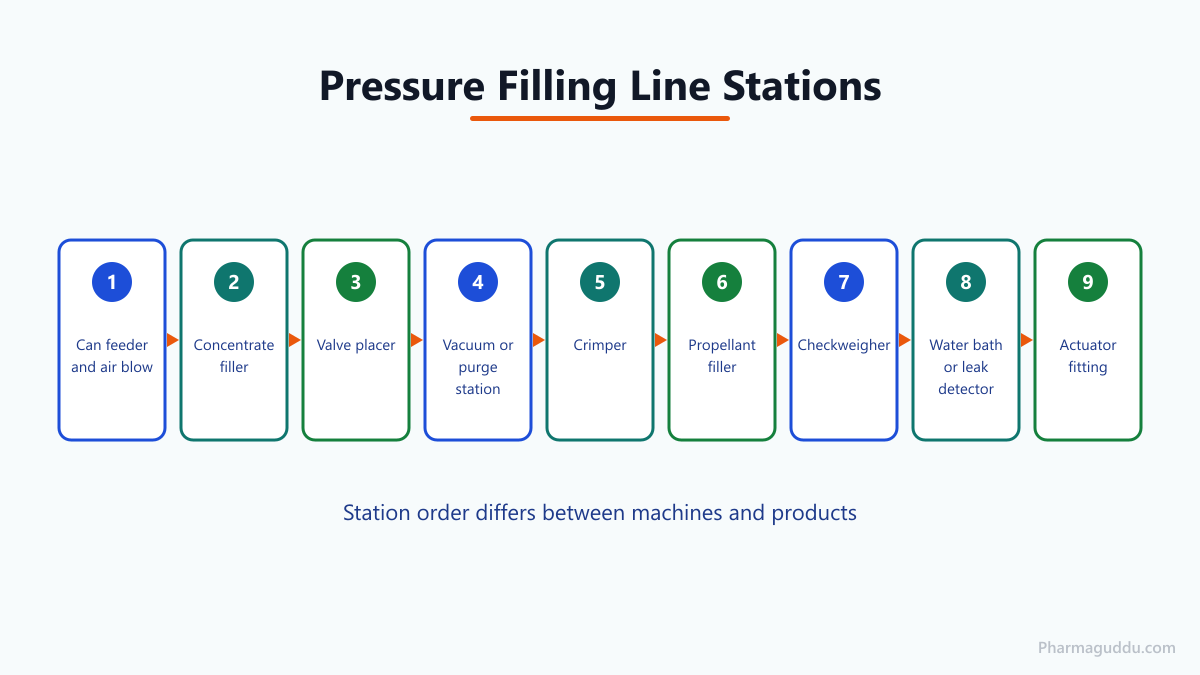
Air is removed by a vacuum line or a propellant vapour purge, so no liquid propellant has to be boiled off. One equipment vendor describes a typical line. It begins with the can feeder with air blow, concentrate filler and valve placer. The vacuum or purge station, crimper and propellant filler (dosing cylinders and filling head) come next, and the line ends with the checkweigher, water bath or leak detector, and actuator fitting. The station order differs between machines and products.
Related topic: aerosol valve and actuator components
Related topic: suspension aerosols
How do cold filling and pressure filling compare?
The table summarises the differences amoung cold filling and Pressure filling. Exact values depend on the manufacturer and model; always follow the Original Equipment Manufacturer (OEM) manual and site Standard Operating Procedure (SOP).
| Feature | Cold filling | Pressure filling |
|---|---|---|
| Concentrate temperature | Chilled | Not chilled |
| Container during propellant fill | Open, atmospheric pressure | Sealed (through-the-valve) or valve held above can (under-the-cap) |
| Valve crimping | After propellant is added | Before propellant (through-the-valve) or immediately after (under-the-cap) |
| Air removal | Brief propellant vaporisation | Vacuum or propellant vapour purge |
| Aqueous products | Not suitable, water freezes | Suitable |
| Temperature-sensitive products | Not suitable | Suitable |
| Moisture control | Needed on filler heads and cold surfaces | Not specific to the method |
| Equipment | Refrigeration plant, more costly | Propellant filler with dosing cylinders, less costly |
| Speed | Historically faster | Historically slower, now hundreds of containers per minute on rotary fillers (one maker’s catalogue) |
| Propellant loss | Some propellant boils off during purge | Lower, especially through-the-valve |
What are the key differences on the shop floor?
Why is cold filling unsuitable for aqueous and temperature-sensitive preparations?
Water-based concentrates cannot be chilled to propellant temperature without freezing. Chilling the filled cans afterwards is laborious and uneconomic, so aqueous products are pressure filled (Soap, Perfumery and Cosmetics).
Humid air also condenses and freezes on cold filler heads, conveyors and container surfaces. The ice can drop moisture into the container and can block narrow passages. For this reason, a cold-fill line is operated with dry air or an enclosure around the filling zone.
A formulation near the edge of solubility is another case. We noticed that such a drug may come out of solution at low temperature, so cold filling suits it poorly.
How are crimping and fill weight controlled?
The valve is crimped to a specified crimp height and diameter. Vacuum crimping is used on some lines to remove air from the headspace at the same time. The crimp dimensions are measured on samples taken from the line, and the limits are specific to the valve and container.
Propellant fill weight is checked by a checkweigher after filling. Leak testing follows, either in a water bath or with an inline detector. For metered products, the valve delivery is also checked. These checks are in-process controls (IPC). The production officer and the in-process quality assurance (IPQA) officer carry them out, and the sampling frequency is stated in the batch manufacturing record (BMR).
The hot water bath test used for leak detection is a transport rule for aerosol containers. Under 49 CFR 173.306, the bath must bring the internal pressure to that reached at 55 °C (131 °F), or 50 °C if the liquid phase does not exceed 95% of capacity. For a pharmaceutical product, the bath temperature and duration are set in the validated leak-test procedure.
What safety measures apply?
Operators handling chilled propellant and concentrate must wear insulated gloves, face protection and protective clothing, because contact with cold liquid causes cold burns. The filling zone needs ventilation.
Hydrocarbons and dimethyl ether (DME) are flammable. Filling with them is done in classified hazardous (explosive atmosphere) areas, called ATEX areas in the EU and UK. These areas have earthing, gas detection and explosion-proof equipment. The hydrofluoroalkane (HFA) propellants HFA-134a and HFA-227ea are non-flammable. HFA-152a is flammable. The filling method does not change with flammability, but the area and equipment do.
What records and equipment controls are needed?
The chilling system of a cold-fill line is part of the process equipment. Under 21 CFR Part 211, automatic, mechanical and electronic equipment must be routinely calibrated, inspected or checked under a written program. Written records are kept. Qualified equipment and a validated process are expected for both methods.
The batch record carries the identity of the equipment and lines, weights and measures, IPC results and the persons who performed and checked each significant step (21 CFR Part 211). Any departure is recorded and justified (21 CFR Part 211). Typical deviation triggers are an out-of-range fill weight, a leak failure, a crimp outside specification and a loss of cold temperature. The engineering staff and the shift in-charge respond to a temperature excursion.
Line clearance is the checked removal of previous product, materials and documents before a new batch. It is done before filling starts, and it is repeated at changeover between products.
When should each method be used?
The choice follows the formulation first and the plant equipment second.
- Aqueous and water-based products: pressure filling. Water cannot be chilled for cold filling. The formulation types are described in Two-Phase vs Three-Phase Aerosol Systems.
- Temperature-sensitive drugs and solutions near the solubility limit: pressure filling, because no chilling step is involved.
- Suspensions with a high powder load: the same contract manufacturer’s article notes that pressure filling can clog the valve and filling head. Cold filling may be considered for these products when the drug tolerates chilling.
- Pressurised metered dose inhalers (pMDI): both methods are used. Pressure filling is widely used for pMDIs, and cold filling is still used where the formulation allows it.
The method also depends on the propellant. Cold filling needs a propellant that remains liquid at the chilled temperature, which means the chill temperature stays below its boiling point. A change of propellant goes through change control, requalification and revalidation.
The FDA draft guidance on metered dose and dry powder inhaler drug products (Quality Considerations, docket FDA-2018-D-1098) gives “recommendations to industry on the development and manufacture of inhalation aerosols”. It does not prescribe one filling method. The choice is therefore justified in the product development and process validation.
What common mistakes occur in aerosol filling?
Cold filling a water-based concentrate. The concentrate freezes or forms ice crystals and the line is stopped, so the method is selected from the formulation and not from the machine available.
Ignoring frost on cold parts. Ice on the filler head, conveyor or container rim carries moisture into the pack. Dry air or an enclosure is checked at the start of each shift.
Using one product’s settings for another. Bath temperature, crimp specifications and fill pressure are product- and machine-specific values, and they are taken from the validated procedure and not copied from a similar product.
Treating under-the-cap as a third method. It is a variant of pressure filling, and it is validated as such.
Skipping line clearance at changeover or shift change. Residues of the previous product or leftover components then remain on the line.
Not acting on a trend in fill weight. A checkweigher result that drifts towards the limit signals a worn seal, a dosing cylinder problem or a pressure change, and the Quality Assurance (QA) officer opens a deviation when a result falls outside the range.
Recording only the final result. Checkweigher results, leak-test rejects, equipment identity and temperature readings belong in the batch record at the time of performance.
Frequently Asked Questions
Pressure filling is the more common method for pharmaceutical aerosols. It avoids deep chilling, loses less propellant and uses less costly equipment. Cold filling is still used for formulations that tolerate low temperatures, and some contract manufacturers run both methods on separate lines.
Historically it was slower, because propellant passes through the small orifice of the valve. Modern rotary propellant fillers have removed most of this difference, and one maker’s catalogue lists rotary units of 100 to 600 containers per minute. Output depends on the propellant quantity and the valve type.
The sealed pack is warmed so that the internal pressure rises. Leaks and weak containers then show up before release. Many plants also use inline checkweighing and leak detection. The bath temperature follows the validated procedure. The transport reference, set by 49 CFR 173.306, is the pressure reached at 55 °C.
No. The sequence of cold filling or pressure filling remains the same. The area is classified as hazardous, equipment is explosion-proof, and earthing and gas detection are provided, with the US using hazardous-location classes of the National Electrical Code and ATEX applying in the EU and UK.
Not necessarily. One contract manufacturer states that it can run both cold and pressure filling for HFA-152a and hydrofluoroolefin (HFO)-1234ze on its new line, with equipment suited to flammable atmospheres. This is the company’s own statement. A propellant change still needs change control and requalification.
References
- US5181366A Crimper-propellant fill head, Google Patents
- Zonesun automatic aerosol filling and crimping machine, vendor description
- Metered Dose Inhaler (MDI) and Dry Powder Inhaler (DPI) Drug Products, Quality Considerations (draft guidance), US FDA
- 21 CFR 211.68, Cornell LII
- 21 CFR 211.100, Cornell LII
- 21 CFR 211.188, Cornell LII
- 49 CFR 173.306, Cornell LII
- Kindeva invests in second manufacturing line for greener inhalers, American Pharmaceutical Review
- 21 CFR 211.68(a), 21 CFR 211.100(b)

Naresh Bhakar is the Founder and Author at Pharmaguddu.com, bringing his extensive expertise in the field of pharmaceuticals to readers worldwide. He has experience in Pharma manufacturing and has worked with top Pharmaceuticals. He has rich knowledge and provides valuable insights and data through his articles and content on Pharmaguddu.com. For further inquiries or collaborations, please don’t hesitate to reach out via email at [email protected].